
RaeRae Reviews: Baron Omatsuri and the Secret Island
Bottom line
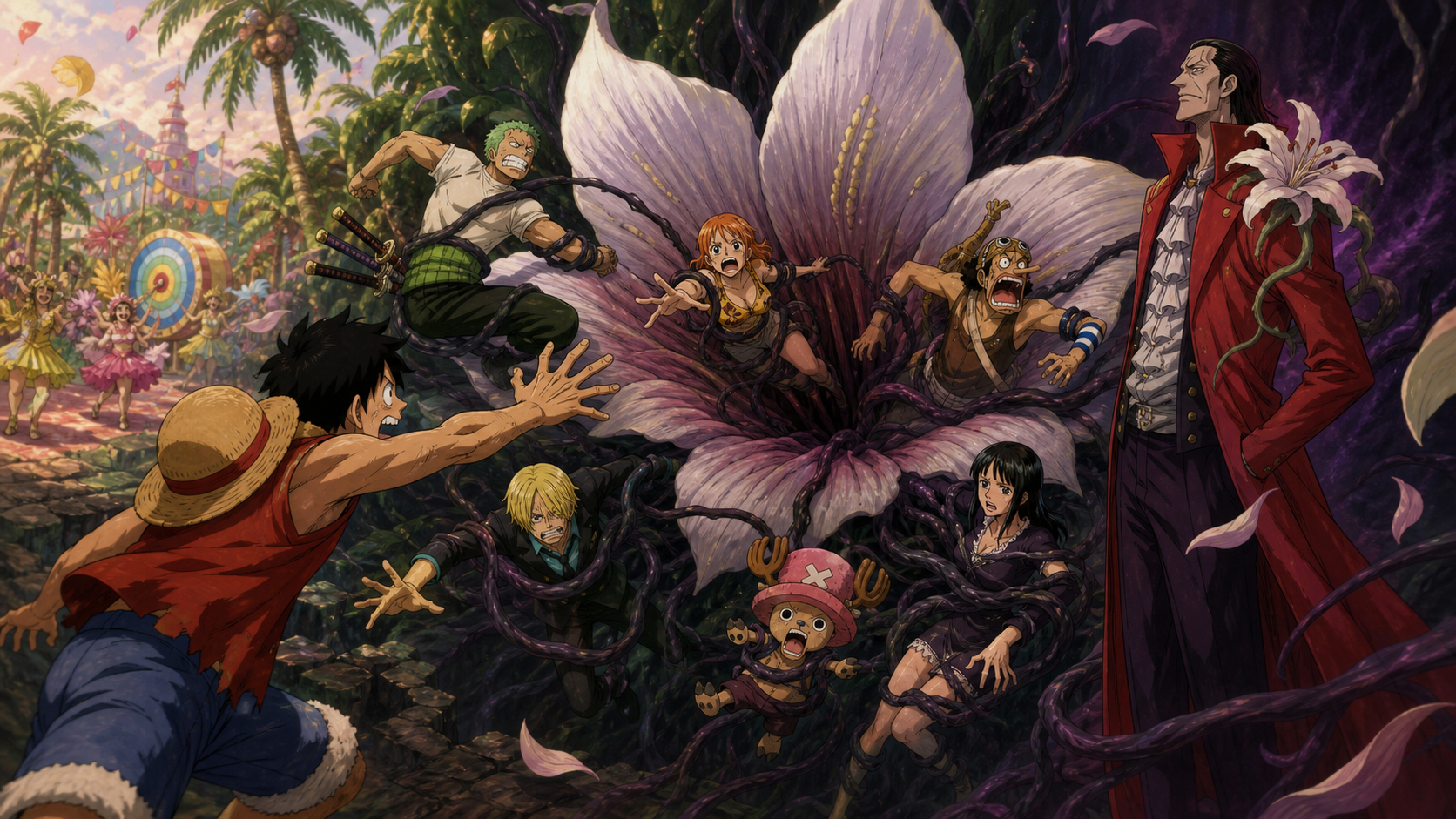
Baron Omatsuri and the Secret Island is the One Piece movie that smiles too long, waits until the crew starts snapping at one another, and then opens the floor beneath everybody. The sixth theatrical film begins as a ridiculous resort challenge and ends as a story about grief turning friendship into captivity.
Released in Japan on March 5, 2005, the movie is messy, frightening, visually restless, and impossible to confuse with any other franchise entry. Director Mamoru Hosoda does not imitate the weekly series. He takes the crew’s safest emotional promise, that these people will find one another, and makes Luffy confront what happens when a captain stops listening before the danger arrives.
What happens on Omatsuri Island
The Straw Hats find a map advertising a Grand Line resort. Luffy chooses the detour because the island promises relaxation, beautiful women, food, and adventure. Baron Omatsuri greets the crew with a parade, a chorus, and a challenge: complete the Trials of Hell to earn a secret treasure.
The games begin as broad comedy. Crew members compete in bizarre events while the Baron’s followers encourage every irritation already moving beneath the jokes. Zoro and Sanji fight harder. Nami and Usopp turn on each other. Robin investigates. Chopper meets outsiders who know the resort is lying. Then Straw Hats begin disappearing.
The resort sells happiness as bait
Omatsuri Island looks like a vacation designed by somebody who has only heard happiness described in a brochure. Music never stops. Performers keep smiling. Every attraction demands participation. Nobody appears allowed to sit quietly and decide whether the place feels wrong.
The pressure creates the first warning. Real hospitality gives guests choices. The Baron uses spectacle to set the pace, control attention, and keep visitors from comparing notes. The resort is not cheerful. The resort is surveillance wearing festival colors.
The Trials of Hell weaponize crew friction
The challenges test more than strength. Each event creates opportunities for embarrassment, blame, and resentment. Zoro and Sanji already compete, so the island rewards escalation. Usopp fears being dismissed, so one failure becomes evidence that nobody respects him. Nami’s practical anger lands harder when the group refuses to slow down.
None of those conflicts come from nowhere. That detail makes the breakdown painful. The Baron cannot invent a crack in the crew, but he can keep striking existing seams until normal arguments feel like permanent judgments.
Luffy fails as a captain before he fights as one
Luffy accepts the Baron’s challenge without properly reading the crew. He treats rising hostility as noise because previous arguments have always ended with everybody aboard the same ship. Familiar recovery becomes an excuse for inattention.
The movie does not claim Luffy caused the Baron’s crimes. The movie does make him responsible for missing his crew’s distress. Leadership cannot depend on friends remaining emotionally available after a captain ignores every warning. Luffy’s later desperation matters because his earlier confidence had consequences.
The crew conflict is ugly on purpose
Some viewers reject the film because the Straw Hats seem unusually cruel to one another. The discomfort is fair. Several exchanges push beyond the television balance, especially when long-running jokes become genuine accusations.
The exaggeration still serves the central horror. A predatory environment does not need to create brand-new personalities. The environment isolates people, removes chances for repair, and gives each person the worst possible interpretation of somebody else’s behavior. The crew sounds wrong because their shared rhythm has been deliberately interrupted.
Baron Omatsuri is grief refusing burial
The Baron once had a crew. After losing them, he accepted the Lily Carnation’s power and rebuilt their shapes rather than living with their deaths. The flower supplies imitation companionship in exchange for new victims.
His tragedy does not excuse the murders. Grief explains why the bargain appealed to him. Possession explains why he keeps feeding strangers to preserve a performance. He does not honor his friends by remembering them. He traps their images inside a system that requires endless harm.
The Lily Carnation is not resurrection
The flower consumes people and produces copies shaped by the Baron’s memory. Those copies laugh, follow routines, and surround him with familiar noise. They do not return the lost crew’s independent lives.
That difference is the movie’s sharpest idea. Memory can keep a relationship present without replacing the person. The Baron refuses that limit. His fake reunion turns love into ownership because the dead are no longer permitted to change, disagree, or leave.
Brief understands survival better than the heroes
Brief, captain of the Tearoom Pirates, looks ridiculous and frequently behaves like a man who expected a different genre. His crew survived by staying together and recognizing the island’s traps. Their awkward loyalty becomes a direct answer to the Baron’s artificial fellowship.
Brief also gives Luffy help when the usual crew structure has collapsed. The gesture matters because rescue does not arrive from the strongest person. Rescue arrives from somebody who kept faith with living companions rather than chasing an ideal image of strength.
Chopper gets the first clean view of the lie
Chopper’s medical instinct draws him toward people who are hurt, frightened, or hiding. That attention gives him access to information the competitive games obscure. He notices vulnerability before the plot is ready to name the monster.
His disappearance also changes the emotional temperature. Chopper cannot be dismissed as another combat rival. When the island swallows the crew’s doctor, the resort fantasy has no comic defense left.
Robin investigates while everybody performs
Robin watches the island rather than accepting the Baron’s frame. Historical remains, strange behavior, and missing information matter more to her than winning a resort game. Her calm makes the surrounding hysteria more visible.
The movie uses her sparingly, but her role fits. Robin has lived inside organizations built on false stories. A theme park that erases its victims and rewrites death as celebration is exactly the kind of official narrative she knows how to distrust.
Nami and Usopp expose the cost of feeling dismissed
Nami and Usopp’s conflict hurts because both characters are often responsible for practical survival while stronger crewmates treat their fear as comedy. The island turns that familiar imbalance into a grievance neither person can safely explain.
Their argument is not proof that the friendship was weak. The argument shows what happens when people speak only after frustration has accumulated. The film could give both characters more repair afterward, but the emotional cause remains legible.
Zoro and Sanji lose the joke
Zoro and Sanji usually fight within boundaries. Their rivalry contains trust, even when neither man would admit that fact without medical intervention. Omatsuri Island removes the invisible boundary and lets competition become contempt.
That shift shows how tone can carry relationship information. Similar insults sound different when nobody is protecting the other person’s dignity. The movie makes a running gag frightening by changing the emotional contract beneath the words.
The archery finale refuses a clean power fantasy
Luffy cannot solve the climax through a normal duel. The Lily Carnation has absorbed his crew, the Baron controls the field, and physical rage does not restore what has been taken. Luffy’s body stretches into disturbing shapes while his confidence collapses.
Help arrives through Brief and the surviving island outsiders. An arrow matters because connection matters. The captain who thought he could carry every decision alone survives only when somebody else creates the opening.
Mamoru Hosoda changes the visual grammar
Hosoda favors flatter staging, elastic motion, abrupt tonal cuts, deep negative space, and crowds that move like one nervous organism. Characters sometimes look looser than their television designs. The animation prioritizes weight, timing, and emotional distortion over model-sheet polish.
That approach gives the movie its identity. Cheerful movement becomes threatening before the dialogue admits danger. The final flower sequences make bodies feel small, fragile, and nearly erased by the environment.
Masahiro Ito’s screenplay takes a real risk
Official Toei records credit Masahiro Ito with the screenplay. The script risks making beloved characters unpleasant because pleasant banter would protect viewers from the central idea. Not every escalation feels equally earned, but the movie commits.
The structure also trusts contrast. Long stretches of games and comedy are not wasted setup. The bright opening teaches viewers the resort’s public language, allowing later images to expose the violence hidden underneath.
Japanese performances
Mayumi Tanaka gives Luffy a breakdown that avoids heroic polish. His cries become raw and frightened once anger can no longer hide loss. Akio Otsuka voices Baron Omatsuri with formal control, buried fatigue, and a cruelty that sounds practiced rather than spontaneous.
Kazuya Nakai, Akemi Okamura, Kappei Yamaguchi, Hiroaki Hirata, Ikue Otani, and Yuriko Yamaguchi push familiar crew rhythms toward discomfort. The performances make each argument recognizable before the island twists the emotion too far.
Continuity and watch order
Baron Omatsuri and the Secret Island is an anime-original companion film outside manga continuity. Robin and Chopper are present while Franky and later members are absent. The crew lineup broadly fits after Alabasta and before Water 7.
Watch after Episode 130 for comfortable character context. The movie does not become numbered-series history, and no later episode explains the island. The emotional experiment works best for viewers who already understand how the crew normally repairs conflict.
What the movie gets right
The film creates an island with a complete emotional logic. The cheerful resort, escalating games, crew arguments, disappearances, flower, and Baron’s grief all serve one question: does companionship remain love when fear tries to freeze every person in place?
The visual direction answers through movement. Living crews argue, fail, adapt, and accept help. The Baron’s copied crew repeats. Repetition looks comforting until the audience realizes nobody in that circle can choose a new sentence.
What still does not work
The crew’s recovery receives less space than the breakdown. Nami and Usopp need a clearer moment after their argument. Several side characters arrive with eccentricity before the story earns emotional attention. The Baron’s former crew remains more symbolic than personal.
The sharp stylistic departure can also feel wrong for viewers seeking the television show’s exact appearance. That reaction is legitimate. The movie’s value comes from committing to a different visual argument, not from pretending every design choice fits the weekly series.
My read: I think Baron Omatsuri is one of the franchise’s most unsettling films because the crew’s familiar irritation becomes a doorway for something predatory. The visual rupture is not decoration. The rupture makes friendship feel physically unstable. I admire the risk and still want more space for the crew to process what happened after survival stops being the only task.
RaeRae’s verdict
Baron Omatsuri and the Secret Island earns nine out of ten. The movie is not comforting, perfectly balanced, or remotely interested in behaving like disposable franchise merchandise. Good. One Piece is built around chosen family, so somebody eventually needed to make a film about the terror of losing that family through neglect, manipulation, and grief.
The missing repair scenes keep the movie from a ten. The resort, Baron, Lily Carnation, and broken Luffy still make this the most daring One Piece theatrical release so far. Come for the vacation games. Leave wondering why every mascot on the island smiles like the waiver already cleared legal.
Official sources and routes
ONE PIECE.com: official Baron Omatsuri page
Toei Animation: official English work listing
Toei Animation: official director and screenplay credits
Browse One Piece anime movies
Return to the One Piece anime hub