
On Clap: YUQI and Lexie Liu Built a Two-Woman Pocket and Locked the Beat Inside
YUQI and Lexie Liu do not split this performance into host and guest territory. They negotiate the beat in real time, trade textures and leave the clap exactly where the swagger needs a period.
Release file
Released: May 3, 2024
Runtime: 2:06
Artist / channel: YUQI featuring Lexie Liu / i-dle
Exact-file focus: The exact official On Clap special performance video, not an audio repost, stage, fancam, short, fan edit or another YUQI release.
Verdict first: the exact upload matters. This React follows the performance and visual choices in this video, not a neighboring stage, fan lyric upload or different song with the same English title.
First reaction: what the hook is actually doing
“On Clap” is built around percussive confidence. Yuqi’s rougher low tone and Lexie Liu’s cooler, elastic delivery do not compete for the same texture; they take turns changing the groove’s surface. The clap is less an instruction than a checkpoint where both performers prove they can arrive differently on the same count.
Catchiness is the entrance, not the verdict. The useful question is how percussion, bass, vocal register and phrasing make the central idea feel repeatable—and whether the repetition reveals more feeling or merely occupies time.
Production under the topline
The arrangement creates a floor before the performers decorate it. Follow the kick and low end, then notice which sounds vanish before a line begins. Empty space can give a low voice more authority than another layer of volume, while a bright response can reset the ear without flattening the groove.
i-dle-related solo work is strongest when the production recognizes the featured voice instead of renting a generic trend. Yuqi’s grain and delayed pocket, Minnie’s atmosphere and Soyeon’s percussive diction require different rooms. The mix here succeeds where it lets identity change structure.
The video argument
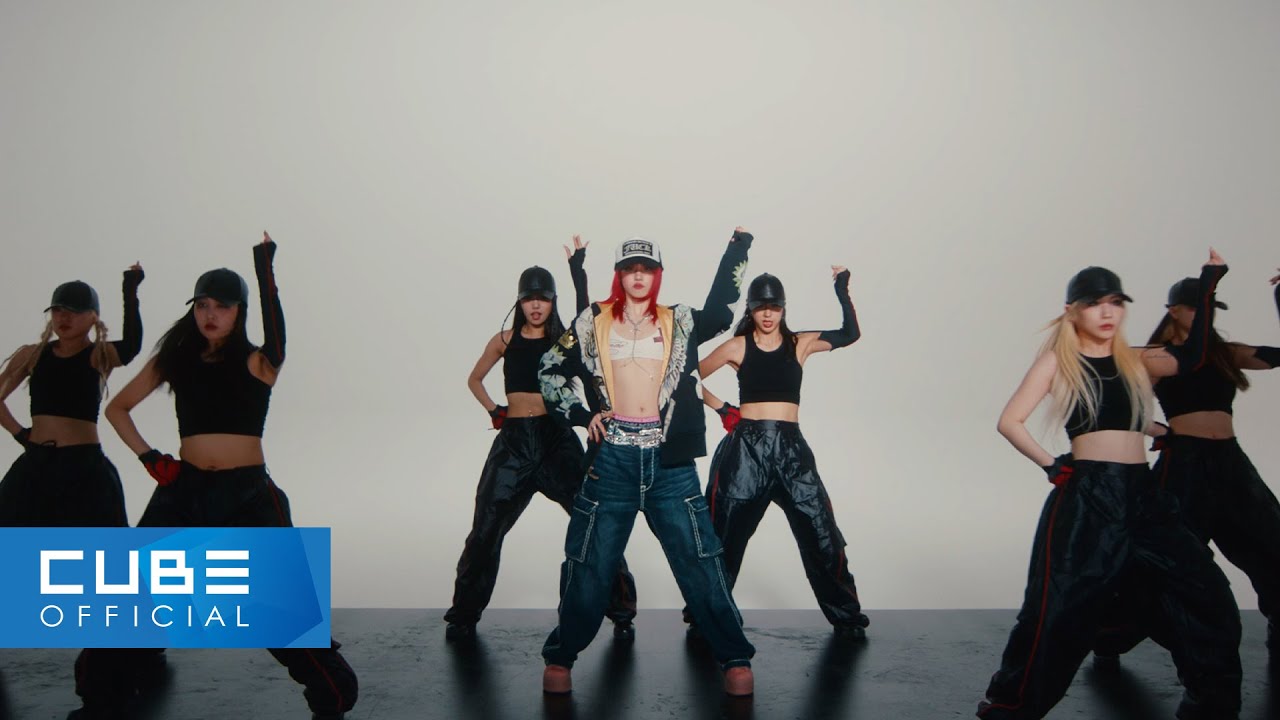
The special performance video strips away narrative so styling, blocking and camera distance can become the argument. Two performers are enough because the frame keeps renegotiating equality: solo close-ups, shared planes and exchanges that feel like replies rather than a feature verse pasted into somebody else’s record.
The canonical still above comes from this exact upload. It remains the featured image, hero, Music Reviews card and social preview, so a reader does not click one visual promise and arrive inside another video’s page.
Performance details worth the replay
Watch the pocket around the beat. Yuqi often lets weight land with the low end, while Lexie can skate across a phrase before snapping the ending into place. Their contrast creates motion even when the choreography remains contained. Hands matter here because the title creates an obvious trap. The choreography uses claps and accents, but the stronger detail is how wrists, elbows and shoulders continue the rhythm after contact. The beat does not stop at the gesture fans can name.
Watch preparation rather than only impact: the breath before a phrase, the body loading weight before a directional change and the eye line that tells the editor where the next cut can land. Those decisions are the bridge between choreography and camera.
What works, and what I would change
The track is short enough that the collaboration ends before it discovers a third relationship between their voices. One traded bridge or overlapped final verse could deepen the chemistry. The brevity also keeps the performance from diluting its central flex.
That tradeoff matters. A harder bridge, longer ending or stranger cut might create complexity, but it can also break the release’s chosen scale. Criticism should identify the price of the existing choice without pretending every song wants to become a different genre.
Participation, not inheritance
The i-dle hub remains connected because the career grew from and continues beside the group. The profile trail follows actual participation, however. A Yuqi and Lexie Liu performance does not automatically belong to all five members; a Yuqi and Minnie duet belongs to both women; a solo choreography file links the solo artist and group history without fabricating group presence.
Bottom line
On Clap: YUQI and Lexie Liu Built a Two-Woman Pocket and Locked the Beat Inside understands the mechanism beneath its hook and gives the camera enough performance evidence to make that mechanism visible. The release has limits, but none of them erase the reason to replay it.
Replay section
- First replay: watch only the performer outside the obvious focal point or the body between named moves.
- Second replay: isolate drums and bass; mark every place the groove removes sound instead of adding it.
- Third replay: follow vocal color and breath, not volume or line count.
- Fourth replay: test the criticism—imagine the proposed change, then decide what pleasure it would cost.
Canonical profile trail
- i-dle group profile
- YUQI artist and member profile
- Lexie Liu official YouTube
- Exact official videoDaily+4.1KTotal views3.8M
Sources and receipts
Two voices, one negotiated center
Feature credits often hide an unequal structure: the primary artist owns the premise, the guest arrives for a verse and the video politely places them together for fifteen seconds. “On Clap” is more convincing because Lexie Liu changes the performance’s center of gravity. Yuqi remains the host, but the record has to adapt when Lexie enters.
Their vocal contrast is not a simple low-versus-high chart. Both can use darker color, but Yuqi tends to make weight feel physical while Lexie makes it slippery. One lands in the pocket like a boot; the other can skim the surface and still leave a cut. The track becomes a conversation about different forms of command.
The blocking supports that equality by avoiding permanent lead-and-backup geometry. When the women share a plane, the camera does not ask one to validate the other’s charisma. Alternating close-ups establish individual authority first, so later two-shots read as alliance rather than an audition.
Fashion contributes rhythm. Hard edges, reflective surfaces and controlled silhouettes extend the percussion into the image. Styling is not evidence of musical depth by itself, but here it helps the body produce the same clean, clipped information as the clap.
The missing third act remains my criticism. A brief overlap—both performers trading fragments inside one bar—could reveal how their pockets collide rather than simply alternate. The song exits while the collaboration is still promising a more complicated relationship.
That limitation makes the replay assignment precise: follow entrances and exits. Notice who leaves silence for the other, who completes a gesture begun across the frame and where the edit treats response as important as delivery. Collaboration lives in those permissions.
The collaboration succeeds because neither performer treats contrast as a problem to solve. Yuqi’s grounded attack and Lexie Liu’s cooler elasticity occupy different surfaces of the same beat. Their exchanges feel like negotiation inside a pocket both women understand, not two guest verses politely waiting for separate promotional clips.
Production leaves deliberate negative space around the vocal rhythm, making tiny delays and clipped consonants audible as choices. That space is where swagger becomes technical rather than decorative. On replay, ignore the larger gestures once and track only entrances: each woman knows exactly when not to fill the bar. The restraint gives the eventual overlaps more authority than a constant race for density would have.
The visual styling follows the same rule. Neither woman is costumed as the other’s variation, and their shared frames gain energy from incompatible silhouettes. Collaboration means building a convincing third space, not proving two established identities can be blended into beige.
That is why the track feels compact rather than slight. Nothing lingers merely to display technique. Every pause, accent and exchange sharpens the relationship between two performers who already know exactly what they bring.
RaeRae verdict
On Clap is criminally short, but it understands the difference between adding a feature credit and changing the record. YUQI brings physical weight, Lexie Liu brings elastic cool and the camera lets their contrast remain useful. I wanted one messier shared passage before the exit. Still, those two minutes have an actual relationship inside them, which is more than plenty of four-minute collaborations manage.
What changed every time I replayed it
The second replay follows entrances instead of whoever owns the close-up. The third listens to how YUQI drops weight into the low end while Lexie Liu skims the beat and snaps the line shut. The fourth watches their hands after the obvious clap, because shoulders, wrists and elbows keep speaking long after the named gesture finishes. The fifth maps shared frames and checks whether the camera grants both women authority or quietly restores a host-and-guest hierarchy. By the sixth, the missing third act becomes obvious: the song needed one longer overlap where both pockets collided instead of another clean handoff.
Lyrics and meaning
On Clap treats command as something built between performers, not a crown one woman wears while the featured artist waits for eight bars. The clap is punctuation and proof of timing. Neither voice has to imitate the other to make the collaboration coherent; the pleasure comes from hearing two kinds of control occupy the same beat. That is the real flex. Collaboration should create a third room neither artist could build alone, not blend two established identities into promotional beige.