
Memory, Sorrow, and Thorn · Canonical Creature Profile
Old Sekob
Old Sekob is ten men of ancient crocodile occupying the place where folktale, territorial authority, and extremely practical survival advice become the same thing. Tiamak does not ask outsiders to believe in a quaint swamp god. He asks them to respect the grandfather of the Wran’s man-eaters before the grandfather notices them.
At a Glance
The grandfather in the deep channel
- Nature
- Enormous ancient crocodile of the Wran
- Territory
- The Pool of Sekob and its wider channels
- Scale
- Described as ten men long
- Wran standing
- Grandfather and master of the region’s great man-eaters
- Narrative guide
- Tiamak, whose explanation joins ecology, custom, and survival
- Confirmed status
- Alive during the Book 3 passage through his territory
The Visual Receipt
Age should look heavy, scarred, and biologically expensive
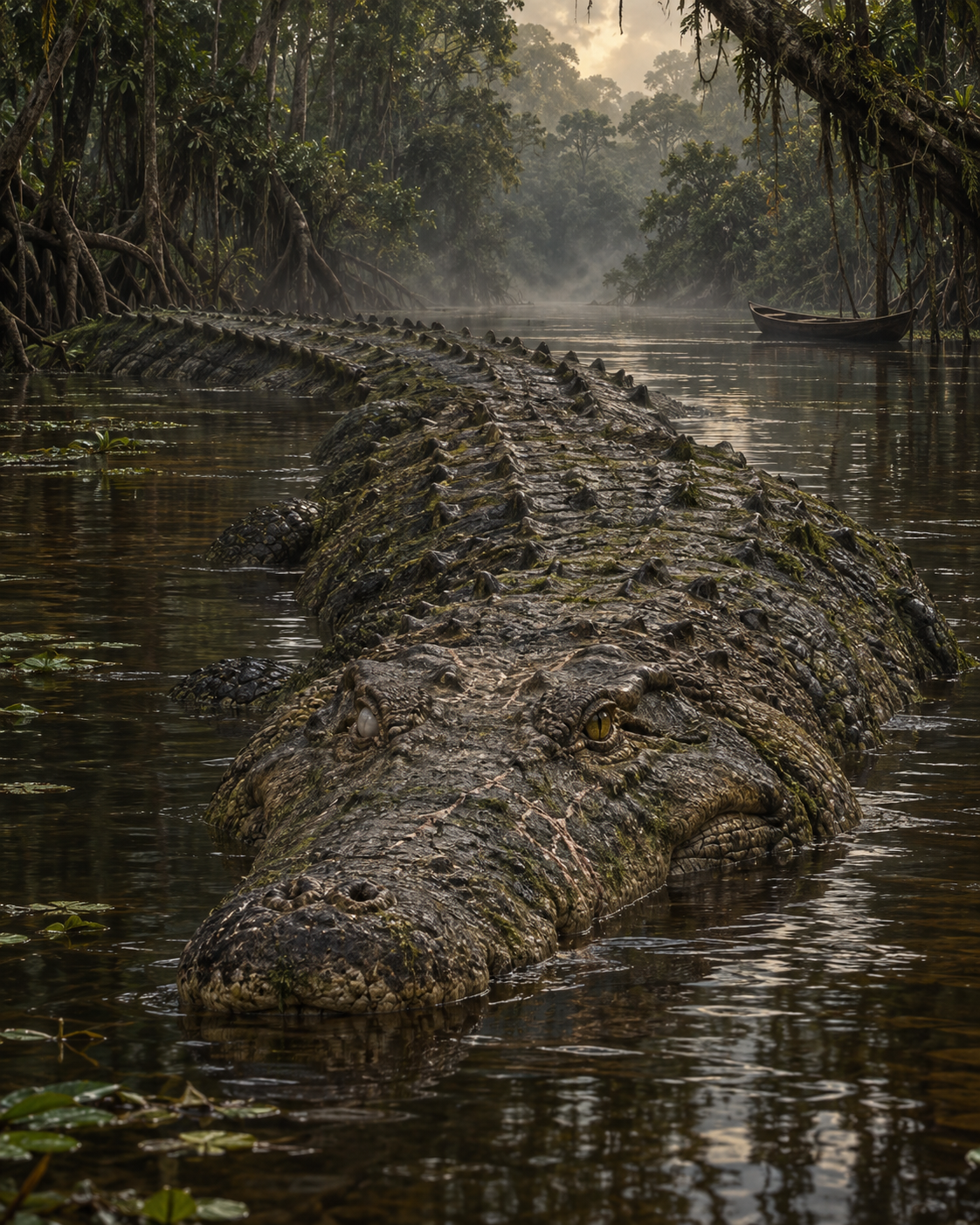
Old Sekob is an ancient crocodile of extraordinary scale—ten men long, with age confining him to the wider channels. The approved design must feel like a real animal that has survived long enough to become landscape. The body should carry mass, old scars, worn armor, algae or water staining where appropriate, and the patient economy of a predator that does not need theatrical rage.
Do not turn him into a dragon, kaiju, dinosaur mash-up, glowing demon, or smiling storybook mascot. The awe comes from crocodilian anatomy pushed to a legendary but coherent extreme. His size must remain consistent against boats, mangrove roots, Wran waterways, and human figures. Murky water can conceal part of him for drama; it cannot become an excuse to change the head, scutes, jaw, or scale between images.
Book 3 · To Green Angel Tower, Part I
The Wran has authorities older than drylander maps
The Pool of Sekob
Tiamak explains the danger without translating it into superstition
As the travelers move through the Wran, Tiamak repeatedly has to explain that the swamp is not an empty obstacle decorated with exotic hazards. Its waterways contain routes, settlements, food systems, medicinal knowledge, taboos, animal territories, and relationships drylanders cannot safely reduce to scenery.
At the Pool of Sekob, that lesson acquires teeth. Tiamak introduces Old Sekob as the grandfather and master of the Wran’s great man-eating crocodiles. The animal is ten men long and so old that he remains in the broad channels. Age has limited his movement without making him harmless. A throne can be a deep pool if every dangerous body nearby behaves as though the occupant’s claim is real.
Tiamak’s treatment of the ancient crocodile combines respect, political language, and practical ecology. He does not pause the journey to provide colorful folklore for visitors. Naming Old Sekob explains how power operates in the water and why surviving passage depends on recognizing a hierarchy humans did not create.
The moment also belongs to Tiamak’s larger intellectual arc. Drylanders repeatedly classify Wran knowledge as primitive until it keeps them alive. Old Sekob makes the category error visible. Calling the crocodile merely an animal ignores the social and territorial system organized around him; calling him merely a god ignores the physical jaw capable of ending the discussion.
The World Around Him
Territory creates relationships even when affection is irrelevant
Tiamak
Tiamak understands Old Sekob through inherited Wran knowledge and direct ecological literacy. He translates enough for outsiders to behave without surrendering the animal to their categories.
The Wran’s crocodiles
They are described as Old Sekob’s descendants or subjects. The language records observable hierarchy through a cultural frame rather than asking readers to choose only one.
The Wran communities
People live around dangerous water through knowledge, gifts, routes, warnings, and respect. Coexistence is not sentimental friendship.
The drylander travelers
They survive by accepting that Tiamak is the authority. Size and steel cannot substitute for knowing whose pool they have entered.
Why It Works
One crocodile exposes the difference between lore and worldbuilding
Old Sekob works because the passage does not hand readers a detached encyclopedia entry. Information arrives at the exact point where misunderstanding could become fatal. Scale, age, territory, belief, and animal behavior reinforce one another until “grandfather and master” feels less like decoration than the most efficient available description.
The encounter also restores scale to Tiamak. In courts he is physically small and socially underestimated. In the Wran, he can name the powers everyone else failed to see. Old Sekob is enormous, but the person who understands him controls the journey.
Grandfather and Master
The title records a relationship humans must navigate, not a zoology error to correct
Tiamak calls Old Sekob the grandfather and master of the Wran’s great man-eaters. The language can hold several kinds of truth at once: exceptional age, possible ancestry, dominance, territorial precedence, inherited story, and the behavior of other crocodiles around his range. The text does not force those possibilities into one laboratory claim.
That openness is not vagueness for its own sake. “Large crocodile” describes anatomy and misses authority. “Swamp god” describes reverence and risks erasing the animal whose body occupies a channel. “Grandfather and master” tells travelers how the Wran understands the relationship and how they should behave inside it.
The profile therefore preserves Tiamak’s category instead of correcting it into drylander language. He is the person whose knowledge keeps the company alive. Demanding that he translate every local relationship into a supposedly neutral vocabulary would repeat the larger habit of treating Wran expertise as colorful belief until danger proves otherwise.
Age as Geography
Old Sekob’s limitation makes the map more precise, not the creature less dangerous
Age confines the crocodile to wider channels. That is a material boundary. A body ten men long cannot move through every narrow waterway, and great age has its costs even for a legendary predator. The receipt gives travelers a usable geography: some routes fall outside his present reach; the Pool and broad channels do not.
This is a better form of awe than unlimited monster power. Old Sekob does not teleport wherever a dramatic scene needs him. Body, water depth, turning space, age, and territory determine where danger can exist. The creature becomes more believable because the world must accommodate his dimensions.
Future scene art must honor that physical logic. A ten-men-long crocodile requires water with credible depth and width. Boats, roots, banks, and human figures must establish scale consistently. An image that shrinks him to fit a canoe scene or makes him kaiju-sized for spectacle would destroy the precise relationship the text provides.
Tiamak’s Authority
The largest body in the scene proves why the smallest traveler must be heard
Outside the Wran, Tiamak is repeatedly underestimated because of his size, accent, homeland, and scholarly manner. Inside it, he reads routes, creatures, weather, plants, custom, food, and danger as one connected field. Old Sekob makes that reversal impossible to ignore.
A heavily armed drylander can do almost nothing useful with the fact that a gigantic crocodile exists. Tiamak can name the territory, explain the hierarchy, and guide behavior before steel becomes an irrelevant last gesture. Expertise changes who leads without requiring a formal transfer of title.
The surrounding cosmology strengthens the point. Tiamak prays over a pinch-eye fish and privately manages gods he experiences as demanding children who may be placated with praise. His spirituality is practical, observant, humorous, and inseparable from survival. Old Sekob belongs to that political ecology without becoming proof that every Wran story should be read literally or dismissed as superstition.
For the travelers, respect is the correct action whether they interpret the ancient crocodile as ruler, ancestor, sacred creature, dominant animal, or all four. The Wran does not wait for outsiders to finish their taxonomy before enforcing consequences.
Why a Creature Gets a Canonical Profile
Named nonhuman lives are part of the franchise record, not decorative bestiary entries
Old Sekob receives a profile because the story identifies an individual with a name, territory, scale, age, social standing, and continuing status. He affects how characters understand and cross the landscape. That is a canonical role even without dialogue, human motive, or a multi-book emotional arc.
The same standard protects the directory from two opposite mistakes. It should not create biographies for every background animal. It also should not collapse Qantaqa, Niku’a, Old Sekob, the kilpa, and other nonhuman presences into interchangeable “creatures.” Different bodies occupy different relationships with people, power, labor, captivity, and place.
Evidence limits remain essential. The books do not provide Old Sekob’s hatch date, sexed anatomy, offspring list, feeding history, thoughts, supernatural abilities, or later fate. “Grandfather” is retained as Tiamak’s title rather than converted into a verified genealogical chart. Depth comes from interpreting the supplied relationship carefully, not inventing additional encounters.
On the Record
Scope, spoilers, and creature identity
This is Old Sekob’s one canonical full-spoiler creature profile for Book 3 and the franchise directory. It is grounded in the completed owned-edition reading ledger. Old Sekob receives a dedicated identity because he is named, individually described, territorially significant, and treated as a distinct actor in Tiamak’s account—not because every background animal needs a profile.
Visual state: approved canonical creature reconstruction. Old Sekob now has one permanent immense crocodilian identity: peat-brown and olive-black armor, weathered-gray snout, fixed pale scar map, algae staining, one clouded old eye and one alert amber-brown eye, and massive coherent crocodile proportions. The empty canoe is scale context, not evidence of a specific encounter. Preserve this exact head, jaw, eye states, scar map, scute geometry, coloring, body scale, and patient stillness across every Pool of Sekob image. The same attachment powers featured image, hero, directory card, and social metadata.