
RaeRae Rant
Ninja Scroll Did Not Make Anime Adult
The VHS box promised forbidden animation. The movie delivered extraordinary craft, ugly exploitation, political rot, and enough blood to make a teenager believe “adult” meant nobody had to ask what the violence was saying.
Graphic content became a shortcut for cultural adulthood
Ninja Scroll did not need a marketing department to invent its danger. Yoshiaki Kawajiri put danger in every frame. Wind crosses grass like a blade. Bodies split before the audience can prepare. Sexual violence is not implied from a polite distance. The film looks and sounds like a world where power reaches the body first and explains itself later.
Western home-video marketing took that danger and turned the whole movie into a dare. Rent this because cartoons are not supposed to look like this. Watch this because parents would hate it. Prove you have graduated from childish animation by sitting through blood, nudity, rape, poison, and monsters. The pitch worked because audiences had been trained to treat animation as children’s property. The pitch also created a new trap. If “adult animation” only meant more visible damage, the medium had escaped one cage by walking into another.
The complaint is not that Ninja Scroll contains explicit material. The complaint is that distributors, viewers, and sometimes critics allowed explicit material to stand in for meaning. A severed limb became evidence of seriousness. A naked woman became evidence of sophistication. A sexual assault became evidence that Japanese animation was fearless. Nobody had to discuss feudal power, government coercion, bodily autonomy, the plague scheme, or the way Kagero’s clan turned her into an asset. The box had already completed the argument: this is not for kids.
That bargain shaped a generation of fandom. Some viewers found a new visual language and kept digging. Others learned to introduce anime with a stack of shock titles, as though embarrassment was the entry fee. Women and younger fans were expected to prove they could “handle” scenes designed without much concern for their experience. Criticism became weakness. Context became censorship. The product called itself mature while the conversation stayed sixteen years old.
The VHS shelf really did break a narrow American idea of animation
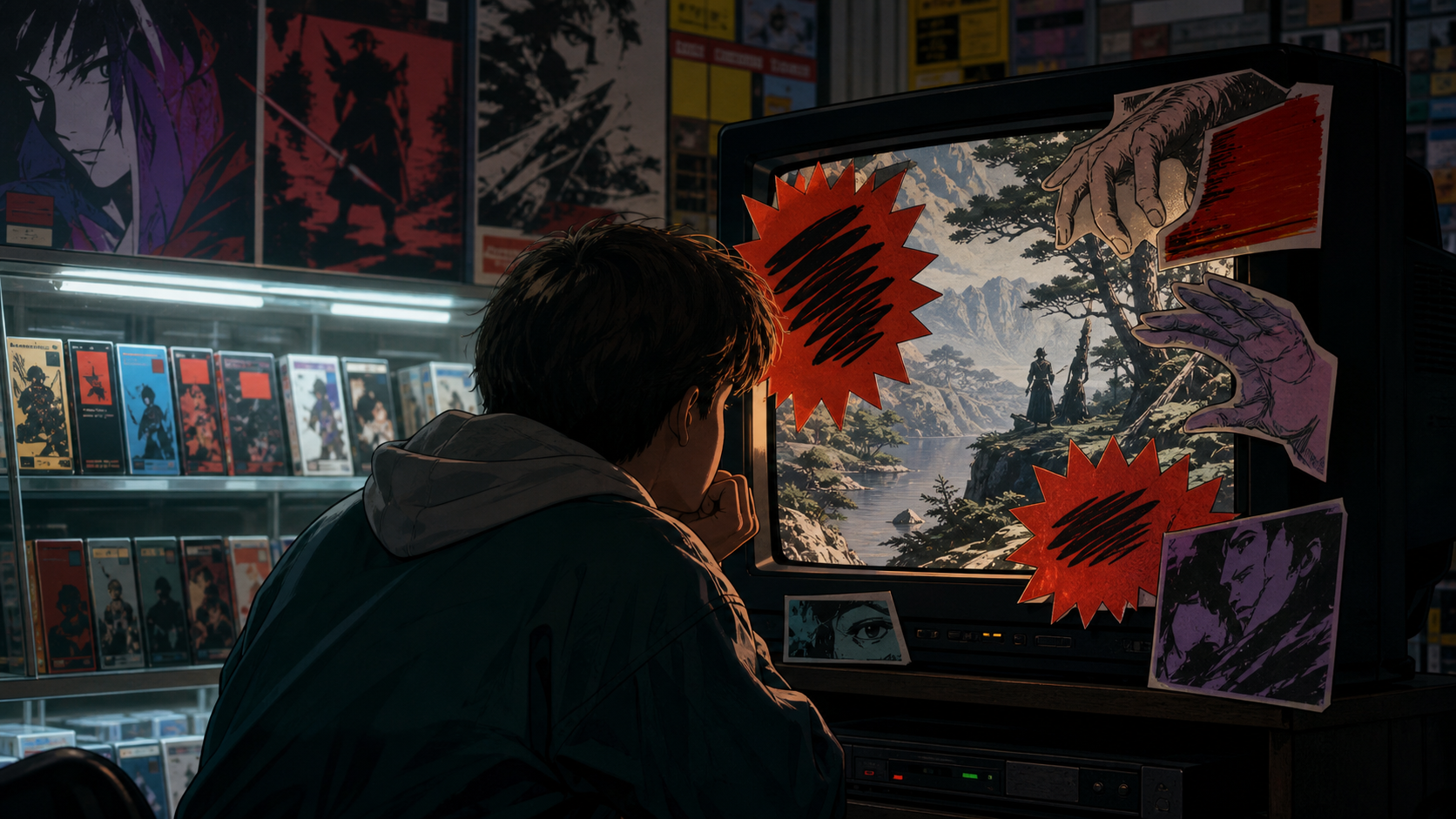
Before streaming placed thousands of titles behind one search bar, physical media carried its own argument. A tape had to earn shelf space, and cover art had to explain a foreign work in seconds. For many American viewers, the surrounding culture offered Disney features, Saturday-morning cartoons, comedy reruns, and a small number of imported works that were often rewritten for television. An uncut or barely cut Japanese feature could feel like contraband from a medium with no ceiling.
Ninja Scroll was perfect for that moment because Kawajiri’s direction made the difference visible. The movement had weight. Weather shaped fights. Silence made sudden violence hurt. Character designs carried age, lust, disease, exhaustion, and cruelty. A viewer did not need a lecture about animation for adults. The movie demonstrated that animated bodies could inhabit erotic thrillers, political conspiracies, samurai horror, and fatal romance.
The sales pitch also helped stores and fans distinguish a theatrical anime feature from children’s television in a market that lacked useful language. “Mature” and “adult” were blunt labels, but blunt labels sometimes got the tape into the correct hands. The BBFC’s record confirms that British releases faced classification and cuts, including alterations tied to sexual violence and restricted weapons. The conflict was not imaginary. Regulators were deciding how this material could circulate, and distributors had practical reasons to foreground its difference.
None of this means the marketers were lying. The movie is graphic. The movie is for adults. The problem begins when the label stops being a warning and becomes a substitute for interpretation. Age restriction tells us who should not watch. An age label does not tell us why the work matters.
Fans learned genres from whatever the rental store could stock
A video store was not a neutral library. Purchasers selected titles according to price, distributor catalogs, local demand, and whatever cover might survive beside action movies and horror. That meant viewers often met anime through a distorted sample. Cyberpunk, ultraviolence, tentacle horror, ninja action, and erotic thrillers travelled well because their difference could be photographed and summarized.
The result was a strange curriculum. A teenager could believe Japan mostly produced demon rape, exploding heads, motorcycles, psychic children, and women with impossible bodies. Quiet family dramas, sports stories, workplace comedies, romance, historical reflection, children’s television, and experimental shorts existed, but the rental shelf did not offer a census. The shelf offered products expected to move.
Ninja Scroll was better than the stereotype it helped reinforce. Jubei is not only a killing machine. Kagero is not only sexual danger. Dakuan is not only comic relief. Gemma’s conspiracy has institutional logic. Yet the most marketable images pulled attention toward the stereotype. Once fans repeated those images as the definition of real anime, distribution bias became cultural truth.
That is how a medium gets mistaken for a genre. Animation describes a method. Anime describes a vast production culture with every kind of audience and tone. The VHS boom often sold “anime” as one genre whose essential qualities were speed, sex, violence, and foreignness. Ninja Scroll could carry that burden because the film was powerful. The burden still flattened everything around it.
Kagero’s suffering became both narrative tragedy and sales material
Kagero embodies the contradiction better than any marketing slogan. Her poisoned body is one of the movie’s strongest ideas. A state-serving clan made her useful by making ordinary intimacy dangerous. Her immunity protects missions while isolating the woman. The premise can support a serious argument about institutions that rename damage as talent.
The film also subjects her to sexual assault and frames parts of her danger through erotic spectacle. International marketing could pull those images out of context and promise exactly the transgression that made the character’s life unbearable. Her pain explained the world’s cruelty inside the movie. Outside the movie, the same pain helped prove that the tape was adult.
Calling that contradiction does not accuse every viewer of enjoying assault. Many viewers were horrified, and horror is part of the intended effect. The question concerns attention. When distributors and fans described the film, did Kagero’s agency, conditioning, tactical judgment, loneliness, and political value remain visible? Or did she become the woman from the scene everybody warned newcomers about?
Adult interpretation begins when the audience notices who pays for the atmosphere. The film’s danger feels real partly because Kagero absorbs so much of it. If discussion praises the atmosphere while treating her cost as disposable, fandom repeats the logic of the clan that used her.
Censorship history made every missing second feel legendary
Classification boards added another layer to the VHS mystique. The BBFC lists altered versions of Ninja Scroll, and historical records connect cuts to sexual violence and weapons policy. Australian classification records show the film entering a different regulatory system in the mid-1990s. These decisions mattered because fans compared tapes, searched for uncut editions, and treated national differences like hidden lore.
The hunt could protect artistic integrity. Viewers had reason to reject clumsy edits that damaged pacing or concealed controversial content without explaining why. An uncut release allows adults to examine the work that creators made rather than a regulator’s substitute.
The hunt also encouraged a childish equation: more footage equals more truth, and the most offensive version must be the most authentic. That logic confuses completeness with quality. A scene can belong to the original cut and still deserve criticism. A viewer can oppose censorship while questioning how a filmmaker used assault. Protecting access does not require surrendering judgment.
Uncut became a badge because scarcity made ownership feel knowledgeable. The danger arrives when the badge replaces engagement. Knowing that one tape contains several extra seconds is not the same as understanding what those seconds do to Kagero, the scene, or the audience.
Format preferences became tests of seriousness
Home video also trained fans to fight about language. A dubbed tape was accessible, portable, and easy to share. A subtitled release promised proximity to the Japanese performance and attracted viewers who distrusted rewritten television imports. Both choices involved real tradeoffs in translation, acting, timing, availability, and cost.
Fandom turned those tradeoffs into moral rankings. Watching subtitles proved commitment. Watching a dub proved laziness. Owning an uncut import proved authenticity. Renting the available tape proved you had not tried hard enough. The conversation reproduced the same maturity performance that surrounded graphic content.
Ninja Scroll survived because its visual storytelling crosses language, but the performances still shape character. Jubei’s restraint, Kagero’s guarded speech, Dakuan’s slippery authority, and Gemma’s confidence can change with casting and adaptation. A useful discussion compares choices. A useless discussion uses the choices to rank viewers.
Adult fandom should make access wider without pretending every version is identical. The question is not whether a fan passed the correct purity test. The question is what the version communicates and what may have changed along the route.
The violence has politics even when marketing sells only impact
Gemma does not unleash the Devils because he enjoys random chaos. The violence serves a plan involving plague, gold, succession, and state weakness. Dakuan does not recruit Jubei because adventure needs a hero. A government operative manufactures cooperation through poison. Kagero does not carry toxins because the script wanted a sexy trick. Her clan turned a person into infrastructure.
Those details make the movie more adult than its blood count. The story asks how authorities convert bodies into tools and how ambitious men hide private control inside public emergency. Jubei’s independence matters because he repeatedly refuses permanent ownership. The Eight Devils fail as a community because Gemma organizes them around specialized utility rather than trust.
The film also understands that beauty does not cleanse power. Forests, rain, moonlight, and precise sword movement share space with corruption and assault. Kawajiri does not draw a safe line between elegant Japan and ugly violence. The elegance often makes the violence more disturbing.
A marketing campaign can show a blade crossing a body. The same campaign has a harder time selling the administrative logic behind the blade. Fans who stop at spectacle receive the loudest half of the film and call the experience complete.
Political meaning does not excuse every use of exploitation
A sophisticated reading cannot become an alibi. The fact that Kagero’s assault demonstrates Tessai’s brutality does not make every camera decision necessary. The fact that her poisoned body comments on institutional abuse does not give her equal narrative space. The fact that the world is cruel does not explain why female pain remains one of its favorite visual proofs.
The movie gives Jubei room to be competent, annoyed, skeptical, playful, protective, and independent. Kagero is competent and guarded, but her trajectory narrows quickly toward violation, attraction, sacrifice, and death. The contrast matters because both characters are used by institutions. One gets to keep walking.
Criticism should be specific. “Problematic” is too vague to teach anybody anything. The useful questions are concrete: What information does Kagero control? What choices can she refuse? How long does the camera remain with her experience instead of Jubei’s reaction? What alternatives does the plot imagine beyond usefulness or death?
A classic does not become smaller when fans ask those questions. The film becomes available for adult conversation instead of adolescent defense.
Distributors sold what retailers believed could move
Home-video culture was built from physical limits. Manufacturing tapes cost money. Translation and dubbing cost money. Retailers bought inventory. Shelf space was finite. Advertising had to communicate quickly. Those conditions rewarded obvious differentiation.
Graphic anime could be positioned near horror and action, where adult customers already looked for transgression. Covers used blades, breasts, monsters, motorcycles, and explosions because visual extremes answered the retailer’s first question: who will rent this? The system did not need a conspiracy to narrow the market. Every participant followed incentives that favored the same sample.
Fans then produced free marketing through conventions, clubs, magazines, campus screenings, tape trading, and shocked recommendations. Community labor expanded access, but community rhetoric often repeated distributor language. The title everyone used to prove anime was not for children became the title newcomers were expected to endure.
A healthier ecosystem would have treated Ninja Scroll as one road into animation, not the border guard. The film belongs beside family work, romance, comedy, documentary, sports, experimental art, and children’s stories. A medium proves adulthood by holding the whole range of life, not by collecting enough severed limbs.
Abundance removed scarcity without removing old habits
Streaming makes anime easier to sample, but the old VHS lessons still travel. Algorithms foreground recognizable genres. Social clips isolate shocking moments. Fans recommend “starter anime” through the same small canon. A title can be available in seconds and still arrive wrapped in thirty years of borrowed reputation.
The difference is that viewers now have fewer excuses for confusing one shelf with a medium. Search, subtitles, legal catalogs, fan criticism, creator interviews, and international discussion expose the range. The problem is no longer simple access. The problem is attention.
Ninja Scroll can finally be discussed outside the rental-store dare. Viewers can compare releases, examine classification history, watch other Kawajiri work, and place the film beside very different animation. The 4K restoration announced for North American theatrical play in 2026 makes that opportunity literal. A sharper image should invite sharper interpretation.
Restoration cannot automatically restore context. The new presentation may reveal paint texture, shadow detail, and motion that older tapes buried. Marketing can still fall back on the same promise of forbidden violence. Fans decide whether the conversation also gets remastered.
Tell newcomers what the movie is, not what they must prove
A responsible recommendation does not apologize for the film or turn the viewing into a test. Say that Ninja Scroll is a 1993 animated samurai horror feature written and directed by Yoshiaki Kawajiri. Explain that the plot follows Jubei, Kagero, and Dakuan against Gemma and the Devils of Kimon. Warn clearly about graphic violence and sexual assault.
Then tell people why the film matters. Talk about action staging, weather, shadow, political coercion, body horror, the international home-video boom, and Kagero’s weaponized body. Mention that classifications and cuts varied. Invite viewers to question the same material they admire.
Do not tell a newcomer that real anime fans can handle it. Endurance is not analysis. A person can stop during an assault scene and still understand animation. A person can dislike the film and still recognize its influence. A person can love the film and still reject parts of its gaze.
The recommendation becomes mature when consent remains present outside the story too. Viewers deserve information before exposure, not shame afterward.
Sell range, context, and craft instead of one forbidden identity
A stronger distributor campaign could preserve the film’s edge without reducing the work to shock. Trailers could emphasize Jubei’s movement, Kagero’s isolation, Gemma’s conspiracy, and Kawajiri’s control of landscape. Content guidance could be direct. Essays and interviews could place the film within Madhouse, samurai cinema, horror, and early international anime circulation.
Retailers and platforms could connect the title to multiple paths: adult animation, historical fantasy, action choreography, political thrillers, and director-focused collections. Those links would help viewers understand that graphic content is one element rather than the entire identity.
Critics could also stop treating influence as innocence. A film can change international perception and still reproduce harmful visual habits. Historical importance describes impact. Historical importance does not settle the argument about representation.
Fans have the easiest improvement available. Recommend the movie with context. Credit the people who made it. Name the difficult scenes. Discuss Kagero as a character. Stop using discomfort as a hazing ritual.
The market imagined one customer and treated everybody else as a guest
The shock campaign assumed a young male viewer whose curiosity could be converted into a rental. That assumption shaped covers, descriptions, store placement, and fan talk. Women watched the same movies, bought the same tapes, organized clubs, translated material, wrote criticism, and built communities, but the market often addressed them as exceptions.
Kagero’s treatment becomes harder to discuss inside that model because the sales pitch assumes identification with Jubei’s danger and desire. The viewer is asked to admire the swordsman, fear the monsters, and absorb the woman as part of the adult landscape. A female viewer who experiences the assault differently is treated as bringing politics into entertainment, even though the film placed politics inside her body.
The answer is not a fake rule that men cannot enjoy the movie or women must reject it. The answer is to stop pretending one reaction represents maturity. Horror, excitement, disgust, grief, anger, attraction, and refusal can coexist. A community becomes stronger when viewers explain those differences instead of ranking them.
Fans who grew up with the tape can also admit nostalgia without making nostalgia a defense. A childhood or teenage encounter may have been formative. The memory belongs to the fan. The meaning still belongs to public argument.
Foreignness was packaged as another special effect
Older marketing and magazine language often separated Japanese animation as an exotic category before audiences developed better vocabulary. The difference could invite genuine curiosity about another production culture. The pitch could also reduce Japan to a place where artists were supposedly willing to animate anything Western studios feared.
That fantasy erased Japanese standards, broadcasters, genres, audiences, labor problems, and debates. The marketing treated explicit imports as representative rather than selected. The market looked at its own narrow buying decisions and called the result national character.
Ninja Scroll contains Japanese history and genre traditions, but the movie is not a documentary about what Japanese people watch or value. Kawajiri made a specific fictional work shaped by samurai cinema, horror, erotic thrillers, animation craft, and commercial conditions. Respect begins with specificity.
When fans use Japanese origin only as permission for shock, culture becomes decoration. When fans examine creators, studios, distribution, performance, and historical reference, origin becomes context.
Owning the tape could feel like owning secret knowledge
Physical scarcity changed the emotional value of media. A fan might drive to another city, order from a catalog, borrow from a club, or copy a copy whose image degraded with every generation. Access required effort, and effort encouraged attachment.
Attachment can sharpen attention. A viewer who owns one expensive tape may rewatch it carefully, learn names, compare scenes, and share it with friends. Attachment can also make criticism feel personal. If the object represented money, community, and discovery, questioning the movie sounded like questioning the fan’s past.
That defensive reflex still appears online even though scarcity has changed. People protect a classic because the title once protected their identity as somebody who knew animation could be more. The history deserves respect. The movie does not require immunity.
Restoration offers a chance to separate preservation from worship. Preserve the work, credits, versions, packaging, and reception. Preserve enough context to explain the cuts and the fandom. Then keep arguing about what the preserved work does.
Content information should protect choice, not advertise violation
A content warning tells viewers what kind of material appears so they can decide whether, when, and how to watch. Hype uses the same material to provoke curiosity and daring. The words may overlap, but the relationship to the audience is opposite.
“Contains sexual violence” gives information. “Too shocking for ordinary viewers” creates a challenge. One respects refusal. The other turns refusal into failure. The VHS-era adult-anime pitch frequently crossed that line because taboo increased demand.
Modern platforms can do better. Warnings should be clear, searchable, and separated from promotional copy. Reviews should mention how the scene functions, not merely count explicit moments. Fans should recommend with enough detail for friends to choose without demanding a confession about personal trauma.
This standard does not make art safe or predictable. The standard makes access consensual. A difficult work remains difficult after the audience receives honest information.
Kawajiri’s restraint matters as much as his brutality
Discussions that focus only on graphic content miss why the film endures visually. Kawajiri controls distance. Jubei sometimes appears small inside landscapes that already feel hostile. Rain and fog complicate perception. Empty pauses let a threat occupy the frame before the body moves.
The action communicates character. Jubei reads space and uses economy. Tessai trusts mass. Yurimaru turns precision into cruelty. Kagero moves with training shaped by institutional service. Gemma’s regeneration makes ordinary consequences feel irrelevant to him.
Older tape quality could bury some of that work in darkness, noise, cropping, and soft detail. A restoration can reveal design choices that the cult reputation reduced to gore. The sharper presentation should expand the conversation from what happened to how the film made the happening legible.
Calling the movie adult because it is well directed would still be too simple. Craft does not possess an age rating. Craft gives viewers more evidence to interpret.
Fans do not have to choose between censorship and silence
Arguments about explicit anime often collapse into two positions. One side wants access protected. The other wants harm discussed. The positions are not enemies. Adults can defend an uncut release and criticize the uncut content.
Censorship removes or alters access through institutional power. Criticism adds language, context, and disagreement. Confusing the two allows fans to treat every negative reading as a threat to possession. That confusion protects distributors from scrutiny because the conversation never reaches marketing, translation, framing, or audience.
The strongest defense of difficult art is not “nobody may object.” The strongest defense is confidence that the work can survive informed objection. Ninja Scroll has survived different cuts, formats, dubs, restorations, and generations of viewers. The film can survive RaeRae asking what the VHS box taught us to ignore.
Silence is not freedom. Silence is merely a market receiving no reply.
The history is visible in classification and restoration records
BBFC: Ninja Scroll classification record documents the film’s UK classification history and altered versions.
Australian Classification: Ninja Scroll records the Australian classification dated March 8, 1995.
HIDIVE and Iconic Events 4K theatrical announcement confirms the 2026 North American limited release of a new 4K restoration and identifies Kawajiri as writer-director.
Adult animation should demand adult attention
Ninja Scroll helped many Western viewers understand that animation could hold horror, sex, politics, cruelty, and fatal romance. The film did not need the audience to pretend those ingredients were automatically profound. Marketing made that mistake because shock was easy to sell.
The better legacy is not a shelf of tapes that teenagers survived. The better legacy is a fandom capable of examining craft, distribution, censorship, sexual violence, translation, labor, and memory without collapsing into worship or disgust.
Ninja Scroll did not make anime adult. Anime already contained adults, children, families, workers, artists, monsters, histories, and every genre a moving image could carry. The tape merely forced one market to notice, then sold the notice back as rebellion.