
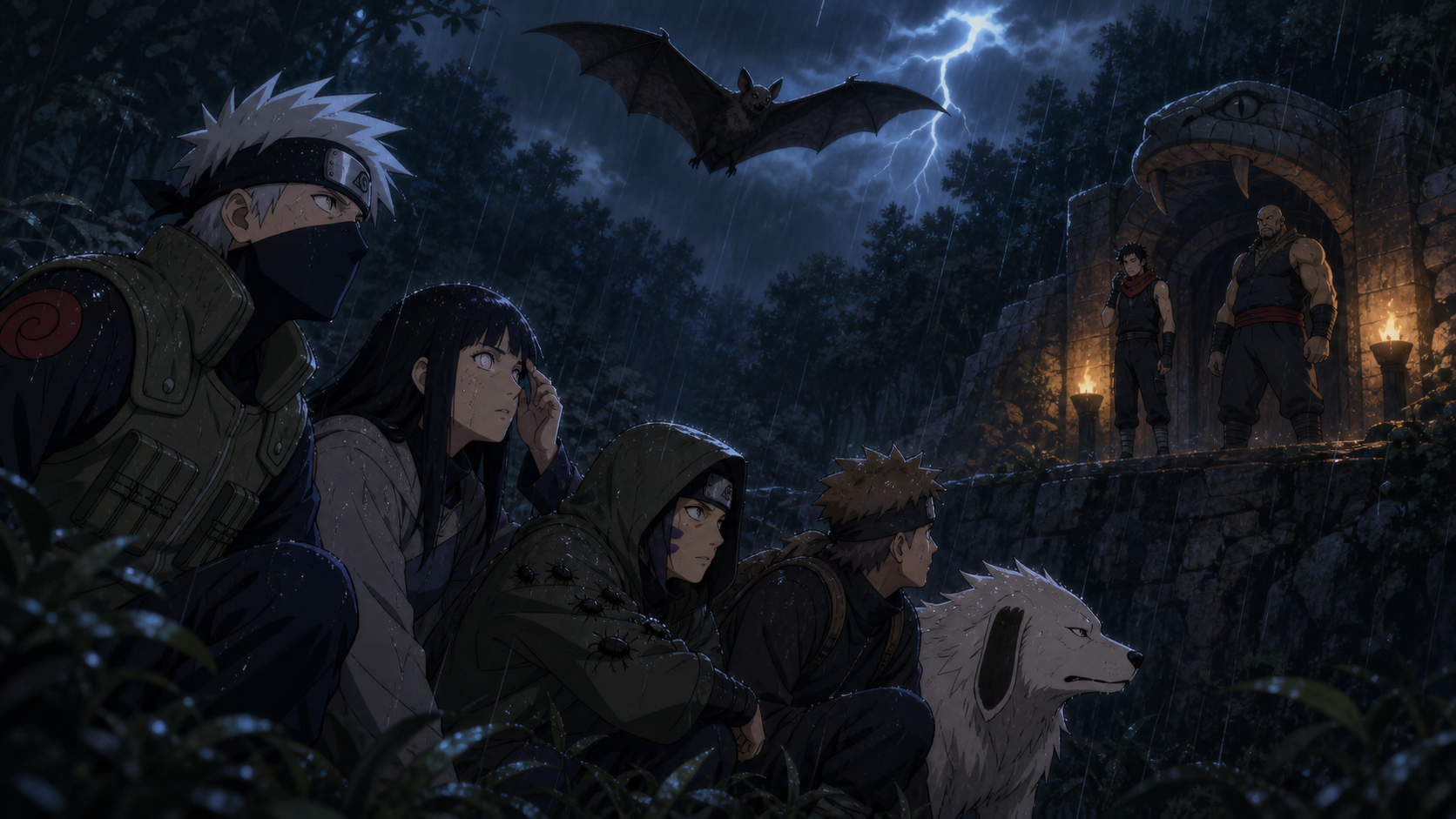
A Night of Rain
A storm turns tracking into a contest of overlapping senses as both sides discover that surveillance exposes the watcher along with the watched.
Rain turns the forest into a field of unreliable evidence
Heavy rain changes every sense the tracking team depends on. Water weakens scent, masks footsteps, bends visibility, and fills the environment with constant movement.
The storm does not erase evidence, but it raises the cost of interpreting it. Kakashi's team must separate deliberate signals from noise while knowing the people ahead are trying to do the same.
The episode builds tension through perception before anyone commits to a fight.
Rinji understands that surveillance works in both directions
Rinji's connection to bats gives Orochimaru's group an aerial warning system. He can scout beyond the hideout without exposing a human body on the trail.
When he realizes someone is following, the advantage becomes complicated. Sending a bat creates information, but the bat itself can be detected and traced back to the person using it.
Every act of observation leaves a shape the observed may learn to recognize.
Gozu protects the entrance through presence and loyalty
Gozu does not need Rinji's subtlety. His size and durability make him a physical boundary at the hideout, someone prepared to absorb danger before it reaches the people inside.
That protective instinct is genuine even though it serves Orochimaru's hierarchy.
The episode does not require loyalty to be wise before admitting it can feel real to the person practicing it.
Kakashi refuses to mistake detection for certainty
The team notices the surveillance bat, but a useful clue is not a complete answer. Kakashi does not immediately charge toward the first direction it suggests.
The animal may be scouting, baiting, or carrying a signal to reinforcements. Its flight path must be read alongside scent, chakra, and terrain.
Experience appears as disciplined hesitation: enough caution to avoid becoming predictable, but not so much that the trail disappears.
Hinata's vision finds structure inside the storm
Rain reduces ordinary visibility while the Byakugan gives Hinata access to chakra pathways and distant movement beyond the immediate curtain of water.
Her contribution is not a magical cancellation of conditions. Range, obstruction, and fatigue still matter.
What she supplies is another layer of evidence that can confirm or challenge what the bat wants the team to believe.
Shino recognizes the logic of another creature-based scout
Shino's insects and Rinji's bats occupy related tactical territory. Both extend perception through living partners whose movement can appear natural within a forest.
That resemblance helps Shino recognize when an animal's behavior has too much purpose to be incidental.
Expertise includes seeing one's own method reflected in an opponent's choices.
Kiba and Akamaru work against the weather together
Rain attacks scent continuity, but Kiba and Akamaru can compare what each detects and adjust for changes in wind, water, and elevation.
Their partnership does not make the nose infallible. It makes uncertainty discussable between two trackers who know one another's signals.
The team benefits from a bond where correction is built into the method.
The hideout becomes a contested threshold
Rinji and Gozu remain behind while others move deeper into Orochimaru's plan. That position makes the abandoned site more than scenery.
It is a threshold between evidence the Leaf can reach and operations already moving away from it.
Both sides understand that whoever controls the entrance can shape what the pursuers learn next.
Surveillance creates pressure without open combat
No one needs to throw the first strike for danger to escalate. Once both groups know they are being watched, every pause and route change becomes communication.
Rinji must decide how much information to send without revealing his own position. Kakashi must decide whether following the bat means following the enemy's intention.
The storm compresses those decisions into a quiet contest over who will act on a false assumption first.
RaeRae's reaction
I like that Episode 94 lets tracking feel like skilled work rather than a transition between battles. Rain is not moody decoration; it actively changes which evidence survives and which specialist becomes most valuable.
The bat is especially effective because it gives both sides information. Rinji sees the pursuers, and the pursuers learn that someone nearby has reason to watch the trail.
Knowledge arrives attached to exposure.
A night of rain reveals the cost of being seen
Episode 94 positions Kakashi's team and Orochimaru's guards inside the same problem. Each needs information without surrendering location, intent, or timing.
The environment rewards patience, overlapping senses, and partners who can challenge a first reading.
By the end, discovery has become mutual. The Leaf knows the bat is surveillance. Rinji and Gozu know the trail is no longer private. The next move will matter because neither side can pretend it remains invisible.
Official episode reference: Naruto Official episode guide
Licensed episode route: Crunchyroll licensed episode page
The rain makes every specialist explain what their confidence is built on
Kakashi has assembled a team whose senses overlap without becoming interchangeable. Hinata can see chakra and distant bodies. Kiba and Akamaru can follow scent. Shino can study insects, animal movement, and small disturbances other people dismiss. The storm weakens some evidence while leaving other evidence readable, so nobody gets to announce certainty without showing the rest of the group how the conclusion was reached.
That matters because a tracking team can become dangerous when expertise turns into private authority. Kakashi keeps the clues in conversation. A scent trail can be checked against a Byakugan sighting. A bat’s deliberate path can be compared with insect behavior and the shape of the ravine. The episode understands that good intelligence is not one gifted person guessing correctly. Good intelligence survives questions from people using different methods.
Rinji’s bat is useful because the forest gives the animal cover
A bat moving through wet trees does not automatically look like a shinobi tool. Rinji depends on that ordinary appearance. His surveillance works best when the Leaf team treats every animal as background and every movement as weather. The technique is clever because Rinji borrows the environment’s normal life instead of forcing a loud supernatural signal through the forest.
The same choice creates a weakness. Natural cover only works while the animal behaves naturally. Once the bat circles, waits, reports, or follows a route with too much purpose, a specialist can notice the difference. Shino’s attention gives the Leaf team a chance because he respects small life enough to recognize when another person is making that life perform a task.
Gozu’s loyalty protects a system that would never protect him the same way
Gozu stands between danger and the hideout with a sincerity Orochimaru has not earned. His willingness to absorb punishment may look admirable when separated from the institution using him. Put the loyalty back inside Orochimaru’s network, and the cost becomes harder to romanticize. Gozu is valuable because his body can endure what the people above him do not want to face.
I can respect the feeling without pretending the arrangement is fair. Gozu chooses to protect people he recognizes as his own, but Orochimaru’s entire operation trains vulnerable followers to confuse being useful with being loved. The rain-soaked threshold turns that manipulation into a physical position. Gozu remains outside, ready to take the first injury, while the people controlling the mission preserve their distance.
Kakashi treats uncertainty as information instead of embarrassment
Weak leaders often respond to incomplete evidence by performing confidence. Kakashi does the opposite. He knows the bat means something, yet he refuses to make the first available explanation carry more weight than the clue can support. The restraint is not hesitation for its own sake. He is protecting the team from an enemy who may be counting on pursuit becoming automatic.
That habit has been built through loss. Kakashi knows how quickly one confident decision can place teammates inside somebody else’s plan. Episode 94 does not turn his caution into a speech about leadership. The direction lets his pauses, questions, and deployment choices show the lesson. He keeps everyone moving while leaving enough room for new evidence to correct the route.
Hinata’s Byakugan gives the group range, not omniscience
Hinata can read chakra networks and survey space ordinary eyesight cannot reach, but weather, distance, fatigue, and the need to choose where to look still shape her work. The Byakugan does not scan every possible danger at once. Hinata has to direct attention, describe what she sees, and decide whether a movement deserves the team’s immediate response.
The limit makes her contribution stronger as drama. A perfect surveillance power would flatten the hunt into a map. Hinata’s actual labor keeps the team dependent on communication. She gives Kakashi another layer of evidence, then Kiba, Akamaru, and Shino help determine how that evidence fits the ground beneath them.
Kiba and Akamaru show why partnership matters most when a sense becomes unreliable
Rain interrupts scent trails, moves particles, and makes every wet surface carry competing smells. Kiba cannot solve that problem by believing harder in his nose. He and Akamaru compare reactions, adjust to wind and elevation, and notice when the other partner hesitates. Their long relationship turns uncertainty into something they can examine together.
Akamaru is not equipment attached to Kiba’s skill. The dog carries knowledge, judgment, fear, and physical limits. The best tracking scenes remember that bond. Kiba reads Akamaru because Akamaru is a partner whose response has meaning, not a detector that flashes when the script needs a clue.
Shino notices the ethics hidden inside creature-based techniques
Rinji and Shino both extend their reach through living creatures, but the resemblance should make viewers ask how each relationship works. Shino’s insects live inside a clan practice with rules, mutual dependence, and costs carried by his own body. Rinji’s bat appears as a controlled scout whose value rests on secrecy and obedience. The episode does not provide a full ethical comparison, yet the parallel gives Shino’s attention more weight.
He recognizes strategy because he knows the work required to guide another living being. That knowledge also keeps the bat from becoming a disposable prop in the audience’s mind. The animal is the point where Rinji’s intention enters the forest, and the animal may carry the danger when the Leaf team responds.
The hideout still holds evidence even after the operation has moved
An abandoned base can reveal routes, restraints, medical work, food, sleeping arrangements, and the priorities of whoever left. Orochimaru’s people understand that physical spaces remember activity. Guarding the threshold buys time for useful traces to disappear and lets the organization decide what the pursuers are allowed to find.
Kakashi’s team therefore faces more than a search for bodies. They are racing the cleanup of a system. Every delay gives Kabuto and Orochimaru more time to move people, destroy records, and turn victims into rumors. The rain helps that erasure by softening tracks and changing the ground.
Surveillance becomes frightening when both sides know the other side noticed
Before discovery, Rinji can observe while imagining himself outside the scene. After the bat is identified, observation becomes a conversation. Kakashi may follow, misdirect, hide, or use the bat to feed information back toward the hideout. Rinji must now interpret the pursuers while knowing they are interpreting him.
That mutual awareness creates pressure without a flashy attack. Each choice communicates intent, and each attempt to conceal intent can become another clue. The episode earns tension by letting smart people fear the consequences of being understood.
Yukimaru remains the human cost behind the tracking problem
The Leaf team is not following an abstract criminal route. Orochimaru’s network is using Yukimaru’s connection to the Three-Tails, while adults around the child decide what his body can endure. The longer the pursuit stalls, the longer that exploitation continues beyond the team’s sight.
Remembering Yukimaru changes how patience should be judged. Kakashi cannot rush recklessly, but caution also has a price. Leadership means carrying both risks at once: protect the people beside you and move fast enough to reach the person who has nobody protecting him.
The episode gives support skills the same dramatic dignity as combat
Tracking, interpreting, reporting, and confirming are easy to reduce to setup before a fight. Episode 94 lets those jobs create the conflict. Hinata, Kiba, Akamaru, and Shino do not wait for Kakashi to solve the forest. Their specialties shape what the team knows and what choices become possible.
I want more anime missions to respect this kind of labor. A shinobi village cannot survive on finishing moves alone. Intelligence teams, medics, messengers, scouts, and people who notice one wrong bat keep everybody else from walking proudly into an ambush.
RaeRae’s full take
A Night of Rain works because the storm changes the mission instead of decorating the mood. Water attacks scent, visibility, footing, sound, and patience. The team has to rebuild certainty from several imperfect senses, which is exactly why Kakashi brought these people together.
Rinji’s bat is my favorite piece of the episode. The scout gives him reach, yet the same scout gives Shino a line back toward him. Information is never free here. Somebody exposes a method, a route, a body, or a loyalty every time knowledge moves.
Gozu is the sadder part. His protectiveness feels real, and that reality makes Orochimaru’s system uglier. The organization survives by taking sincere needs for belonging and turning them into labor, secrecy, and bodies placed at the door.
The episode closes with both groups aware that invisibility has ended. Nobody owns the night anymore. The next decision will reveal who can adapt without treating teammates, followers, animals, or a vulnerable child as tools that can be spent.
Reporting the trail is part of protecting the next team
The team also has to decide how to report uncertainty. A message that says the enemy is definitely inside the hideout could push reinforcements toward an empty trap. A message so cautious that nobody can act would protect the speaker’s reputation while leaving Yukimaru in danger. Kakashi has to separate observation, interpretation, and confidence so Tsunade can make a decision without inheriting a disguised guess.
That discipline sounds ordinary until people are frightened. Under pressure, witnesses often remember conclusions as if they were sights. Episode 94 gives Kakashi a group capable of resisting that slide because each member can name a different piece of the route. Hinata can say what chakra she saw. Kiba and Akamaru can describe where scent weakened. Shino can explain why the bat’s behavior looked directed. Their report becomes useful because the limits remain visible beside the findings.
Rain also changes the physical cost of waiting
Wet clothing becomes heavy. Cold settles into hands that still need to form signs. Mud changes balance, and standing still for surveillance can become as exhausting as moving. Those conditions make patience a bodily choice rather than a calm idea. Every extra minute asks the team to preserve attention while discomfort keeps offering easy reasons to hurry.
The enemy pays a similar cost. Rinji must keep watching without exposing his position. Gozu must hold the threshold while water, darkness, and uncertainty wear down readiness. Neither side receives a clean observation post outside the weather. The mission feels fairer and more tense because the environment does not recognize which group the audience wants to win.
The Leaf team’s trust does not require silent agreement
Kakashi’s authority works best when Hinata, Kiba, Shino, and Akamaru can complicate his first reading. Agreement reached before anyone speaks would only make the specialists decorative. Trust means they can bring contradictory evidence forward without turning the mission into a fight over pride.
That principle matters beyond this ravine. Konoha often celebrates teamwork while maintaining strict rank and expecting young shinobi to obey. Episode 94 shows a better version of hierarchy for a few quiet minutes. Kakashi carries responsibility for the decision, but responsibility does not make everybody else’s knowledge disappear. He listens because the team’s safety depends on people saying what he cannot sense himself.
Rinji and Gozu reveal two different survival strategies inside Orochimaru’s world
Rinji survives through information, distance, and the ability to anticipate danger before danger arrives. Gozu survives through endurance and willingness to place his body where another person would retreat. Both strategies make sense for people shaped by an organization that rewards usefulness more reliably than care.
The tragedy is that their skills reinforce the same structure holding them. Rinji’s warnings protect the network. Gozu’s body protects the entrance. Orochimaru can keep moving because followers spend their intelligence and strength on preserving his freedom. Their competence deserves recognition, but competence does not turn exploitation into belonging.
The episode leaves the audience with responsibility instead of a cheap reveal
Mutual detection does not solve the mission. Kakashi still needs a route, Rinji still needs a response, and Yukimaru remains beyond the immediate frame. The ending works because knowledge narrows the choices without making the choice for anyone.
That unfinished pressure belongs to the episode’s title. A night of rain can hide movement, erase tracks, expose cold bodies, and force strangers to measure one another through fragments. Morning will not automatically make the truth visible. The people carrying those fragments must decide whose safety matters, which evidence deserves action, and what cost they are willing to place on someone else before taking the next step.
That is why the episode stays with me. Nobody wins by possessing the strongest sense. The safer team is the team that admits what each person cannot know alone and keeps listening anyway through rain.
RaeRae checkpoint: The smartest part of Episode 94 is not that one tracker finds the correct clue. Kakashi’s team becomes trustworthy because several specialists can question, confirm, and correct one another before the enemy turns confidence into a trap.
Receipts and official routes
- Official synopsis, licensed title, and episode placement: Naruto Official Site episode guide.
- Licensed episode title, number, and current watch route: Crunchyroll.