
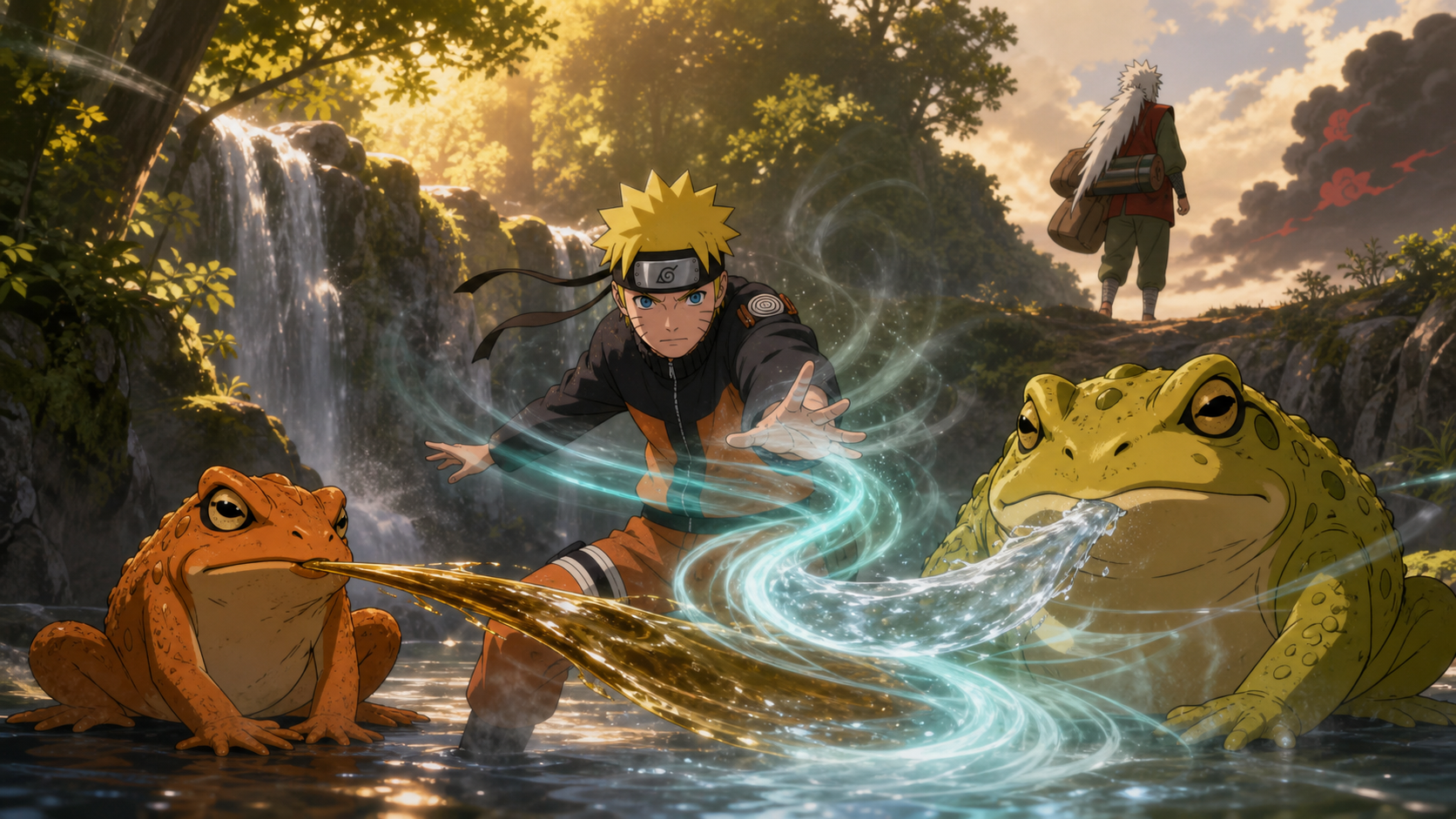
Connecting Hearts
Naruto discovers that a safer new technique depends on understanding partners whose abilities, limits, and agency cannot be treated like shadow clones.
Collaboration succeeds when Naruto stops treating it as synchronization alone
Naruto begins the exercise assuming that combined ninjutsu is mostly a timing problem. If he, Gamakichi, and Gamatatsu release the correct elements together, the technique should work.
The practice reveals something more demanding. Timing follows understanding. Each partner needs to know what the others can sustain, how they react under pressure, and which role lets their contribution remain stable.
Connection becomes a technical requirement rather than an inspirational slogan.
The toads are partners with unequal strengths
Gamakichi is sharper and more experienced. Gamatatsu is powerful but easily distracted and less precise. Naruto cannot pretend those differences do not exist.
Good collaboration does not require identical performers. It requires a structure that lets different capacities meet without humiliating the person who needs more guidance.
Naruto's task is to coordinate the team they actually are, not the team he wishes would make training easier.
Oil, water, and wind become a negotiated technique
The three components behave differently. Toad oil carries density and combustion potential. Water supplies volume and movement. Naruto's wind shapes and accelerates the combined stream.
No element simply dominates the others. Too much force scatters the mixture; poor timing breaks the flow; hesitation weakens the result.
The jutsu works only when power is balanced across contributions that remain distinct.
Naruto's healed arm does not erase the warning
Medical recovery means the immediate Rasen Shuriken damage has healed. It does not make the close-range design safe.
Returning to training could tempt Naruto to prove that his body is ready for the forbidden technique again. Instead, he works on an alternative built around range and partnership.
Healing becomes meaningful because behavior changes with the information pain provided.
Jiraiya knows when supervision should loosen
Jiraiya watches until the collaboration jutsu is close enough to completion that Naruto can continue without him. Then new intelligence about Akatsuki pulls him away.
Leaving is not abandonment. It is an assessment that the student now owns the remaining work and that the wider threat requires the mentor's investigative skill.
Trust appears as distance granted at the correct moment.
Akatsuki turns training into part of a larger clock
Naruto's practice feels local and almost playful, but Jiraiya's departure restores the strategic context. Akatsuki continues moving, collecting information, and hunting tailed beasts.
The time available for safe development is not unlimited. That pressure makes restraint harder and more necessary.
A rushed dangerous technique may answer one emergency while creating the next one inside Naruto's own body.
Returning to the village marks a change in ownership
Naruto comes back with a technique that is nearly complete rather than a finished result presented by his teacher. He must decide how to practice, when to ask for help, and how to judge readiness.
The return therefore feels different from simply ending a trip. Responsibility for the next stage transfers to him.
He carries both Jiraiya's confidence and Tsunade's boundary home.
The title describes method, not destiny
“Connecting Hearts” could sound sentimental, but the episode makes connection concrete. Naruto pays attention to partners, alters his approach, and builds a shared rhythm through repeated failure.
The hearts connect because the work recognizes each participant as a person.
That makes the result fundamentally different from Orochimaru's experiments, where rare abilities are connected by force to goals their owners did not choose.
Partnership creates power without converting anyone into equipment
Naruto needs the toads' oil and water. They need his wind shaping. Dependence exists in every direction.
No one is reduced to a resource that can be discarded after extraction. The technique's strength is inseparable from continuing cooperation.
The episode quietly offers an ethical definition of teamwork: usefulness does not cancel agency.
RaeRae's reaction
I enjoy how unglamorous the breakthrough is. The team has to repeat instructions, compensate for uneven skill, and keep working after combinations fall apart.
Naruto's real improvement is not louder chakra. It is patience with a partner who cannot immediately perform the role he imagined.
That patience is exactly what separates connection from control.
Naruto leaves training with a safer direction and a larger responsibility
Episode 93 does not pretend every problem is solved. The collaboration technique still needs refinement. Rasen Shuriken remains restricted. Jiraiya's Akatsuki investigation points toward danger beyond the waterfall.
What changes is Naruto's direction. He no longer has to choose between repeating a self-destructive attack and standing still.
By building with Gamakichi and Gamatatsu, he finds a path where advancement depends on listening. The healed arm represents recovery; the shared jutsu represents what he chooses to do with another chance.
Official episode reference: Naruto Official episode guide
Licensed episode route: Crunchyroll licensed episode page
Naruto begins by trying to make partnership obey his private blueprint
He knows the result he wants and assumes the toads need to match his timing. That approach works with shadow clones because they inherit one intention. Gamakichi and Gamatatsu do not.
The failed combinations reveal that Naruto has not yet created a shared plan. He has distributed instructions without distributing understanding.
Gamakichi brings interpretation as well as technique
He can understand Naruto’s goal, evaluate his brother’s contribution, and translate between different communication styles. That labor stabilizes the group before chakra does.
A partner who explains another partner is not merely support around the real jutsu. He is part of the mechanism that lets distinct abilities become coordinated.
Gamatatsu’s water release requires teaching without humiliation
He may lack precision and become distracted, but he is not empty material waiting for competent people to use. He needs explanation, repetition, and a role sized to what he can currently sustain.
Naruto’s patience determines whether training becomes collaboration or another hierarchy where the least experienced participant absorbs everyone’s frustration.
Food can build rapport without becoming the only reason Gamatatsu matters
Shared meals and appetite create easy connection. Naruto knows how powerful food can be when loneliness makes ordinary welcome feel enormous.
The relationship should grow beyond bribing performance. Gamatatsu deserves enjoyment, safety, and belonging even when a technique fails.
Water supplies volume that Naruto’s wind can shape
The combination works because the elements retain different jobs. Gamatatsu provides the moving body of the attack. Naruto adds direction and cutting force.
Neither contribution becomes meaningful by dominating the other. Balance determines whether the stream holds together or scatters uselessly.
Gamakichi’s oil introduces power and hazard together
Toad oil can intensify combustion and change how an elemental technique spreads. That potential demands careful control around hot springs, vegetation, and partners standing close.
Collaboration is not automatically safer because several people participate. Shared power needs shared stop signals and responsibility for the environment.
The waterfall offers immediate evidence without punishing every mistake
Flow direction, impact, spray, and distance show whether timing works. The team can see the result and adjust before another attempt.
Jiraiya has chosen a training site that teaches through feedback rather than injury. That design honors Tsunade’s warning even while Naruto keeps moving.
Naruto’s healed arm represents permission to continue living, not permission to repeat harm
Recovery closes the immediate wound. It does not reverse the medical finding about close-range Rasen Shuriken use.
The collaboration jutsu matters because Naruto accepts another route instead of treating healed tissue as proof the original risk was exaggerated.
Jiraiya knows that staying can become another form of control
Once Naruto and the toads understand the problem, constant supervision may keep them performing for the teacher rather than owning their process.
Leaving creates responsibility. Naruto has to listen, make adjustments, and judge readiness without waiting for Jiraiya to declare every attempt valid.
Jiraiya’s Akatsuki intelligence gives departure a darker purpose
He is not leaving because training bores him. New information about the organization hunting tailed beasts requires investigation only he may be positioned to conduct.
The mentor trusts Naruto with one unfinished connection while pursuing evidence about a network built to exploit another connection between beast and host.
Akatsuki’s pursuit makes safe progress politically urgent
Naruto cannot remain unprepared, but urgency cannot justify destroying his chakra network. The village needs techniques, teams, and plans that keep him alive as a person rather than preserving only the Nine-Tails.
Safety is strategic precisely because enemies intend to make his body a resource.
The episode’s warmth should not hide the labor of communication
Toad personalities make the practice funny, but every misunderstanding requires emotional work. Someone must repeat, translate, apologize, and try again without turning difference into blame.
That labor is what connection looks like before the inspirational music arrives.
Unequal ability does not require unequal dignity
Gamakichi understands faster and Naruto supplies enormous chakra. Gamatatsu may contribute less precision. None of those facts determines whose comfort or consent matters.
A good team adapts responsibility to capacity while preserving respect across the difference.
The title describes hearts connecting through practice, not destiny
No mystical bond makes the technique work automatically. They become closer because they spend time learning how each person communicates and fails.
Connection is produced through attention. That makes it repeatable, repairable, and morally different from relationships declared by someone with power over everyone else.
Orochimaru’s network remains the episode’s negative reflection
Yukimaru’s resonance with the Three-Tails is treated as experimental property. Guren’s loyalty is treated as deployable capacity. Sasuke’s body is treated as a future vessel.
Naruto’s training matters because another person’s ability remains theirs while becoming part of something shared.
Naruto needs to ask what the toads want the technique to become
Range, purpose, and acceptable risk should not come entirely from him. Gamakichi and Gamatatsu may imagine uses or limits he has not considered.
Inviting that input changes them from performers inside Naruto’s idea into authors of a joint method.
The finished combination should include an abort procedure
If timing breaks, a partner loses balance, or the environment becomes unsafe, everyone needs a signal to stop release. No one should be forced to continue because the others already committed chakra.
Control includes ending an attempt without turning disappointment into punishment.
Returning to Konoha transfers supervision into self-discipline
Naruto carries the technique home before it is perfect. He must decide when to practice, whom to involve, and how to respect the Rasen Shuriken restriction without Jiraiya beside him.
Trust becomes meaningful when the student maintains the boundary after the teacher leaves.
RaeRae’s full take
This episode knows connection is not three people shouting at the same time. Naruto has to learn what Gamakichi understands, what Gamatatsu can do today, and how his own impatience changes the space between them.
I love that the awkward attempts count. Miscommunication is not filler before teamwork. It is the work teamwork is made from.
Jiraiya leaving once they can continue without him feels like trust instead of abandonment. He gives Naruto ownership while taking the Akatsuki threat seriously elsewhere.
The healed arm and unfinished shared jutsu belong together. Recovery did not return Naruto to the same road. It made another road possible, one where power arrives with voices beside his own.
Naruto should learn each partner’s fatigue signals
Gamakichi and Gamatatsu may not describe chakra depletion the way a human shinobi does. Changes in breath, posture, speech, or water output can reveal a limit before collapse.
Watching those signals is part of control. A shared technique should stop when one participant cannot continue safely, not when the strongest person finally notices.
The toads need a clear reason for practicing the attack
Naruto knows he wants alternatives to Rasen Shuriken and preparation against Akatsuki. His partners deserve that context.
Understanding the protective goal helps them consent to risk, suggest uses, and decide whether the technique belongs in their own future battles.
Jiraiya should leave written limits as well as verbal trust
Urgency can distort memory after a mentor departs. Clear restrictions about environment, duration, and unsafe combinations give Naruto something concrete to follow.
Documentation also helps Tsunade evaluate the training rather than discovering a new elemental hazard after deployment.
Practice should test communication failure deliberately
A real battlefield may include noise, separation, injury, or a partner who cannot hear the signal. The team should build visual cues and fallback sequences.
Collaboration becomes reliable when it can survive imperfect conditions instead of requiring a peaceful waterfall and complete attention.
Gamatatsu should be allowed to become better gradually
The episode’s deadline pressure can make his slower learning feel like an obstacle Naruto must overcome. That framing would place urgency above the learner.
A safer method may begin with smaller water volume and repeatable timing, then expand only after confidence belongs to Gamatatsu too.
Gamakichi should not be assigned permanent translator duty without choice
He can bridge communication with his brother, but that labor consumes attention and may limit his own technical role.
Naruto needs to learn direct communication rather than depending forever on one sibling to manage the other.
The combined jutsu needs a name everyone accepts
Naming can mark shared authorship if the decision includes all participants. It can also erase contributors if Naruto declares the result his technique.
A joint name should preserve the elements and the people whose work created the method.
Returning home should include reporting the new risks
Naruto should tell Tsunade what elements were combined, how far the technique traveled, and where control failed. Medical restriction created the training path, so medical and command oversight remain relevant.
Transparency protects the partners from being deployed through assumptions nobody tested.
Jiraiya’s departure carries emotional weight beyond the assignment
Naruto has experienced mentors leaving and people disappearing. Trusting him to continue may feel good and unsettling at once.
Jiraiya should state why he is going and when contact is expected. Independence grows more safely when distance is not manufactured through silence.
Connection becomes strongest when it does not demand sameness
Naruto, Gamakichi, and Gamatatsu succeed through wind, oil, water, speed, translation, appetite, patience, and uneven experience. The jutsu holds because those differences are arranged rather than erased.
That is the episode’s cleanest argument: unity can preserve distinct people instead of turning everyone into one command.
Episode 93 makes connection practical by allowing it to be inconvenient. Naruto cannot order two toads into perfect rhythm the way he sends shadow clones toward one intention. Gamakichi understands the plan but carries translation work. Gamatatsu has useful water and uneven control. Naruto brings wind, urgency, and a habit of assuming effort can solve every mismatch if he repeats loudly enough. The technique improves only when those truths become shared information instead of reasons to blame the slowest partner. That is why the title works for me. Hearts do not connect because the story declares friendship. They connect through explaining, listening, eating together, adjusting timing, noticing fatigue, and returning after an attempt falls apart. The emotional bond becomes visible inside technical choices. Naruto reduces force when another person cannot hold the stream. Gamakichi bridges without taking over. Gamatatsu contributes something nobody else in the group can supply. I also need Jiraiya’s departure to remain connected to this lesson. He trusts Naruto enough to leave, but he is following Akatsuki intelligence about an organization that treats tailed beasts and jinchuriki as useful objects. The safer power Naruto is building offers a direct moral answer. Nobody has to be extracted. Nobody disappears inside the result. Every contributor remains recognizable when the technique ends. The healed arm makes this more than a sweet training interlude. Naruto has already learned what happens when an extraordinary attack treats his own body as acceptable collateral. Collaboration gives him another direction, but only if he refuses to turn the toads into collateral instead. Safety must travel across the whole team. Consent must survive urgency. Credit must remain shared after success. Those conditions are not decoration around power. They are what make the power worth carrying home. The episode should also let unfinished work remain honest. Naruto returns to Konoha without a perfect collaboration jutsu, and that is not failure. He has a method, partners, safety information, and responsibility for the next stage. Progress can be real before performance becomes polished. That matters for Gamatatsu, who deserves time to improve without becoming the joke holding everybody back. It matters for Naruto, who needs to learn that a boundary does not make him useless. It matters for Jiraiya, whose trust should not become an excuse to disappear without communication. Connecting hearts is a continuing practice, not a certificate awarded after one successful release. The group will misunderstand again. Someone will rush. Another partner will lose focus. The important question is whether they have built a way to repair the attempt without humiliating one another or hiding risk. That repair process is the technique beneath the technique. It lets three unequal people keep choosing the same work. I want Tsunade to hear the report when Naruto returns: range, elements, failures, injuries, and partner limits. Her medical warning began this safer path, so the village should support it with oversight rather than waiting to celebrate a dramatic debut. Naruto deserves adults who value sustainable growth even when Akatsuki makes every delay frightening. Gamakichi and Gamatatsu deserve to enter any future battle knowing exactly what they agreed to create. The final connection is not chakra touching chakra. It is responsibility moving in every direction. Naruto protects the toads while they protect him. Jiraiya trusts the team while remaining accountable for the training he designed. Konoha gains another option without pretending any participant is equipment. That is how a shared jutsu becomes more than three elements occupying one frame.
RaeRae checkpoint: Naruto does not complete collaboration by making two toads behave like clones. He succeeds when each partner’s difference remains visible, useful, and respected inside the same moving technique.
Receipts and official routes
- Licensed title and official account of Naruto advancing collaboration practice with Gamakichi and Gamatatsu while Jiraiya departs on Akatsuki intelligence: Naruto Official Site episode guide.
- Licensed episode title, number, and watch route: Crunchyroll.