
The Jinchuriki’s Tears
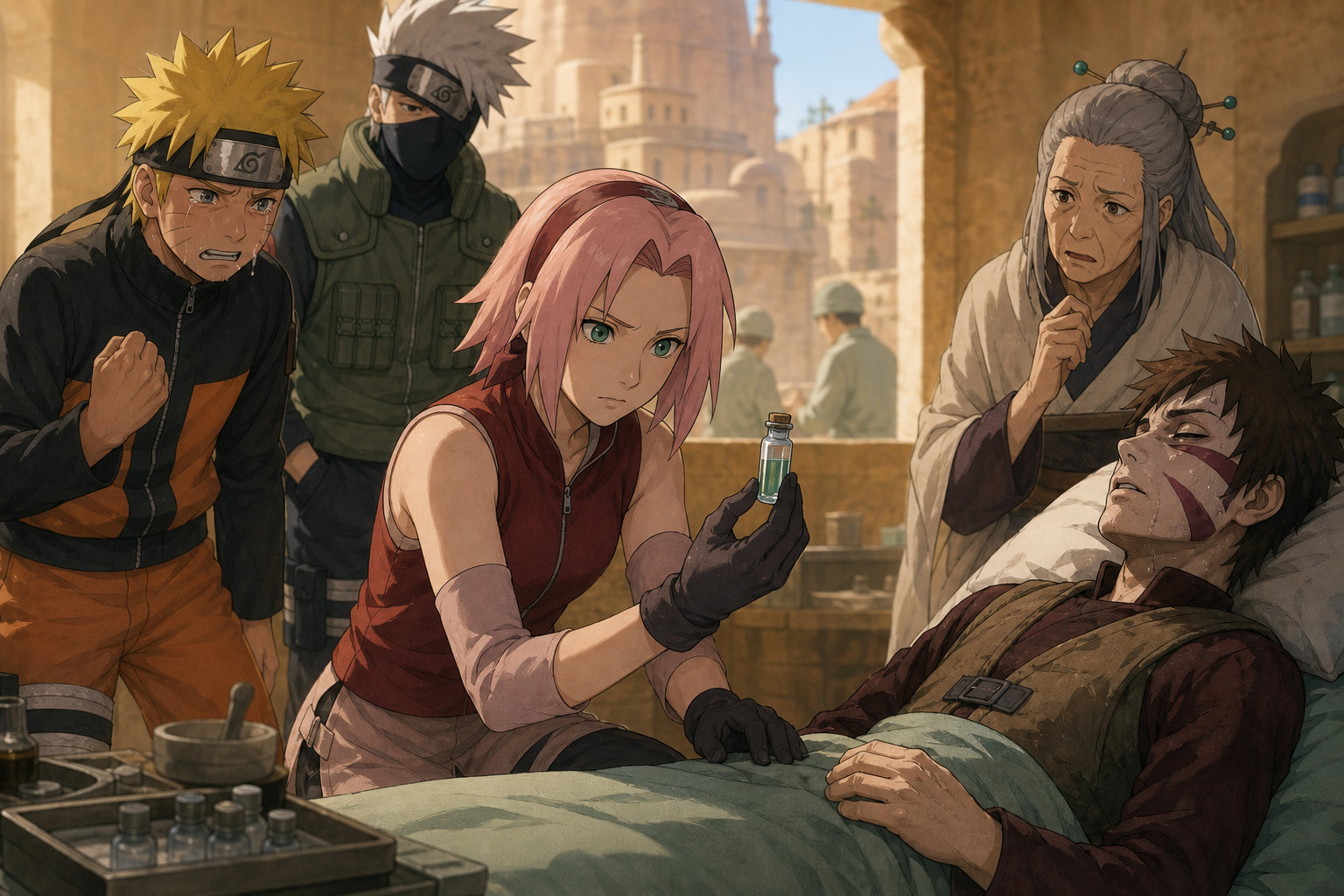
Sakura takes command of Kankuro’s poison case while Naruto explains why Gaara’s abduction is inseparable from their shared life as jinchuriki.
The rescue reaches a room where speed is useless
Naruto Shippuden Episode 9 brings Team Kakashi into Sunagakure, but arrival does not produce the release Naruto wants. Gaara is still gone. Kankuro is still dying. The Akatsuki still controls the timetable. The rescue team crosses the village gate and immediately discovers that reaching the crisis is different from solving it.
That distinction gives “The Jinchuriki's Tears” its weight. The previous episode made deployment a test of coordination. This one asks whether the people who arrived can accept the roles the emergency gives them. Naruto wants forward motion. Sakura has to stop beside a bed. Kakashi has to gather information. Chiyo has to decide whether old contempt matters more than a young man's life.
The medical room becomes the episode's real battlefield. There is no dramatic clash, only a poisoned body, exhausted specialists, and a clock nobody can see. Sakura enters as the least famous person in the room and quickly becomes the one whose judgment everyone needs. Shippuden has spent years telling us that the original Team 7 changed. Here, it proves that claim through work.
Sakura does not wait for permission to be useful
Sakura's first major victory in this rescue is diagnostic. She observes Kankuro, asks for the available information, isolates the poison, and begins stabilizing him. None of those actions has the spectacle of a finishing blow. Every one of them requires training, confidence, and the willingness to be responsible for the result.
The scene matters because competence is not presented as a magical personality upgrade. Sakura does not suddenly know medicine because the plot needs a solution. Her work carries Tsunade's method: inspect before acting, understand the toxin, protect the patient's remaining time, then build an antidote from evidence. The episode makes the process visible enough that her authority feels earned.
Sunagakure's medics are not fools. Sasori designed a poison that defeats ordinary expertise, and even Chiyo's legendary knowledge cannot immediately identify it. Sakura contributes a rare specialty shaped by one of the world's greatest medical ninja. The rescue succeeds because the alliance lets knowledge cross a border, not because the Sand has nothing to offer.
She also refuses to perform uncertainty as weakness. Sakura understands that Kankuro's condition is dangerous, but panic would not make her more honest. She speaks clearly, creates tasks, and turns a room full of dread into a working treatment space. This is leadership without a speech.
Kankuro's body carries information
Kankuro returned from the desert with more than poison in his bloodstream. His injuries describe the enemy. Sasori knew the mechanisms of his puppets. The toxin resists local treatment. The cloth Kankuro attached to Sasori preserves a route for trackers. Even unconscious, he has delivered evidence the rescue party can use.
That does not romanticize his defeat. His decision to pursue Gaara alone was reckless, and the cost is written across the medical room. Yet the episode allows his failure to contain useful choices. He fought because his brother had been taken. He marked the enemy because pursuit might outlast him. Love did not make the plan good, but it kept him thinking after the plan broke.
Sakura's treatment completes that chain of effort. Kankuro bought information with his body, and Sakura protects the person who carried it home. The scene connects combat intelligence to medical labor. A clue means less if the witness dies before he can help explain it.
Naruto recognizes the cage around Gaara
The title belongs to Naruto's emotional knowledge. Other people understand that the Kazekage has been abducted. Naruto understands why Akatsuki targeted Gaara and what it feels like to have a life reduced to the creature sealed inside it. His anger is not abstract loyalty between villages. It is recognition.
Naruto and Gaara were both made into containers before they could consent. Adults feared them, used them, and then judged the damage that isolation produced. Their later paths diverged because relationships intervened, not because one boy deserved care more than the other. When Naruto hears officials discuss Gaara as a jinchuriki problem, the language lands on his own history.
His tears are not a loss of control. They are the point at which the rescue stops being a prestigious mission and becomes testimony. Naruto knows Akatsuki did not kidnap only a political leader. They took a person whose village once treated him as a weapon and who fought to become someone that village could trust.
There is also fear beneath the anger. If Akatsuki can remove Gaara from the center of his own village, Naruto cannot pretend Konoha makes him permanently safe. Gaara's abduction is a warning about Naruto's future. The tears belong to his friend, but they also belong to the boy who can see himself on the same table.
Empathy and expertise are both rescue tools
The episode places Naruto and Sakura beside the same crisis because neither can replace the other. Naruto supplies moral clarity. Sakura supplies a medical answer. He insists that Gaara must be understood as a person. She demonstrates that saving a person requires exact, disciplined labor.
This balance is one of Team 7's strongest new dynamics. Naruto's empathy prevents the mission from becoming procedural. Sakura's expertise prevents empathy from becoming helplessness. Kakashi creates enough structure for both qualities to operate without competing for attention.
The contrast also corrects a shallow way of measuring growth. Naruto's new techniques matter, but his deepest strength here is the ability to name another jinchuriki's pain. Sakura's physical power matters, but her decisive contribution is analysis. Shippuden is at its best when improvement changes what characters can notice and carry, not only what they can destroy.
Chiyo meets the future she did not expect
Chiyo enters the rescue carrying the authority of age and the injuries of war. Her anger toward Kakashi is tangled with Sakumo Hatake's role in the deaths of her son and daughter-in-law. That grief does not disappear because the Leaf and Sand signed an alliance. Political cooperation can change present obligations without rewriting personal loss.
The episode lets Chiyo be wrong without making her history trivial. Attacking Kakashi for his father's actions is unfair. Treating her anger as meaningless would also be unfair. She belongs to a generation that converted children into tools, buried the consequences, and then called the resulting bitterness duty.
Sakura disrupts Chiyo's expectations more effectively than an argument could. A young Leaf ninja kneels beside Chiyo's poisoned grandson and does the work Sand specialists could not finish. The alliance becomes concrete through treatment. Sakura does not demand that Chiyo forgive Konoha. She gives her a reason to cooperate now.
That is a more durable political gesture than a ceremonial handshake. Trust begins when one village places rare knowledge at the service of another village's family. Chiyo's surprise is not simply admiration for talent. It is the uncomfortable discovery that the enemy category she preserved cannot explain the person in front of her.
The episode gives medical labor dramatic dignity
Anime emergencies often treat healers as a pause between real battles. “The Jinchuriki's Tears” refuses that hierarchy. Sakura's examination has stakes, reversals, and a deadline. The enemy's weapon is inside Kankuro, continuing the attack after Sasori has left the frame.
Poison is especially effective for this story because it turns knowledge into conflict. Strength cannot intimidate a toxin. Speed cannot outrun it once it is circulating. The rescue needs concentration, controlled extraction, and an antidote built from the substance meant to kill the patient.
The medical room also exposes how institutions depend on specialists. The Sand has authority, guards, and experienced ninja, but the exact expertise it needs arrives from an ally. That is not institutional humiliation. It is the reason alliances exist. No village possesses every answer, and pretending otherwise would cost Kankuro his life.
Sakura earns the room's attention through the quality of her decisions. She does not need Kakashi to announce her credentials. She establishes them in practice. For a character whose earlier insecurity often made her look toward teammates for validation, that independence is a meaningful transformation.
What the adaptation slows down for
This early Shippuden stretch is deliberately patient. The Akatsuki extraction continues elsewhere, but Episode 9 spends time on arrival, explanation, examination, and grief. Viewers waiting for the next large fight may read that pace as delay. The episode is actually assembling the conditions that make the next movement believable.
The team needs a trail. Kankuro needs stabilization. Sakura needs a poison sample. Naruto needs the adults around him to understand why Gaara's jinchuriki status changes the stakes. Chiyo needs a reason to step out of retirement. Skipping those steps would make later cooperation feel automatic.
The repeated attention to Naruto's anger can be blunt, but bluntness suits the wound. He has spent his life hearing people discuss jinchuriki as military inventory. Polite restraint would make the scene easier for the officials and less truthful for him. His emotion interrupts language that has hidden children inside policy.
Fandom arguments worth sorting out
One argument says Sakura's breakthrough makes the Sand medics incompetent. That reading ignores the poison's author. Sasori is an elite puppeteer and poison specialist from Sunagakure itself. A toxin designed to defeat familiar methods is evidence of his preparation, not proof that every medic in the village is useless.
Another argument dismisses Naruto's tears as excessive. Naruto is watching Gaara's history repeat under a more organized predator. He knows capture is not merely imprisonment and understands that the target is the tailed beast inside his friend. Emotion proportional to that recognition is not melodrama.
A third argument treats Kankuro as dead weight after his loss. He preserved a tracking clue, returned with information about Sasori, and survived long enough for treatment to become possible. A failed duel can still change the mission.
The last argument says nothing happens because the rescue has not reached Akatsuki. Sakura changes Kankuro's survival odds. Naruto changes how the room understands Gaara. Chiyo's relationship to the Leaf team begins to shift. Those are plot events, even without an explosion.
RaeRae's verdict
“The Jinchuriki's Tears” gives Team 7 a better definition of strength. Naruto sees the person inside the military label. Sakura sees the treatment inside the panic. Kakashi gives both of them room to work.
Sakura owns the episode because her competence changes the available future. Kankuro can survive. The poison can be understood. Chiyo can no longer reduce the Leaf visitors to old enemies. None of that requires Sakura to imitate Naruto's volume or Kakashi's reputation.
Naruto's tears keep the medical victory from becoming only a technical exercise. Saving Kankuro matters, and so does naming the system that placed Gaara in danger. The episode connects one body on a bed to a larger history of villages making children carry power for adults.
The rescue is still late, the enemy is still ahead, and Gaara is still in danger. Yet this room produces what the mission lacked: a living witness, a medical countermeasure, an alliance beginning to function, and people willing to say why the Kazekage cannot be treated as cargo. That is not waiting for the story to start. It is the story learning how to save someone.
Most importantly, the episode refuses to rank care beneath courage. Naruto's grief, Sakura's analysis, Kankuro's clue, Kakashi's restraint, and Chiyo's reluctant attention all move the same rescue forward. The mission becomes credible when these different forms of labor finally share a room.
Arrival changes the available work, not the enemy’s clock
Team Kakashi reaches Sunagakure, but Gaara remains farther away and Akatsuki continues extraction. Crossing the gate does not pause the organization controlling the timetable.
The team must accept the crisis actually present rather than the heroic scene each person imagined. Sakura stops beside Kankuro. Kakashi gathers evidence. Naruto has to let medicine and planning occur while every instinct demands immediate pursuit.
Sakura establishes authority through sequence
She observes symptoms, requests information, isolates poison, stabilizes the patient, and begins building a countermeasure. Confidence follows method rather than replacing it.
The room listens because each decision improves the next one. Sakura does not need a speech about being Tsunade’s student when disciplined work makes the training visible.
Diagnosis is an offensive act against Sasori
The poison is a weapon designed to keep killing after its creator leaves. Identifying its behavior interrupts that continued attack and begins converting Sasori’s secrecy into usable knowledge.
Sakura does not strike the puppeteer directly, but she denies part of the outcome he planned. Medical analysis can damage an enemy strategy even when the enemy is miles away.
Sand’s medics face specialization, not stupidity
Sasori grew from their own puppet tradition and spent years developing toxins outside village oversight. A compound designed around familiar defenses can exceed the general knowledge available in an emergency room.
Outside expertise is exactly what alliance should provide. Accepting Sakura’s help is not an admission that Sunagakure has no competent healers. It is recognition that no institution possesses every rare answer.
Kankuro’s body is evidence and a patient
His injuries describe Sasori’s reach, weapon mechanisms, and poison. The torn cloth supplies a tracking trace. Preserving his life protects both a brother and a witness.
This is why treatment and intelligence cannot be separated cleanly. Evidence carried by a dying person becomes less useful when the system treats survival as secondary to extracting a report.
Naruto hears policy language as personal history
Officials can discuss Gaara as a missing Kazekage and jinchuriki target. Naruto hears the category adults used to justify fear, isolation, surveillance, and ownership of children like them.
His anger forces the room to confront what the terminology hides. Akatsuki did not steal an abstract military asset. It took a person whose body was turned into policy before he could consent.
The tears are recognition, not helplessness
Naruto understands that Gaara’s capture previews the danger attached to his own body. Konoha’s affection and protection do not make the extraction system incapable of reaching him later.
Fear for Gaara and fear for himself occupy the same response. Crying does not remove his ability to act. It names the stakes before action turns into another procedure detached from the person.
Empathy and expertise prevent different failures
Naruto keeps the mission from reducing Gaara to cargo. Sakura keeps care from remaining a feeling without a treatment. Neither contribution can substitute for the other.
Team Kakashi works because moral clarity and technical precision share space. Kakashi’s command gives both enough structure to operate without competing for the title of strongest response.
Chiyo’s surprise is political evidence
A young Leaf shinobi kneels beside her poisoned grandson and brings rare knowledge without demanding that old grief disappear first. The alliance becomes material through treatment.
Sakura cannot repair Sakumo’s wartime violence or decide what Chiyo should forgive. She can create a present fact the category “enemy” no longer explains.
Medical labor receives a full dramatic clock
There is suspense in symptoms changing, a compound resisting identification, and time disappearing from a body. The conflict does not become less real because nobody throws a punch in the room.
Strength cannot intimidate poison and speed cannot outrun it after circulation begins. The episode gives concentration, controlled extraction, and antidote design the dignity usually reserved for combat.
Slower pacing makes later cooperation earned
The team needs a trail, Kankuro needs stabilization, Naruto needs adults to understand Gaara’s personhood, and Chiyo needs a reason to reenter a conflict she tried to leave behind.
Skipping these steps would make the rescue move faster on screen and feel less credible. Preparation is not absence of plot when every later survival depends on what the room establishes.
RaeRae’s full take
Sakura owns this episode because she changes the future without asking the room to applaud first. Kankuro can live. Sasori’s poison can be studied. Chiyo must update what she thinks a Leaf shinobi looks like. That is power with receipts.
Naruto’s tears make sure the achievement stays human. He knows exactly what happens when adults look at a child and see only the creature sealed inside. Gaara becoming Kazekage did not protect him from that reduction. Naruto refuses to let the rescue repeat it.
I love that the episode places grief and expertise beside the same bed. Care is not one personality trait. It is Kankuro preserving a clue, Naruto naming the person, Sakura building an antidote, Kakashi making room, and Chiyo allowing new evidence to enter an old wound.
RaeRae checkpoint: Naruto makes the room remember who was taken. Sakura makes sure the poisoned witness beside them still has a future.
The antidote must become shared knowledge
Saving Kankuro is the immediate objective, but Sakura’s analysis can protect later teams only if the compound, symptoms, extraction process, and countermeasure are documented and distributed. A single brilliant treatment is fragile when knowledge remains inside one medic.
Sasori’s advantage depends partly on secrecy. Each recorded observation reduces that advantage for the next person exposed. Medical success becomes institutional defense when the alliance preserves what it learned instead of treating Kankuro as an isolated case.
Chiyo’s participation carries expertise and accountability
She knows Sand’s puppet tradition, Sasori’s history, and the family conditions surrounding his departure. Returning to action can help rescue Gaara and confront consequences her generation helped create.
That does not mean an older woman must personally repair an entire village’s failures. It means her knowledge has present value and her choices can decide whether it remains sealed inside retirement while younger people inherit the danger.
Naruto’s interruption corrects the mission vocabulary
Operational language is necessary, but it can become anesthesia. Target, asset, extraction, and jinchuriki describe parts of the problem while hiding the human experience beneath them.
Naruto forces the room to carry both levels at once. Gaara is strategically important and personally terrified. A rescue plan becomes more accurate, not less professional, when it remembers the captive can feel what the plan is trying to prevent.
Receipts and official routes
- Episode number, titles, Team Kakashi reaching the Sand, Kankuro’s medical crisis, Naruto’s response to Gaara’s capture, and Sakura beginning treatment: Naruto Official Site episode guide.
- Licensed Naruto Shippuden series route: Crunchyroll.