
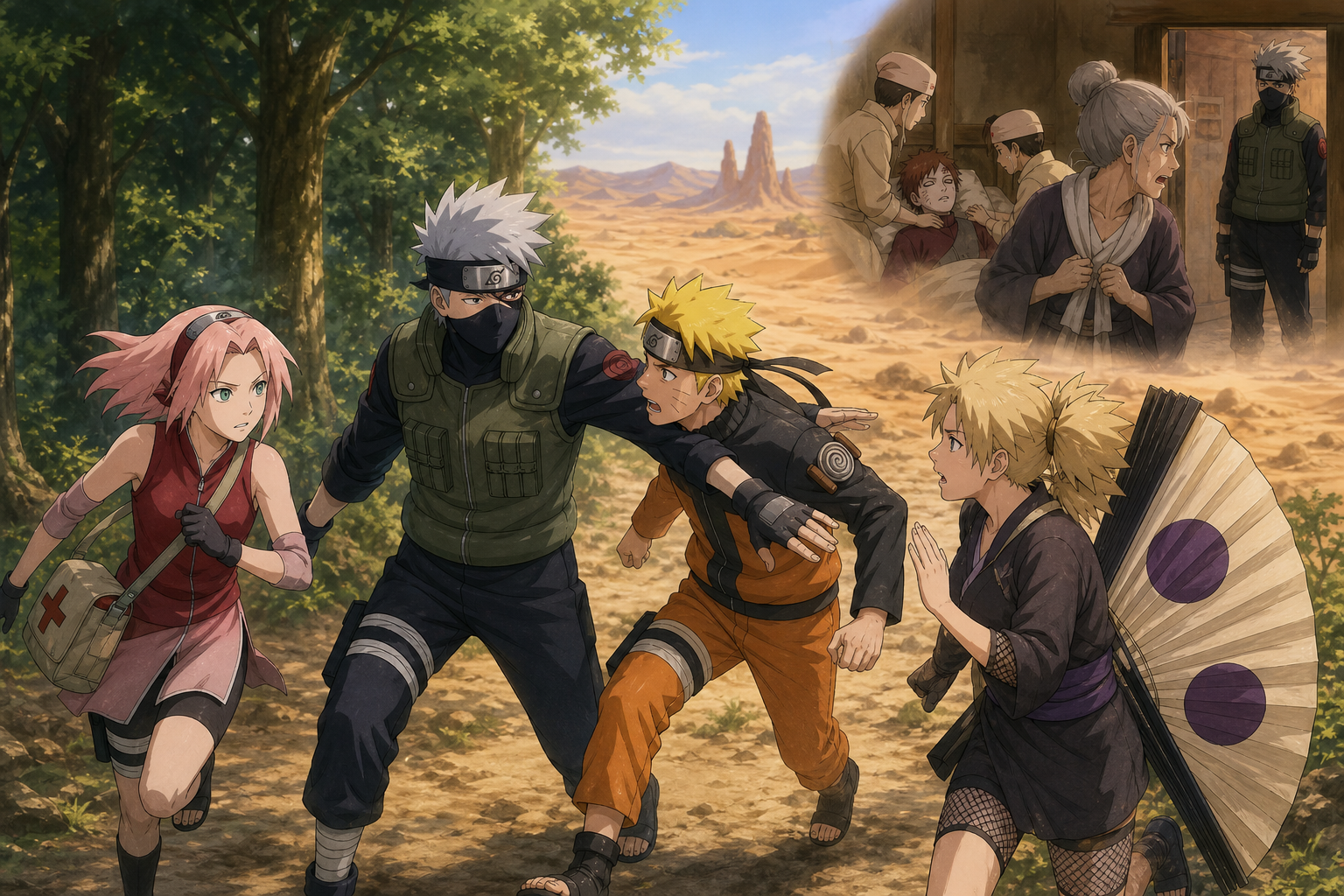
Team Kakashi, Deployed
Team Kakashi meets Temari on the road to Sunagakure while Kankuro’s poison and Chiyo’s war memory test what the alliance means.
Bottom line
Naruto Shippuden Episode 8 begins the rescue by refusing to let urgency impersonate a plan. Team Kakashi heads toward Sunagakure, Temari meets them on the road, and Naruto immediately wants to outrun everyone. Kakashi stops him because arriving first, exhausted, alone, and uninformed would not save Gaara. In the Sand, Kankuro's poison turns medical knowledge into the next battlefield while Chiyo's reaction to Kakashi exposes how an alliance can be current policy and old grief at the same time.
The episode is mostly movement and preparation, but it is not empty transit. Every road carries history. Naruto runs toward another jinchuriki. Temari runs toward a village that lost her brother. Sakura runs toward a poisoned patient whose survival will test Tsunade's training. Kakashi runs into the memory of what his father did during an earlier war.
Deployment is not departure
A team leaving the gate is not yet a rescue operation. Deployment means matching people, information, supplies, authority, route, and timing to the objective. Tsunade sends Kakashi, Naruto, and Sakura because their abilities fit different parts of the crisis.
Kakashi brings command experience, tracking judgment, and knowledge of Akatsuki. Naruto brings stamina, clone versatility, and a personal understanding of what it means to be hunted as a jinchuriki. Sakura brings combat strength and medical training that may matter as much as any attack.
The three-person formation also tests Kakashi's new statement that Naruto and Sakura stand beside him as fellow shinobi. Equality in a training field is pleasant. Equality on an urgent mission means listening when the leader identifies a risk and contributing without waiting to be carried.
The episode makes that transition immediately. Naruto's first instinct is emotionally generous and operationally dangerous. Kakashi does not punish the love behind it. He reorganizes the behavior it produces.
Naruto wants speed to become certainty
Naruto hears that Gaara is in danger and converts fear into forward motion. Running faster feels like doing more. Distance becomes the visible enemy because the actual Akatsuki plan remains unknown.
This reaction makes sense. Naruto knows what villages do to jinchuriki, what loneliness can do inside them, and how close Gaara came to disappearing into violence. Gaara's capture is not abstract foreign policy. It is the seizure of someone whose life proves Naruto's pain was not unique.
The danger is that Naruto treats shared pain as shared circumstances. He understands why Gaara matters. He does not yet know Deidara's route, Sasori's poison, the Sand's medical condition, the enemy location, or the support plan.
Kakashi's warning is therefore not “care less.” It is “make the caring useful.” A rescue team that fragments because one member outruns communication can create another captive.
Junko Takeuchi gives Naruto's urgency a raw edge that separates it from ordinary impatience. The energy is still recognizably Naruto, but the emotional object is different. He is not racing for attention or a personal victory. He is racing because he imagines Gaara alone inside a system that wants the beast more than the person.
Kakashi controls tempo instead of emotion
Kakashi does not tell Naruto that his fear is irrational. He controls the team's pace, formation, and decision-making. This is good command because feelings do not have to disappear before a mission can function.
Kazuhiko Inoue's calm delivery matters. Kakashi is not matching Naruto's volume to prove authority. He gives the urgency a container. The contrast lets the audience feel both the need to hurry and the need not to become stupid while hurrying.
The scene also shows why Kakashi's experience remains valuable after calling the younger shinobi equals. Respect does not erase specialization. Naruto can be a fellow professional and still need correction from someone who has watched rescue missions collapse under bad pacing.
Leadership here is not dominance. Kakashi makes sure the entire team reaches the problem with enough strength and information to matter. Slowing Naruto for that purpose is part of moving faster at mission scale.
This distinction is easy to miss in stories where the fastest body usually reaches the dramatic scene first. Logistics measures speed by completed outcome, not by who crossed a tree line ahead of everyone else.
Temari meets the mission between villages
Temari's encounter with Team Kakashi turns the alliance from paperwork into people sharing a road. She is a Sand shinobi, Gaara's sister, and someone with enough history in Konoha to understand both the political and personal stakes.
Her presence gives the Leaf team information and gives the Sand a representative inside the approaching support. She is not merely the person who announces what the audience already knows. She connects the village that requested aid to the team answering.
Temari also carries a different relationship to Gaara than Naruto does. Naruto recognizes a fellow jinchuriki and former enemy. Temari recognizes the brother her family once feared and failed. Both want him saved, but their guilt, memory, and authority are not interchangeable.
Romi Park's Japanese performance gives Temari urgency without stripping away her command. She does not become helpless because the captive is family. The steadiness matters because Sand leadership has already lost its center.
The road meeting symbolizes how alliances actually work. Cooperation does not happen only in council rooms. It happens when specific people exchange information quickly enough to alter what the next hour looks like.
Sakura's training is about to meet chemistry
Kankuro's condition makes Sakura's role urgent before she reaches the village. Sasori's poison is not a wound that ordinary healing closes. It is a designed compound moving through the body on a clock.
Medical ninjutsu must therefore become investigation. The healer needs symptoms, samples, timing, mechanism, and enough chemical understanding to build a countermeasure. Chakra can support the work, but chakra is not a magic synonym for “problem gone.”
This is the payoff to giving Sakura a discipline instead of only a stronger punch. The rescue arc needs someone who can fight and someone who can keep a poisoned witness alive. She is both people.
The Sand medics' inability to identify the poison should not be read as proof that they are useless. Sasori is a master from their own tradition who has spent years developing lethal mechanisms outside village oversight. Specialized knowledge can exceed a general medical system.
The institutional question is whether the village can accept outside expertise quickly. Pride becomes dangerous when a patient's body is counting the minutes.
Chiyo sees Sakumo before she sees Kakashi
Chiyo's reaction to Kakashi is a collision between resemblance and grief. His face recalls his father, Sakumo Hatake, whose wartime actions killed Chiyo's son and daughter-in-law. The current Leaf-Sand alliance does not erase that family loss.
This does not mean Chiyo is entitled to attack an uninvolved son without consequence. It means her anger has a history that diplomacy did not resolve. Understanding the source and judging the action are separate tasks.
Kakashi also carries a complicated relationship with Sakumo. His father died after being condemned for choosing teammates over mission rules. Chiyo remembers Sakumo as the enemy who took her family. Kakashi remembers a parent destroyed by his own village's judgment.
The two memories are not mutually exclusive. One person's moral tragedy can include another person's bereavement. War produces overlapping truths that refuse the comfort of a single heroic biography.
The encounter also demonstrates why alliances need more than shared enemies. Konoha and the Sand can agree that Akatsuki is dangerous while old violence remains active inside the people expected to cooperate.
Diplomacy changes policy faster than memory
The Leaf and Sand were enemies, temporary partners in an invasion, and now allies responding to a kidnapping. Institutional relationships can change on a council's timeline. Bodies and families do not update that quickly.
Chiyo's grief is not a bureaucratic error. It is evidence that peace agreements do not automatically provide truth, accountability, apology, or mourning. Those tasks require deliberate work.
At the same time, memory cannot become a license to sabotage present rescue. Gaara's life depends on people whose villages harmed one another choosing cooperation without pretending the harm was imaginary.
This is mature political tension for a rescue arc. The alliance is neither fake because resentment exists nor complete because leaders signed it. It is a structure people must practice under pressure.
Temari, Kakashi, Sakura, and Naruto become the practice. Their movement toward the Sand is a live answer to the question of whether former enemies can protect one another's people.
Team Guy and the shape of support
Team Guy's preparation expands the response beyond the three people named in the episode title. Rescue work needs backup capable of taking a separate route, breaking obstacles, or confronting a second enemy team.
The existence of support also reinforces Kakashi's warning to Naruto. The mission is not a race where the first hero earns ownership of the rescue. Multiple teams coordinate because Akatsuki operates through pairs, traps, hideouts, and information advantages.
That coordination also protects the people left behind. Konoha cannot empty its roster for one emergency, and Sunagakure cannot send every capable shinobi after Gaara while its defenses remain damaged. Support planning is the unglamorous work of deciding who moves, who stays, who carries medical supplies, and who can assume command if the first team disappears.
Might Guy's team brings close combat, Byakugan reconnaissance, weapons expertise, and speed. Those skills do not duplicate Team Kakashi's package. Good deployment creates complementary capacity instead of stacking famous names.
The audience knows the enemy is prepared. Sending more than one team is not excess. It is the beginning of treating Akatsuki as an organization rather than a dramatic stranger in a cloak.
Fandom arguments worth sorting out
The first argument is that Kakashi wastes time by slowing Naruto. A runner separated from medical support, command, and tracking information is not a faster rescue. Kakashi protects mission speed by preventing individual haste from fragmenting the team.
The second argument treats Chiyo's anger as irrational old-person comedy. The attack can be wrong while the grief remains serious. Sakumo's wartime history killed members of her family, and the alliance did not perform emotional amputation.
The third argument says Sand medics look incompetent so Sakura can shine. The more grounded reading is specialization. Sasori's poison is engineered by an elite rogue puppeteer. Sakura's Tsunade-trained analysis may provide a rare counter, not proof that every local medic lacks value.
The fourth argument treats deployment episodes as filler between fights. This episode changes who knows what, who travels with whom, how the alliance operates, and which skills the rescue will require. Preparation is plot when later survival depends on it.
RaeRae's verdict
“Team Kakashi, Deployed” understands that urgency needs structure. Naruto's desire to reach Gaara is morally right. Kakashi's refusal to let him sprint alone is operationally right. The episode respects both truths.
Temari turns an alliance into a face on the road. Sakura's medical training becomes the answer to a threat brute force cannot solve. Chiyo makes sure nobody mistakes present cooperation for a past without bodies.
This is not the loudest episode in the arc, but it builds the conditions that make the rescue credible. Teams deploy, information crosses borders, old enemies meet under new rules, and a poisoned patient waits for expertise. Running matters. Knowing how to arrive matters more.
That distinction is the episode's quiet strength. It gives urgency a shape the entire rescue party can carry together.
Deployment turns concern into an operating system
Leaving Konoha quickly matters, but a rescue becomes credible only when people, authority, supplies, routes, intelligence, and backup move together. The title names organization rather than emotion for a reason.
Team Kakashi contains command experience, jinchuriki understanding, tracking judgment, combat force, and advanced medical training. Those roles overlap enough to support one another without pretending every member is interchangeable.
Naruto’s urgency is morally accurate and tactically incomplete
He knows Gaara may be treated as a container before anyone acknowledges the person. Shared pain makes the abduction immediate in a way foreign policy never could.
That recognition explains why he runs. It does not reveal Akatsuki’s route, the poison in Kankuro’s body, the state of Sand’s defenses, or the location of the extraction. Empathy identifies why the mission matters; intelligence determines how to reach it.
Kakashi commands tempo instead of punishing feeling
He does not ask Naruto to care less or mock the fear beneath his speed. He keeps the team within communication range and preserves enough stamina for everyone to arrive useful.
This is why equality after the bell test does not eliminate leadership. Fellow professionals still have different experience. Kakashi’s responsibility is to stop one person’s urgency from fragmenting the collective rescue.
Fastest at mission scale is not fastest across one tree line
Naruto can arrive first by outrunning Sakura and Kakashi. He would then arrive without the medic, commander, full intelligence picture, or support needed against an organization operating in pairs.
Logistics measures speed by completed outcome. A coordinated team that reaches the correct problem intact can be faster than a solitary runner who reaches uncertainty early.
Temari makes the alliance specific
A treaty cannot brief Team Kakashi on the road. Gaara’s sister can. She carries Sand’s current information, family urgency, and enough history with Konoha to translate between village procedure and personal stakes.
Her presence prevents cooperation from remaining an abstract promise between leaders. The alliance becomes people trusting one another with the next hour.
Naruto and Temari do not carry identical grief
Naruto recognizes another jinchuriki and the terror of being valued for a beast. Temari recognizes the brother her family once feared, failed, and only recently learned to follow.
Both connections matter without becoming interchangeable. Effective rescue respects the different knowledge inside each bond instead of turning shared urgency into one generic emotion.
Kankuro’s poison expands the battlefield into medicine
Sasori’s compound continues attacking after the puppets stop moving. Diagnosis, stabilization, chemical analysis, and antidote creation now determine whether a witness and skilled Sand shinobi survives.
This is not recovery after the real action. Poison makes the treatment room another front of the same fight, with a clock as lethal as any blade.
Sakura brings a discipline, not a convenient miracle
Tsunade’s training gives her methods for gathering symptoms, isolating compounds, controlling chakra precisely, and testing a countermeasure. Expertise makes success possible without making it automatic.
Sand medics facing a rare poison created by an elite rogue are not useless because they need outside help. Specialized threats sometimes require specialized knowledge. The alliance matters because knowledge can cross the border faster than pride closes it.
Chiyo sees a dead son before a living ally
Kakashi’s face recalls Sakumo, whose wartime actions killed Chiyo’s family. Present policy cannot order that grief to become historical trivia.
Her reaction can be wrong in action and grounded in real loss. Understanding why she strikes does not make striking an uninvolved son acceptable. Moral analysis can hold source and responsibility separately.
Kakashi carries a different tragedy attached to Sakumo
Chiyo remembers the enemy responsible for deaths in her family. Kakashi remembers a father condemned by his own village after choosing comrades over mission doctrine.
Neither memory erases the other. War produces biographies in which one person’s moral wound exists alongside another family’s bereavement. Alliance requires cooperation without demanding a single clean story about the past.
Policy changes faster than bodies remember
Leaf and Sand can sign agreements, exchange requests, and deploy teams on a council timeline. Grief, suspicion, shame, and inherited stories remain inside the people asked to perform that policy.
The alliance is not fake because resentment survives, and it is not complete because officials named it. It becomes real through repeated choices to protect one another while the history remains true.
RaeRae’s full take
I am with Naruto’s heart and Kakashi’s pace. Gaara cannot wait forever, but a lone exhausted Naruto arriving without Sakura, intelligence, or a plan would give Akatsuki another person to manage. Caring becomes useful when it can survive the road.
Sakura is the quiet reason this deployment feels different from a parade of fighters. Kankuro’s body presents a problem punches cannot solve. Her training makes rescue larger than catching the people in cloaks.
Chiyo keeps the alliance honest. Sand and Leaf need one another today, but today did not bury everyone lost yesterday. The episode makes them travel through that truth rather than cleaning the road first. That is what cooperation looks like when history refuses to become convenient.
RaeRae checkpoint: Naruto knows why Gaara must be saved. Kakashi makes sure the people capable of saving him arrive together.
A rescue cannot empty both villages
Sunagakure has lost its leader after an internal and aerial breach. Konoha is sending valuable shinobi toward an organization whose full strength remains unknown. Neither village can treat the pursuit as permission to abandon every other defense.
Deployment therefore includes the people who stay. Someone must maintain gates, receive intelligence, protect civilians, coordinate medical supplies, and respond if Akatsuki’s attack has a second stage. The rescue force is only one part of the emergency system.
Team Guy adds capacity rather than celebrity
Byakugan reconnaissance, weapons expertise, speed, and close-combat strength create a second package capable of taking another route or meeting another Akatsuki member. Those abilities complement Team Kakashi instead of merely adding four familiar names.
The enemy works through pairs, hideouts, seals, and prepared terrain. Sending one famous squad would reproduce Naruto’s mistake at a larger scale: reaching quickly without enough structure to handle the problem discovered on arrival.
Old grief can become current intelligence
Chiyo’s history with Sakumo creates conflict, but it also means she carries knowledge about prior wars, Sand techniques, Sasori’s childhood, and the village conditions that produced his departure.
Cooperation does not require erasing anger. It requires preventing anger from blocking information and action that might save Gaara and Kankuro now.
Receipts and official routes
- Episode number, Japanese and licensed titles, Team Kakashi’s deployment, Temari’s road meeting, the Kankuro medical crisis, and Chiyo’s response to Kakashi: Naruto Official Site episode guide.
- Licensed Naruto Shippuden series route: Crunchyroll.