
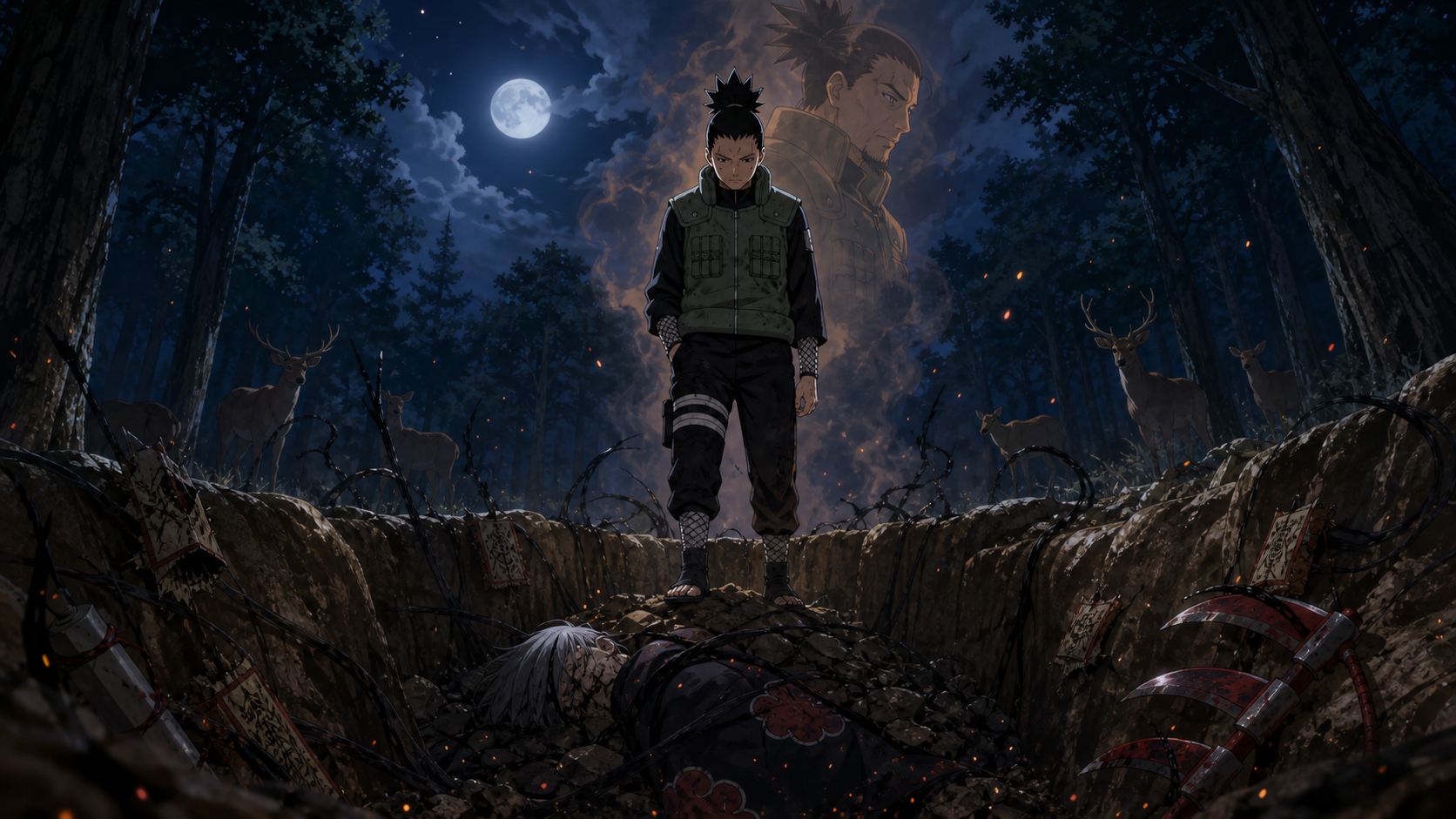
When You Curse Someone, You Dig Your Own Grave
Shikamaru turns immortality into confinement, closes the grave beneath Hidan, and leaves the forest carrying grief that victory cannot erase.
The grave is an answer to immortality, not a contradiction
Hidan survives wounds that would end an ordinary fight, so Shikamaru stops treating death as the only possible victory condition. The pit beneath the Nara forest offers a colder solution: separate the immortal body from every ally, weapon, witness, and route back into the world.
The punishment fits the rule already established. Hidan's body may refuse death, but immortality does not guarantee freedom, repair, or rescue.
Shikamaru wins by changing the question from “How do I kill him?” to “How do I make survival useless?”
Preparation becomes visible one layer at a time
Episode 86 let us see the outline of a trap. Episode 87 reveals its engineering: the borrowed blood, the shadow placement, the explosive tags, and the grave waiting exactly where Hidan's certainty would carry him.
None of those parts works alone. Together they form a sequence that converts the ritualist's habits into reliable timing.
Shikamaru did not predict every motion by magic. He built a battlefield where Hidan's favorite choices would keep producing the result he needed.
Hidan's curse returns through cause and consequence
The title sounds supernatural, but its sharpest meaning is practical. Hidan has spent years treating other bodies as objects inside his ceremony. He believes suffering proves his god's favor and immortality exempts him from consequence.
The grave reverses that logic. The man who turns blood into a sentence is sentenced by the habits he never questioned.
Shikamaru does not adopt Hidan's theology. He forces the ritualist to live inside the ordinary consequences of arrogance, isolation, and accumulated enemies.
Anger is present, but discipline chooses its shape
This confrontation is revenge. Pretending otherwise would flatten Shikamaru's grief and the promise he made after Asuma's death. What matters is that anger does not erase his judgment.
He allows himself one final declaration, then completes the plan he prepared. The scene is emotionally fierce because restraint holds until the exact moment it can become action.
Asuma's memory does not command Shikamaru to become reckless. It reminds him what kind of shinobi his teacher believed he could be.
The Nara forest makes the victory communal
Shikamaru tells Hidan that the forest belongs to his clan and that its deer will prevent discovery. That detail matters. He is physically alone at the grave, but he is not unsupported.
The land carries family history, protection, and knowledge that Hidan cannot read. Shikamaru's plan succeeds inside a place maintained by people before him and guarded by living bonds after he leaves.
The contrast is brutal: Hidan mistakes partnership for convenience, while Shikamaru understands belonging as infrastructure.
Asuma's presence is memory rather than rescue
The warm outline of Asuma appears at the emotional crest, but it does not perform the victory for his student. Shikamaru has already observed, prepared, endured, and acted.
The image gives grief a visible language. It lets the episode acknowledge that this achievement is inseparable from loss without suggesting loss has been repaired.
Asuma cannot return. Shikamaru can carry forward the patience, responsibility, and faith his teacher invested in him.
Team Kakashi arrives at a different kind of crisis
While Shikamaru concludes his private battle, Naruto, Sakura, Sai, and Yamato reach Kakashi, Ino, and Choji. The rescue widens the episode from one completed strategy to another confrontation still moving.
Kakuzu's multiple hearts make him a different problem from Hidan. Containment alone will not answer an enemy who can replace damage and attack through several elemental bodies.
The team divides according to need: Sakura and Sai move toward Shikamaru while Naruto and Yamato reinforce the fight against Kakuzu.
Naruto returns carrying unfinished power
Naruto's entrance is hopeful, but the episode refuses to treat arrival as proof of mastery. His new wind-style technique has been developed under severe time pressure and remains dangerous even to its creator.
That uncertainty gives the cliffhanger weight. He is not simply unveiling a larger attack. He is testing whether accelerated training can become reliable judgment in a live battlefield.
Shikamaru's victory was built on controlling variables. Naruto enters while still learning which variables his own jutsu contains.
RaeRae's reaction
The burial is one of the series' most satisfying victories because it does not cheat the rules. Hidan remains what he has always claimed to be. Shikamaru simply proves that endless life can become a prison when arrogance has burned every bridge to rescue.
I also love that the episode does not let revenge consume the entire team story. One fight closes in the forest while another demands cooperation, adaptation, and a new technique that has not earned our trust yet.
The emotional release is real, but it arrives beside another warning: power is only useful when the person holding it understands the cost.
Shikamaru leaves the grave with grief still intact
Episode 87 does not claim that defeating Hidan heals Asuma's students. Ino and Choji still carry the absence. Kurenai still faces a future changed by loss. Shikamaru still has to grow around a wound strategy cannot erase.
What the victory restores is agency. Hidan no longer controls the meaning of Asuma's death, and grief no longer traps Shikamaru in the moment of failure.
He walks away having kept his promise through preparation rather than self-destruction. The grave closes on Hidan, but the episode's real movement belongs to the student who can finally step beyond it.
Official episode reference: Naruto Official episode guide
Licensed episode route: Crunchyroll licensed episode page
Shikamaru’s final move changes immortality from power into duration
Hidan can continue living after wounds, dismemberment, and explosion. The pit asks what that life can accomplish without movement, blood, ritual ground, or a partner capable of reconstruction.
The answer is almost nothing. Shikamaru does not disprove immortality. He separates existence from agency until the ability Hidan worships becomes the length of his confinement.
The title warns that curses produce architecture
Every curse Hidan performed required a circle, a victim, and confidence that consequences belonged to someone else. The grave is the structure built by those choices.
Shikamaru prepared the literal hole, but Hidan supplied the habits that led him into it. The proverb works because revenge and consequence occupy the same terrain without becoming identical.
The blood switch turns Hidan’s certainty against Kakuzu
Hidan believes the sample belongs to Shikamaru and performs the ritual without questioning the evidence. Kakuzu’s blood makes the transferred strike land on the partner whose multiple hearts have protected both men.
The tactic weakens one battlefield while controlling another. Separation becomes coordination because Shikamaru’s private duel still changes what Kakashi, Ino, and Choji face elsewhere.
Hidan’s ritual fails because he trusts procedure without verifying premise
He follows every sacred step correctly. The circle, transformation, and self-inflicted wound operate exactly as expected. The false assumption enters before the ceremony begins.
That is why the deception is so effective. Shikamaru does not need to break the jutsu. He lets a functioning technique amplify bad information supplied by its own user.
The explosive tags are stored effort released at the exact limit
Shikamaru reaches the end of his chakra with no physical power capable of destroying Hidan’s body alone. Preparation lets earlier time contribute force to the present.
The tags, wires, and pit are not accessories to genius. They are how a strategist respects his own limits. He does the heavy work before exhaustion makes heavy work impossible.
Asuma’s lighter belongs to memory before it belongs to revenge
The object carries the intimacy of a familiar habit, not only the drama of a final ignition. Shikamaru remembers games, conversations, meals, and the teacher who noticed his ability long before the village needed it.
Lighting the trap connects action to that relationship. It does not mean Asuma’s whole life exists to justify Hidan’s punishment.
Asuma’s apparition does not absolve the village of supporting Shikamaru
The warm image gives emotional language to memory, but Shikamaru still needs living people after the forest. Ino, Choji, his parents, Kurenai, and the village cannot hand all future care to a vision.
Remembering a teacher can guide him. Community has to help him sleep, return, and build a life beyond the mission.
The Nara deer make the grave part of protected territory
Hidan is not merely buried in an unknown woodland. He is contained inside land watched by the clan and hostile to outsiders searching without permission.
That environmental custody matters because Kakuzu once repaired him. A grave remains secure only if rescue routes are denied after Shikamaru leaves.
Containment creates responsibilities that continue past the victory scene
The site should be mapped, restricted, monitored, and passed through clan knowledge. An immortal prisoner cannot be treated as a solved threat whose location becomes folklore.
Future generations need explicit warning about what lies beneath the rubble and which disturbance could restore Hidan’s access to the world.
Shikamaru’s speech gives anger a boundary
He tells Hidan where he is, why rescue will not come, and whose land will hold him. The words are severe because grief has earned no polite performance.
Then Shikamaru leaves. He does not remain seeking endless emotional payment from Hidan’s fear. Walking away prevents the enemy’s voice from becoming a permanent relationship.
Hidan is defeated by the connections he never valued
Shikamaru has clan land, teammates holding the other battle, a father who gave grief room, and a teacher whose lessons remain active. Hidan has a partner based on utility and a religion expressed through harm.
When utility fails, nobody comes. The grave exposes the practical poverty of treating every bond as transaction or sacrifice.
Revenge gives Shikamaru agency without granting closure
He kept the promise to stop Hidan. That achievement matters. It does not remove Asuma’s empty chair, restore Kurenai’s future, or turn Team Ten back into its earlier shape.
The episode wisely lets satisfaction and grief coexist. An enemy can be defeated while mourning remains unfinished.
Sakura and Sai move toward Shikamaru because victory still needs recovery
The strategist has spent chakra, endured danger alone, and triggered an explosion at close range. Somebody must confirm he can leave the forest safely.
Reinforcement after the decisive move is not redundant. A mission ends when people return, information is shared, and injuries are treated, not when the villain stops moving.
Naruto arrives at Kakuzu’s battle carrying a different kind of risk
The new Wind Style technique promises power capable of damaging multiple hearts, but it remains incomplete and dangerous to its user. Arrival does not equal readiness.
Naruto has to listen to the battlefield intelligence before trying to become the answer. Kakuzu’s masks, elements, and remaining reserves determine whether the jutsu can be used without harming allies.
Shikamaru and Naruto represent opposite relationships to preparation
Shikamaru constructed his battlefield in advance and guided Hidan through known steps. Naruto compressed training under a deadline and enters conditions he has not controlled.
Neither method is automatically superior. The contrast asks whether Naruto can bring judgment equal to his new power when improvisation replaces a prepared forest.
Kakuzu now faces a team no longer divided by Hidan’s threat
Once Hidan is contained, the Leaf can concentrate resources on the remaining hearts. The partnership that multiplied danger has been reduced to one distributed body.
Shikamaru’s victory therefore changes more than personal revenge. It removes a tactical system and gives Kakashi’s group room to coordinate Naruto’s arrival.
The grave refuses the fantasy that all justice must look clean
Hidan remains conscious beneath rubble, and the punishment is deliberately brutal. The scene should be allowed to feel satisfying and disturbing.
Shikamaru is a grieving teenager operating inside a military world that offered few humane ways to contain an immortal killer. Understanding the choice does not require pretending the violence has no moral weight.
The series must let Shikamaru become more than this victory
“Genius who buried Hidan” cannot replace “boy who loved Asuma.” Future episodes should preserve his humor, laziness, friendships, leadership, and capacity for ordinary life.
Trauma may shape him without owning every part. The most meaningful survival is becoming larger than the act grief required.
RaeRae’s full take
Hidan spent two episodes assuming immortality was the end of every argument. Shikamaru answered with a hole. Sometimes strategy is asking a rude little practical question nobody else bothered to ask.
The blood switch is delicious because Hidan’s ritual works. He follows his rules and punishes the wrong body. Arrogance did not make the jutsu fail. It made him certain he had verified something he never checked.
Asuma’s lighter hurts more than the explosion satisfies. It brings the teacher into the scene through an object Shikamaru actually held and remembered, not through a speech pretending revenge cured anything.
Then Naruto arrives elsewhere with a technique that could change everything and hurt him badly. One trap closes with perfect preparation while another fight opens around unfinished power. That contrast keeps victory from becoming rest.
Konoha should treat the buried site as an active containment zone
Hidan is defeated operationally, not biologically. That distinction must shape what happens after the mission. The location needs restricted access, regular observation, and a record that survives changes in clan leadership.
A seal, warning system, or layered barrier could add protection without disturbing the grave. Secrecy alone is fragile if the people holding it die or records disappear.
Shikamaru should not become the sole keeper of Hidan’s prison
The site is personal to him, but personal responsibility can become another burden grief refuses to release. The Nara clan and village should share custody.
Distributed knowledge protects the containment and allows Shikamaru to live without believing every future escape would be his private failure.
Hidan’s final threats reveal that he still expects attention to restore power
His body cannot reach Shikamaru, so his voice tries to continue the relationship. Rage, insult, and promises of revenge are the only tools left above the rubble.
Walking away is the last containment step. Shikamaru denies Hidan an audience and refuses to spend his future maintaining the enemy’s emotional importance.
The proverb should apply to systems as well as individuals
Akatsuki has built power by creating graves across countries. Every bounty, extracted beast, and murdered opponent generates people with knowledge and reason to resist.
The organization treats consequences as isolated grief. Team Ten demonstrates how grief can become coordinated intelligence that reaches back.
Ino and Choji deserve the full account of what happened in the forest
Shikamaru’s private victory belongs to their shared mission. They need to know the blood substitution, containment site, and risks that remain.
Telling them also prevents the duel from becoming a solitary legend. Team Ten held Kakuzu away and made the separation possible. The result belongs to the formation.
Kurenai should not be asked to bless the revenge after the fact
She may feel relief, anger, discomfort, or nothing clean enough to name. Hidan’s burial does not obligate her to provide emotional closure for the team or village.
Her grief and her child’s future exist independently of whether the mission feels satisfying to others. Support means allowing that complexity.
Naruto’s entrance must not erase the cost already paid
A heroic arrival can redirect attention toward the next spectacular technique. The episode still needs us to remember exhausted Kakashi, injured teammates, stolen hearts, and Shikamaru walking away from a grave.
Naruto joins an existing operation. He does not replace its knowledge or become the only person whose risk matters.
The true opposite of Hidan’s curse is collective care
Hidan links bodies so one person suffers for his pleasure. Team Ten links abilities so several people reduce one another’s danger.
Both structures depend on connection, but only one allows every participant to remain a person. That difference gives the arc its moral shape beyond who lands the final attack.
Episode 87 gives Shikamaru a victory without pretending victory is medicine. Hidan is contained. Asuma is still gone. Those facts can share a scene without canceling each other. The grave matters because it prevents another ritual, another stolen body, and another family receiving sad news. The lighter matters because Shikamaru’s reason for acting is larger than the man beneath the rubble. His teacher remains present through memory, habit, and a lesson about protecting the future. I want the village to recognize that this ending creates ongoing work. Immortality means the site cannot become a forgotten landmark. Clan stewardship, records, barriers, and shared responsibility have to continue after the audience leaves. Shikamaru should not spend his life guarding one enemy in his mind simply because he designed the prison. Walking away is part of the win. Elsewhere, Naruto’s arrival keeps the arc from settling into revenge as the only answer. Kakuzu still threatens Team Ten. Kakashi is exhausted. The new Wind Style technique is powerful, unfinished, and arriving inside a battlefield shaped by other people’s work. Naruto has to listen before he strikes. That is the bridge between the two victories this story is trying to build. Shikamaru defeats Hidan by knowing every condition. Naruto can help defeat Kakuzu only if he respects the conditions already discovered. Power and preparation need each other. So do grief and community. The grave closes because Shikamaru planned alone for a moment, but he can leave because he never truly acted alone. The forest holds the enemy so the people Asuma loved can keep moving toward lives not organized around him or the pain he caused again.
RaeRae checkpoint: Hidan asked immortality to excuse every consequence. Shikamaru gave him consequence without death: a grave, no partner, no ritual, and all the time in the world to understand the difference.
Receipts and official routes
- Licensed title and official account of Shikamaru completing the Nara forest trap while reinforcements divide between him and Kakuzu’s battle: Naruto Official Site episode guide.
- Licensed episode title, number, and watch route: Crunchyroll.