
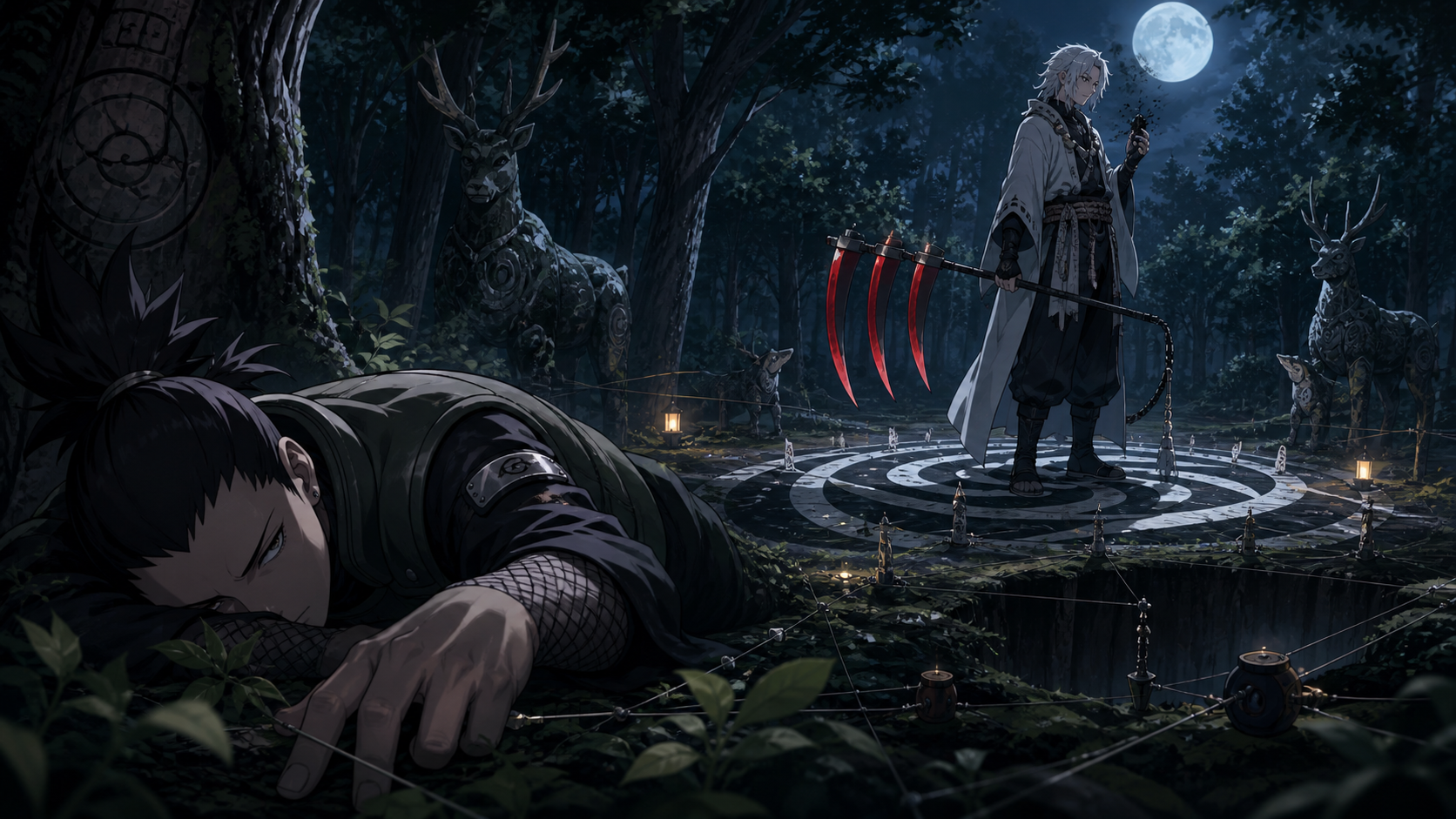
Shikamaru’s Genius
Hidan sees an exhausted opponent and a completed ritual; Shikamaru sees a predictable enemy standing inside a forest prepared several moves ago.
Shikamaru chooses isolation as part of the plan
Episode 86 separates Hidan from Kakuzu and draws him deep into the forest. On the surface, this leaves Shikamaru alone against an immortal opponent whose ritual has already killed his teacher.
The isolation is dangerous, but it is not accidental. Hidan's partnership provides rescue, repair, and additional pressure. Removing that support turns the duel into a system Shikamaru can model.
He chooses a smaller battlefield because fewer variables can be controlled more completely.
The forest belongs to Shikamaru before Hidan enters it
Terrain is never neutral in a planned confrontation. The Nara clan's forest offers familiar paths, concealed boundaries, and prepared spaces Hidan cannot read on arrival.
Shikamaru has transformed trees, shadows, pits, and distance into components of a strategy assembled before the first exchange.
Hidan believes he is chasing a wounded target. He is moving through an argument whose conclusion has already been placed beneath his feet.
Chakra depletion becomes part of the deception
Shikamaru's techniques consume real chakra, and fighting alone carries genuine risk. His exhaustion is not entirely performance.
That truth makes the staged vulnerability convincing. A deception works best when it aligns with what the opponent expects and with evidence that is partly real.
Shikamaru does not pretend to be limitless. He builds a plan that uses Hidan's confidence about his limits.
Hidan sees blood and stops asking questions
The ritualist believes that obtaining Shikamaru's blood gives him control of the encounter. Previous success has trained him to trust the sequence: sample, circle, transformation, judgment.
Certainty narrows his attention. He does not investigate why the strategist allowed the pursuit to reach this location or why the apparent defeat feels so complete.
Hidan's power is governed by rules, but his arrogance makes him repeat those rules predictably.
The apparent wound is a tactical story
Shikamaru lets Hidan believe he has reached the same decisive condition used against Asuma. The image of a wounded opponent supplies emotional satisfaction that discourages caution.
What matters is not only whether blood exists, but whose blood the ritual has accepted. The sample becomes a hidden variable inside Hidan's familiar ceremony.
The trap turns the enemy's confidence in evidence into the mechanism of his mistake.
Genius is preparation meeting observed behavior
Shikamaru's plan is not magic foresight. It is built from the previous battle: Hidan needs blood, must occupy a circle, trusts his immortality, and becomes careless when he believes the ritual is complete.
Every deduction came from costly observation. Genius lies in preserving those facts, arranging them, and creating a setting where Hidan is likely to reproduce them.
The strategy respects evidence more than ego.
Shadow techniques control the space between belief and reality
Hidan thinks Shikamaru is nearly unable to move. In fact, concealed shadow paths connect the strategist to triggers and boundaries across the forest floor.
The technique does not need to overpower immortality directly. It needs to place Hidan where the prepared environment can do what a conventional attack cannot.
Control becomes decisive because the trap has already supplied the force.
Asuma's memory guides without replacing judgment
Shikamaru's anger is present in every stage of the confrontation, but the plan remains patient. He refuses to honor Asuma through a reckless exchange Hidan would enjoy.
Instead, he uses the habits his teacher cultivated: observe the board, understand the king, and spend pieces for a purpose larger than pride.
Memory becomes discipline rather than an excuse to abandon it.
The episode weaponizes the audience's fear
The official synopsis presents Shikamaru depleted, wounded, and near death because that is the position Hidan believes he has created. The scene asks us to feel the earlier ritual repeating.
Small visual details resist that conclusion: a focused eye, a shadow traveling where it should not, and a forest too carefully arranged to be accidental.
Suspense comes from recognizing a plan before knowing whether every dependency will hold.
RaeRae's reaction
This is Shikamaru at his best because the genius is visible in the environment, not announced by someone watching from safety. Hidan sees a lonely, exhausted teenager. We gradually see a strategist standing inside preparation that began long before the chase.
I love that the trap exploits habit instead of inventing a new weakness. Hidan has shown exactly what makes him confident, and Shikamaru gives him the scene he expects.
The danger remains real because one exhausted mistake could still make the performance true.
The winning move begins before Hidan knows a game exists
Episode 86 makes Shikamaru's isolation look like vulnerability while revealing it as control. The Nara forest, concealed triggers, ritual sample, and Hidan's arrogance all occupy positions in a plan shaped from observed rules.
Shikamaru cannot kill immortality through force. He can remove support, manipulate certainty, and prepare a consequence survival does not solve.
Hidan believes he has drawn the strategist's blood. The deeper truth is that Shikamaru has drawn Hidan into the board.
Official episode reference: Naruto Official episode guide
Licensed episode route: Crunchyroll licensed episode page
Shikamaru wins the first exchange by deciding where the duel will exist
Hidan believes separation means he has isolated a weaker opponent. Shikamaru understands that removing Kakuzu also removes the person who can repair, retrieve, and complicate every answer.
The Nara forest is not empty terrain. It is controlled access, known shadows, prepared earth, and a place where Shikamaru’s family has authority. Location becomes the first successful move before Hidan recognizes the board.
The plan begins with intelligence purchased through Asuma’s death
Shikamaru knows the ritual needs blood, a transformation, a marked circle, and Hidan’s continued position. He also knows immortality does not restore mobility or supply help.
Using those facts does not make the loss worthwhile. It makes refusing to learn from the loss unacceptable. The plan carries Asuma’s final battle forward without pretending knowledge balances the cost.
Hidan’s predictability is built from confidence, not stupidity alone
His ritual has worked repeatedly. Victims panic after seeing transferred damage, and ordinary attacks cannot frighten him away from the sequence. Success has trained him to treat familiar conditions as proof of inevitable victory.
Shikamaru does not need Hidan to become foolish. He needs him to repeat the behavior his power rewards. The trap fits the enemy’s history closely enough that caution feels unnecessary.
Isolation lets Shikamaru turn personality into a tactical variable
Kakuzu might notice the forest is prepared or stop Hidan from chasing emotional bait. Alone, Hidan’s impatience and desire to complete the sacrifice face no corrective voice.
Separating partners does more than divide strength. It removes the person who compensates for another fighter’s habits. Hidan becomes easier to model when nobody interrupts his worst instincts.
The forest pit answers immortality with containment
Shikamaru cannot rely on killing a man who survives decapitation. He prepares a consequence that does not need death to function. Burial can deny movement, blood access, ritual space, and rescue.
This is the correct change in victory condition. If existence cannot be ended reliably, agency can be restricted. An immortal body trapped beyond reach is operationally defeated even while consciousness continues.
Explosive tags transform preparation into force Shikamaru does not have to generate
His chakra is finite and the duel demands repeated shadow control. The trap stores energy before the fight, allowing planning time to substitute for reserves he will not possess later.
That is one meaning of genius the title sometimes obscures. Shikamaru does not become physically limitless. He arranges the environment so the decisive force is waiting when his body reaches its limit.
The blood sample is the plan’s most dangerous hinge
Hidan must believe he has consumed Shikamaru’s blood while the sample actually belongs to Kakuzu. The deception redirects the ritual’s damage toward the partner Hidan assumes is safely elsewhere.
One contaminated assumption can turn a perfect ceremony against its user. Yet obtaining, preserving, and substituting the sample requires precision. If Hidan notices anything wrong, the entire chain changes.
Shikamaru uses Hidan’s faith as a schedule
The ritualist follows steps with devotion: taste blood, transform, enter the circle, injure the body. Belief makes the sequence reliable because Hidan does not improvise once he thinks the conditions are complete.
Shikamaru can place triggers around that schedule. He knows when attention will narrow, when Hidan will stand still, and when the apparent result will make him celebrate.
Apparent exhaustion makes the trap believable because the exhaustion is real
Shikamaru has spent chakra controlling Hidan, traveled under pressure, and entered the duel carrying grief. He is genuinely near his limit.
The performance adds posture and timing to a true weakness. Hidan sees what he expects because the evidence is credible. The danger is that Shikamaru cannot fully separate acting depleted from becoming unable to finish.
Genius does not remove the need for a margin
A plan with no allowance for a broken tag, changed step, or delayed shadow is a wish dressed as precision. Shikamaru’s preparation needs overlapping controls.
The pit, tags, wires, shadows, and terrain each cover different failures. Redundancy matters because Hidan only needs one unexpected opening to make the blood ritual real.
Shikamaru’s eye tells the audience not to accept the same story Hidan accepts
The official setup emphasizes depletion and mortal danger. Small moments of focus suggest that panic is not the whole truth. His gaze remains connected to details beyond Hidan’s immediate attack.
The episode lets suspense live between recognition and explanation. We can sense preparation without knowing every mechanism, which makes each revealed layer feel like evidence clicking into place.
Asuma’s lighter carries memory into the machinery of the trap
An ordinary object associated with his teacher becomes part of Shikamaru’s final commitment. The lighter is not magical inheritance. Its weight comes from meals, smoke, games, and years of being known.
Using it against Hidan makes remembrance active without reducing Asuma to revenge. The object connects the plan’s fire to the person whose lessons taught Shikamaru why the fight matters.
The Nara deer are part of the forest’s authority
Hidan enters land where Shikamaru’s clan controls access and where retrieval will not be simple. The forest is protected space, not an anonymous hole beside a road.
Containment gains durability from community and territory. Even if Hidan survives the explosion, escape and rescue require crossing a place already aligned against him.
Shikamaru rejects the duel Hidan thinks they are having
Hidan wants a contest of pain, endurance, and ritual dominance. Shikamaru creates a contest of information, route choice, and prepared consequence.
Refusing the opponent’s preferred terms is not cowardice. It is the entire strategic task. Hidan’s immortality only dominates battles organized around who can endure more damage.
The plan keeps Asuma’s students from sharing Asuma’s fate
Shikamaru separates himself, which is risky, but the larger operation prevents Ino and Choji from entering Hidan’s blood ritual range. He carries the specific counter because he understands it best.
Protection remains the purpose beneath revenge. The strategy should end with Hidan contained and Team Ten alive, not with matching sacrifices.
Kakuzu becomes vulnerable to his partner without knowing it
The stolen blood lets Hidan’s certainty cross the separation Shikamaru created. Kakuzu’s body may survive the transferred wound, but the attack can eliminate another heart and reduce the system Kakashi’s group faces.
The partnership’s coordination turns inward. Hidan’s ritual, usually supported by Kakuzu’s repair, becomes a weapon against the inventory that makes repair possible.
Every hidden trigger depends on Shikamaru maintaining sequence
Preparation alone does not execute the plan. He must lure Hidan along the route, control distance, sell the false wound, guide the ritual, and activate the final containment while exhausted.
Genius here is sustained attention. One clever idea would not survive without disciplined performance across every stage.
The title risks making the team around Shikamaru disappear
His plan is exceptional, but Kakashi, Ino, and Choji are holding Kakuzu and the masks away from the duel. Their survival protects the separation on which the forest strategy depends.
Shikamaru can act alone because a team is doing dangerous work elsewhere. Calling him a genius should not erase the people maintaining the conditions his genius requires.
RaeRae’s full take
Hidan thinks he has followed Shikamaru into a private execution. Sir, you followed a Nara into his own forest and never once wondered why the exhausted teenager kept choosing the route. Arrogance deserves a map.
I love that the plan does not need to prove Hidan can die. It asks a better question: what if immortality has nowhere to go? A pit, an explosion, controlled land, and no Kakuzu create an answer his body cannot brag its way out of.
The blood switch is vicious because Hidan performs every step correctly. His failure is believing the sample tells the story he wants. Shikamaru turns certainty into misdirection.
But the chakra drain remains real. Genius has to finish before the body carrying it gives out. That is why the scene keeps its danger even after we begin seeing the trap.
The plan should preserve proof that Hidan remains contained
Burial prevents immediate movement, but an immortal enemy should not disappear from Konoha’s threat model simply because nobody can see him. The forest needs monitoring and access restrictions.
Shikamaru should record the exact site, trap condition, and risks of disturbance. Future clan members must know that opening the ground is not excavation. It is releasing an active combatant.
The Nara forest turns family knowledge into village defense
Shikamaru’s familiarity with the terrain comes from belonging, not merely scouting. Paths, shadows, animals, and boundaries have meaning accumulated across generations.
That inheritance becomes operational without becoming impersonal. The clan’s stewardship supplies a place capable of holding a threat ordinary prisons may not understand.
Hidan’s mouth remains dangerous even when his body cannot move
He can provoke, threaten, and search for emotional weakness. Shikamaru should not remain near the pit seeking satisfaction from an argument the trapped man can extend forever.
Containment includes denying attention. Hidan’s voice should not be allowed to pull the strategist back into ritual terms after the physical mechanism has failed.
The blood substitution requires accountability after the mission
Using Kakuzu’s blood against him is tactically brilliant, but the report should document how the sample was obtained and verified. Future teams need the method, not only the surprise.
Clear documentation separates a reproducible counter from a legend about Shikamaru predicting everything. Genius becomes more protective when other people can learn its steps.
Kakashi’s group must know when the forest plan succeeds
Separation works only if both sub-battles coordinate their changing conditions. Once Hidan is contained, Shikamaru should signal that Kakuzu can no longer expect repair or ritual support.
That knowledge may change how aggressively the other team targets remaining hearts. Information should cross the distance as quickly as the tactical advantage does.
Shikamaru needs an extraction plan for himself
Explosions, collapsing ground, depleted chakra, and isolation can trap the strategist beside the enemy he intended to bury. Prepared routes and a rendezvous point are not optional details.
A plan honoring Asuma must include Shikamaru returning to Ino and Choji. Survival is part of the finish, not a hopeful event after it.
The revenge becomes justice only through prevention
Hidan’s suffering may satisfy anger briefly, but the lasting value is that he cannot take another person’s blood or turn another body into worship.
Containment protects strangers Team Ten will never meet. That outward effect keeps the mission connected to Asuma’s king instead of narrowing it to private pain.
Shikamaru’s genius includes knowing force is not his language
He does not imitate Naruto’s power or Kakashi’s Lightning Blade. He builds with observation, terrain, timing, and the enemy’s habits.
The episode respects difference. Intelligence becomes strongest when Shikamaru stops measuring it against physical spectacle and creates a consequence only his way of seeing could assemble.
Episode 86 earns the word genius because the plan never asks Shikamaru to become somebody else. He does not overpower immortality, invent a convenient weakness, or receive perfect certainty from nowhere. He remembers every condition Hidan exposed, chooses land he understands, removes the partner who repairs mistakes, and stores force in the environment before his chakra begins to fail. The result is personal without becoming reckless. Asuma lives inside the lighter, the shogi logic, and the insistence that the next generation must survive the answer. Hidan thinks grief has made Shikamaru easy to provoke. Grief has made every detail impossible to forget. I still need the story to remember that the forest duel is supported by Ino, Choji, and Kakashi holding Kakuzu away. Isolation is the visible shape of Shikamaru’s strategy, not proof that he achieved everything alone. The trap succeeds because a team preserves the conditions around it. Hidan’s ritual once made another person’s body pay for his choices. Shikamaru returns that logic through the blood sample, then refuses to make death the only available victory. A pit can answer a man who survives wounds. Distance can answer a mouth that wants attention. Clan territory can answer a partner searching for retrieval. The final move is not a larger explosion. It is a complete change in what counts as defeat. If Hidan cannot move, reach blood, rebuild the circle, or receive Kakuzu’s help, immortality becomes time without agency. Shikamaru does not solve death. He solves what this living threat is still allowed to do. That is strategy shaped by care, and care is why the plan must bring its exhausted architect safely home afterward.
RaeRae checkpoint: Hidan believes the ritual gives him ownership of the ending. Shikamaru gave him borrowed blood, borrowed confidence, and a forest where every shadow already belonged to the plan.
Receipts and official routes
- Licensed title and official account of isolated Shikamaru appearing depleted while a concealed shadow-trigger plan begins to surface: Naruto Official Site episode guide.
- Licensed episode title, number, and watch route: Crunchyroll.