
Team Ten
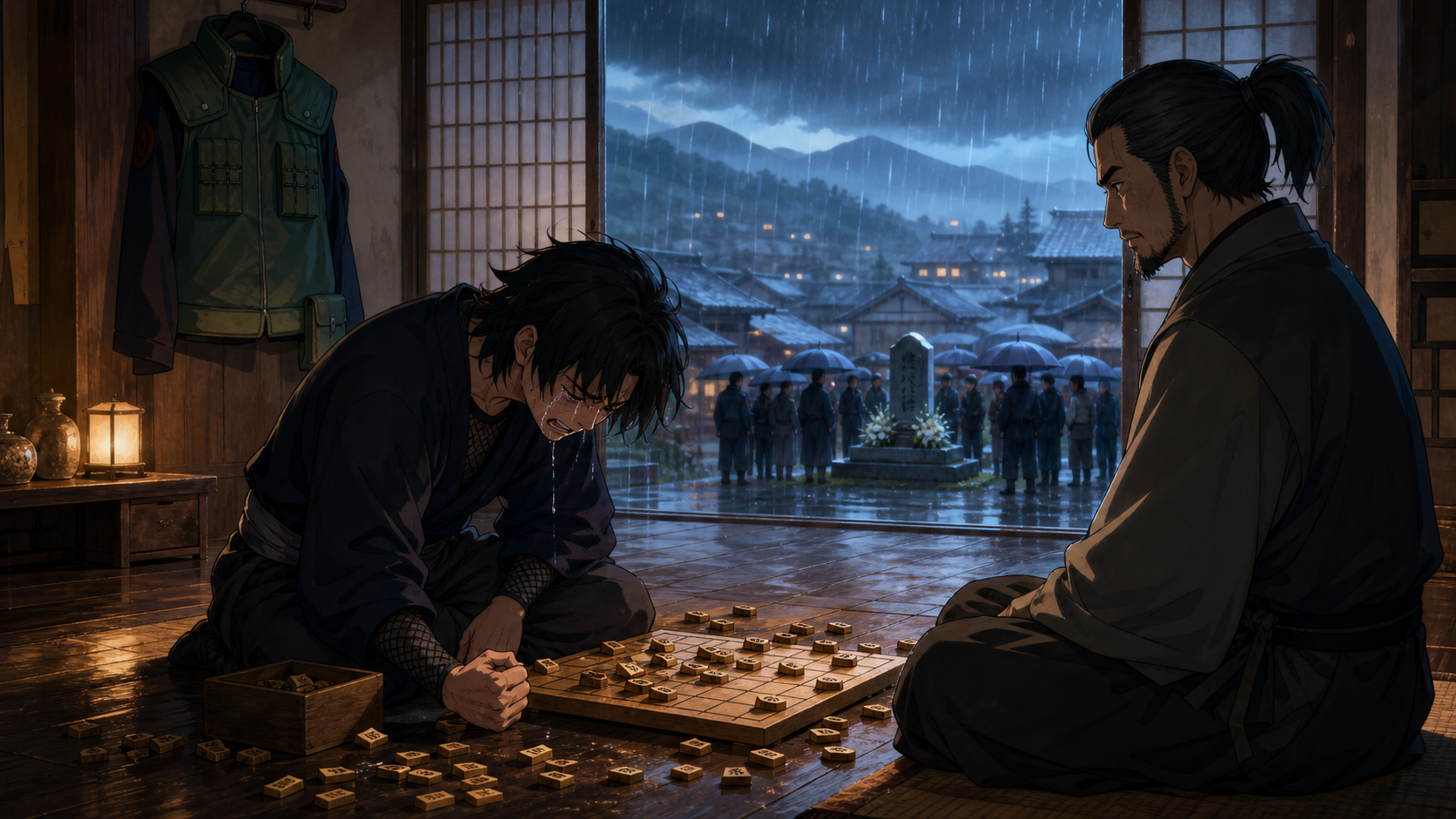
The village gathers to mourn Asuma while Shikamaru sits outside the ceremony, discovering that even his sharpest mind cannot calculate a way around grief.
The funeral gathers everyone except the person most visibly lost
Episode 82 holds Asuma's funeral in the Hidden Leaf beneath collective grief. Shinobi, friends, and family can stand together, acknowledge the death, and participate in the village's ritual of farewell.
Shikamaru is absent. His absence is not indifference or disrespect. He cannot yet place his grief inside a public ceremony where everyone can see it.
The empty space he leaves at the funeral reveals how completely the loss has disoriented him.
Grief does not follow the village schedule
A funeral gives mourning a time, place, and shared language. Personal grief rarely agrees to those boundaries.
Shikamaru has already reported the mission with painful precision. That administrative clarity did not make him emotionally ready to stand beside a memorial stone.
Knowing exactly what happened can sometimes make participation harder because no comforting ambiguity remains.
The shogi board becomes a place where control fails
Shikamaru returns to a game built from rules, positions, and consequences. Usually the board rewards his ability to see many moves ahead.
This time the pieces cannot protect him from the move that already occurred. There is no variation in which better analysis returns Asuma to the room.
The scattered board externalizes a mind that can organize battle but cannot organize bereavement.
Shikaku refuses to solve his son's pain for him
Shikaku understands that intelligence does not exempt Shikamaru from being young, angry, and devastated. He does not offer a slogan designed to end the conversation quickly.
Instead, he creates enough safety for Shikamaru to stop performing control. The father stays present while the son finally allows grief to become visible.
Support here means enduring the emotion rather than redirecting it.
Breaking down is movement, not defeat
Shikamaru's tears do not erase his strategic discipline. They release pressure that discipline had been forced to contain through the report, the return home, and every conversation afterward.
Grief held entirely inside can harden into paralysis. Expressing it does not finish mourning, but it lets the person experience loss instead of only analyzing it.
The breakdown becomes the first honest step toward choosing what comes next.
Team Ten exists even when its formation is incomplete
Ino and Choji attend the funeral while Shikamaru remains away. Their different responses do not fracture the team.
Each student carries Asuma through a separate temperament: care, loyalty, anger, memory, and the need to act. Team Ten cannot demand identical mourning without denying who its members are.
The bond survives by making room for those differences.
Asuma's lesson about the king changes meaning
Shogi once gave Asuma a language for responsibility. The most important piece was never the leader protecting personal status; it was the future embodied by the village's children.
After his death, that lesson becomes an inheritance Shikamaru can no longer treat as an abstract riddle.
Protecting the king will require him to move forward without the teacher who first explained the board.
Revenge and responsibility begin close together
Anger at Hidan and Kakuzu is unavoidable. The danger lies in allowing anger to define the whole mission.
Asuma's final words point Team Ten toward the people they must protect, not only the enemies they want to punish. That orientation can turn revenge into a disciplined objective with boundaries, allies, and an exit.
Grief supplies energy. Responsibility must decide its direction.
The village memorial and the private room need each other
The funeral affirms that Asuma belonged to a community. Shikamaru's private collapse affirms that the community's loss is also singular and intimate.
Neither space is more legitimate. Public ritual prevents isolation; private mourning allows emotions that ceremony cannot contain.
Together they show a person remembered by many and irreplaceable to each.
RaeRae's reaction
This is one of my favorite Shikamaru episodes because it lets his intelligence become useless for a while. He can solve Hidan's ritual, write the report, and understand every tactical error. None of that tells him how to live through Asuma's absence.
Shikaku's patience is the real intervention. He does not shame Shikamaru for missing the funeral or demand immediate strength. He waits until his son can finally fall apart safely.
The shogi pieces scatter, and for once that is the right move.
Team Ten reforms after accepting what cannot be restored
Episode 82 does not bring Asuma back or make grief orderly. It gives Shikamaru enough room to admit the loss before choosing how to answer it.
The funeral marks Asuma's place in the village. The conversation with Shikaku marks his place inside Shikamaru.
Team Ten will move again, but its next formation begins with the truth that one position will remain empty.
Official episode reference: Naruto Official episode guide
Licensed episode route: Crunchyroll licensed episode page
Shikamaru misses the funeral because public grief is not the only honest grief
The village gathers in rain, following a ritual meant to hold communal loss. Shikamaru cannot enter that space. His absence could look like withdrawal, but the episode refuses to punish him for mourning differently.
He has spent every hour since the battle being useful. He reported the mission, preserved intelligence, and answered questions. The funeral asks him to stop performing a task and simply feel what happened. That may be the demand he is least prepared to meet in front of other people.
Ino and Choji attend without becoming evidence against Shikamaru
Their presence at the memorial is not proof that they loved Asuma more or handled loss better. It reflects what they can bear and need at that moment. Grief does not create a ranking based on attendance.
Team Ten survives by allowing its members different routes toward the same absence. Forcing sameness would turn Asuma’s funeral into another performance instead of a place where each student can meet loss honestly.
The rain gives the village a shared atmosphere, not a shared experience
Everyone stands beneath the same weather, yet each person carries a different Asuma. Fellow jonin remember a colleague. Kurenai mourns a partner. Team Ten mourns the teacher who helped shape their childhood into vocation.
The visual unity is beautiful and misleading. Community can surround grief without making it identical. The episode keeps cutting toward private reactions because collective ceremony cannot contain every relationship.
Shikaku understands that his son’s intelligence has become a hiding place
Shikamaru can explain, predict, and organize. Those abilities let him remain composed while adults praise his maturity. Shikaku recognizes that competence may be postponing the part where his son admits he is devastated.
He does not confuse a coherent report with recovery. A parent who knows the child behind the reputation can see when intelligence is protecting everyone except the person using it.
The shogi game begins as familiar language between father and son
Shikaku does not open with a lecture about grief. He meets Shikamaru at the board, a place where they already know how to communicate through pressure, patience, and choices.
That familiarity creates enough safety for the conversation to become harder. Support does not always require inventing perfect words. Sometimes it begins with a ritual ordinary enough to let the hurting person stay in the room.
Scattering the pieces rejects the fantasy of one correct move
Shikamaru wants a board where better foresight could have saved Asuma. The pieces represent a system in which consequences can be calculated before commitment. Grief refuses that bargain.
When the board breaks apart, he is not abandoning intelligence. He is admitting that intelligence cannot rewrite the completed battle. The physical disorder finally matches what he has been containing internally.
Shikaku gives anger somewhere safe to land
He allows Shikamaru to shout, cry, and strike the board without retaliating or demanding respectability. The room becomes a container for feelings that would be dangerous if carried unexamined into the next Akatsuki mission.
This is active parenting. Shikaku does not solve the pain, but he stays close enough that his son can stop controlling it without becoming alone inside it.
Tears are not the opposite of strategic readiness
Shikamaru’s breakdown clears no tactical obstacle and revives nobody. It does something equally necessary: it reconnects his decisions to the person making them.
A strategist who buries grief may mistake compulsion for logic. Crying does not guarantee wisdom, but it makes the emotional stakes visible before he builds a plan around them.
The revenge plan begins after feeling, not instead of feeling
Shikamaru will pursue Hidan and Kakuzu. The episode makes space for grief first so the pursuit can become deliberate rather than a reflex desperate for relief.
He can now ask what Team Ten needs, what support the mission requires, and how Asuma’s intelligence should change the approach. Emotion remains present. It no longer has to disguise itself as pure strategy.
Asuma’s empty place changes the meaning of Team Ten
The title does not say former Team Ten. Ino, Shikamaru, and Choji still share a formation, history, and responsibility. Asuma’s death changes the team without canceling it.
His position becomes distributed across the people he trained and the adults who support them. The absence remains visible precisely because the team continues moving around it.
Kakashi’s support must respect the team’s ownership of its grief
An experienced jonin can help them confront Akatsuki without pretending to replace Asuma. The distinction matters. Team Ten needs tactical reinforcement, not a substitute father assigned before the funeral rain dries.
Kakashi understands carrying dead teammates into future missions. His best contribution will be protection, honest risk assessment, and room for Ino, Choji, and Shikamaru to remain the center of their own response.
Ino’s grief should shape the plan even if she is not the lead strategist
She knows her teammates’ emotional state and can recognize when anger narrows their judgment. Her sensory and mind-based techniques also offer tactical possibilities against enemies whose bodies violate normal rules.
A plan worthy of Team Ten cannot treat Ino as support added after the important decisions. Her view of the people involved is part of the intelligence Shikamaru needs.
Choji’s gentleness is protection against revenge becoming cruelty
Choji wants Hidan stopped, but his compassion can preserve the difference between justice and enjoying harm. That difference matters when the target is someone whose behavior makes hatred easy.
Asuma did not ask Choji to become hard. The team should build around his strength without requiring him to imitate the enemy’s appetite for suffering.
The king is present at the funeral in more than one form
Kurenai’s unborn child gives Asuma’s shogi lesson immediate meaning. So do the young shinobi standing in rain, the students he protected, and every future child the village claims its missions serve.
Protecting the king means more than avenging a fallen guardian. It means ensuring grief does not consume the next generation while adults congratulate them for being strong.
The village should not romanticize young shinobi carrying adult loss
Shikamaru’s composure, Ino’s caretaking, and Choji’s loyalty can be praised until nobody notices they need help. Calling them resilient may become permission for institutions to move on.
Real support includes time, counseling, meals, altered duty, and adults willing to hear anger directed at the village itself. Heroic language cannot replace care.
Shikamaru’s mother and father offer different kinds of steadiness
Yoshino’s directness and Shikaku’s measured patience belong to the same household. Shikamaru needs people who will not be impressed into silence by his intelligence or frightened away by his anger.
Family can remind him that he existed before this mission and remains more than the strategist who failed to save Asuma. That identity matters when guilt tries to make one event the definition of a life.
Guilt will keep offering Shikamaru imaginary better moves
He can replay the pursuit, the blood, the circle, and the arrival of reinforcements forever. Each replay may invent a decision that seems obvious only because he now knows the result.
Post-battle analysis is necessary, but hindsight must not become prosecution. The team faced hidden abilities with limited information. Learning from that fact is different from pretending Shikamaru controlled every variable.
The funeral and shogi room form one complete farewell
The public ceremony acknowledges Asuma’s place in Konoha. The private collapse acknowledges his place inside Shikamaru. Neither can replace the other.
Together they resist two failures: reducing death to a village symbol and reducing grief to a solitary burden. Asuma belonged to a community and to specific people who will miss him in specific ways.
RaeRae’s full take
Shikaku sitting there while the board goes flying is parenting. He does not rush to save the pieces, defend the furniture, or make his son’s grief easier to look at. He makes sure Shikamaru does not have to be brilliant for one minute.
I love Ino and Choji for going to the funeral, and I love that the episode does not use them to shame Shikamaru for staying away. Three children lost the same teacher. They did not lose the same relationship or the same ability to stand in public rain.
The scattered shogi pieces are the first honest board Shikamaru has seen since the mission. Nothing is in place. There is no move that makes Asuma walk through the door. His father lets that truth hurt before asking him to decide anything else.
Team Ten is not complete, but it is still a team. The next mission has to carry Asuma’s lessons without turning his students into sacrifices offered to revenge.
The plan against Hidan should begin with what Team Ten learned
They know blood starts the danger, the ritual circle maintains the transfer, and displacement interrupts it. They also know damage alone cannot be trusted to stop Hidan and that Kakuzu can restore his partner’s function.
A revenge mission that ignores those facts would turn grief into repetition. Shikamaru should design the battlefield before contact, assign separate answers for each enemy, and prevent either Akatsuki member from choosing the conditions again.
Team Ten needs a mission objective larger than punishment
Stopping Hidan and Kakuzu protects future targets, denies Akatsuki bounty money, and preserves the intelligence Asuma died helping them obtain. Those goals matter even when anger is exhausted.
A mission built only around making Hidan suffer could lose direction the moment satisfaction fails to arrive. Protection gives the team a reason to survive its own success.
Shikamaru must tell Ino and Choji the whole plan
His intelligence does not grant him the right to decide alone how much risk his friends should carry. They lost Asuma too. They deserve the known dangers, contingencies, and chance to challenge assumptions.
Collaboration is especially important when grief may bias the strategist. Ino and Choji can notice what Shikamaru overlooks in himself, just as he notices tactical patterns for them.
Shikaku’s challenge is to support action without endorsing compulsion
He knows his son may need to confront Hidan in order to move forward. He also knows a brilliant plan can conceal a desperate wish not to return.
Parental support does not mean forbidding every dangerous choice or approving every determined one. It means asking whether Shikamaru has protected his teammates, accepted help, and imagined a life after the mission.
The broken board can be rebuilt without pretending nothing happened
Pieces can be gathered and arranged again. The next game will not erase the moment Shikamaru scattered them, and it should not. Repair can preserve evidence of rupture.
That is a useful model for Team Ten. They can reform, train, laugh, and take missions while still carrying the fact that their original formation broke. Healing is not restoration to an untouched state.
Asuma’s memory should remain larger than the coming fight
If every thought of him becomes a reason to kill Hidan, the enemy will occupy too much of Asuma’s legacy. Team Ten also inherited meals, patience, jokes, teaching, and the belief that each student’s nature held value.
Defeating Hidan may answer one consequence. Living those quieter lessons will answer Asuma across years.
The episode makes family part of shinobi readiness
Shikaku contributes no battlefield technique here. He helps Shikamaru reach the emotional clarity from which a safer strategy can emerge. That work belongs inside readiness even if mission reports cannot quantify it.
A village that depends on soldiers should value the homes, friendships, and care that help them return to themselves after violence. Otherwise it trains technique while abandoning the person expected to use it.
Episode 82 understands that a team does not survive by denying the empty position. It survives by learning how to move while the absence remains clearly visible. Ino and Choji stand at the funeral because public mourning is what they can do. Shikamaru sits at a shogi board because he needs a private room where control can finally fail. Shikaku does not compare those choices or demand a cleaner grief. He stays quietly. That simple act gives his son somewhere to place the anger before it becomes a mission plan. The next pursuit will need Shikamaru’s intelligence, Ino’s attention, Choji’s compassion, Kakashi’s experience, and a village willing to protect all of them. It will also need honesty about revenge. Wanting Hidan stopped is righteous. Wanting pain returned is human. Neither feeling should be allowed to spend Team Ten carelessly. Asuma taught them to recognize the king as the future they protect. His death does not change that answer. It makes the answer expensive. Team Ten honors him by returning from the next board together, carrying his lessons without offering another beloved life to prove they remember.
RaeRae checkpoint: Shikaku does not rescue Shikamaru from grief. He gives his son a room where grief can stop behaving, scatter every piece, and still find someone waiting beside it.
Receipts and official routes
- Licensed title and official account of Asuma’s funeral, Shikamaru’s absence, and Shikaku helping his son face grief: Naruto Official Site episode guide.
- Licensed episode title, number, and watch route: Crunchyroll.