
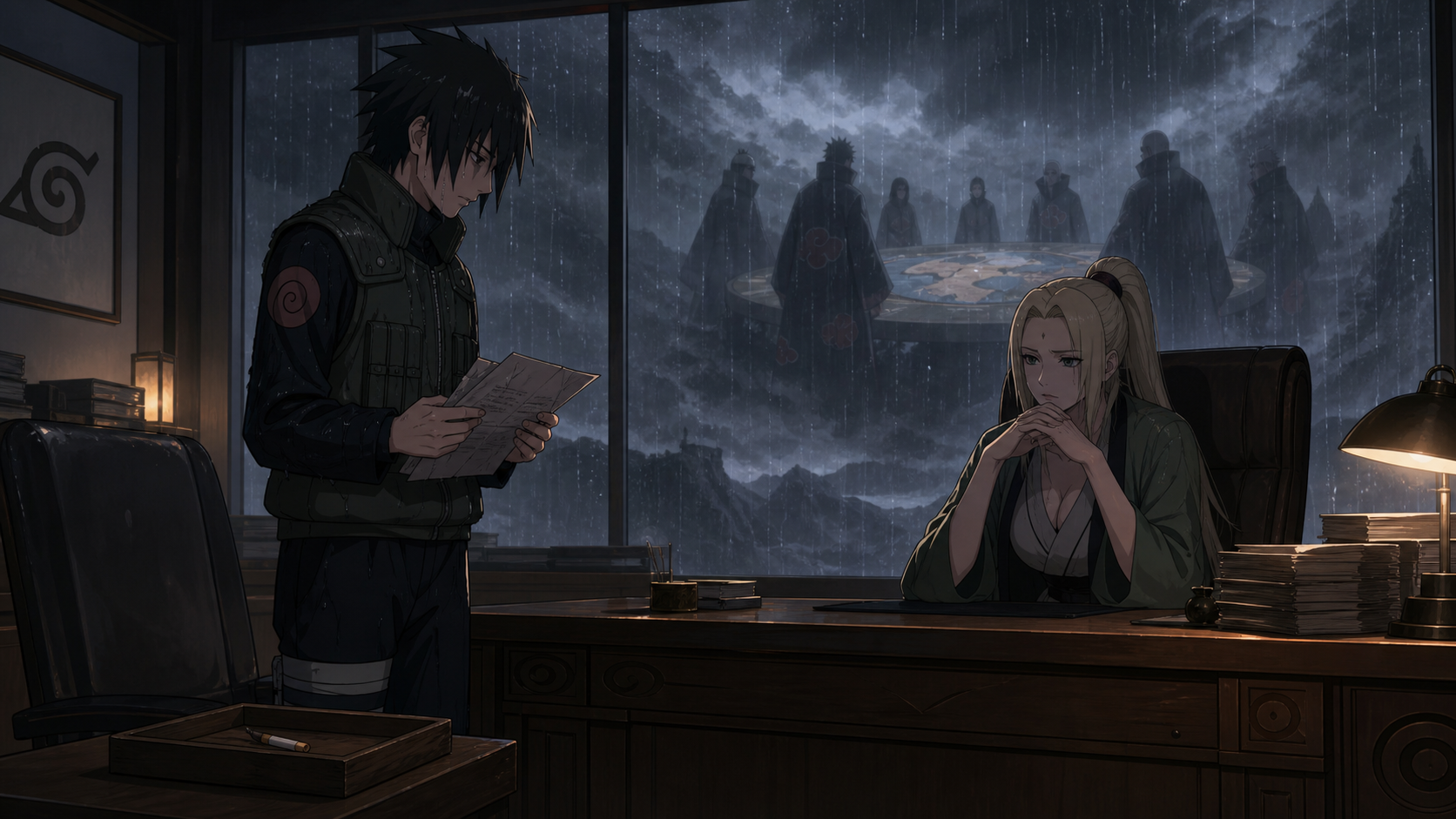
Sad News
Shikamaru turns the worst mission of his life into a precise report while Akatsuki discusses ambitions large enough to make one village’s grief look incidental.
Shikamaru has to convert loss into a report
Episode 81 brings Shikamaru back to Konoha with a responsibility that feels cruelly ordinary. He must explain the mission to Tsunade in sequence: what the squad knew, what Hidan's ritual required, how Kakuzu intervened, and where Asuma was lost.
A report demands clarity at the moment grief makes every fact personal. The institution needs information, while the student is still trying to understand the absence behind it.
Shikamaru cannot postpone one task until the other is complete.
Tsunade listens as commander and mourner
As Hokage, Tsunade must extract intelligence that can protect the next team. She needs the Akatsuki pair's abilities, habits, vulnerabilities, and likely route.
As someone who sent Asuma into the operation, she also receives the human cost of her command. Leadership does not permit her to treat the death as private, even when it hurts personally.
Controlled attention becomes a form of respect for both the report and the person missing from it.
Facts preserve what shock tries to blur
Trauma can make a battle feel like disconnected images: a scythe, a circle, a shadow, an attack arriving in the wrong body. Reporting forces those images back into cause and effect.
That reconstruction matters beyond intelligence. It keeps Asuma's death from becoming an incomprehensible catastrophe inside Shikamaru's memory.
Naming what happened is not closure, but it gives grief a truthful foundation.
Akatsuki reveals ambition on a different scale
Far from Konoha's mourning, the organization discusses an aim that reaches beyond collecting targets or earning money. World conquest reframes individual attacks as components of a larger system.
The Fire Temple, Asuma's squad, and the hunt for tailed beasts are not isolated episodes of violence. They supply resources, fear, and leverage for a project designed to reshape political power.
Local grief is connected to an international threat whether the mourners asked for that scale or not.
Distance protects Akatsuki from the meaning of its actions
The organization can speak abstractly about conquest because its members are not present in Tsunade's office. They do not see the empty chair beside Shikamaru or hear a mission report pause around a mentor's name.
That separation supports their ideology. People become pieces of a plan when consequences remain far away and unnamed.
The episode closes that distance for the audience even while the characters occupy different places.
Shikamaru's intelligence cannot solve bereavement
He can identify Hidan's ritual conditions and explain Kakuzu's intervention. He cannot calculate a move that restores Asuma.
This is a brutal limit for someone accustomed to finding hidden structure. Grief has patterns, but it is not a puzzle with a winning line.
Shikamaru's next growth will require living with knowledge that does not grant control.
The report becomes part of Konoha's defense
Every precise detail Shikamaru provides reduces the secrecy that made Hidan and Kakuzu so dangerous. Future teams can understand that blood initiates the ritual, the circle maintains it, and immortality does not equal unrestricted movement.
Asuma's final mission therefore continues to protect people through the information his team brings home.
The lesson is costly, but refusing to preserve it would make the cost larger.
Sad news changes differently for every listener
Tsunade receives the death as commander. Team Ten receives it as family. Kurenai will receive it through a relationship the mission report cannot summarize. The village will receive it as the loss of a respected jonin.
One fact produces many forms of grief because no person occupies only one role.
The title's simplicity respects that the news does not need decoration to alter a life.
Silence in the office carries Asuma's presence
An empty chair, an unlit cigarette, and the pause after a name can communicate what exposition cannot. The objects remain ordinary while their context changes permanently.
Asuma is absent from the room, yet the report is structured around decisions he made and people he protected.
Absence becomes a kind of presence because everyone must now act around its shape.
RaeRae's reaction
I appreciate that Shikamaru is not allowed to disappear into a dramatic revenge speech immediately. He has to sit with Tsunade and do the administrative work of telling the truth.
That task feels painfully adult. His intelligence makes him the person best equipped to report the mission, even though being accurate means revisiting every moment that failed to save Asuma.
The Akatsuki council makes the contrast colder: they discuss the world while Konoha is trying to account for one irreplaceable life.
Information moves forward before grief is ready
Episode 81 places strategic revelation beside personal aftermath. Akatsuki names a global ambition, while Shikamaru gives Tsunade the local evidence of what that ambition costs.
The report will help Konoha prepare. It will not make Shikamaru prepared for the empty spaces waiting outside the Hokage's office.
Sad news becomes intelligence, and intelligence becomes responsibility, long before grief agrees to become anything else.
Official episode reference: Naruto Official episode guide
Licensed episode route: Crunchyroll licensed episode page
The mission report asks Shikamaru to speak before he can process
Shikamaru returns carrying facts the village urgently needs and grief he has barely had time to name. The two burdens cannot be separated neatly. Every detail about Hidan’s circle is also a detail about how Asuma was hurt.
Reporting requires him to revisit the sequence without the protection of action. On the battlefield, observation led to a counter. In Tsunade’s office, observation leads only to understanding. The absence of a move makes accuracy feel heavier.
Tsunade must receive the report without turning Shikamaru into a tool
The Hokage needs a complete account because Hidan and Kakuzu remain active threats. She also has a grieving young shinobi in front of her. Pressing for detail without recognizing his condition would repeat the organization’s habit of treating people as resources.
Good command makes room for pauses, verifies what the witness can remember, and distinguishes uncertainty from failure. Shikamaru’s report should protect future teams without requiring him to perform emotional invulnerability.
Asuma’s death becomes institutional knowledge through painful precision
The team can now identify blood as the ritual’s entry point, the ground symbol as its boundary, and displacement as a counter. They know Hidan survives catastrophic injury and that Kakuzu can restore his partner’s function.
Those facts belong in briefings, mission planning, and medical protocols. Intelligence honors the dead when it changes what the living do. A report filed and forgotten would turn Asuma’s experience into paperwork rather than protection.
Kurenai receives news no mission summary can contain
The official consequences reach far beyond the squad. Kurenai loses the person with whom she expected to build a family, and the child she carries will inherit stories instead of memories made together.
No commander can deliver that news in a way that makes it acceptable. The village’s responsibility begins after the announcement, when practical support, companionship, and truthful remembrance must continue beyond the first wave of sympathy.
Team Ten needs permission to grieve outside its assigned roles
Ino should not be required to hold everyone together immediately. Choji should not be judged by how openly he cries. Shikamaru should not be mistaken for stable simply because he can produce a coherent report.
Their familiar team functions may become hiding places. Recovery requires people around them to notice when competence is covering pain and when loyalty is turning into self-neglect.
Shikamaru’s silence at home is different from his silence in the office
With Tsunade, silence is a pause inside duty. At home, it can become the place where everything he controlled finally reaches him. The strategist does not stop grieving because the official account is complete.
His parents will matter because they know the child underneath the promotion, rank, and reputation. A village can praise Shikamaru’s composure while his family recognizes that composure is costing him something.
Akatsuki’s meeting turns murder into policy
The members do not discuss Asuma as a person. Their conversation moves toward money, military power, tailed beasts, and control of conflict itself. Individual deaths become inputs inside an organizational plan.
That scale is frightening because it explains why cruelty keeps appearing in different countries. The group is not merely collecting dangerous personalities. It is building a system that expects instability to become profitable and dependence to become authority.
Pain’s plan imitates the structures he claims to replace
Akatsuki proposes using overwhelming force to dominate the market for war, then turning that dominance toward the nations that relied on it. The language promises transformation while reproducing exploitation.
A plan cannot become liberating merely because its architect has suffered under the current order. If ordinary people remain expendable, changing who controls violence does not change what violence does to them.
Kakuzu’s obsession with money fits the organization’s first stage
Kakuzu treats bounties as practical value, and Akatsuki’s strategy needs funding before it can claim larger power. His personal greed and the group’s institutional ambition reinforce each other.
The Fire Temple attack therefore connects directly to the meeting. Chiriku and Asuma were not random obstacles. Their bodies entered an economy that finances the organization discussing how to control every future battlefield.
The tailed beasts are discussed as weapons while Naruto remains a person
Akatsuki’s abstraction converts jinchuriki into containers whose power can be extracted and deployed. The meeting talks about military balance without acknowledging the lives inside that balance.
Naruto is training, failing, improving, and worrying about people. That ordinary humanity is the argument the organization refuses to hear. A vessel is easier to sacrifice than a boy with teachers, teammates, and a home.
Sad news travels unevenly through a village
Officials receive reports. Family receives a visit. Teammates encounter an empty meeting place. Friends hear a name followed by a past tense that does not feel possible yet.
The title is plain because grief often arrives through plain language. No elaborate phrase changes the fact. The news becomes different in every life it enters, and Konoha will keep discovering the size of Asuma’s absence.
The empty chair reveals what administration cannot record
A mission file can list one casualty and several survivors. It cannot show who used to occupy the space beside Shikamaru or how many future conversations will begin with an instinct to ask Asuma.
Objects carry relational evidence. The chair, cigarette, shogi board, and familiar routes through the village become reminders because a person repeatedly gave them meaning.
Naruto should learn about Asuma as more than a fallen jonin
Asuma helped Naruto understand Wind Style by making chakra nature tangible. That lesson now belongs inside Naruto’s most ambitious technique. The connection is brief but real.
When Naruto receives the news, adults should not use it only to motivate harder training. He deserves to grieve the teacher who offered help, and to understand what Team Ten lost before the village turns Asuma into a symbol.
Information about Hidan must include the conditions that saved lives
“Immortal” is memorable and dangerously incomplete. The report should state that Hidan needs a target’s blood, consumes it, transforms, occupies a marked circle, and transfers self-inflicted damage while the link remains active.
It should also explain that removing him from the circle interrupted the transfer. Countermeasures belong beside threat descriptions. Fear warns people. Procedure helps them survive.
Kakuzu remains the larger unknown
The Leaf learned that he can retrieve and reattach Hidan’s head, but his own body and techniques remain mostly concealed. The next pursuit cannot assume he is merely support.
Shikamaru should flag every observation without forcing a theory: unusual strength, composure under pressure, financial motive, and the ability to handle injuries that should be impossible. Honest uncertainty is part of good intelligence.
The next mission must not become revenge disguised as strategy
Team Ten will want to finish what began in the clearing. That desire is understandable, but command has to separate useful motivation from dangerous compulsion.
A pursuit should include appropriate support, medical preparation, a plan for both Akatsuki members, and clear withdrawal conditions. Honoring Asuma cannot mean sending his students into the same trap with grief narrowing their attention.
Shikamaru’s report is already leadership
Leadership is not only issuing commands during a fight. It is preserving what the team learned, admitting what remains unknown, and making the cost legible to people who decide the next action.
Shikamaru does this work while hurting. That does not make the pain useful or necessary. It shows that responsibility can coexist with vulnerability, and that the village should support both.
RaeRae’s full take
I hate that Shikamaru has to turn the worst moments of his life into sentences clean enough for a mission record. He can explain the blood, the circle, the shadow, and Kakuzu’s intervention. He cannot explain how the world kept moving after Asuma stopped.
Tsunade has to hear two reports at once. One is tactical intelligence about an Akatsuki pair. The other is a young man saying, in the only language the office officially requires, that his teacher did not come home.
Then Akatsuki starts talking about world power as if the bodies funding that conversation never belonged to anybody. That contrast is the episode’s moral center. Their scale is enormous because their attention to human life is so small.
Sad news is not a plot bridge. It is a responsibility distributed across everyone who hears it. What Konoha does for Team Ten and Kurenai will tell us whether the village’s talk about protecting the next generation means anything after the funeral.
A complete report should name the limits of certainty
Shikamaru knows what interrupted Hidan’s ritual during one encounter. He does not yet know whether a different circle, another sample of blood, or additional preparation could alter the rule. The distinction between observed fact and reasonable inference must remain visible.
That caution does not weaken the report. It prevents confidence from becoming another vulnerability. Future squads can act on the known counter while remaining alert to variations instead of assuming one success explained the entire technique.
Tsunade’s next order will reveal how command values grief
She could treat Team Ten as damaged assets to be replaced, furious soldiers to be unleashed, or young people who deserve support while participating in a careful response. Only the third choice respects both their ability and their loss.
Rest should not become exclusion, and duty should not become punishment. Tsunade needs to involve them honestly in planning, explain risk, and ensure that the desire to face Hidan does not erase their right to survive him.
Kurenai should hear Asuma’s last care without inheriting a polished myth
Team Ten can tell her what he said, how he fought, and how he kept thinking about the people around him. They should also be allowed to remember his impatience, humor, bad habits, and ordinary contradictions.
A child deserves a father who feels human in memory, not a flawless village statue. Honest stories create a relationship across absence more durable than ceremonial praise.
Akatsuki’s abstraction is a warning about language
Words like assets, vessels, markets, and deterrence can hide the people being harmed. The organization’s plan sounds strategic because it removes faces from every sentence.
Konoha is not automatically innocent of the same habit. Mission ranks, casualty counts, and military necessity can also flatten lives. Shikamaru’s presence in the office forces administration to encounter the person inside its report.
The village’s intelligence network must share this beyond one desk
Hidan and Kakuzu cross borders, target bounties, and participate in a larger collection effort. The report should reach trackers, gate teams, medics, allied villages, and anyone protecting a jinchuriki.
Information trapped inside Konoha would preserve institutional pride at the expense of lives elsewhere. Akatsuki operates internationally, so counterintelligence has to move faster than political suspicion.
Shikamaru’s parents can offer what the Hokage’s office cannot
Tsunade can validate the report and direct resources. Shikaku and Yoshino can recognize when their son needs food, quiet, confrontation, or permission to stop being useful for an evening.
Recovery requires both public systems and intimate knowledge. The smartest shinobi in the room may still need somebody to sit beside him without requesting an answer.
Sad news becomes dangerous when everyone rushes to make it meaningful
Asuma’s death will influence choices, but nobody should tell Team Ten that loss happened so they could grow. Growth may follow because people keep living. It does not justify the violence or make the timing necessary.
The episode earns its seriousness by allowing the death to remain wrong. Meaning belongs to what the survivors choose afterward, not to a universe demanding payment for character development.
Episode 81 understands that information does not become less personal when it enters a room. Shikamaru can describe every condition and still hear Asuma inside each sentence. Tsunade can turn those details into orders and still mourn the man behind the casualty line. That double responsibility is what separates protection from administration performed at a distance. Akatsuki speaks about nations, markets, and weapons because abstraction makes cruelty easier to organize. Konoha has to answer by keeping people visible inside strategy. The report matters because another squad may survive. The grieving witness matters even when his usefulness pauses. Team Ten matters beyond the revenge its knowledge could enable. Kurenai and her child matter beyond the symbolism others may assign them. Sad news moves forward, but nobody should hurry the people carrying it. The village proves its values through what happens after the office understands the facts and the room becomes painfully quiet.
RaeRae checkpoint: Shikamaru gives Tsunade the facts that may save the next squad. The village owes him more than praise for staying coherent while every fact carries Asuma’s absence inside it.
Receipts and official routes
- Licensed title and official account of Shikamaru reporting to Tsunade while Akatsuki reveals ambitions extending toward world conquest: Naruto Official Site episode guide.
- Licensed episode title, number, and watch route: Crunchyroll.