
Robbed of Sleep
The untouched offerings prove the thieves came for the dead themselves.
The mission begins with an empty grave and the wrong kind of theft
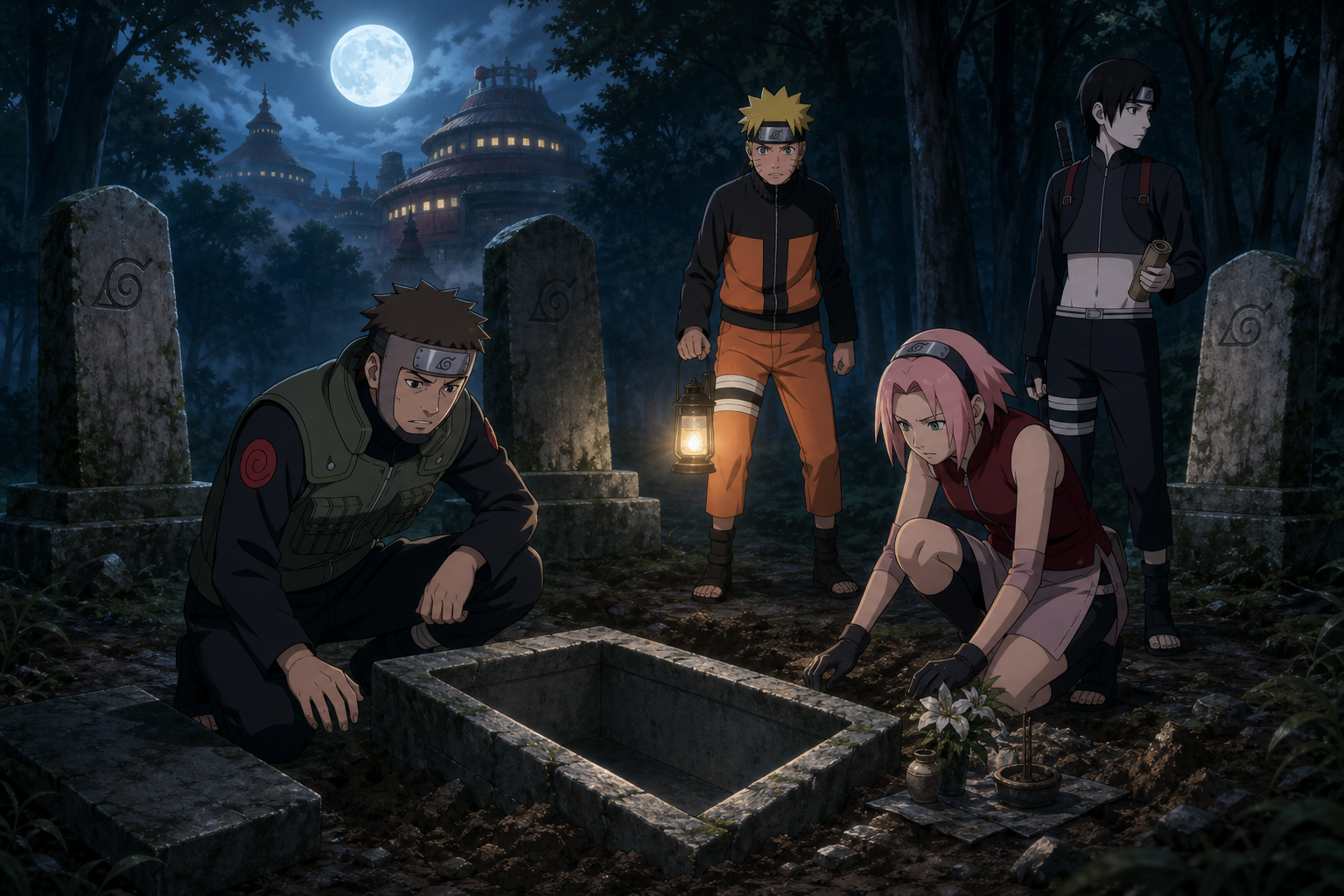
Episode 57 sends Team Kakashi to investigate repeated grave vandalism near the Fire Temple. The first assumption is ordinary robbery. Burial sites hold offerings, valuables, and objects a thief might sell.
The evidence does not support that answer. Possessions remain while the graves themselves have been disturbed. Yamato identifies the more frightening possibility: the intruders want the bodies of the ninja buried in four hidden tombs.
An empty grave changes the mission from property crime to preparation. Someone is collecting the dead for a purpose that has not yet been revealed.
Yamato reads what the thieves chose not to take
Good investigation depends on absence. The team can see disturbed soil and opened stone, but the intact offerings matter just as much. They show that profit was not the motive.
Yamato's conclusion is valuable because he does not wait for the perpetrators to announce themselves. He compares the expected behavior of grave robbers with the actual scene and follows the contradiction.
That method gives Team Kakashi a different kind of leadership than Naruto's instinctive pursuit. Before action, Yamato establishes what the evidence permits them to believe.
The four hidden tombs turn history into a target
These are not random burial sites. The hidden tombs contain shinobi whose significance extends beyond death. Whoever seeks the bodies understands that history can be weaponized.
Graves usually establish a boundary. The living remember; the dead are allowed to rest. Violating that boundary treats a person's remains as equipment and their legacy as a resource to seize.
The mission therefore carries both tactical and moral urgency. Team Kakashi is not only preventing theft. It is protecting the dead from being forced into another conflict.
The Fire Temple expands the world beyond village walls
The setting introduces a religious institution with its own history, protectors, and relationship to the Land of Fire. The Leaf is important, but it is not the only community carrying political and spiritual weight.
That broader geography matters after an arc centered so tightly on Sasuke. Naruto's personal promise remains unresolved, yet the world continues producing obligations that do not revolve around him.
The Fire Temple mission asks Team Kakashi to protect people and history they did not personally choose. That is part of becoming responsible shinobi rather than a group organized around one private loss.
Naruto enters the mission while training is still unfinished
Naruto has only begun learning wind transformation. The leaf exercise has given him a direction, not a reliable battlefield technique. Leaving the training ground tests whether he can carry the discipline into a real assignment without pretending he has already mastered it.
This is important after the Tenchi Bridge. Naruto's urgency around Sasuke encouraged him to reach for power beyond his control. The new mission offers a chance to practice restraint and observation before force becomes necessary.
Progress should appear in decisions, not only in a new attack.
Sakura's medical eye supports the investigation
Sakura understands bodies differently from the rest of the team. A grave containing a shinobi is not simply an object of reverence; it holds physical evidence of ability, injury, and identity.
That knowledge makes the theft especially disturbing. A body can reveal secrets, supply material for forbidden techniques, or become a tool in someone else's hands. Sakura does not need to see gore to recognize the stakes.
Her careful attention to disturbed earth and preserved offerings complements Yamato's strategic inference. Investigation becomes team work rather than a single dramatic deduction.
Sai watches the perimeter of a team he has chosen to join
Sai's role changes quietly in this mission. He is no longer the secret Team Kakashi is chasing. He is part of the group scanning for danger, sharing information, and protecting the same objective.
That does not erase his Root history, but it gives his new loyalty practical form. Trust grows through ordinary assignments as much as decisive betrayals. Watching the tree line and keeping an ink scroll ready are small acts of participation.
Sai is learning that belonging can mean responsibility to people who are not targets or handlers.
“Robbed of Sleep” describes more than disturbed graves
The dead have been denied rest, but the title also follows Naruto from the previous episode's nightmare. Sleep remains unstable because unresolved danger crosses boundaries that should be safe.
Naruto's room could not keep Sasuke and the Nine-Tails out of his mind. The hidden tombs cannot keep the thieves out of the dead. Both situations turn rest into vulnerability.
The parallel gives the new arc an uneasy foundation. Something is moving through spaces meant to be closed.
The missing corpses imply planning rather than vandalism
Removing a shinobi's body from a concealed tomb requires information, tools, transport, and a reason to accept the risk. The crime is organized.
That means Team Kakashi should not look only for whoever touched the grave. They need to ask who knew the tomb existed, why these particular dead matter, and what larger operation requires all four.
The scene is a starting point in a chain of decisions. Treating it as random damage would leave the plan intact.
RaeRae's reaction
An empty tomb is so much creepier than stolen jewelry. The untouched offerings tell the team that the intruders came for one precise thing, and that thing used to be a person.
I like Yamato arriving at the conclusion through evidence instead of supernatural intuition. He notices what a normal thief would have taken and recognizes that the absence changes the category of crime.
The mission also gives Team Kakashi a useful reset. Naruto is still carrying the failed reunion, Sai is still learning how to belong, and Sakura is still recovering from being injured. They now have to function together around a threat that does not wait for those emotional threads to resolve.
Protecting rest becomes the first obligation of the arc
Episode 57 establishes the Guardian Shinobi Twelve story through desecration rather than spectacle. Four hidden tombs connect the present mission to an older conflict, and the missing remains suggest someone intends to make that history move again.
Team Kakashi begins with limited information but a clear responsibility. The dead cannot defend their own boundaries. The living must understand why those boundaries were broken before another grave is emptied.
The title makes the violation personal: rest has been stolen, and the mission is now chasing whoever believes even death should remain useful.
Official episode reference: Naruto Official episode guide
Licensed episode route: Crunchyroll licensed episode page
Grave robbery becomes body theft the moment the offerings stay put
The scene refuses the comfortable explanation. A thief motivated by money would take the valuables and leave the body. Here, the valuables remain while the person is gone. That reversal tells Team Kakashi the desecration is not careless destruction. Somebody arrived with a list, a destination, and enough confidence to remove exactly what they wanted.
That specificity makes the crime colder. The dead shinobi has been reduced to a component in somebody else’s plan. The missing body is not collateral damage. It is the objective.
Yamato earns his authority by letting the evidence change the question.
The title names a violation that death was supposed to end
“Robbed of Sleep” sounds gentle until the episode shows what it means. Eternal rest is not poetic decoration here. It is the final boundary that should protect a person from orders, weapons, politics, and exploitation.
Someone has crossed that boundary because shinobi society keeps finding uses for human bodies. Bloodlines can be studied. Techniques can be stolen. Corpses can become intelligence, leverage, or weapons. Death does not automatically stop the system from claiming more labor.
The horror comes from recognition, not surprise. Everybody knows enough forbidden history to understand why an intact shinobi body has value.
Team Kakashi has to investigate before Naruto can punch the problem
Naruto’s instinct is movement. Once danger has a direction, he wants to chase it. This mission begins before the team possesses that direction. They have disturbed ground, untouched offerings, missing remains, and four locations that may be connected.
Rushing toward the first suspicious figure could expose the remaining tombs or push the thieves into changing their route. Patience is therefore active work. The team must compare scenes, protect what remains, and identify the pattern without announcing how much they know.
That restraint continues Naruto’s wind training in a less obvious form. Precision begins with choosing the right target.
Yamato’s calm does not make the discovery less appalling
Yamato delivers his conclusion without theatrical panic. That steadiness keeps the team useful, but viewers should not mistake controlled speech for emotional neutrality. He understands exactly what kind of preparation corpse theft can support.
Good leadership holds two truths at once: the violation is severe, and the people investigating it need enough calm to think. Yamato does not soften the facts. He gives them an order the team can act on.
That is a sharp contrast with institutions that hide frightening information and call secrecy protection.
Sakura’s medical knowledge makes the stolen bodies impossible to call objects
Sakura has trained to preserve bodies, read injuries, and keep people alive. She knows how much history physical remains can hold. Scars record battles. Tissue can reveal poisons, bloodlines, treatments, and techniques. A trained shinobi’s body carries information even after speech ends.
That knowledge deepens the ethical wound. Medical skill should protect bodily integrity and consent. The thieves treat the same body as accessible material because its owner can no longer refuse.
Sakura’s presence keeps the mission connected to care rather than only village security.
Sai understands what it means to be valued for usefulness alone
Root taught Sai to detach identity from function. A person completed a task, became a tool, and disappeared into the institution’s needs. The stolen corpses extend that logic past death: usefulness remains, so personhood is ignored.
Sai may not narrate that parallel, but it belongs around him. His new team is trying to recover and protect people whom the thieves see as assets. That mission quietly argues against everything Root normalized.
Belonging gives Sai a reason to defend the boundary between a human being and a usable thing.
The Fire Temple carries memory outside the Hidden Leaf’s control
The temple preserves its own dead, traditions, and account of the Land of Fire’s conflicts. Konoha cannot act as though every meaningful history begins inside village walls. The monks have authority over their sacred space and grief.
Team Kakashi arrives as support, not ownership. Their job is to listen to the people responsible for the tombs, combine that knowledge with shinobi investigation, and protect the remaining sites.
Respect matters because institutions often become most possessive when danger makes cooperation necessary.
Four tombs mean the thieves are assembling a set
One missing body might suggest a personal grudge or a single desired technique. Four hidden tombs point toward a coordinated collection. The number makes sequence important: which grave came first, which remain untouched, and what do the buried shinobi share?
A set also implies an intended arrangement. The thieves may need the bodies together, may assign each one a role, or may be rebuilding a structure connected to an older conflict.
The mission becomes a race against completion even before Team Kakashi understands what completion will produce.
Naruto is carrying a nightmare into a mission about stolen rest
The transition from his dream to the violated tombs is doing real thematic work. Naruto wakes from a vision in which Sasuke refuses him and the Nine-Tails offers power through possession. He then confronts bodies taken from the only rest no enemy should interrupt.
Both stories ask who controls a body. Naruto fears losing his to the fox. The dead shinobi have already lost theirs to thieves. Power becomes horrifying when it requires the person to disappear.
Wind training matters because it offers Naruto strength built through conscious control rather than surrender.
An unfinished technique should not become an excuse to abandon basic judgment
Naruto does not need a completed wind attack to contribute. He can observe tracks, protect teammates, question assumptions, and follow Yamato’s plan. The series sometimes makes new techniques feel like the only visible proof of growth. This assignment offers more ordinary measurements.
Can Naruto wait when waiting protects evidence? Can he hear Sakura or Sai before charging? Can he separate urgency from the demand to perform heroism immediately?
Those decisions determine whether future power will serve the team or merely make Naruto louder.
The episode treats absence as evidence instead of empty space
The body is missing. The valuables are not. The thieves are gone. None of those absences leaves the team with nothing. Each one limits the possible explanations.
This investigative rhythm asks viewers to notice negative space. What should be present? What would an ordinary criminal remove? What has been preserved too carefully to be accidental?
The answers build tension without requiring a villain to stand beside the grave and explain the scheme.
Protecting the remaining tombs requires refusing the easiest bait
If the thieves expect pursuit, they can use the stolen body or obvious trail to draw Team Kakashi away from the next target. A sensible response must divide attention without scattering the team into isolated victims.
That challenge tests Yamato’s planning and the team’s communication. Every member needs to know the priority, the regrouping point, and what information justifies changing course.
A mission built around hidden sites punishes assumptions that everybody can simply follow the loudest person.
Desecration turns an old political conflict into a present personal wound
The buried shinobi belonged to history, but the graves belong to living communities. Monks maintained them. People remembered them. Their removal creates new grief rather than merely reopening an archived event.
That is how political violence survives. Institutions may label a conflict finished while families and caretakers continue carrying its dead. When someone weaponizes those remains, the past returns through bodies the present failed to protect.
The arc earns its stakes when it treats that grief as more than plot machinery.
The villains’ method depends on the belief that power outranks consent
Corpse theft is an extreme version of a familiar shinobi-world habit. Villages recruit children, seal beings inside bodies, harvest techniques, and praise sacrifice when institutions benefit. The thieves are not inventing the idea that power can justify taking a person.
They are removing the polite language. A dead shinobi cannot consent, so they proceed as though consent no longer matters.
Team Kakashi’s response should defend more than strategic secrets. It should defend the principle that usefulness never erases personhood.
Teamwork begins with agreeing about what the evidence means
Naruto, Sakura, Sai, and Yamato cannot protect four sites effectively if each person is solving a different crime. The intact offerings give them a shared premise: the bodies are the targets.
That agreement narrows their choices and makes communication useful. A footprint, transport route, or witness report can now be judged against the same theory instead of becoming four unrelated clues.
Teams do not become coordinated merely by standing together. They become coordinated when information changes everybody’s next decision.
The tomb keepers deserve answers that do not turn grief into classified property
Shinobi institutions love secrecy, especially when a threat involves forbidden techniques or old political conflicts. The monks maintaining these graves still deserve to know what happened, what remains at risk, and how the Leaf intends to protect the other sites.
Withholding every detail would reproduce the same disrespect as treating the tombs like strategic storage. The community responsible for the dead is part of the response.
Security can limit operational details without erasing the people living with the consequences.
A stolen body creates urgency without granting permission for reckless pursuit
Every hour may bring the thieves closer to the next grave or to whatever ritual requires the remains. That pressure is real. It still does not make the first available trail trustworthy.
Naruto must learn that speed and haste are not synonyms. Speed follows a sound decision quickly. Haste moves before the decision exists and lets an enemy choose the destination.
The episode’s quiet investigation is therefore preparation for action right now, not a delay imposed on it.
RaeRae’s full take
I love a mystery that lets one untouched object do more work than a giant speech. The offerings are still there. That single fact tells Yamato this is not robbery in the ordinary sense, and suddenly an open grave becomes the beginning of a planned operation.
The title is vicious once you sit with it. Shinobi spend their lives being used by villages, clans, enemies, and promises. These four were supposed to be beyond assignment. Somebody looked at eternal rest and saw wasted resources.
Naruto needs this mission right now because his own nightmare was about control. Sasuke remained unreachable, and the Nine-Tails offered strength by swallowing Naruto’s agency. The stolen bodies show the endpoint of power that stops caring whether a person is present inside it.
I also need Sakura and Sai to matter here. Sakura understands bodily integrity through healing. Sai understands institutional dehumanization through Root. Both perspectives belong beside Yamato’s deduction and Naruto’s urgency.
The episode does not need an explosion to establish danger. It gives us empty earth, preserved offerings, and the sick certainty that somebody came prepared. That is enough. The dead have been drafted again, and Team Kakashi is already behind whoever issued the order.
RaeRae checkpoint: The valuables were left behind because the thieves decided the person was the valuable. That is not clever grave robbery. It is the shinobi world’s ugliest habit stripped of ceremony: power first, personhood never.
Receipts and official routes
- Episode number, Japanese title, grave investigation, hidden-tomb premise, and official placement: Naruto Official Site episode guide.
- Licensed title and episode route: Crunchyroll.