
Squirming
Naruto learns that wind becomes dangerous through precision, not volume.
Knowing the element makes Naruto push harder
Episode 56 begins with Naruto energized by the discovery that his chakra nature is wind. Kakashi explains that wind is especially effective in close combat because it can create a sharp cutting edge. Naruto immediately treats that information as proof he has found the route to catch Sasuke.
The enthusiasm is familiar. What changes is the task in front of him. Naruto cannot unlock wind nature through a single burst of emotion. He has to shape chakra finely enough to split a leaf.
For once, progress depends less on how much force he can produce and more on how precisely he can direct it.
The leaf refuses to respond to determination alone
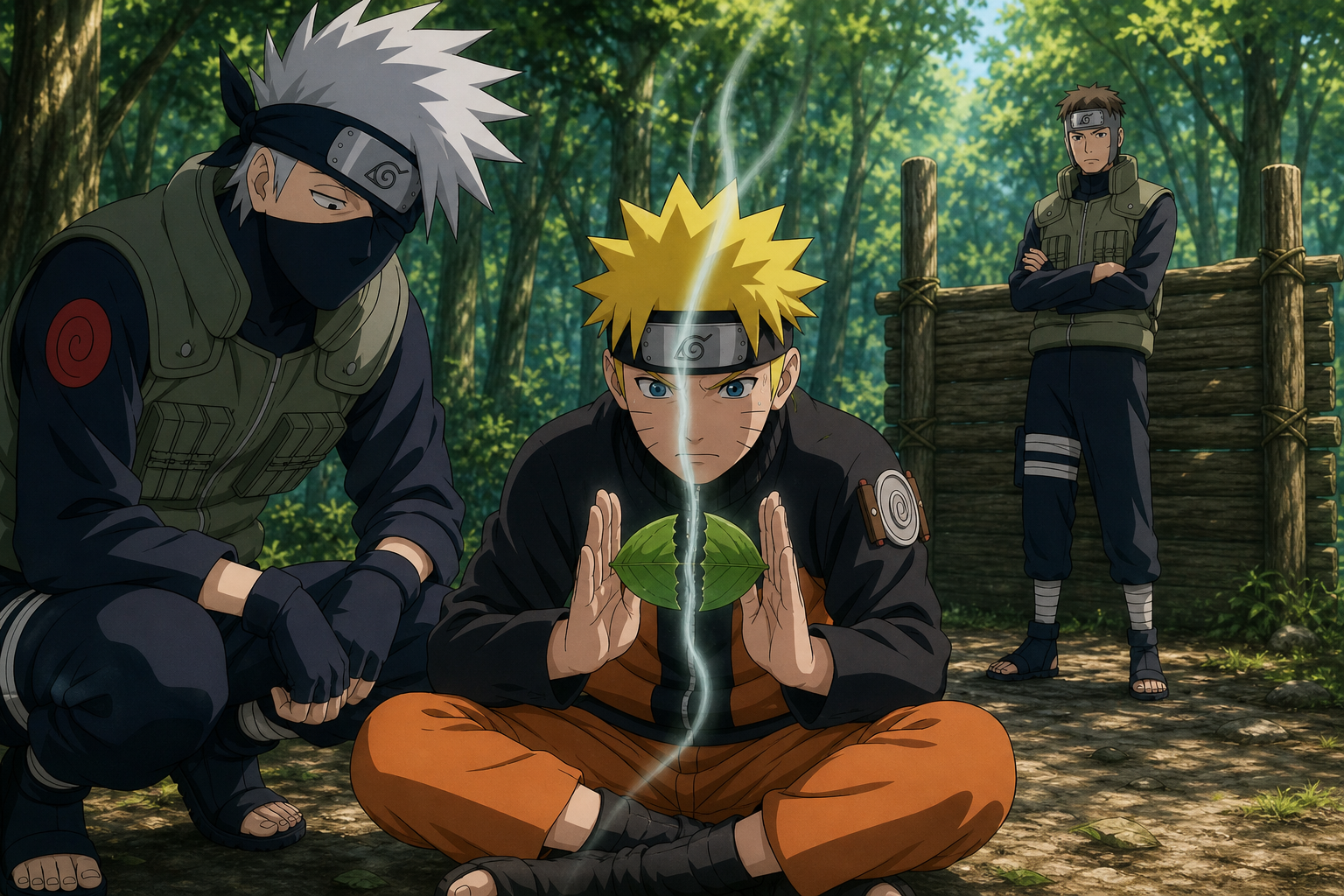
Naruto holds a leaf between his palms and tries to cut it with wind chakra. The exercise looks almost too small for a shinobi who summons giant toads and creates armies of clones. That smallness is the lesson.
Wind transformation begins at an edge Naruto can barely perceive. If the chakra is broad, unstable, or inconsistent, the leaf remains intact. Naruto must sustain a narrow effect without replacing control with volume.
The exercise gives him immediate evidence. Every partial split shows what improved, and every failure identifies where concentration broke.
Wind's combat value can become another dangerous shortcut
Learning that wind excels at fighting increases Naruto's effort, but it also risks reinforcing the idea that the only meaningful strength is strength that defeats someone. Naruto needs power because Sasuke overwhelmed the team. The urgency is real.
Still, wind nature is valuable because it can be controlled, adapted, and combined with judgment. If Naruto treats it only as a faster route to a stronger attack, he may reproduce the same problem the Nine-Tails created: enormous force without enough attention to who stands nearby.
The goal cannot be damage by itself. It has to be deliberate protection.
Kakashi teaches the difference between affinity and mastery
The chakra paper revealed what comes naturally to Naruto. It did not hand him a completed technique. Kakashi keeps that distinction clear by moving directly into practice.
An affinity is potential. Mastery comes from the boring, repetitive work Naruto often wants to skip. The episode grounds elemental power in technique rather than destiny. Wind belongs to Naruto, but he still has to earn the ability to use it well.
That framing is healthier than telling Naruto he possesses another exceptional gift. It gives him agency and responsibility in equal measure.
Shadow Clones turn Naruto's old trick into a learning method
Kakashi's plan uses the fact that a Shadow Clone's experience returns to the original when the clone disappears. Naruto can divide practice across many bodies, then collect the learning.
The insight redefines a technique Naruto has used mostly for combat. Clones are no longer only extra fists or distractions. They become parallel students.
This is good teaching because it starts with Naruto's actual strengths. Kakashi does not ask him to imitate Sasuke's solitary discipline. He designs training around Naruto's chakra reserves, signature jutsu, and practical way of learning.
Accelerated learning still carries a cost
Experience returns from every clone, and so does fatigue. The method can compress time, but it cannot make Naruto's mind and body infinite. Yamato's presence helps maintain the training field and monitor the Nine-Tails, yet external supervision cannot replace Naruto's awareness of his own limits.
This matters after the nightmare and Sakura's injury. Naruto's desire to recover lost ground makes overwork feel virtuous. It is not automatically virtuous if exhaustion destroys judgment.
Efficiency should create room for learning, not permission to treat Naruto as disposable labor.
Yamato keeps the training connected to safety
Yamato's Wood Release is part of the training infrastructure because the risk of Nine-Tails chakra has not disappeared. His presence reminds the audience that this is not an ordinary elemental lesson.
Naruto is learning a new form of power while still carrying one he cannot fully control. Yamato can intervene, but the long-term goal must be for Naruto to remain responsible for himself.
Safety measures do not undermine Naruto's strength. They make sustained growth possible after a mission where emergency power injured a teammate.
The title suggests pressure moving under the surface
“Squirming” fits Naruto's impatience, but the episode also begins shifting attention toward the unease surrounding the Guardian Shinobi Twelve story. Something is moving beyond the training field, and the Leaf will not have unlimited time before a new threat demands action.
That tension gives Naruto's lesson urgency without requiring him to know the full danger yet. Training happens in the space before crisis, when repetition can still create options.
Once the next mission begins, Naruto will have to rely on whatever control he has actually built.
Sasuke remains the comparison Naruto has to outgrow
Naruto measures every new technique against Sasuke's power. The reunion made that comparison unavoidable, but it can become a trap. If Naruto defines wind only as the tool that will let him catch Sasuke, his growth remains organized around another person's path.
Wind training is an opportunity to build a shinobi identity that is not a reaction to Sasuke or the Nine-Tails. Naruto's chakra nature, Shadow Clones, and learning style create a combination nobody else can reproduce in the same way.
Closing the gap begins with becoming more fully himself, not with copying the person ahead of him.
RaeRae's reaction
I enjoy Naruto getting excited that wind is good for close combat because it is so predictably Naruto. Give him an entire lesson about elemental theory and he locks onto the part that sounds useful in a fight.
The leaf exercise is exactly what he needs. Naruto is used to making more chakra, more clones, and more noise. Splitting one leaf asks him to become smaller and sharper. That kind of control is a better answer to the Tenchi Bridge disaster than another overwhelming transformation.
Kakashi's clone-training idea is also brilliant because it treats Naruto's old technique as intelligence instead of a gimmick. The ability that once got him dismissed as chaotic becomes a legitimate learning advantage.
Precision begins replacing panic
Episode 56 does not deliver a finished wind technique. It establishes the method Naruto will need to create one. The leaf begins to split, clones multiply the experience, and Kakashi and Yamato build a structure capable of holding Naruto's urgency.
That structure is the real progress. Naruto left the hideout wanting to erase failure with more strength. The training asks him to slow down enough to understand how strength is made.
Wind will become dangerous because Naruto learns to shape it, not because he wants the result badly enough.
Official episode reference: Naruto Official episode guide
Licensed episode route: Crunchyroll licensed episode page
The leaf is small enough to expose every imprecise habit
Naruto cannot hide behind battlefield chaos, clone numbers, or an opponent’s movement. The leaf offers one surface and one result: either wind chakra creates a controlled split or it does not.
That simplicity makes the exercise demanding. Small work removes excuses that large spectacle often provides.
The leaf becomes a receipt for attention.
Naruto wants the combat application before he owns the foundation
Hearing that wind creates a cutting edge immediately pulls his imagination toward defeating stronger enemies and reaching Sasuke.
The excitement is useful motivation. It can also tempt him to treat the exercise as an irritating gate before the “real” power.
Foundations are real power because they determine whether the later technique remains usable, repeatable, and safe.
Precision is a different form of strength from endurance
Naruto has survived through stamina and the willingness to try after other people stop. Wind transformation asks him to sustain a fine edge rather than survive a larger impact.
Endurance keeps him practicing. Precision determines whether practice changes the leaf.
Growth happens when an old strength supports a new one instead of replacing it.
The exercise teaches Naruto to feel chakra rather than only spend it
Large techniques can make chakra seem like fuel measured by quantity. Splitting the leaf requires attention to texture, flow, direction, and pressure.
Naruto must notice what happens inside the technique while it happens.
That bodily awareness may eventually help him recognize escalation before the Nine-Tails takes over.
Wind becomes dangerous through an edge, not through volume
Kakashi describes the element’s ability to cut and sharpen. The lesson contradicts Naruto’s habit of adding more force whenever a result resists him.
A broad gust can move everything without cutting the intended point. A narrow edge can change one surface decisively.
Control allows less chakra to become more consequential.
The Shadow Clone method turns repetition into collaboration with himself
Each clone practices separately and returns experience to the original. Naruto becomes student, experiment, observer, and archive at once.
The method works because the clones are not disposable strangers. Their learning returns to one consciousness.
Multiplication supports integration rather than fragmentation when Naruto has enough recovery time to process what comes back.
Clone fatigue deserves to be treated as real labor
A clone vanishes, but its exhaustion and experience do not become imaginary. Naruto receives the accumulated burden.
The spectacular efficiency can encourage Kakashi, Yamato, or Naruto himself to ignore the cost because individual bodies disappear.
Training remains ethical only when the original person’s limits determine the workload.
Hundreds of attempts make failure ordinary
One unsuccessful leaf can feel personal. A field of clones produces a range of partial results, mistakes, and small improvements.
Failure becomes expected data inside a process rather than evidence Naruto lacks talent.
This shift is especially valuable after the failed reunion, where Naruto risks translating one outcome into a judgment on his entire promise.
Kakashi designs the lesson around Naruto instead of around tradition
Another student might train sequentially. Naruto’s reserves and clone expertise make parallel practice possible.
Individualized instruction does not lower standards. It identifies the route through which the student can meet them.
Kakashi’s creativity as a teacher matters as much as his knowledge of elemental chakra.
Yamato makes the impossible scale physically sustainable
His Wood Style supports the training ground and provides a response if Nine-Tails chakra begins surfacing. The method depends on more than Naruto and Kakashi.
That dependency should remain visible. Naruto’s accelerated progress is collective labor even when the final technique belongs to him.
Acknowledging support does not diminish individual achievement.
Safety supervision should be collaborative rather than secret
Yamato’s presence can feel like a handler monitoring a dangerous jinchuriki if Naruto is excluded from the rationale.
The healthier arrangement names the warning signs, intervention threshold, and purpose openly.
Naruto gains more control when he understands the safety structure instead of experiencing restraint as something adults impose after failure.
The training field is calm because danger is still moving elsewhere
The title points beyond Naruto’s squirming impatience. New threats and political tensions are developing while the Leaf appears to have time for practice.
Preparation is possible precisely because the crisis has not fully announced itself.
The episode values the quiet interval when skill can be built before urgency chooses the terms.
Foreshadowing should not make training feel pointless
An approaching threat may interrupt Naruto before mastery. Partial control remains meaningful.
Training is not useful only when a complete technique debuts perfectly. Increased awareness, a stronger foundation, and better teamwork can alter survival.
Incomplete progress still creates options the untrained person would not have.
Sasuke remains motivation and must stop being the only metric
Naruto wants wind power because Sasuke exposed the gap. That reason gets him onto the field.
If every leaf is judged against Sasuke, Naruto’s own progress will always feel secondary.
The training should create an identity and capability that matter across friendships, missions, and Naruto’s future beyond one pursuit.
Comparison can start the work without owning its meaning
Learning that wind can challenge lightning gives Naruto an immediate relational hook. Kakashi wisely uses what motivates the student.
Over time, Naruto must understand wind on its own terms and decide what he wants the element to protect.
A borrowed reason can open the door to self-directed mastery.
Naruto needs permission to be a beginner again
He is an experienced shinobi with major victories, yet elemental transformation places him at an early stage.
Expertise in one area does not eliminate beginner status in another. Shame about the gap would encourage shortcuts.
Learning becomes faster when Naruto can admit what he does not know without defending his worth.
Kakashi needs permission to teach what he assumed was obvious
Elite experience can make foundational knowledge invisible to the expert. Naruto’s questions expose those assumptions.
The teacher must unpack categories, demonstrate effects, and verify understanding.
Good instruction changes the expert too by forcing knowledge into a form another person can actually use.
The split leaf rewards attention more than drama
There is no crowd, rank promotion, or spectacular explosion attached to the first success.
The reward is evidence that Naruto felt the chakra correctly for a moment.
Private mastery builds the capacity public heroism later depends on.
Wind control offers a repair to Naruto’s relationship with his body
The four-tailed form made his body foreign, dangerous, and unavailable to conscious intention.
Leaf training asks Naruto to inhabit sensation closely enough to create a chosen effect. The body becomes a place of learning rather than only a container for threat.
Technical practice can support recovery when it increases ownership instead of punishment.
Overtraining could repeat the self-abandonment in a cleaner form
Using his own chakra and clones is safer than surrendering to the fox, but Naruto can still erase himself through exhaustion.
A controlled-looking method does not become healthy if the student treats collapse as proof of commitment.
Rest and stopping thresholds must belong inside the technique from the beginning.
Yamato and Kakashi should model adults coordinating openly
Both men possess different knowledge about Naruto’s development and risk. Their cooperation can counter the secrecy surrounding his earlier containment.
Naruto should see how their roles fit and understand what each intervention means.
Transparent teamwork teaches him that accepting support does not surrender agency.
The exercise separates urgency from panic
Urgency says Sasuke remains in danger and Naruto needs to grow. Panic says every moment without dramatic progress proves another failure.
The leaf accepts urgency through repeated work and rejects panic because panic cannot create precision.
Training gives Naruto a way to move now without pretending mastery can be rushed.
Squirming is what pressure looks like before it finds direction
Naruto’s body wants action faster than the technique can develop. Threats beyond the field are beginning to move. Old failure remains emotionally active.
Everything strains against waiting.
The lesson is not to eliminate pressure, but to channel it into an edge capable of serving a chosen purpose.
Precision gives Naruto a language for stopping before collapse
To split the leaf, Naruto has to notice when concentration drifts and the edge softens. Those observations create smaller intervention points than total failure.
The same skill can support safer training. Fatigue, agitation, unstable chakra, and loss of focus do not need to be ignored until Yamato suppresses a crisis. Naruto can learn to respond while choice remains available.
Stopping at an early signal is not surrender. It protects the next attempt and the people sharing the field.
The clone field makes learning visible as a collective process
Each Naruto approaches the same task with tiny differences in timing and sensation. When the clones release, those variations become one person’s knowledge.
The method turns apparent duplication into a record of experimentation. Naruto is not mindlessly repeating the same failure. He is generating comparisons at a scale suited to his unusual chakra.
Kakashi’s teaching succeeds because it recognizes that volume can serve precision when the structure converts many attempts into careful observation.
The first clean split should not erase the attempts before it
Success arrives from accumulated adjustments, not a sudden revelation detached from failure. Every leaf that remained whole helped Naruto distinguish pressure, direction, and concentration.
Remembering the sequence protects him from believing mastery appears only through dramatic breakthroughs. The slow evidence matters. A technique becomes reliable when Naruto can reproduce the result, explain what changed, and recognize when the conditions are wrong.
That repeatability is what separates controlled power from another emergency that happens to succeed once.
The smallest exercise is teaching Naruto how deliberate strength feels before crisis arrives.
Precisely.
RaeRae’s full take
I love that Naruto’s next great power begins with a leaf refusing to cooperate. He can summon a thousand clones and still has to become quiet enough to feel one narrow line of chakra.
This is exactly the correction the Tenchi Bridge mission demanded. The Nine-Tails gave Naruto more force by taking Naruto away. Wind training gives him more force by requiring more Naruto in every second.
Kakashi’s clone method is brilliant because he sees a learning system inside the technique everybody treats as Naruto’s chaotic gimmick. The student does not have to become Sasuke to deserve elite instruction.
I need the fatigue counted. Hundreds of clones mean hundreds of experiences returning to one body. Naruto’s stamina is an advantage, not public property.
Yamato’s safety role should be open and collaborative. Naruto deserves to know when intervention happens and why. Containment should help build his control instead of reminding him that adults possess secret plans for his body.
The title captures the pressure under everything. Naruto is impatient. New danger is moving. Failure still hurts. The leaf turns all that squirming into a task small enough to repeat honestly. Precision begins when panic finally has somewhere specific to go.
RaeRae checkpoint: Naruto does not split the leaf by caring harder about Sasuke. He splits it by feeling his own chakra closely enough to direct the edge. That is growth rooted in presence.
Receipts and official routes
- Episode placement, Naruto’s leaf-splitting exercise, the wind-nature lesson, Shadow Clone training, and Kakashi and Yamato’s supervision: Naruto Official Site episode guide.
- Licensed episode route: Crunchyroll.