
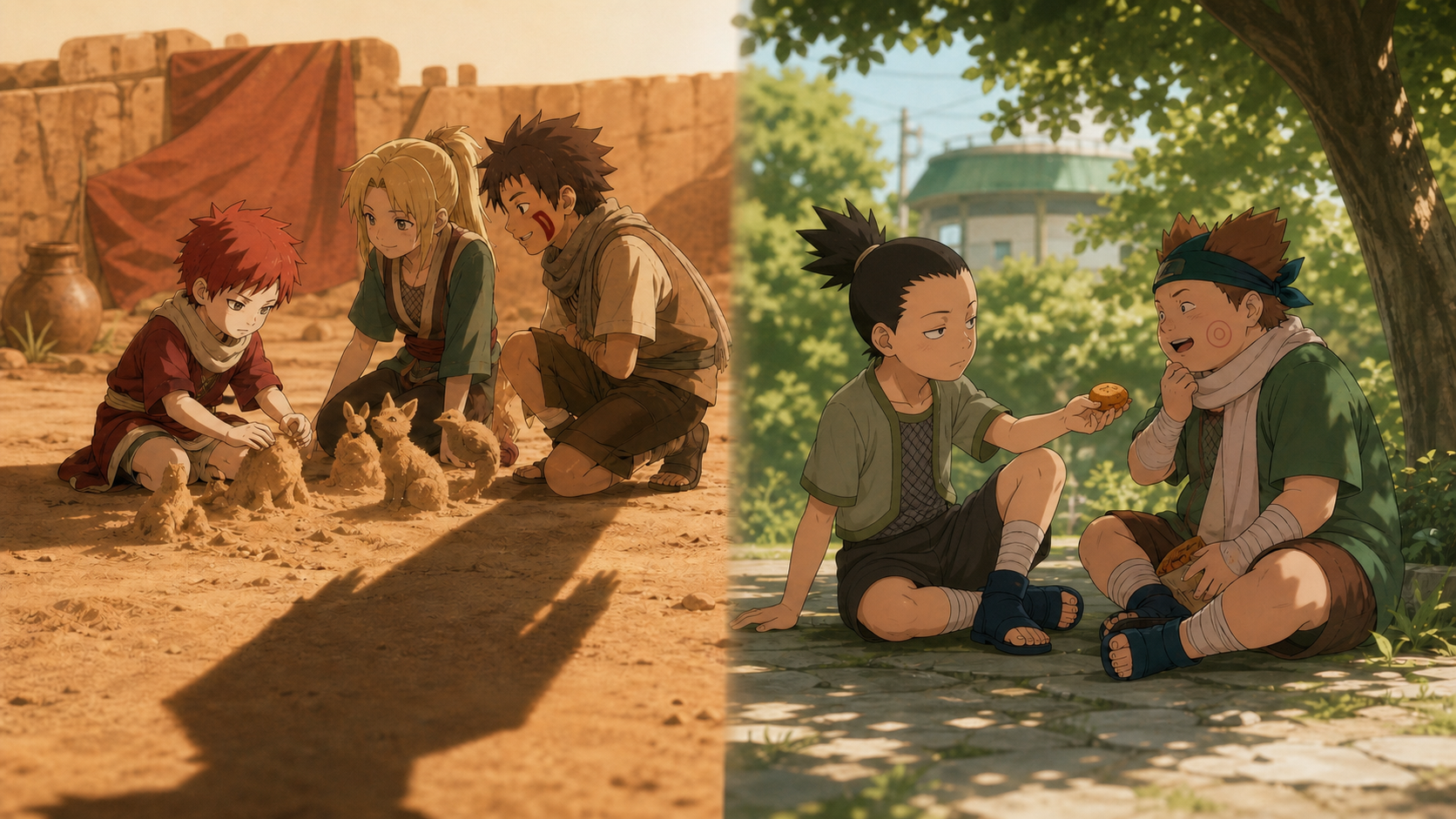
Gaara and Shikamaru
One child’s every mistake becomes evidence for isolation while another friendship survives irritation, consequence and ordinary repair.
Bottom line
“Gaara and Shikamaru” contrasts a child whom adults deliberately isolate with a child whose friendships survive irritation, embarrassment, and ordinary conflict. Gaara builds intricate figures from sand while Temari and Kankuro briefly play beside him, proving that sibling affection existed before fear separated them. Rasa orders the older children away, and Yashamaru becomes Gaara's only dependable caretaker even while carrying the Kazekage's lethal command. Shikamaru's half looks almost weightless beside that cruelty: he pranks Choji, argues over money, receives punishment with Naruto, and eventually repairs the disagreement. That unevenness is the point. Shikamaru can make a mistake without becoming a monster in anyone's eyes. Choji can feel hurt without needing to fear assassination. Gaara cannot lose control, misunderstand an adult, or simply want company without the village treating his existence as a weapon problem. The episode should not turn Shikamaru and Choji into proof that Naruto was never lonely, nor should quiet images of sand soften Rasa's responsibility. Childhood becomes healthy through room for repair. Gaara was denied that room until Naruto met him as an equal survivor.
Episode 482 continues the anime-original Childhood arc
Episode 482 is titled “Gaara and Shikamaru.” The episode aired in Japan on November 3, 2016, and divides its runtime between memories from Sunagakure and Konoha.
The material is anime-original rather than a direct manga chapter adaptation.
Baby Gaara reaches for his mother
The episode begins with a loss he cannot understand. Karura is absent before her son can build memories of direct care.
Longing appears before language.
Gaara cries without knowing the history
Adults understand that his birth, Shukaku's sealing, and Karura's death are connected. The infant only experiences missing warmth.
Political decisions enter his body before consent.
Sand becomes Gaara's first language
As a young child, he shapes detailed figures and structures with instinctive control. The ability can create rather than only defend or destroy.
Imagination exists inside the weaponized child.
Temari and Kankuro play nearby
His siblings are initially willing to share space and respond to his creations. Their presence challenges the idea that distance between them was natural.
Fear had to be taught and enforced.
The sandbox becomes a temporary family space
All three children can participate without rank, mission, or succession dominating the moment. Sand belongs to play before adults return the substance to military meaning.
Childhood briefly interrupts policy.
Gaara makes complex sculptures
Control appears through patience and aesthetic attention rather than rage. His talent could have been nurtured as craft, precision, and self-expression.
Power did not require cruelty to develop.
His siblings admire the result
Temari and Kankuro see a younger brother capable of delighting them. Admiration offers Gaara recognition unrelated to being a jinchuriki.
Connection forms around creativity.
Rasa calls Temari and Kankuro away
The Kazekage removes the siblings from Gaara instead of building conditions for safe contact. Authority converts uncertainty into enforced isolation.
Parental fear becomes village policy.
The older children do not choose separation freely
They follow their father within a household structured around obedience. Later fear is real, but the episode shows an earlier bond adults interrupted.
Siblings inherit decisions they did not design.
Gaara remains alone beside his work
The sculptures continue standing after the audience has gone. Creativity cannot answer the child's need for another person to remain.
Abandonment changes the meaning of play.
Rasa sees a military asset
Gaara carries Shukaku because the village wanted strategic power. The same leadership that created the jinchuriki then condemns the child for instability produced by that burden.
The institution blames its own subject.
Sleeplessness compounds every wound
Shukaku threatens Gaara whenever sleep approaches, denying the regulation and restoration children need. Exhaustion makes emotional control harder while adults demand flawless control.
His body receives no safe interval.
Villagers treat him as danger first
Their fear may respond to real incidents, but fear becomes collective permission to deny personhood. Nobody can learn safety through permanent rejection.
Containment replaces care.
Yashamaru becomes the surviving source of warmth
Gaara's maternal uncle cooks, listens, tends injuries, and explains feelings. One adult gives the child language for pain.
Care becomes inseparable from dependence.
Gaara sees Karura in Yashamaru
Family resemblance lets him imagine a connection to the mother he never knew. Yashamaru carries both his own identity and the emotional outline of her absence.
Grief attaches to the only available caretaker.
Yashamaru explains physical and emotional wounds
The lesson helps Gaara understand that pain can exist without visible blood. Naming inner hurt gives shape to experiences the village refuses to discuss honestly.
Language offers temporary containment.
The explanation of love becomes foundational
Gaara learns that care can ease pain and make another person's existence matter. He wants evidence that his mother's love remains inside the sand protecting him.
Hope depends on an adult's answer.
Karura's protection is real
Her will remains attached to Gaara through the sand, defending him beyond death. Later revelation confirms that he was loved from the beginning.
The child receives that truth far too late.
Rasa orders a test through assassination
The Kazekage chooses violence to determine whether Gaara can control Shukaku and whether love restrains him. The method creates the crisis claimed as evidence.
An abusive experiment cannot produce neutral results.
Yashamaru is placed in an impossible role
He must obey his Kazekage and attack the child he raised. Coercion explains his position without making the attack harmless.
Systems can victimize someone while using that person to harm another.
Gaara's trust becomes a weapon against him
An attack from a stranger would confirm public fear. An attack from Yashamaru destroys the one relationship through which Gaara understood love.
Betrayal targets his emotional foundation.
The episode's quiet tone carries dread
Viewers know where the memory leads even when Gaara is only playing. Gentle scenes become painful because safety has an expiration date set by adults.
Nostalgia cannot remove approaching violence.
Shikamaru's half changes emotional scale
Konoha offers a childhood where mistakes can remain small. The contrast is not proof that Shikamaru has no problems.
Ordinary conflict is a form of privilege.
Shikamaru is bored at the Academy
Lessons fail to engage his extraordinary intelligence, and he responds through minimal effort rather than open ambition. Adults often read laziness before asking what work could challenge him.
Understimulation hides ability.
Choji borrows money
Their friendship includes snacks, informal debts, and the casual dependence of children who expect another day together. Money can become a source of irritation without threatening the bond's existence.
Familiarity creates low-stakes friction.
Shikamaru pulls a prank
He directs cleverness toward amusement and control when bored. The joke crosses a line because Choji experiences the result rather than merely watching the plan.
Intelligence does not cancel responsibility.
Choji becomes angry
His hurt deserves respect rather than dismissal as oversensitivity. Friendship gives Shikamaru access to vulnerabilities that should not become easy targets.
Closeness increases duty of care.
Their disagreement becomes physical and loud
Both boys react before articulating the real grievance. The conflict remains visible enough for someone else to interrupt.
Messy emotion has room to surface.
Naruto enters the argument
His presence places him among classmates with whom he sometimes shared trouble. Those moments matter without proving that he possessed stable, intimate friendship throughout childhood.
Occasional inclusion and deep loneliness can coexist.
Anime continuity needs careful framing
Later original episodes expand Naruto's early contact with Shikamaru and Choji beyond the manga's emphasis. The scene belongs to the anime's version of their childhood.
Adaptation additions should not overwrite source distinctions.
Iruka responds as a teacher
The boys face consequences within an educational relationship rather than being branded permanent threats. Discipline assumes they can learn and return.
Correction leaves a route back.
Punishment groups them together
Shared consequences turn misbehavior into a story classmates may later laugh about. Nobody orders an assassination to test whether friendship can control them.
Scale reveals the difference between guidance and abuse.
Shikamaru can admit fault indirectly
His detached style makes emotional declarations uncomfortable, but behavior can still show that Choji matters more than winning an argument. Repair does not require dramatic performance.
Consistency carries apology.
Choji can forgive without losing dignity
Reconciliation does not demand pretending the prank was funny. He can name hurt, accept changed conduct, and continue a relationship chosen by both boys.
Forgiveness remains voluntary.
Their friendship survives irritation
The bond later supports battlefield trust, grief after Asuma's death, clan duty, and war leadership. Durability begins through smaller repairs long before heroic sacrifice.
Ordinary maintenance builds extraordinary trust.
Shikaku and Choza create a different adult context
Their fathers maintain an established clan partnership and allow their sons room to form a genuine friendship within that inheritance. Tradition supports connection rather than requiring one child to die for another.
Legacy can be cooperative instead of coercive.
Choji is seen beyond appearance
Shikamaru does not reduce him to weight or appetite, even when snacks and money cause conflict. That baseline recognition matters in a peer culture willing to mock him.
Friendship protects personhood without idealizing behavior.
Gaara receives no comparable repair
Every failed interaction confirms the village's fear, and every fear response increases the chance of another failure. Adults construct the cycle they cite as justification.
Isolation becomes self-fulfilling policy.
The two halves reject destiny in different ways
Gaara's childhood shows how power can trap a person inside an assigned identity. Shikamaru's shows how repeated choice can deepen an inherited clan connection without eliminating autonomy.
Relationships depend on the conditions surrounding them.
Sand and shadow reflect different controls
Gaara's sand protects him automatically, sometimes beyond conscious command. Shikamaru's shadow techniques later depend on precision, limits, and strategic collaboration.
Both abilities reveal how control shapes identity.
Future leadership changes the contrast
Gaara becomes Kazekage after learning from Naruto, while Shikamaru becomes a strategist trusted across national lines. Each man eventually uses intelligence and power to sustain cooperation.
Their adult work answers different childhood failures.
Temari later connects both stories
Gaara's sister builds a relationship with Shikamaru, joining Sand and Leaf through more than wartime necessity. Her future also shows that Rasa's household does not define every bond available to his children.
Family can be rebuilt across borders.
Naruto becomes Gaara's missing equal
Naruto recognizes jinchuriki loneliness without approaching Gaara as experiment, asset, or threat alone. Their fight ends only after Naruto insists that protecting others can create strength.
Recognition reaches Gaara from someone who survived a related wound.
Sympathy should not erase Gaara's victims
His childhood explains later violence without making killed or terrorized people irrelevant. Recovery requires holding structural abuse and personal harm in the same account.
Understanding is not acquittal.
Shikamaru's mistakes also remain his own
Boredom and intelligence explain the prank but do not excuse hurting Choji. The healthy difference lies in proportionate consequence and available repair.
Accountability works when change remains possible.
Gaara’s creativity is evidence adults ignored
The sand figures matter because they show what the village refused to imagine. Gaara’s power could make something delicate, social, funny, and beautiful. He was not born as a single-purpose weapon. Sunagakure chose to organize his ability through military value, surveillance, fear, and testing, then treated every instability produced by those conditions as proof that the child himself was defective.
Temari and Kankuro respond to his creativity before Rasa teaches distance. Their brief play proves sibling fear was not inevitable. It was cultivated inside a household where obedience to the Kazekage carried more weight than ordinary attachment. The children did not design that system, though each would later have to decide whether to repeat it.
Rasa manufactures the result he expects
Ordering Yashamaru to attack Gaara is not a neutral assessment. It removes the child’s only trusted caregiver, weaponizes private knowledge, confirms his worst fear, and then observes the collapse. Any institution could make a person look unstable by destroying every stabilizing relationship and arranging a lethal betrayal. Calling the aftermath data does not make the experiment legitimate.
Rasa holds more responsibility because he acts as father and Kazekage. He helps create the jinchuriki policy, has authority over Yashamaru, separates the siblings, and controls the official story. Gaara’s later violence remains real. The chain leading toward it is not mysterious.
Yashamaru can be coerced and accountable
I do not need to turn Yashamaru into a secret monster in order to name what his attack does. He lives beneath political authority, carries grief connected to Karura’s death, and receives an order from the village leader. Those pressures constrain him. They do not make Gaara experience the betrayal as anything less than the destruction of love.
This is one of the story’s recurring truths: systems move harm through people who are also being harmed. Recognition should widen accountability, not make it disappear. Rasa designed the test. Yashamaru enacted it. Gaara endured it. Each position is different, and collapsing them into one word such as tragedy protects the authority most able to choose differently.
Shikamaru gets the gift of proportion
His prank hurts Choji, and adults respond as though a child made a repairable mistake. That sounds ordinary because it should be ordinary. Nobody declares Shikamaru’s intelligence a permanent threat. Nobody isolates Choji for becoming angry. Consequence is proportionate, the relationship remains available, and tomorrow is assumed.
Gaara receives no such scale. A mistake becomes evidence for assassination. Fear becomes policy. Policy creates more fear. The contrast explains why healthy accountability needs a route back. Children learn responsibility when correction assumes they are capable of change, not when every failure confirms they should be removed.
Choji’s hurt deserves the center too
Shikamaru’s brilliance and boredom do not make the prank harmless. Choji is not merely the forgiving friend who proves Shikamaru has a good heart. He gets to feel embarrassed, angry, and unwilling to laugh. Friendship increases responsibility because access to another person’s vulnerabilities makes it easier to hurt them precisely.
The repair works when changed behavior matters more than clever justification. Shikamaru does not need a heroic speech. He needs to stop treating Choji’s discomfort as acceptable collateral for amusement. Choji can continue the friendship without surrendering the truth that a line was crossed.
Future leaders carry opposite childhood lessons
Gaara becomes Kazekage after surviving a leader who treated him as an asset and experiment. Shikamaru becomes a strategist after growing inside relationships where intelligence could fail, apologize, and try again. Their leadership will be measured by whether they reproduce the conditions that formed them or build something safer for the next child.
That is the quiet bridge between both halves. Power needs room for creativity. Intelligence needs accountability. Tradition needs consent. Friendship needs repair. None of those lessons require a child to be perfect before receiving care.
The contrast also asks who is allowed to have an ordinary childhood in a military village. Shikamaru can be bored, petty, funny, and wrong without those moments becoming a national-security file. Gaara’s play is observed through the possibility of weapon failure. Even his need for siblings is evaluated according to whether attachment improves control. That difference is not personality. It is policy deciding which child receives privacy and which child becomes public property. Naruto’s eventual bond with Gaara matters because he addresses him as a person capable of choice, but friendship should not be the only escape route available to a jinchuriki. Villages need safeguards before another exceptional peer arrives: independent advocates, medical and psychological care, stable caregivers, protection from experimentation, and legal recognition that a sealed being and its host are not equipment owned by the Kage. The same principle applies to Academy students. Shikamaru and Choji benefit from adults who treat correction as temporary, yet their world still trains children for lethal work. Proportionate discipline is better than abuse, but it does not answer the larger institution. Peace should expand what counts as childhood, giving every child time to play, learn, fail, reconcile, and imagine a future that is not assigned by clan or state. Gaara’s sand figures are a blueprint for that possibility. The tragedy is how quickly authority tells him they are less important than the weapon inside him. A child was creating life while his father measured military risk.
Final verdict
“Gaara and Shikamaru” draws its strongest argument through unequal stakes. Gaara uses sand to make beauty, enjoys a brief game with Temari and Kankuro, and depends on Yashamaru for the language of love. Rasa answers those signs of humanity by separating the siblings and turning the trusted caretaker into an assassin. The resulting collapse cannot honestly be called a test of Gaara's nature. Shikamaru, Choji, and Naruto inhabit a childhood where boredom produces pranks, pranks produce anger, and anger can end through punishment and repair. That ordinary sequence is precisely what Gaara lacks. The Konoha scenes should not be used to deny Naruto's established isolation, especially where anime-original memories expand early classmate contact. Their real value lies in showing children allowed to remain children. Gaara's tragedy begins because every mistake becomes evidence for execution, while Shikamaru's growth begins because a mistake can remain something a friend survives and a boy learns to repair.
Sources and watch notes
- Naruto Official episode guide for the official series record.
- Crunchyroll for the licensed episode route where available.
What I am carrying forward
Episode 483 turns to Jiraiya and Kakashi. I am carrying forward Gaara’s creative sand, the siblings’ interrupted play, Rasa’s manufactured crisis, Yashamaru’s coercion, Choji’s right to be hurt, and Shikamaru’s access to proportionate repair. Childhood safety depends on what adults permit after imperfection.