
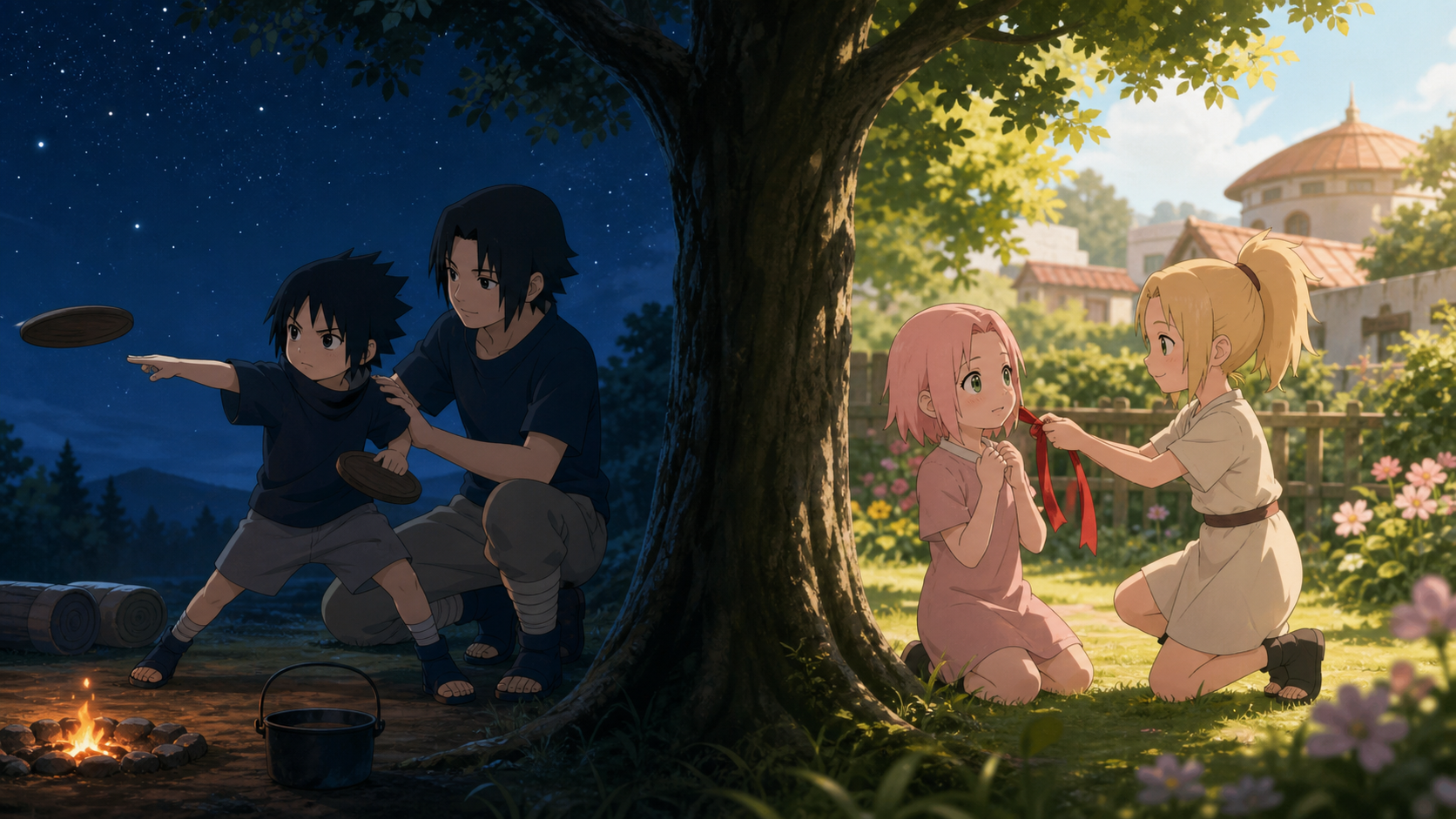
Sasuke and Sakura
Two ordinary childhood needs for attention and friendship remain separate before secrecy, tragedy, insecurity and rivalry distort them.
Bottom line
“Sasuke and Sakura” places two ordinary childhood wants beside futures that will distort them. Sasuke wants time with the brother he adores. Sakura wants a friend and enough confidence to stop hiding her forehead. Their needs are small, recognizable, and painfully vulnerable to the meanings adults and peers attach later. Itachi gives Sasuke one evening of training, cooking, and sleep beneath the sky, but every affectionate delay carries secrets that will eventually destroy the boy's understanding of love. Ino gives Sakura a ribbon and names the obvious truth that bullies target whatever shame can make visible. That friendship helps Sakura emerge from hiding before their shared crush on Sasuke turns connection into rivalry. The episode succeeds when Sasuke and Sakura remain separate children rather than pieces of a predetermined romance. His family tragedy does not make her future devotion inevitable. Her insecurity does not reduce her to a girl waiting for male recognition. Each half shows a child building identity through another person's attention, then asks what happens when attention disappears, becomes competitive, or arrives wrapped in concealment.
Episode 481 continues the anime-original Childhood arc
Episode 481 is titled “Sasuke and Sakura.” The episode aired in Japan on October 27, 2016, and divides its story between early memories of Sasuke Uchiha and Sakura Haruno.
Neither half directly adapts a numbered manga chapter.
Sasuke begins with a simple request
The young boy asks Itachi to teach him shurikenjutsu. He wants technique, but he also wants private time with the person he admires most.
Training becomes a request for closeness.
Itachi says he is busy
Clan duties, missions, and political pressure occupy the older brother's life. Sasuke only sees another refusal without access to those hidden burdens.
Silence makes absence feel personal.
Sasuke thinks his brother dislikes him
Children often interpret unavailable adults through the only relationship evidence they possess. Repeated postponement sounds like rejection when nobody explains the real stakes.
Affection cannot always survive on implication.
Itachi denies the accusation
He cares deeply for Sasuke, yet care communicated through secrecy will later become almost impossible for the younger boy to recognize. The denial is sincere and incomplete.
Love needs truthful conduct.
The forehead poke returns
Itachi touches Sasuke's forehead and promises another time. The gesture is warm, playful, and already tied to delay.
Tenderness and avoidance occupy the same motion.
Their parents plan to leave home
The adults' absence creates an opening for the brothers to spend an evening alone. Sasuke treats the chance as a rare gift rather than ordinary family access.
Scarcity makes attention feel precious.
Sasuke chooses to stay with Itachi
He values time with his brother more than joining the family outing. The decision shows how strongly Itachi defines his emotional world.
Admiration has become dependence.
Itachi keeps the promise
For once, “next time” arrives. He sets aside competing demands and gives Sasuke the lesson requested.
Follow-through changes the meaning of reassurance.
Shuriken practice becomes shared language
Itachi demonstrates control while Sasuke watches every movement. Technique allows the younger brother to imagine a future where effort closes the distance between them.
Learning carries hope of equality.
Sasuke wants recognition through skill
Praise from Itachi matters because family comparisons already place the prodigy beyond reach. Sasuke does not only want to hit a target.
He wants proof that his brother sees him.
Itachi teaches without humiliation
The lesson gives correction and time rather than treating beginner mistakes as failure. Sasuke receives a glimpse of mentorship unburdened by clan politics.
Patience makes talent teachable.
Their evening includes domestic work
Training gives way to preparing food and occupying the house together. Ordinary tasks reveal a relationship beyond battlefield ability.
Family life happens in small routines.
Itachi struggles with dinner
The brilliant shinobi can still overdo food and misjudge an everyday task. Sasuke sees his idealized brother as fallible without losing affection.
Imperfection briefly makes closeness easier.
They eat what they made
The meal matters because both contributed to a shared evening rather than receiving another formal family performance. The scene allows Sasuke uncomplicated happiness.
Joy exists before the massacre.
The brothers sleep outside
Night removes walls, clan meetings, and the pressure of household rank. Sasuke can look upward beside Itachi rather than chase him from behind.
Physical closeness quiets comparison.
Itachi explains the Uchiha crest
The fan represents the clan and the power expected from those who carry its name. Family identity reaches Sasuke through the brother he most wants to resemble.
Belonging arrives tied to achievement.
Sasuke promises to surpass him
His declaration sounds playful because rivalry has not yet become revenge. Growth means catching someone beloved, not killing an enemy.
Ambition begins inside affection.
Itachi leaves before morning
Sasuke wakes to absence after finally receiving the promised time. The departure repeats the pattern that one good evening cannot repair.
Connection remains vulnerable to secrecy.
Political danger remains outside the frame
The audience knows Itachi is moving toward impossible orders, divided loyalties, and the Uchiha massacre. Sasuke cannot interpret any warning because adults have denied him context.
Dramatic irony turns warmth into grief.
Itachi's love will become violence
He later chooses to traumatize Sasuke while believing hatred can keep his brother alive and strong. Protective intention cannot make psychological torture loving conduct.
Sacrifice without consent can reproduce harm.
The memory restores the brother before the myth
Sasuke remembers someone who cooked badly, taught patiently, and slept beside him. Those details resist reducing Itachi to either flawless martyr or monstrous killer.
A person can love and still cause devastating damage.
Sakura's half begins in hiding
The setting shifts from a famous clan household to a makeshift private refuge. Sakura avoids other children because ridicule has made visibility feel unsafe.
Shame creates its own small room.
Her forehead attracts teasing
Peers target a physical feature that carries no moral meaning. Repetition teaches Sakura to inspect herself through hostile eyes.
Bullying manufactures defect where none exists.
Sakura experiments with her hair
Bangs become an attempt to manage other people's cruelty by reducing what they can see. The strategy offers temporary control while reinforcing the belief that concealment is necessary.
Self-protection can deepen shame.
Her loneliness differs from Sasuke's
Sakura has living parents and no inherited clan catastrophe. Her pain comes through peer rejection and low confidence rather than massacre or state conspiracy.
Different scale does not make humiliation unreal.
Ino finds her
The confident Yamanaka girl enters Sakura's hidden space without treating her as ridiculous. A peer becomes the first person to challenge the logic of concealment.
Friendship interrupts isolation.
Ino understands the bullies' strategy
She explains that hiding the forehead advertises a source of shame and gives tormentors a reliable reaction. The observation targets the social dynamic, not Sakura's appearance.
The problem belongs to cruelty, not anatomy.
The ribbon changes presentation
Ino gives Sakura a way to pull her hair back and show the feature she feared. The gift is both practical and symbolic.
Visibility becomes a chosen act.
Confidence does not arrive instantly
A ribbon cannot erase learned anxiety after one conversation. Sakura still has to test a new way of moving through school and withstand possible ridicule.
Courage begins before comfort.
Ino models social ease
She speaks directly, occupies space, and treats Sakura as someone worth befriending. That example gives Sakura a behavior she can adapt without copying completely.
Peers can lend confidence temporarily.
Sakura tells her parents about Ino
Her excitement shows how important one friendship feels after isolation. Mebuki and Kizashi are relieved that their daughter has connected with someone.
Home support does not automatically solve school cruelty.
The Haruno household is comparatively ordinary
Sakura lacks a bloodline burden, jinchuriki seal, clan massacre, or political inheritance. That ordinary background later lets her achievements demonstrate training rather than inherited destiny.
Her growth is built through study and labor.
Sakura discovers her crush on Sasuke
Attraction enters before she knows much about his private life. The admired Academy boy functions partly as an image onto which classmates project status and fantasy.
A crush is not yet intimacy.
She confides in Ino
Sharing the secret tests the trust that helped her emerge from hiding. Sakura expects friendship to hold vulnerability safely.
The confession changes their social balance.
Ino likes Sasuke too
Jealousy turns common interest into perceived competition. The story reflects a familiar childhood conflict but gives too much future weight to a boy neither girl truly knows.
Romance begins to narrow friendship.
Rivalry does not erase Ino's earlier care
The ribbon, encouragement, and companionship remain real even after tension appears. Later competition should not rewrite their friendship as false from the beginning.
Relationships can contain generosity and conflict.
Sakura tries to confess
She approaches Sasuke with courage borrowed from her recent growth. The attempt is less about a mature relationship than testing whether a desired person can see her.
Recognition remains her immediate goal.
Sasuke asks who she is
His question punctures the imagined closeness surrounding her crush. Sasuke has been absorbed in Itachi and clan expectations, leaving little attention for classmates.
Admiration has not created mutual knowledge.
Sakura runs away angry
Embarrassment quickly transforms into defensive fury. Her internal voice begins pushing against the timid presentation used around other people.
Anger gives shame somewhere to move.
Inner Sakura appears
The exaggerated internal persona expresses confidence, frustration, and desire Sakura does not yet voice openly. Comedy externalizes the split between acceptable behavior and private feeling.
Her hidden self refuses permanent smallness.
Rejection motivates training
Sakura resolves to work harder after Sasuke fails to recognize her. The motivation remains tied to him, but the labor gradually becomes her own capacity.
External validation can start growth without owning the result.
Naruto notices her intensity
His surprise positions Sakura as more forceful than her quiet exterior suggested. The future Team 7 members already orbit one another without understanding the histories beneath Academy behavior.
First impressions conceal entire lives.
Sakura deserves an identity beyond Sasuke
Her medical mastery, strategic intelligence, mentorship under Tsunade, war service, and hospital leadership cannot be reduced to a childhood crush. Any reading of this episode should preserve that future agency.
Romantic interest is one thread, not her whole person.
Sasuke deserves an identity beyond romance too
His half concerns brotherhood, clan belonging, secrecy, and the approaching destruction of home. Pairing both names in the title does not turn every childhood moment into couple development.
Parallel structure is not shared intimacy.
Both children seek another person's attention
Sasuke wants Itachi to choose him over work. Sakura wants peers to stop defining her through ridicule and later wants Sasuke to notice her.
Recognition carries different emotional stakes in each story.
Both memories end with absence
Itachi is gone when Sasuke wakes, while Sakura's hoped-for confession meets nonrecognition. Neither child receives stable confirmation from the desired person.
Disappointment becomes part of self-construction.
The episode resists a clean romantic origin
Sasuke and Sakura do not form a meaningful bond here. Their halves show who they were before Team 7, which makes later connection more complicated rather than inevitable.
Future love requires development the childhood crush cannot supply.
The title does not create a childhood romance
I want to say this plainly because retrospective storytelling loves to make every childhood beat feel inevitable: Sasuke and Sakura do not build a relationship in this episode. They occupy parallel halves. Sasuke is reaching toward Itachi and the security of family attention. Sakura is reaching toward confidence, friendship, and later the idea of a boy who barely knows her. The pairing gives us contrast, not destiny.
That distinction protects both characters. Sasuke’s grief does not exist to make him an emotionally difficult prize. Sakura’s insecurity does not exist to prove she was always meant to wait for him. Whatever adult relationship they eventually create has to be judged by adult choices, repair, reciprocity, and conduct. A childhood crush cannot perform that labor in advance.
Itachi’s tenderness makes the betrayal harder
The dinner, training, and night beneath the stars are real love. I reject the idea that naming Itachi’s later harm requires denying every gentle memory. Sasuke trusted him because there was something trustworthy to remember. That is exactly why the massacre, Tsukuyomi, secrecy, and deliberate cultivation of hatred cut so deeply. The person who knew how to teach without humiliation later used intimate knowledge to break his brother’s mind.
Protective intention cannot turn torture into care. Itachi was a child under state pressure too, and Konoha’s leadership bears enormous responsibility for constructing the choice. Sasuke still lived with the consequences of Itachi’s decisions. Compassion for one traumatized brother should not require erasing the trauma inflicted on the other.
Ino gives Sakura more than a ribbon
Ino identifies the mechanism of bullying. The forehead was never the problem. The bullies learned that Sakura believed it was a problem, then used her reaction to keep power. By naming the strategy and standing beside her, Ino helps relocate shame from Sakura’s body to the cruelty surrounding it. The ribbon becomes useful because a friend changes the social meaning of being seen.
I wish the franchise protected that friendship with the same energy it gives their rivalry. Ino’s care is not a temporary prologue before Sasuke becomes the only relationship that matters. She notices Sakura, offers practical help, and models confidence without asking for repayment. Those are formative acts. Later competition can complicate them without making them disposable.
Inner Sakura is anger looking for a language
The joke works because polite Sakura has already learned how much of herself other people consider acceptable. Inner Sakura refuses that small box. She is loud, annoyed, ambitious, petty, funny, and certain. Those qualities are not a second person. They are feelings Sakura has not yet learned to express without fearing rejection.
Her growth should not be measured by how successfully she attracts Sasuke. The more important arc is whether inner and outer Sakura can become one person with a public voice, professional mastery, ethical judgment, and boundaries that do not disappear around someone she loves. Tsunade’s mentorship eventually gives that work a much larger field than Academy romance.
Recognition can begin growth without owning it
Sasuke wants Itachi’s praise. Sakura wants Sasuke to see her. Neither desire is shameful. Children develop through mirrors supplied by other people. The danger comes when one person’s attention becomes the only authorized proof of worth. Itachi’s absence leaves Sasuke chasing a standard tied to family catastrophe. Sasuke’s indifference briefly makes Sakura treat training as a route toward romantic recognition.
Both characters eventually build abilities far beyond those original motives. Sasuke’s technique becomes entangled with revenge, politics, and chosen bonds. Sakura’s study becomes lifesaving medical practice, battlefield leadership, and care infrastructure. The beginning remains part of the story. It does not own the destination.
There is responsibility beneath both halves: adults must explain absence without making children responsible for it. Sasuke should not have had to guess whether Itachi loved him while clan leaders and village officials turned his brother into a covert instrument. Sakura should not have had to solve bullying through presentation alone while teachers watched a classroom hierarchy form around appearance and popularity. Children can practice resilience, but adults still owe intervention. A teacher can stop harassment, build safer peer norms, and make belonging something more reliable than one confident classmate choosing kindness. A family can say why work keeps someone away, protect time together, and avoid using secrecy as the default language of care. Konoha repeatedly celebrates children who adapt to failures adults created. That pattern deserves interruption. Sasuke’s one good evening and Sakura’s ribbon matter because attention changes what each child believes is possible. Imagine what consistent attention could have done. Not perfect parenting, flawless teachers, or lives without disappointment. Just dependable truth, protection, and affection that did not arrive as a rare event. The episode gives us fragments. My frustration comes from knowing the children deserved a structure sturdy enough that those fragments did not have to carry so much of their future.
Final verdict
“Sasuke and Sakura” earns its place by protecting the smallness of childhood desire against the enormous future waiting outside the frame. Sasuke wants one evening with Itachi and receives training, a flawed dinner, a lesson about the Uchiha crest, and sleep beneath the stars. The tenderness is real, which makes Itachi's secrecy and later violence harder rather than easier to excuse. Sakura wants to stop hiding. Ino recognizes how bullying uses visible shame, gives her a ribbon, and offers the friendship that lets Sakura take up more space. Their rivalry over Sasuke weakens that connection, but competition cannot erase the care that came first. Most importantly, the title should not force both halves into a romance neither child has built. Sasuke barely knows Sakura, and Sakura loves an imagined boy before understanding his grief. The episode gives each of them an origin rooted in recognition: one child reaches for a brother who keeps leaving, while another learns that being seen does not require making herself smaller.
Sources and watch notes
- Naruto Official episode guide for the official series record.
- Crunchyroll for the licensed episode route where available.
What I am carrying forward
Episode 482 turns toward Gaara and Shikamaru. I am carrying forward the difference between love and safe conduct, Ino’s foundational care, Sakura’s emerging public voice, Sasuke’s need to be seen by Itachi, and the warning against treating parallel childhood memories as proof of a romance that still needs adult work.