
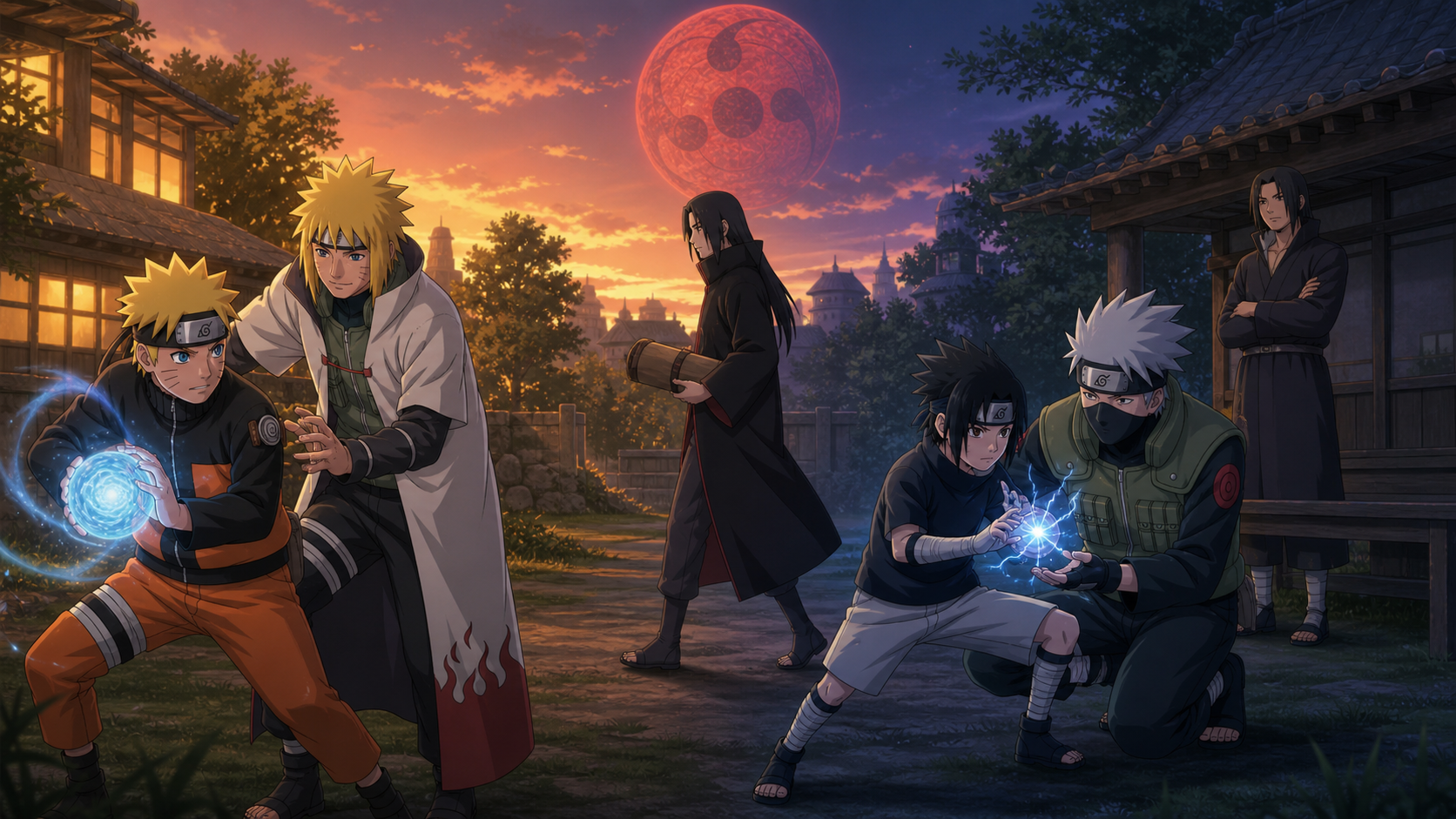
Returning Home
Naruto returns to instruction and relationship; Sasuke returns to comparison and evaluation, then tries to make technique cover the distance between them.
Bottom line
“Returning Home” brings the rookies back to Konoha, but home does not offer every child the same welcome. Minato recognizes that disobeying orders helped the teams complete the mission, listens to Itachi’s political report, and trains Naruto in the Big Ball Rasengan. Fugaku blames Sasuke for failing to control his teammates, measures him against Itachi, and barely acknowledges his training. Sasuke responds by asking Kakashi for the Chidori, then treats mastery as insufficient the moment he sees Naruto training with his father. The episode is not simply about friendly rivalry producing stronger techniques. Naruto’s progress grows inside attention and instruction. Sasuke’s progress grows inside neglect, comparison, and fear of being ordinary. Both boys return from the same mission, yet one comes home to a relationship while the other comes home to an evaluation. Power can hide that difference for only so long.
Episode 441 opens the manuscript’s second volume
Episode 441 continues Tsunade’s Infinite Tsukuyomi dream through Jiraiya’s anime-original “Shinobi Handbook” manuscript. The Japanese title is “Kikan,” meaning “Returning Home.” The episode aired in Japan on December 10, 2015.
The alternate Konoha still has Minato as Hokage, Naruto’s parents alive, and the Uchiha clan intact. Those changes make familiar rivalries develop through different wounds.
Tsunade hates the first volume’s ending
Morning finds Tsunade complaining about Jiraiya’s abrupt, miserable ending. The explosion that closed Episode 440 denied her the satisfaction of a clean resolution.
Her reaction sounds like an editor arguing with an absent writer. Grief keeps the complaint tender beneath all the irritation.
Shizune brings breakfast and practical reality
Shizune arrives with food while Tsunade remains consumed by the story. Breakfast marks the passage of a full night.
Tsunade has kept reading because Jiraiya’s imagined world offers a version of him that can still surprise and annoy her.
A second volume makes stopping impossible
The continuation waits within reach. Tsunade begins reading again despite criticizing the previous ending.
That contradiction feels honest. A flawed story written by someone beloved can hold more power than a polished story from a stranger.
Four genin teams report to Minato
The rookies return to Konoha and stand before the Hokage. They must account for a mission completed through disobedience, improvisation, and cooperation.
Returning home means submitting field decisions to institutional judgment.
The teams broke direct orders
Sasuke’s faction had emphasized reporting to Konoha while Shikamaru’s faction pushed to rescue captured comrades. The final group acted beyond the narrow command they received.
Their success does not erase the breach. The breach also cannot be judged without the lives their choice saved.
Minato evaluates outcome and intent together
Minato declines to punish them because their disobedience contributed to a successful mission. His response acknowledges context rather than worshipping procedure.
A Hokage still needs rules. Leadership requires knowing when the purpose behind a rule matters more than literal compliance.
No punishment does not mean no lesson
The rookies continue discussing their decision afterward. Relief does not settle every disagreement about command, risk, and responsibility.
Minato allows them room to think rather than reducing the mission to a reward or penalty.
Naruto receives recognition from his peers
The other genin acknowledge Naruto’s contribution against Sasori’s puppets. His rescue effort has changed how they assess his ability.
Recognition feels meaningful because they witnessed the work. Naruto did not win respect through a title or prediction.
Sasuke cannot join the praise
Sasuke remains apart from the group’s admiration. Naruto’s improvement lands directly against the insecurity Fugaku has reinforced for years.
Silence protects Sasuke from admitting that his rival’s success frightens him.
Jiraiya recovers in the hospital
Jiraiya lies injured after four-tailed Naruto attacked him. The hospital bed records the cost of weakening the Nine-Tails seal.
Naruto regained control, but Jiraiya’s wounds prevent the episode from pretending the gamble was harmless.
Jiraiya traces the incident to Orochimaru
He recounts finding Orochimaru and discovering evidence that connects him to the recent operation. The manufactured test belongs to a wider pattern of manipulation.
The revelation keeps Hizashi’s grievance from becoming the only explanation. Someone knew how to weaponize that grievance.
Evidence does not yet reveal the full architect
Orochimaru’s involvement answers one question while opening several more. The reanimation, recruited fighters, and village explosion point beyond an isolated experiment.
Konoha has returned home, but the threat has not disappeared with the mission report.
Fugaku judges Sasuke by failed control
At home, Fugaku berates Sasuke for allowing teammates to break orders. He expects his son to have imposed discipline on the group.
The criticism ignores that cooperation made the rescue possible. Sasuke is blamed for failing to prevent success from taking an unauthorized shape.
Sasuke is assigned responsibility without authority
Sasuke did not command all four teams. Fugaku still treats their choices as evidence of his son’s weakness.
That burden gives Sasuke no fair path. Controlling peers would violate their agency, while failing to control them disappoints his father.
Itachi’s arrival displaces Sasuke
Itachi enters to give Fugaku a report, and Sasuke leaves. The older brother’s official importance pushes the younger son out of the conversation.
No open cruelty is required. Repeated displacement teaches Sasuke where he ranks in his father’s attention.
The Uchiha negotiations carry real stakes
Itachi and Minato discuss promises made to the Uchiha clan. The alternate village has avoided massacre, but political distrust remains active.
Peace survives through negotiation, not through pretending the clan’s grievances vanished.
Minato intends to keep his promises
Minato assures Itachi that he will honor the commitments made during talks with the clan. The answer treats trust as a practice requiring follow-through.
A promise from the Hokage matters only when policy and action support the words.
Itachi carries family and village at once
Itachi reports to Fugaku and speaks with Minato. He occupies the narrow space between clan expectations and village authority.
The role earns Fugaku’s attention, yet that attention comes with political weight Sasuke may not see.
The genin gather at Yakiniku Q
Away from formal reports and family tension, the rookies eat together. The restaurant gives them a place to process what happened as friends.
Shared food restores ordinary rhythm after poison, puppets, and captivity.
The destroyed village shadows the meal
Conversation turns toward the explosion at the settlement Team Jiraiya helped evacuate. Homecoming cannot erase the people who lost their home.
The rookies understand that their successful rescue occurred beside another community’s disaster.
Team Jiraiya becomes a source of suspicion
The genin wonder how Nagato, Konan, and Yahiko connect to the blast and the larger scheme. Limited evidence makes certainty dangerous.
Their suspicion mirrors Nagato’s belief that Yahiko died. Everyone is building conclusions from fragments selected by someone else.
Itachi speaks to Sasuke about Fugaku
The brothers discuss their father and the strain surrounding clan negotiations. Itachi offers context Sasuke rarely receives directly from Fugaku.
Understanding political pressure may explain some distance. Explanation does not make emotional neglect painless.
Sasuke wants proof his progress matters
Fugaku’s indifference leaves Sasuke searching for a result too visible to dismiss. Strength becomes a language he hopes his father will finally hear.
The danger lies in making recognition the finish line. Someone who withholds praise can keep moving that line forever.
Sasuke asks Kakashi for a new technique
He approaches Kakashi and requests stronger training. Kakashi responds by teaching the Chidori.
The choice fits Sasuke’s lightning affinity and precise movement, but the emotional reason behind the request deserves equal attention.
Chidori demands commitment and control
The technique concentrates lightning chakra into a high-speed thrust. Power depends on focus, timing, and willingness to close distance.
Sasuke’s discipline lets him learn quickly. Talent remains real even when insecurity drives the training.
Kakashi gives Sasuke direct instruction
For once, an adult focuses on Sasuke’s specific capacity rather than comparing him to Itachi. Kakashi breaks the technique into work Sasuke can perform.
That attention offers a healthier path, though Kakashi cannot remove the approval wound waiting at home.
Naruto trains with Minato
Naruto begins developing the Big Ball Rasengan under his father’s guidance. Their training relationship is visible, patient, and personal.
Minato does not merely celebrate Naruto’s potential. He spends time helping that potential become skill.
The Big Ball Rasengan expands controlled power
Naruto works to enlarge the Rasengan while preserving its shape and rotation. The lesson answers the previous episode’s uncontrolled four-tailed transformation.
Greater power now requires greater containment rather than surrender to rage.
A father teaches instead of ranking
Minato challenges Naruto without measuring his worth against another child. Progress belongs to the task in front of them.
That environment gives failure somewhere safe to go. A failed attempt becomes information, not evidence that love has been withdrawn.
Sasuke witnesses what he lacks
Sasuke sees Naruto training with Minato. The painful sight includes more than a larger Rasengan.
Naruto has a father watching closely, explaining patiently, and treating his growth as worthy of shared time.
Rivalry absorbs parental envy
Sasuke can compete with Naruto more easily than he can confront Fugaku. The rival becomes a reachable target for anger that began at home.
Defeating Naruto starts to feel like a way to defeat every comparison and absence Sasuke cannot name.
Fugaku dismisses Sasuke’s training
Sasuke returns with evidence of new effort, but Fugaku barely responds. The dismissal confirms that one achievement will not repair their relationship.
Sasuke hears a demand for greater power even when Fugaku says almost nothing.
Mastery brings no satisfaction
Sasuke learns the Chidori, a major technical achievement. Instead of feeling secure, he immediately measures the technique against Naruto’s expanding Rasengan.
Success cannot satisfy a need that success did not create.
Sasuke asks how much farther Chidori can go
He asks Kakashi how far the technique can be developed. Curiosity and ambition belong in good training.
The urgency carries another message: Sasuke fears that standing still for one moment will let Naruto become more worthy than him.
Naruto and Sasuke receive different mirrors
Minato reflects Naruto’s capacity back through instruction. Fugaku reflects Sasuke’s insufficiency through comparison and distance.
Each boy builds identity from the mirror available at home. Rivalry then makes those reflections collide.
The episode does not blame talent
Naruto and Sasuke both work hard, learn quickly, and desire improvement. Their techniques are not moral evidence.
The problem appears when power becomes a substitute for security, affection, or honest family conversation.
Returning home exposes unequal safety
Konoha is physically familiar to both boys. Naruto returns to parents who engage with his growth. Sasuke returns to a father whose attention feels conditional.
Home can be a location without becoming an emotional refuge.
Minato’s leadership and fatherhood echo each other
As Hokage, Minato judges the rookies with context. As Naruto’s father, he teaches through patient attention.
Both roles show authority that listens before deciding what growth requires.
Fugaku confuses pressure with preparation
Fugaku wants Sasuke strong enough for clan and village conflict. Constant comparison may look like a way to harden him.
Pressure without reassurance teaches Sasuke that belonging must be earned repeatedly.
Itachi cannot solve the father-son distance
Itachi can explain Fugaku, encourage Sasuke, and carry political responsibilities. He cannot provide the recognition Sasuke specifically wants from their father.
The older brother becomes both comfort and unavoidable standard.
The title applies to more than the mission
The rookies return from danger. Jiraiya returns injured. Political negotiations return to the foreground. Naruto and Sasuke return to training.
Each homecoming reveals unfinished conflict rather than closing a chapter.
Minato evaluates disobedience without erasing rescue
The rookies broke orders, endangered themselves, and still saved people the original plan left exposed. A responsible debrief has to hold all three facts.
Immediate punishment would simplify leadership into obedience. Immediate celebration would teach that a good outcome makes every reckless method acceptable.
The teams deserve credit beyond Naruto’s arrival
Tracking, medical knowledge, sensory skill, tactical revision, and cross-faction cooperation kept the mission alive before Naruto returned. His power changed the final battlefield.
Recognition becomes honest when it names the people who created a group sturdy enough for one late intervention to matter.
Sasuke cannot receive praise as a shared resource
The room celebrates Naruto, but Sasuke hears the applause through Fugaku’s comparison to Itachi and his own fear of being second. Another person’s success becomes private evidence against him.
That reaction is unfair to Naruto and still rooted in a home where recognition feels scarce.
Fugaku assigns responsibility without matching authority
Sasuke is expected to control power, represent the clan, improve quickly, and understand political stakes, yet adults decide the terms and withhold the information shaping them.
A child cannot be held accountable like a leader while being denied a leader’s context, voice, and ability to alter the plan.
Itachi carries negotiations no child should mediate
He moves between Minato, Fugaku, village interests, clan expectations, and Sasuke’s longing for attention. Competence makes adults give him more weight rather than more protection.
The peaceful timeline remains unsafe when a young person becomes the bridge holding institutions apart.
Promises need public structure behind them
Minato intends to honor commitments to the Uchiha, but personal sincerity cannot guarantee durable policy. Agreements need records, oversight, timelines, representation, and consequences for breach.
Otherwise the clan’s safety depends on one Hokage remaining trusted, alive, informed, and politically strong enough to resist every competing pressure.
Kakashi teaches the technique Sasuke can measure
Chidori offers steps, repetition, visible progress, and feedback. Unlike Fugaku’s shifting approval, the technique has conditions Sasuke can study and improve.
That clarity is comforting, but it also encourages him to translate emotional hunger into more speed, sharper focus, and greater destructive capacity.
Minato teaches relationship alongside Rasengan
He watches Naruto’s form, explains adjustments, and remains present while power expands. The Big Ball Rasengan grows from controlled practice rather than a demand to defeat another child.
Naruto receives correction without hearing that failure makes him less worthy of coming home.
Sasuke witnesses a safety he cannot name
What hurts is not only Naruto’s larger technique. It is the ease of a father giving attention, instruction, and pride without using a sibling as the measuring stick.
Envy attaches to power because admitting the deeper need would expose how little control Sasuke has over receiving love.
Fugaku mistakes dissatisfaction for motivation
Withholding approval may keep Sasuke striving, but striving without a stable point of recognition makes mastery feel empty the moment it arrives.
Pressure can produce performance while damaging judgment, rest, cooperation, and the ability to experience achievement as anything other than temporary relief.
Itachi cannot repair a relationship Fugaku keeps withholding
He can explain their father, encourage Sasuke, and offer affection, but every intervention also reinforces the triangle in which Sasuke reaches Fugaku through Itachi.
The older brother should not be responsible for translating a parent’s care or absorbing the resentment created when that care remains indirect.
Home is a pattern of response, not an address
Naruto returns to parents who question, teach, feed, and continue belonging after error. Sasuke returns to evaluation that makes affection feel conditional on improvement.
Both boys live in Konoha. Only one home consistently separates correction from the threat of emotional displacement.
RaeRae’s verdict
“Returning Home” turns parallel training into a warning about what children think power can repair. Naruto learns Big Ball Rasengan because Minato stays present, corrects technique, and lets improvement occur inside secure belonging. Sasuke learns Chidori because measurable mastery feels safer than Fugaku’s shifting approval. The techniques may both grow, but the emotional conditions are not equal.
The episode also refuses to make the Uchiha problem private. Itachi is carrying negotiations between family and village while Sasuke is expected to absorb responsibility without authority. Minato’s good intentions matter, but promises need structures that survive one good leader. Returning home should mean more than entering a familiar building. It should mean correction without ranking, information without manipulation, rest without earning it, and love that does not disappear when another child performs better.
Episode 441 turns parallel training into warning
Big Ball Rasengan and Chidori look like exciting steps toward stronger versions of familiar heroes. The emotional framing makes the parallel uneasy.
Naruto trains to extend a lesson shared with his father. Sasuke trains to outrun a father’s indifference.
The next episode will measure the gap
Sasuke has mastered a powerful technique and already fears Naruto’s progress exceeds his own. That comparison cannot remain private forever.
Episode 442, “The Mutual Path,” must show whether the boys can grow beside each other or whether unequal support turns rivalry into separation.
RaeRae’s call
Naruto and Sasuke both return home, but only Naruto returns to instruction that does not rank his worth. Minato turns correction into relationship. Fugaku turns comparison into preparation and leaves Sasuke chasing a finish line that moves with every achievement. Kakashi’s Chidori offers measurable progress, which makes technique feel safer than asking directly for love. Itachi remains trapped between clan, village, father, and brother because adults keep treating competence as permission to add burden. Power cannot repair that architecture. Home becomes safe when children receive context, boundaries, rest, and affection that another person’s success cannot take away. Children should never have to turn power into evidence that they deserve affection at home.
Episode details and viewing routes
- Official episode reference: Naruto Official episode guide
- Licensed episode route: Crunchyroll licensed episode page
What I am carrying forward
The four rookie teams returned to Konoha after breaking Minato’s direct orders to report before engaging. Minato evaluated their intent and results without treating the rescue as proof that procedure no longer mattered. Jiraiya survived Naruto’s four-tailed transformation and traced the incident toward Orochimaru’s network.
Minato trained Naruto in Big Ball Rasengan. Kakashi began teaching Sasuke Chidori after Sasuke struggled with Fugaku’s comparison to Itachi and watched Naruto receive direct instruction from his father. Episode 442, “The Mutual Path,” continues the widening emotional and technical gap.