
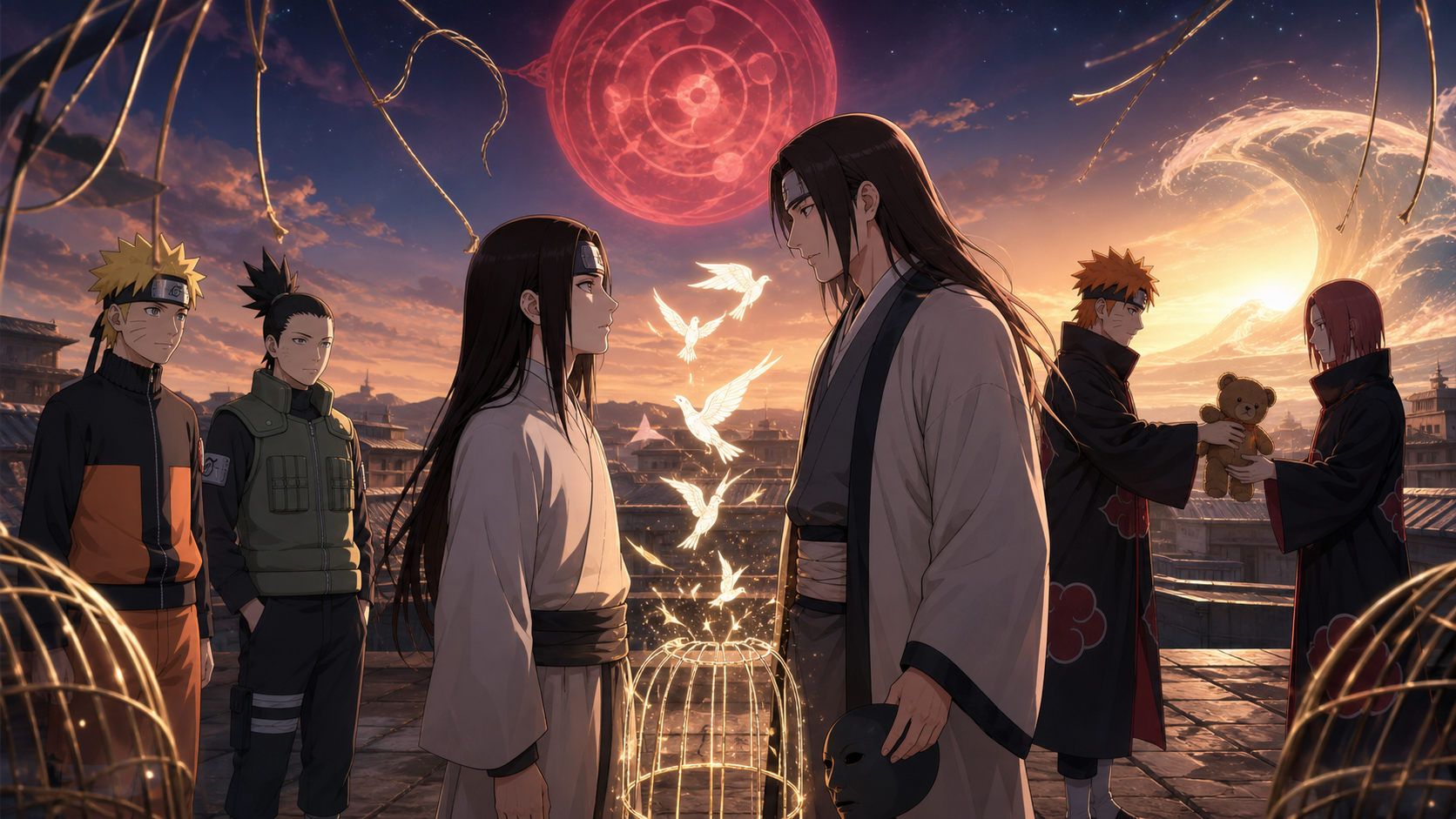
The Caged Bird
Hizashi built a cruel test from the wound Konoha left him, but Neji proves that acknowledging the cage does not require letting its bars choose every future.
Bottom line
“The Caged Bird” gives Neji a second conversation with the father whose death once made fate feel absolute. Hizashi engineered a cruel test because resurrection returned him to a world he no longer trusted. He wanted proof that Konoha would still sacrifice people to rules, just as the Hyūga Affair sacrificed him. Instead, the rookies reunite, rescue their teachers, and choose comrades without becoming enemies of their village. Neji explains that fighting Naruto changed his understanding of destiny. Freedom does not mean denying the cage or pretending the bars never wounded anybody. Freedom begins when a person refuses to let those bars dictate every future choice. Hizashi releases his resentment after hearing his son speak with conviction. The peace lasts only seconds. Yahiko returns a child’s teddy bear, an explosion destroys the village, and Nagato believes his friend died. One father escapes an old grievance while another young man falls toward a new one.
Episode 440 continues Jiraiya’s alternate manuscript
Episode 440 remains inside the anime-original “Jiraiya Shinobi Handbook” story that Tsunade reads during Infinite Tsukuyomi. The Japanese title is “Kago no Tori,” meaning “The Caged Bird.” The episode aired in Japan on December 3, 2015.
The manuscript rearranges familiar history. Hizashi’s return, the rookie mission, and Team Jiraiya’s role belong to that alternate story rather than the main Naruto timeline.
Tsunade reacts before the explanation arrives
Neji’s use of “father” shocks Tsunade. The masked man has spent several episodes speaking like an anonymous judge, and one word makes his argument painfully specific.
Tsunade knows enough of Konoha’s history to understand why Hizashi’s presence cannot be a harmless reunion.
Shizune brings the drink Tsunade wanted
Shizune arrives with alcohol, and Tsunade accepts the small comfort before returning to the pages. Her reading has become equal parts mourning, irritation, and compulsion.
The drink does not soften the manuscript’s questions. Tsunade must watch Jiraiya use the village’s old wounds as story fuel.
Neji asks about the kidnapped shinobi first
Even after recognizing his father, Neji does not abandon the immediate mission. He asks where the captured jōnin are being held and whether they remain safe.
That priority already answers part of Hizashi’s test. Neji can face a private shock without forgetting the people depending on him.
Hizashi promises their release
The masked man says Team Jiraiya will lead the rookies to the prisoners. The test has produced the result he wanted, or at least a result he can no longer deny.
Ending the danger does not erase his responsibility for creating that danger.
Neji returns to his comrades
Hizashi lets Neji leave the isolated observation space and rejoin the rookie group. Neji moves from captive witness back to active teammate.
That transition carries the episode’s title in miniature. The cage loses power when Neji chooses where to stand.
The rookies become one team
Naruto, Sasuke, Shikamaru, and the others stop operating as rival factions. They coordinate around finding Asuma and the other missing leaders.
Their earlier disagreement remains real. Unity does not require pretending nobody argued. The group simply refuses to let the argument decide who deserves rescue.
Shikamaru corrects the mission’s emotional center
The search begins with specific concern for Asuma, then expands to every captured friend and teacher. Personal attachment becomes a path into shared responsibility.
Rules work best when they organize care rather than replace care.
Neji explains the experiment
When Neji rejoins the others, he tells them the crisis was designed as a test. The masked man wanted to learn whether Leaf shinobi would obey village rules or protect comrades.
The explanation gives shape to the manipulation, but cannot make the suffering theoretical. Poison, fear, combat, and captivity were real to the people inside the test.
An answer produced through coercion stays compromised
Hizashi created limited choices and watched how frightened young people responded. Their compassion belongs to them. The cruelty of the conditions belongs to him.
A good result does not retroactively make the experiment ethical.
Hizashi dismisses his hired fighters
The masked man tells Hidan, Kakuzu, and Sasori that their part is finished. They leave once the test no longer needs their pressure.
Their withdrawal reveals how much of the conflict was staged, but staging does not make poison or weapons safe.
Team Jiraiya receives a final assignment
Hizashi instructs Nagato, Konan, and Yahiko to return evacuated villagers to their homes. He also gives them another task tied to the captured jōnin.
Team Jiraiya has served as both participant and instrument. The episode now lets them help repair a fraction of the disruption.
Konan turns paper into a guide
Konan creates paper butterflies that lead the rookies toward their imprisoned teachers. A technique often associated with surveillance or attack becomes a trail toward reunion.
Her guidance is quiet and precise. The rookies still have to follow, search, and free the captives themselves.
The genin find their teachers
The group reaches the captured jōnin and releases them. The rescue resolves the practical question that divided the rookies across the previous episodes.
They succeed because former factions combine effort rather than because one side wins the argument.
Kurenai demands an explanation
Kurenai asks what happened and why their students faced such danger. Her question restores adult accountability to a story that kept testing children.
The rookies should never have carried the full burden of explaining someone else’s experiment.
The masked man steps forward
Hizashi arrives and offers to explain the incident himself. For the first time, he must speak before the people harmed by his design rather than from a protected distance.
Accountability begins when the architect of a test stops hiding behind the subjects’ behavior.
The mask and bandages come off
He removes the coverings and reveals Hizashi Hyūga. The face confirms what Neji already understood.
Recognition does not produce an easy embrace. Father and son still stand on opposite sides of a manufactured crisis.
Hizashi returned through reanimation
Hizashi explains that a bandaged man brought him back through a reanimation technique. Resurrection restored his body while preserving the grievance attached to his death.
He returned without peace because the world that demanded his life had not earned his trust.
The Hyūga Affair shaped his suspicion
Neji recounts the conflict involving the Hidden Cloud, Hinata’s attempted kidnapping, and the demand for Hiashi’s body. Hizashi died in his twin brother’s place.
That sacrifice cannot be separated from the branch-family system that marked one brother as expendable.
Hizashi wanted to measure the village after his death
The resurrected father arranged the experiment to learn whether his sacrifice changed Konoha. Would the village still elevate rules above people when pressure returned?
His question is legitimate. His method forces another generation to pay for an answer.
Old injustice does not authorize new harm
Hizashi suffered under a system built before Neji’s teammates were born. That history deserves truth and anger.
Using those young people as pieces repeats the same logic he condemns: powerful adults decide whose pain is acceptable for a larger purpose.
Neji once believed destiny was fixed
The branch-family seal, his father’s death, and the clan hierarchy taught Neji that birth determined every ending. He treated fatalism as knowledge because hope felt dishonest.
The cage was physical, political, and emotional. His certainty protected him from expecting freedom.
Naruto challenged Neji’s certainty
Their Chūnin Exam fight did not erase the Hyūga system. Naruto challenged Neji’s claim that effort and choice were meaningless inside that system.
Neji lost more than a match. He lost the comfort of believing every outcome had already been assigned.
Change began with an argument Neji hated
Naruto spoke from outside the branch family and could not fully understand Neji’s burden. Neji had good reason to resent simple encouragement.
Still, Naruto’s refusal to accept the verdict forced open a question. A narrow opening can matter when every wall claims to be permanent.
Neji chose what to do with Naruto’s challenge
Naruto did not hand Neji a finished freedom. Neji reconsidered his father, his own strength, and the purpose behind his choices.
That internal work belongs to Neji. Credit for growth should not erase the person who performed the growth.
Strength gains a different purpose
Neji tells his father that he wants to become strong without losing to anyone. The statement can sound competitive, but the surrounding lesson changes the meaning.
Strength is no longer proof that fate selected him. Strength becomes room to protect bonds and choose his direction.
The caged bird still wants the sky
The title does not claim the cage vanished. Hyūga customs, the curse mark, and the memory of sacrifice remain part of Neji’s life.
Freedom appears through continued desire, deliberate movement, and refusal to treat imposed limits as moral truth.
Hizashi hears a son rather than a victim
Hizashi expected Neji to confirm that his death produced only bitterness. Instead, Neji speaks as someone changed by friendship without denying injustice.
The answer gives Hizashi what the wider experiment could not: direct evidence from the child most affected by his loss.
Father and son finally discuss motivation
Their exchange reaches beneath clan politics. Hizashi asks what drives Neji now, and Neji answers from a life his father never got to witness.
The tragedy lies in how much growth happened during Hizashi’s absence. The mercy lies in their brief chance to name that growth together.
Hizashi releases his attachment
Neji’s conviction allows Hizashi to let go of the resentment binding him to the reanimated body. His soul begins to depart.
Peace does not mean Konoha was innocent. Hizashi releases his need to make Neji prove that the village remained hopeless.
Letting go is not historical forgiveness
The Hyūga Affair still happened. The branch family still suffered. Hizashi’s departure cannot settle every institutional wrong through one emotional conversation.
His release is personal. Reform still belongs to the living.
Neji gives his father a different legacy
Hizashi feared his death left a son trapped by rage and a village unchanged by sacrifice. Neji shows that pain did not dictate his entire future.
The father’s legacy becomes more than the manner of his death. Neji carries love, questions, and chosen bonds forward.
Behavior answers Hizashi.
The village test ends with cautious hope
Hizashi sees a future in the young shinobi. That hope comes from their ability to reconsider choices and return to one another.
Konoha has not become flawless. A future exists because the next generation can challenge inherited failures.
Yahiko remembers Komichi’s teddy bear
Away from the Hyūga reunion, Yahiko carries Kenta, the teddy bear belonging to the child Komichi. Returning the toy makes the evacuation feel personal rather than procedural.
Yahiko is thinking about one frightened child and one promised comfort.
A small kindness sends Yahiko back
He heads toward the village to return Kenta. The errand expresses the same principle the rookies defended: individual people matter inside large missions.
No prophecy or order makes the gesture important. Yahiko simply remembers someone’s need.
The village disappears in an explosion
An explosion destroys the settlement before the hopeful resolution can breathe. Smoke and ruin replace the homes Team Jiraiya expected to restore.
The timing feels deliberately cruel. One cycle of resentment closes as another begins.
Nagato finds the damaged bear
Nagato sees Kenta among the wreckage and believes Yahiko was killed. The child’s toy becomes evidence of loss before Nagato can confirm the full truth.
Grief races ahead of investigation because the object connects Yahiko directly to the destroyed village.
Assumed death becomes emotional fuel
Nagato’s anger rises from love, shock, and incomplete information. Those ingredients make manipulation easy.
The episode understands how quickly a person seeking peace can become vulnerable to vengeance when a friend appears stolen.
Hizashi and Nagato move in opposite directions
Hizashi releases an old grievance after hearing Neji’s truth. Nagato acquires a new grievance after seeing what looks like proof of Yahiko’s death.
The parallel gives the ending weight. Escaping hatred requires access to truth, while uncertainty can build a fresh cage in seconds.
The episode refuses a clean victory
The jōnin are free, the rookies reunite, and Hizashi finds peace. Every apparent resolution could have supported a comforting ending.
The explosion interrupts that comfort. Peace remains fragile when hidden actors can manufacture loss and control what survivors believe.
Episode 440 makes freedom relational
Neji changes through conflict with Naruto, honesty about Hizashi, and commitment to comrades. Nobody escapes a cage entirely alone.
Relationships can also build cages through comparison, sacrifice, secrecy, and coercion. The difference lies in whether a bond expands choice or demands surrender.
Hizashi’s return gives him power Neji never requested
Reanimation lets a dead father design conditions around the living son, conceal his identity, restrain him, and judge his friendships. Grief does not make that authority fair.
Hizashi deserves to speak about the system that killed him. Neji also deserves to decide whether, when, and how that conversation happens.
The test reproduces the control it claims to examine
Hizashi condemns Konoha for sacrificing people to rules, then abducts jōnin, hires attackers, isolates children, and forces choices through manufactured danger.
His method repeats the logic of the cage: somebody with power decides another person’s suffering will reveal a useful truth.
Neji asks about the captives before asking for closure
His first priority is the people still being used as leverage. That choice proves growth more clearly than any speech about destiny.
Neji refuses to let private longing for his father eclipse the public harm the test caused, which makes reconciliation accountable rather than sentimental.
Shikamaru repairs the mission’s emotional center
The rookies stop organizing themselves around winning the argument and return to the kidnapped teachers. Shikamaru names the shared obligation.
Leadership works because he revises course after new evidence, not because his earlier caution or later rescue becomes the single universal rule.
Konan’s paper turns release into practical guidance
Team Jiraiya does more than approve of the rookies. Konan creates the route that helps them reach the captives, translating changed judgment into material assistance.
Reconciliation becomes credible when it alters access, information, and safety rather than remaining a warm conclusion between leaders.
Neji can honor Hizashi without forgiving the institution
He can understand his father’s love, reject fatalism, and carry a different legacy while still condemning the branch seal and Konoha’s treaty decision.
Personal peace should not be used as evidence that structural harm is resolved. The cage remains a political responsibility after one spirit departs.
Freedom is the ability to revise inherited meaning
Neji once read Hizashi’s death as proof that destiny owned every branch-family life. Later knowledge gave him another interpretation, but Naruto did not simply replace one doctrine with another.
Neji chooses what the challenge means and what kind of strength he wants to practice afterward.
Yahiko’s teddy bear keeps ordinary people inside the war
Komichi’s small gift matters because villages are more than factions, techniques, and leaders. The bear represents a child’s relationship surviving political suspicion.
When the village explodes and Nagato finds the damaged toy, apparent loss becomes personal evidence that can be weaponized toward despair.
Hizashi and Nagato demonstrate opposite grief movements
Hizashi sees changed behavior and releases his attachment, although his test caused harm. Nagato encounters apparent destruction and moves toward deeper anger.
Neither response is inevitable. Relationships, evidence, manipulation, and the presence or absence of living witnesses shape what grief becomes next.
RaeRae’s verdict
“The Caged Bird” earns its emotion when Neji refuses to make reunion the only thing that matters. He asks about the captives, returns to his comrades, explains the experiment, and then meets Hizashi as a son with judgment of his own. His father can be loved, understood, and released without turning the Hyūga Affair into acceptable history.
The episode weakens itself whenever Hizashi’s suffering is allowed to excuse the coercive test. He reproduced control while claiming to evaluate whether Konoha could escape it. The stronger answer comes from behavior he did not fully script: Shikamaru revises the mission, Konan provides a route, the rookies find their teachers, and Neji decides what his father’s legacy will mean. Freedom is not somebody opening the cage after finishing an experiment. It is Neji retaining authority over the story carried out of it.
The next chapter begins with a false conclusion
Nagato believes Yahiko died because every visible clue points toward that conclusion. The audience ends beside his anger without yet knowing the full design behind the blast.
Episode 441, “Returning Home,” must follow the consequences of that belief and the force arranging events around Team Jiraiya.
RaeRae’s call
Neji does not prove freedom by forgiving quickly. He proves it by asking about the people still captive, returning to his team, judging Hizashi’s method, and choosing what his father’s life will mean. Hizashi names a real institutional betrayal, but his manufactured test repeats the control he condemns. Konan, Shikamaru, and the rookies provide the answer through changed behavior and practical cooperation. The branch seal, treaty sacrifice, and clan hierarchy remain wrong after the reunion becomes tender. A son can love his father without certifying the cage that shaped them both.
Episode details and viewing routes
- Official episode reference: Naruto Official episode guide
- Licensed episode route: Crunchyroll licensed episode page
What I am carrying forward
Neji identified the masked examiner as his reanimated father, Hizashi. Hizashi released the kidnapped jōnin after seeing the rookies revise their priorities and cooperate. Neji rejected fatalism, accepted a different understanding of his father’s choice, and allowed Hizashi to release his attachment without absolving the Hyūga system.
Yahiko returned toward the village because he remembered Komichi and the child’s teddy bear. An explosion destroyed the settlement before he arrived, and Nagato found the damaged toy among the wreckage. Episode 441, “Returning Home,” continues from that apparent loss.