
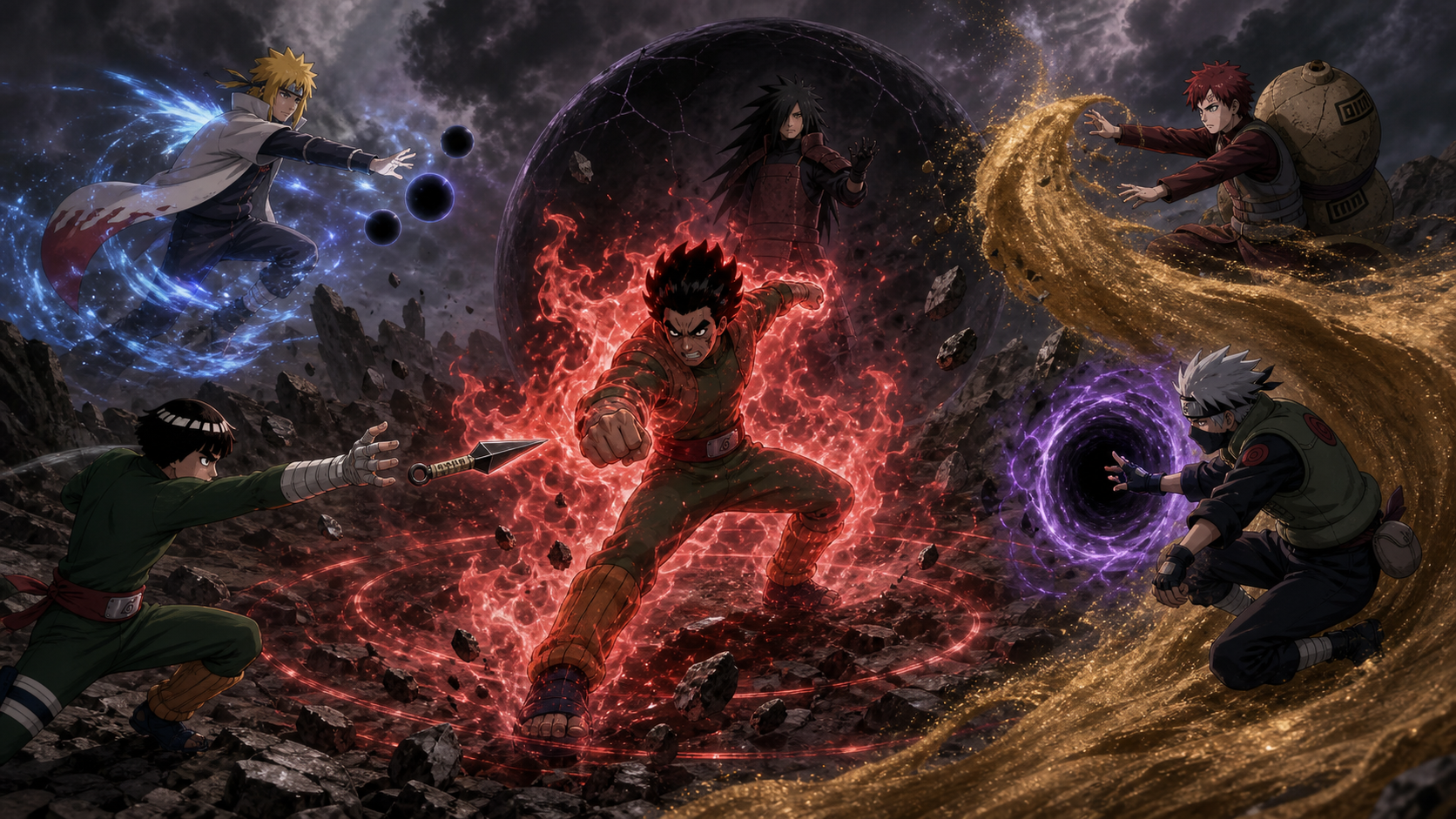
The Eight Inner Gates Formation
Guy supplies terminal force, but Lee, Minato, Gaara and Kakashi turn that force into an attack capable of crossing Madara’s erasing defense.
Bottom line
“Eight Gates Released Formation” turns Might Guy’s terminal technique into a team operation. The first Evening Elephant sequence fails because the pain of the Eighth Gate interrupts Guy after the second step. Madara rises behind a Truth-Seeking Ball shield, delighted to watch another attempt. Guy can supply the force, but force alone cannot cross a defense that erases bodies and techniques on contact. Minato, Rock Lee, Gaara, and Kakashi build the route. Lee throws a marked kunai into the path of Madara’s counterattack. Minato teleports the Truth-Seeking Balls away while accepting contact that destroys part of his reanimated body. Gaara lifts Kakashi into range. Kakashi uses Kamui to remove a section of Madara’s shell. Guy drives the fifth Evening Elephant through that opening and buries Madara in the earth. Madara still rises. The episode then moves inside Naruto’s consciousness, where Hagoromo Ōtsutsuki reveals that Naruto is the reincarnation of his younger son, Asura. The two halves belong together. Guy’s greatest individual output succeeds only through cooperation, while Asura’s inherited strength came through bonds rather than solitary genius. Power becomes world-changing when other people can act inside the power.
Episode 420 continues the present war
Episode 419 ended with Guy opening the Eighth Gate of Death and beginning his attack. Episode 420 resumes at the first step of Evening Elephant.
The battle is already inside Guy’s terminal countdown.
This episode adapts manga chapters 669–670
Chapter 669 carries the coordinated Eight Gates assault. Chapter 670 begins Naruto’s meeting with Hagoromo and the history of Indra and Asura.
The two settings share one episode without sharing physical space.
Red vapor marks the Gate of Death
Guy’s blood evaporates under the heat and pressure generated by the final gate. The red cloud is evidence that his body is consuming itself.
Every movement advances physical collapse.
Lee compares the color to fallen leaves
The image recognizes death without calling the fall meaningless. Leaves can become nutrients for the growth that follows.
The metaphor gives sacrifice a future beyond the person dying.
Guy answers with the springtime of youth
He frames the final burn as a bridge toward fresh green leaves. The language comes from Duy’s teaching and Guy’s years of passing that teaching to Lee.
Inheritance speaks during the attack.
Evening Elephant begins with the first step
Guy punches fast enough to create a column of compressed air. The technique strikes from a distance even though the force originates in taijutsu.
Air pressure carries the physical blow.
The technique can accelerate across five steps
Each consecutive strike increases speed and restricts the target’s movement. The sequence is designed as a continuous formation rather than five unrelated punches.
Timing creates the trap.
Guy reaches the second step and stops
The pain of the Eighth Gate overwhelms him before the full combination develops. His body has gained enormous power without gaining immunity from that power.
Access does not equal control.
Madara sees the interruption immediately
He recognizes the incomplete sequence and the physical cost behind the interruption. Rather than retreating, he waits for Guy to acclimate and attack again.
Curiosity replaces ordinary caution.
Madara rises into the air
Flight gives him distance and forces Guy to fight without stable ground. The repositioning tests whether taijutsu can pursue a Six Paths opponent vertically.
Terrain becomes another defense.
Guy kicks the air to move upward
His speed and force create temporary footholds through pressure alone. The maneuver keeps him aligned with Madara despite lacking conventional flight.
Physical mastery answers impossible geometry.
Guy acclimates to the pain
The first failed attempt gives his nervous system enough information to continue through the next burst. Acclimation does not reduce the damage or extend his life safely.
He learns inside a shrinking interval.
Minato insists that the others help
Guy’s willingness to die does not turn every nearby shinobi into an audience. Minato reads the defense and assigns work around the next attempt.
Respect for sacrifice requires intervention.
The support plan has several dependent steps
Lee must place a marked kunai. Minato must intercept the counterattack. Gaara must position Kakashi. Kakashi must open the shell. Guy must maintain the Evening Elephant sequence through the exact opening.
No contribution works alone.
Minato gives Lee a Flying Thunder God kunai
The marker allows Minato to teleport to a location Lee can reach through throwing strength and timing. Lee becomes the delivery system for space-time ninjutsu.
The borrowed tool expands his role without replacing taijutsu.
Lee watches the teacher who shaped him
He understands the gate sequence and the death attached to the eighth release. Participation means helping Guy use the fatal interval effectively.
The student supports a choice he desperately does not want to lose.
Madara forms a Truth-Seeking Ball shield
The black material closes around him and nullifies ordinary contact. Guy can generate enough force to move Madara, but touching the shell directly risks erasure.
Power needs access to become damage.
Madara launches a Truth-Seeking Ball at Guy
The counterattack crosses the path of the second Evening Elephant sequence. Guy cannot safely absorb or strike through the orb.
The support plan enters its first live test.
Lee throws the marked kunai into the attack path
His timing places Minato’s formula between Guy and the incoming sphere. A missed throw would leave no teleportation point.
Precision makes the legendary technique available.
Minato uses Flying Thunder God
He appears at the marker and redirects the Truth-Seeking Ball away from Guy. The movement removes an attack that could end the formation immediately.
Defense becomes control of location.
Minato accepts catastrophic contact risk
Truth-Seeking material can destroy portions of his reanimated body beyond normal recovery. He enters the path knowing the interception may cost what remains of him.
The dead Hokage still has something physical to lose.
Lee’s throw and Minato’s teleport are one action chain
Calling the moment Minato’s save alone would erase the placement that made the save possible. Lee supplies the coordinate under combat pressure.
Shared techniques include the person who creates the opening.
Gaara raises Kakashi on sand
Kakashi needs a usable angle and distance for Kamui. Gaara moves him toward Madara’s airborne shell while maintaining control in the middle of Guy’s pressure attacks.
Transport becomes offensive setup.
Kakashi targets the Truth-Seeking Ball defense
He does not try to overpower the shell. Kamui removes a selected portion by sending that space into another dimension.
Precision defeats the need for equal force.
Kamui creates a physical opening
The gap is small and temporary, but Guy’s final step needs only a path through the defense. Kakashi turns inaccessible power into a hittable body.
Support changes the geometry of victory.
Guy maintains the sequence through the fifth step
His second attempt continues beyond the pain that stopped him earlier. Each air-pressure strike builds speed and confinement around Madara.
Endurance completes the formation.
The fifth Evening Elephant lands directly
Guy drives the final column through Kakashi’s opening and forces Madara through the back of his own defense. The impact sends him into the ground.
The clean hit belongs to five people’s timing.
Madara’s shield becomes part of his collision
The defense that isolated him also channels the final blow once Kakashi cuts the entrance. Guy pushes Madara through a structure meant to make contact impossible.
Control of shape reverses the protection.
Evening Elephant does not kill Madara
The crater and bodily damage look decisive, but the Ten-Tails’ jinchūriki rises again. His regeneration and Six Paths power remain active.
The team earns damage without earning a finish.
Madara compares the excitement to Hashirama
He says no battle since his clashes with Hashirama has made him feel this way. The comparison acknowledges Guy’s combat level while centering Madara’s appetite for stimulation.
Enemy praise is not the moral purpose of the attack.
Guy has less time after the sequence
Every step accelerates the failure of his body. Surviving the first combination does not reset the gate or create a safe pause.
The next decision must be stronger and faster.
Night Guy remains ahead
The final kick that bends space and destroys part of Madara’s body does not occur in Episode 420. This episode ends the Evening Elephant phase before moving to Naruto.
Publication must not pull Episode 421’s climax backward.
Naruto wakes in an unfamiliar inner space
While Obito transfers tailed-beast chakra and Sakura protects his body, Naruto regains awareness somewhere outside ordinary battlefield perception. He initially wonders whether death has already occurred.
Consciousness returns before orientation.
A floating old man tells Naruto he is alive
The stranger corrects the immediate fear without explaining the full condition of Naruto’s body. The rescue outside continues while the inner meeting begins.
Spiritual encounter and medical survival happen together.
The old man is Hagoromo Ōtsutsuki
He identifies himself as the Sage of Six Paths, the figure connected to ninshū, the tailed beasts, and the shinobi world’s earliest history.
Myth enters the conversation as a person.
Naruto struggles with Hagoromo’s formal speech
The Sage’s vocabulary and old manner do not automatically communicate authority to him. Naruto asks for clearer language rather than performing reverence.
Understanding matters more than ceremony.
Hagoromo adapts his explanation
He adjusts enough to continue the conversation with the person in front of him. The founder of ninshū has to practice communication rather than merely possess knowledge.
Connection requires meeting another person halfway.
Hagoromo speaks about his mother
Kaguya Ōtsutsuki possessed extraordinary power and became central to the origin of chakra on Earth. Her history sits behind the conflict now expressed through Madara.
The war’s timeline expands beyond known villages.
Hagoromo and Hamura opposed the Ten-Tails
The brothers fought the monstrous form connected to Kaguya and sealed its power. Hagoromo later became the Ten-Tails’ jinchūriki and divided its chakra into the tailed beasts.
Naruto’s relationships with those beasts connect directly to this history.
Hagoromo founded ninshū
His teaching used chakra to connect spiritual energy so people could understand one another. Ninjutsu later emphasized weaponized application.
The distinction challenges Madara’s account of inevitable human failure.
Hagoromo had two sons
Indra, the elder, inherited remarkable talent and ocular power. Asura, the younger, began without comparable individual ability.
Their difference becomes a dispute over leadership and method.
Indra trusted solitary power
His gifts made achievement through personal strength appear natural. Control and superiority became plausible answers to disorder.
Talent can narrow what a person learns to need.
Asura needed cooperation
Because he could not solve every challenge alone, Asura built relationships and gained strength through other people. Dependence became a path to collective power.
Limitation opened social knowledge.
Naruto recognizes himself in Asura
The description of weak early talent, persistent work, and bonds resembles Naruto’s own development. He responds before Hagoromo names the connection.
Recognition comes through lived pattern.
Naruto is Asura’s reincarnation
Hagoromo reveals that Asura’s chakra and conflict have continued through later lives, now including Naruto. The statement changes the scale of Naruto’s bond with Sasuke.
Inheritance becomes active rather than historical.
Reincarnation does not erase Naruto’s choices
The pattern explains pressures and parallels, but Naruto’s specific friendships, failures, promises, and decisions remain his own. Destiny cannot substitute for character evidence.
The final React should resist reducing him to a vessel.
The battle and inner meeting share a thesis
Guy cannot land the fifth step alone. Asura did not become strong alone. Both sequences show limits producing cooperation rather than shame.
Dependence becomes capability.
Minato’s team does not borrow Guy’s glory
Guy supplies the speed, pain tolerance, and terminal power. The others make that power usable against Madara’s specific defenses.
Credit can be shared without flattening contribution.
Guy’s sacrifice does not cancel the duty to help him
Minato rejects passive admiration and organizes support. A person willing to die is still owed every possible improvement to the plan.
Respect should reduce waste.
Naruto’s rescue also remains collaborative
Sakura, Gaara, Minato, Kakashi, Obito, Kurama, and the other tailed beasts make the inner meeting possible by keeping his body and chakra within reach.
Spiritual revelation rests on material care.
The final React should name the Evening Elephant mechanics correctly
Sekizō uses successive compressed-air punches, building through five steps. Guy does not strike Madara five times through ordinary hand-to-body contact.
Technique accuracy protects the analysis.
The final React should preserve each support role
Lee places the marked kunai, Minato removes the counterattack, Gaara positions Kakashi, Kakashi opens the shell, and Guy lands the fifth step. Omitting one person breaks the causal chain.
The sequence is a model of layered teamwork.
The final React should not call Hagoromo a hallucination
Naruto’s meeting occurs in a spiritual or internal plane tied to chakra and reincarnation. Later effects confirm that the encounter changes the physical battle.
Unfamiliar setting does not make the Sage imaginary.
Japanese performance requires direct listening
Claims about Guy’s pain, Lee’s fear, Minato’s urgency, Madara’s excitement, Naruto’s confusion, or Hagoromo’s manner require lawful scene-level Japanese listening.
No invented vocal analysis belongs in publication.
The fifth strike is a team-built opening
Guy supplies the terminal technique, but Madara’s air position and Truth-Seeking Ball defense make a clean route impossible. Minato designs the sequence, Lee places the marker, Gaara raises Kakashi, and Kamui removes the shield.
Credit does not shrink Guy. It explains how specialists preserve his chance to land what he chose.
Lee’s throw carries trust and unbearable knowledge
He must place the Flying Thunder God kunai accurately while watching the teacher who gave his life direction burn through the Gate of Death. Grief cannot pause the timing.
Lee’s contribution is not emotional decoration. The entire interception depends on his hand.
Minato’s risk requires exact consent
Teleporting into the Truth-Seeking Ball’s path exposes a body already missing both arms to further destruction. He makes the decision because the projectile must leave Guy’s route.
Heroic framing should still name the catastrophic contact risk and the narrow timing that prevents it from spreading.
Hagoromo adapts instead of demanding reverence
Naruto struggles with formal explanation, so Hagoromo changes language. Authority becomes useful when it accepts responsibility for being understood rather than blaming the listener.
The conversation can carry enormous history without treating confusion as disrespect.
Asura’s cooperation does not erase Naruto’s authorship
Reincarnation explains a pattern of inherited conflict, not every bond Naruto formed or every choice he made. He resembles Asura while remaining accountable for his own path.
The battle outside proves the distinction. Cooperation works through specific people making present decisions, not destiny moving bodies automatically.
RaeRae’s verdict
“Eight Gates Released Formation” earns its scale by refusing the fantasy that Guy’s ultimate sacrifice should make everybody else stand back. His first Evening Elephant breaks under pain. The response is not another speech about believing harder. Minato studies Madara’s counterattack and distributes responsibility. Lee’s throw makes Flying Thunder God possible. Minato risks erasure to remove the orb. Gaara gives Kakashi the correct angle. Kakashi edits a hole into the defense. Guy does what nobody else can do and drives the fifth step through that opening. The result is still not enough to kill Madara, but the sequence proves that support can sharpen even the most individual form of mastery.
Naruto’s meeting with Hagoromo could feel detached after that impact, yet the transition extends the same idea. Asura began behind his gifted brother and became strong through bonds. Naruto recognizes the pattern because his life has followed the same route. Reincarnation raises difficult questions about inherited conflict, but Episode 420 does not need destiny to explain why Naruto matters. The evidence is already outside: while he lies unconscious, former enemies, friends, teachers, tailed beasts, medics, and rivals are reorganizing the battlefield so he can return. The episode’s real formation is larger than eight gates.
RaeRae’s call
Guy’s fifth Evening Elephant lands because a whole rescue-and-attack chain protects the route. Lee throws the marker, Minato intercepts the Truth-Seeking Ball, Gaara positions Kakashi, and Kamui removes Madara’s defense. Guy keeps moving through pain none of that support can cancel. The result is still not victory, and the Gate of Death remains a terminal cost rather than a red upgrade. Inside Naruto, Hagoromo explains another inheritance built around solitary power and cooperation. Reincarnation does not author Naruto’s choices. People do. The episode’s thesis is visible outside: shared work creates possibilities no isolated fighter, however gifted or willing to die, can create alone.
Episode details and viewing routes
- Official episode reference: Naruto Official episode guide
- Licensed episode route: Crunchyroll licensed episode page
The fight becomes legible when the formation is treated as logistics under pressure. Guy cannot protect himself while maintaining the sequence, so a teammate takes responsibility for one obstacle. Nobody can substitute for another after the timing begins. That precision makes the support more than encouragement shouted. It is participation in the attack and participation in its cost. When the fifth step lands, the moment belongs to Guy without becoming his alone. The people clearing his path inherit responsibility to remember him as a teacher and person, not merely the body that reached Madara.
What I am carrying forward
Guy’s first Evening Elephant stopped after the second step because of the Eighth Gate’s pain. Minato organized support for the next attempt. Lee threw a Flying Thunder God kunai into Madara’s counterattack, Minato teleported the Truth-Seeking Balls away, Gaara lifted Kakashi into range, and Kakashi used Kamui to open Madara’s shield. Guy landed the fifth step directly, but Madara survived.
Inside an unfamiliar spiritual space, Naruto met Hagoromo Ōtsutsuki, the Sage of Six Paths. Hagoromo described his sons Indra and Asura: the gifted elder who trusted individual power and the initially weak younger son who became strong through cooperation. Hagoromo revealed that Naruto is Asura’s reincarnation. Episode 421 continues that history while Guy prepares the last technique beyond Evening Elephant.