
Papa’s Youth
Duy’s worth existed through twenty uncelebrated years, and Guy’s final gate is not proof of value but the protection he chooses to buy with it.
Bottom line
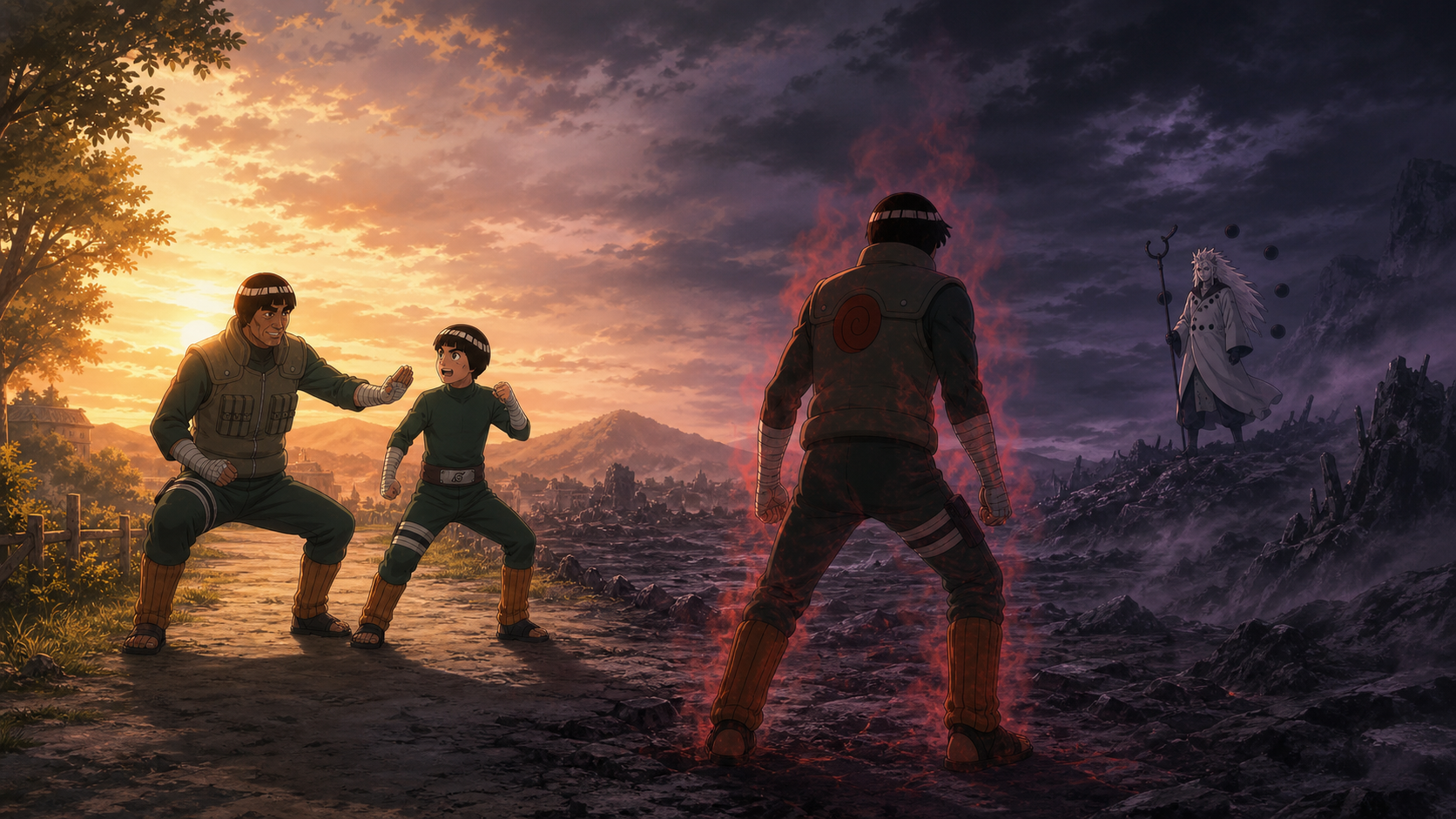
“Papa’s Youth” explains why Might Guy can open a gate called Death without confusing sacrifice with defeat. Might Duy spends twenty years as an eternal genin, takes work other shinobi mock, and trains after those missions have already exhausted him. Young Guy is ashamed before he understands what his father has built. Duy’s optimism is not denial. He gives pain a use through self-rules, teaches that victory means protecting something precious, and reserves the Eighth Gate for the one moment when spending a life can preserve other lives. That moment comes when Guy’s team encounters the Seven Ninja Swordsmen of the Mist. Duy steps between the children and certain death, opens all eight gates, and turns the village joke into their only path home. In the present, Guy makes the same decision against Six Paths Madara. The red vapor around him is his blood burning into steam. He is not finally proving that Duy was secretly worthy. Duy’s worth existed while nobody applauded, and Guy’s worth existed before Madara noticed him. The final gate is not their value. The final gate is what they choose to protect with value built over a lifetime.
The episode pauses at Guy’s final threshold
Episode 418 established that the Seventh Gate and Daytime Tiger could reach Madara but could not stop him. Before Guy opens the last gate, Episode 419 returns to the childhood that gave the technique a rule.
The flashback supplies decision-making context rather than a victory delay.
Episode 419 expands manga chapter 668
Might Duy’s philosophy, the encounter with the Seven Ninja Swordsmen, and Guy’s present choice come from chapter 668. The anime adds substantial childhood and training material around that core.
The final React should label the episode manga-based with anime-original expansion.
Young Guy sees his father being mocked
Villagers and shinobi treat Duy’s eternal-genin rank as proof that his effort has accomplished nothing. Their laughter turns public status into a verdict on the whole person.
Guy absorbs the shame before he can challenge the measure.
Duy responds with optimism
He refuses to let ridicule determine the emotional meaning of his day. The smile is active discipline, not evidence that contempt does not hurt.
Resilience can coexist with injury.
Guy asks how his father stays positive
The question comes from frustration because cheerful slogans seem inadequate beside repeated humiliation. Guy wants an explanation strong enough to survive what he witnesses.
Duy answers with a practice rather than a mood.
True victory is not defeating another person
Duy separates strength from ranking, domination, and public acknowledgment. Winning matters most when power protects someone precious.
The definition changes the purpose of training.
Protection gives force a moral boundary
Without a protected person or principle, greater strength can become vanity or cruelty. Duy’s rule requires power to answer for its use.
Capability alone cannot define success.
Guy struggles to enter the Academy
His weak ninjutsu and genjutsu performance make formal admission uncertain. The village system recognizes the areas where he falls short before recognizing the discipline he can build.
Early evaluation mistakes current ability for final capacity.
Guy runs five hundred laps
He creates an extreme physical challenge outside the ordinary entrance measure. The work demonstrates persistence but also shows how quickly he learns to make his body carry every answer.
Determination needs guidance as much as praise.
Hiruzen notices the effort
The Third Hokage sees a quality the standard evaluation failed to capture. Admission becomes possible because somebody with authority looks beyond the first score.
Systems change when observers question their measures.
Duy helps Guy turn limits into direction
He does not promise that effort will make his son equally gifted in every field. Guy can build around taijutsu while still learning the baseline knowledge required of a shinobi.
Specialization is not pretending weakness disappeared.
Kakashi becomes an immediate comparison
The prodigy advances early, performs techniques Guy cannot manage, and carries a respected clan name. Guy sees him as proof of the distance ahead.
Comparison can motivate while also distorting self-worth.
Guy wants to challenge Kakashi
A direct contest would give the rivalry a score. Duy recognizes that issuing the challenge too early may turn Kakashi into the owner of Guy’s progress.
The goal needs to remain Guy’s.
Duy proposes a self-rule
Guy can set a difficult condition and attach a consequence to failure. The rule converts frustration into a chosen training structure.
Discipline becomes a promise made to oneself.
A self-rule is not random punishment
The condition must serve growth and carry meaning. Endless suffering without reflection would only reproduce the contempt Guy already receives.
Purpose separates discipline from self-harm.
Guy trains instead of challenging Kakashi immediately
He delays the public contest and works on the capacity he wants to test. Restraint becomes part of the rivalry.
Preparation is an action, not an absence of courage.
Kakashi trains beyond natural talent
Guy eventually sees that the prodigy also works relentlessly. Talent explains part of Kakashi’s lead but not the entire person.
Respect begins when the comparison becomes more accurate.
Rivalry becomes recognition
Guy can admire Kakashi’s discipline without abandoning the desire to surpass him. The relationship grows stronger when imitation gives way to mutual challenge.
Competition does not require contempt.
Guy graduates from the Academy
The milestone confirms that his first rejection was not a final truth. Repetition, instruction, and a route suited to his strengths produce measurable change.
Effort matters because the work alters capacity.
Graduation does not end the struggle
Guy enters missions while his technique remains narrow and his reputation remains unfinished. The headband opens a path rather than delivering status.
Progress creates new responsibilities.
Duy remains an eternal genin
His rank does not rise alongside Guy’s development. He continues taking low-level assignments despite decades of experience.
The father’s hidden mastery stays invisible to institutional promotion.
Guy feels embarrassed by Duy’s missions
He hears other shinobi complain about his father’s performance and interprets rank as evidence. The shame is painful because Guy loves Duy while wanting distance from the ridicule attached to him.
Affection does not prevent a child from absorbing social judgment.
A jōnin criticizes Duy’s work
The complaint frames him as slow, limited, and unsuitable for serious responsibility. From the outside, Duy’s daily condition appears to confirm the assessment.
The observer sees fatigue without knowing its source.
Duy trains at night after completing missions
His ordinary work is followed by the private labor of mastering the Eight Gates. The schedule explains why he can look depleted during duties others consider easy.
Invisible training has visible costs.
Twenty years built the Eight Gates technique
Duy’s mastery is not a sudden revelation delivered by bloodline talent. Two decades of repeated physical study create access to the body’s internal limiters.
Time is part of the technique.
Rank cannot measure this mastery
The village calls Duy an eternal genin while he possesses a forbidden method capable of challenging elite enemies. His career exposes how incomplete rank can be as a record of human ability.
Unrecognized does not mean unskilled.
Hidden ability does not make every criticism false
Duy’s nightly training may impair his daytime performance, and teammates still experience those consequences. Secret greatness cannot excuse all unreliability.
Complex respect is stronger than reversal fantasy.
Duy teaches the Eight Gates to Guy
The inheritance includes anatomy, conditioning, access sequence, danger, and moral restriction. Passing down the technique means passing down judgment about use.
Power arrives with a condition.
The final gate is reserved for protection
Duy tells Guy that the Eighth Gate should open only when something precious must be defended at the cost of one’s life. The rule keeps desperation from becoming casual spectacle.
Death must not become a training target.
Guy’s team enters a dangerous mission
The Third Shinobi World War places young shinobi into conditions far beyond classroom rivalry. Guy travels with Genma and Ebisu when the threat escalates.
War makes children carry adult consequences.
They encounter the Seven Ninja Swordsmen of the Mist
The elite group represents a lethal mismatch for the young Konoha team. Escape is not guaranteed once the Swordsmen surround them.
Skill assessment becomes immediate survival knowledge.
Guy recognizes that his team cannot win
Fear is accurate under these conditions. Courage does not require pretending the opponents are manageable.
Clear danger assessment prepares the ground for sacrifice.
Duy arrives between the Swordsmen and the children
The eternal genin enters a battlefield occupied by some of Kirigakure’s most feared fighters. His position announces the choice before the technique begins.
He makes himself the obstacle so the children can leave.
Duy tells the team to run
The order separates protection from audience. He does not need Guy to watch the full proof of his strength.
The objective is escape, not recognition.
Duy opens all Eight Gates
The technique releases the body’s final restraints and guarantees his death. Red vapor marks the internal damage powering the assault.
His hidden training becomes visible only when visibility no longer benefits him.
The Seven Swordsmen encounter receives anime detail
The manga establishes Duy confronting the group, while the anime visually identifies and expands members involved. Those additions should be described as adaptation detail rather than retroactively assigned to every manga panel.
Medium-specific evidence stays separate.
Duy creates an escape path
Whether every opponent falls is less important than the result his rule demanded: Guy, Genma, and Ebisu survive. The sacrifice succeeds through protected lives.
Victory follows Duy’s own definition.
The final battle does not improve Duy’s past rank
He dies an eternal genin. No promotion can arrive afterward to make the life respectable under the system that mocked him.
The episode asks viewers to reject the measure, not imagine a late correction.
Guy inherits more than a technique
He carries the self-rules, the definition of victory, the willingness to train privately, and the duty to protect. The Eight Gates are the most visible part of a larger inheritance.
Method matters as much as force.
Guy later teaches Rock Lee through the same framework
Lee’s limits resemble Guy’s early struggle with ninjutsu and genjutsu. Guy can recognize potential because Duy once recognized his.
Care travels forward through instruction.
Duy’s parenting is specific rather than perfect
He supports Guy, explains ridicule without surrendering to the ridicule, and gives disciplined structure to effort. His extreme training model also teaches a child to understand bodily destruction as a possible duty.
Love can carry danger alongside wisdom.
The present returns to Six Paths Madara
Guy stands where Duy once stood: between an overwhelming enemy and people who cannot currently defend themselves. Naruto and Sasuke are still receiving emergency treatment.
The protected group is now an entire battlefield.
Kakashi understands the inherited rule
He knows Duy’s sacrifice and recognizes the final gate’s consequence. Watching Guy prepare means watching a childhood rival choose the same terminal protection.
Knowledge makes the moment harder, not easier.
Lee recognizes his teacher’s decision
Guy taught him the Eight Gates and the conditions around their use. The student can read the change in posture and chakra before the attack begins.
Inheritance includes the fear of losing the teacher.
Guy opens the Eighth Gate of Death
The final limiter releases around the heart and drives the body beyond survival. His power rises to a level capable of confronting Madara directly.
The gate begins a countdown rather than a stable form.
The Blue Beast becomes the Red Beast
Blood evaporating from Guy’s body produces the red vapor around him. The color change is physiological evidence of lethal strain.
The visual should never be described as decorative aura.
Madara recognizes the Eight Gates Formation
He understands the technique’s reputation and welcomes the chance to face its maximum output. His excitement treats Guy’s death as entertainment worthy of attention.
Recognition from the enemy remains morally empty.
Guy advances with Evening Elephant
Sekizō uses high-speed punches to create cannon-like columns of compressed air. The sequence begins as Guy charges Madara under the Eighth Gate.
Episode 420 carries the full formation forward.
Episode 419 ends at the beginning of the terminal fight
The flashback resolves why Guy accepts the cost, but the present battle has only started. The final React should preserve that cliff edge.
Decision and outcome belong to different episodes.
The title gives youth to Duy
Guy usually declares the “springtime of youth” as an ongoing commitment to effort. Calling this “Papa’s Youth” returns the phrase to the father whose discipline shaped the idea.
The philosophy has a lineage.
Youth does not mean biological age here
Duy remains committed to growth through adulthood, low rank, exhaustion, and ridicule. Youth names willingness to work toward a chosen self.
The concept survives social failure.
The episode rejects talent as destiny
Kakashi’s gifts are real, and Guy’s early limits are real. Neither fact fully predicts who will stand against Madara.
Training changes the field without denying its starting conditions.
The episode also rejects suffering as proof by itself
Duy is not worthy because people mock him or because he dies. His worth appears in how he teaches, protects, and directs strength.
Pain gains no automatic moral authority.
The final React should distinguish Duy and Guy spellings
Official English materials may render the father as Might Duy or Might Dai. The publication should choose the site’s established form and keep that form consistent in title text, metadata, and image fields.
Naming consistency supports search and reader clarity.
The final React should avoid uncertain kill counts
The manga and anime presentations of the Seven Swordsmen encounter support different inferences about membership and survivors. The essential confirmed result is that Duy opened all eight gates and saved the three young Konoha shinobi.
Unsupported arithmetic does not strengthen the sacrifice.
Japanese performance requires direct listening
Claims about Duy’s optimism, Guy’s shame, Kakashi’s respect, Lee’s fear, or Madara’s anticipation require lawful scene-level Japanese listening.
No invented vocal analysis belongs in publication.
Duy’s unseen training challenges rank as a measure of worth
Twenty years of practice produce knowledge the village never recognizes. His eternal-genin status records evaluation, not the reach of his discipline.
Protection gives the final gate a boundary
Duy teaches that victory means protecting something precious rather than defeating an opponent. The rule stops the Eight Gates from becoming a technique opened for pride, insult, or spectacle.
A terminal method requires an extraordinary duty and no safer route. Love defines the purpose without making death desirable.
Parenting can inspire and still carry pressure
Duy gives Guy belief, structure, technique, and a language for surviving ridicule. He also models relentless training and a final sacrifice that Guy may come to see as the purest proof of devotion.
Honoring Duy should include protecting Guy from feeling required to repeat every cost.
Lee inherits a decision he should not be asked to celebrate
Lee recognizes the gate, the rule, and the bodily consequence before the attack begins. His teacher’s choice places him inside grief while the battle still demands attention.
Inheritance should mean carrying knowledge and care forward, not learning that every generation must die the same way.
RaeRae’s verdict
“Papa’s Youth” understands that the easiest version of Might Duy’s story would be a late reveal that proves everybody else stupid. The stronger version keeps the discomfort. Duy really is an eternal genin. His night training can leave him depleted during the low-level work assigned to him. Guy really does feel ashamed. Hidden power does not cleanly reverse every criticism. What changes the measure is Duy’s definition of strength: practice exists so a person can protect something precious when no safer answer remains.
That definition prevents the Eighth Gate from becoming Guy’s final attempt to earn respect. Kakashi already respects him. Lee already loves him. The village already knows the Blue Beast. Madara’s attention adds nothing essential. Guy opens the gate because Naruto and Sasuke are helpless, Kakashi is exposed, and the world behind them may disappear into Infinite Tsukuyomi. The red vapor is horrifying precisely because Guy does not need death to prove his life mattered. Duy taught him that the final gate has one acceptable purpose. Episode 419 ends as the son applies the rule his father died demonstrating.
RaeRae’s call
Might Duy deserves more than the twist that an eternal genin secretly held enormous power. His years of unnoticed training gave Guy a discipline and a moral boundary: the last gate is for protecting something precious, not proving worth. That boundary makes his stand against the Seven Swordsmen meaningful and makes Guy’s present choice devastating. Love can explain why someone accepts a terminal cost without turning death into the only honest form of love. Kakashi and Lee understand what Guy is carrying because Duy’s teaching became community memory. The strongest inheritance would preserve courage, training, and protection while refusing to demand the same loss from every student.
Episode details and viewing routes
- Official episode reference: Naruto Official episode guide
- Licensed episode route: Crunchyroll licensed episode page
What I am carrying forward
Might Duy taught young Guy to define victory as protecting something precious and to use self-rules to direct effort. Although mocked as an eternal genin, Duy spent twenty years mastering the Eight Gates and passed both the technique and its restriction to his son. When Guy, Genma, and Ebisu encountered the Seven Ninja Swordsmen of the Mist, Duy opened all eight gates so the children could escape.
In the present, Guy recognized Six Paths Madara as the moment covered by his father’s rule. He opened the Eighth Gate of Death, surrounded himself in red vapor created by his own burning blood, and began the Evening Elephant assault. Episode 420 continues the Eight Gates Formation and the coordinated effort to keep Madara inside Guy’s attack path.