
Their Backs
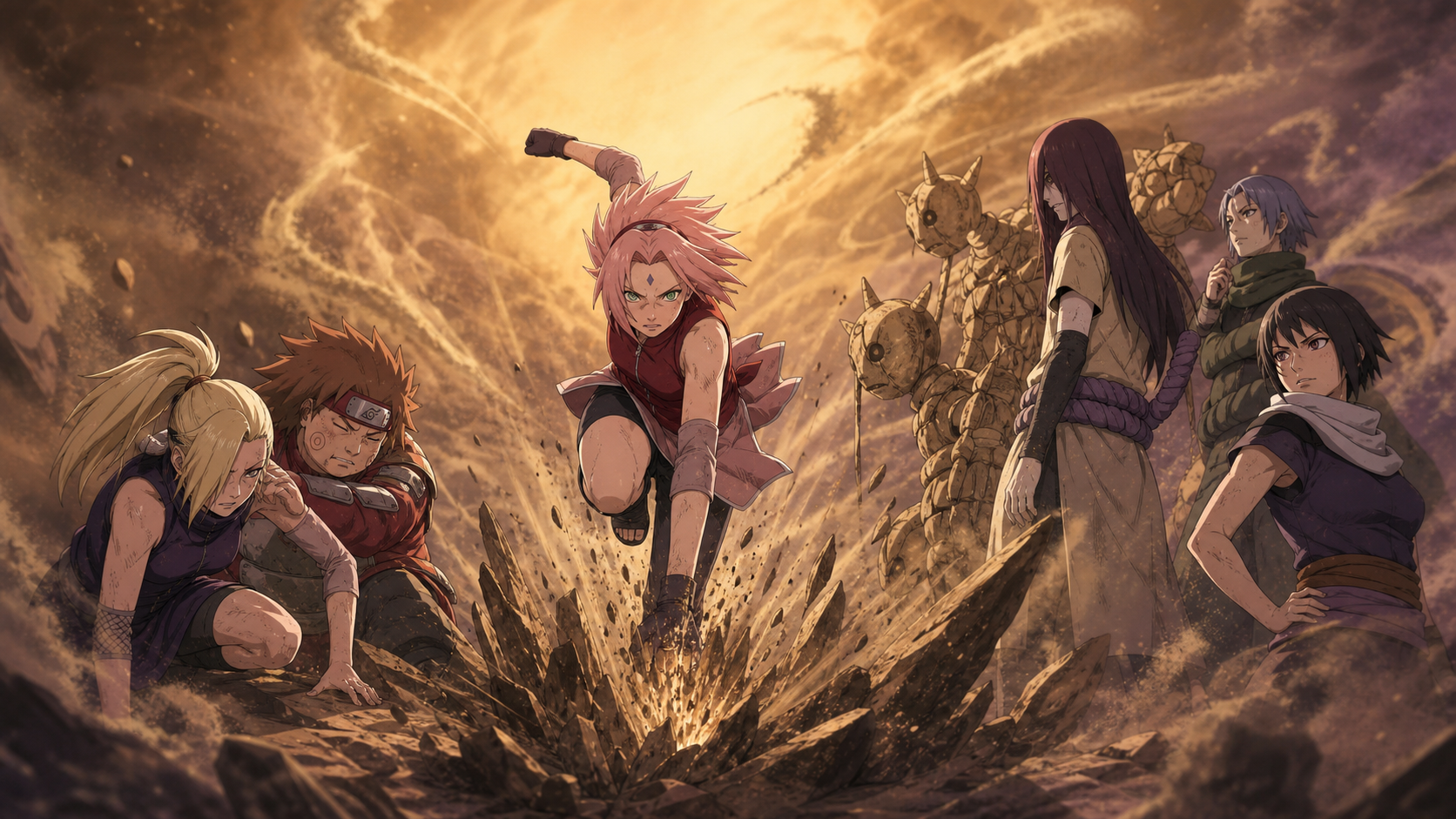
Ino and Chōji guard Sakura until her daily chakra returns, and Sakura answers their trust by taking the front without breaking her unfinished seal.
Bottom line
“Their Backs” completes Sakura’s exam test by reversing the position she remembers from Team 7. Naruto and Sasuke once stood in front while she watched their backs and waited for rescue. In the Demon Desert, Ino and Chōji spend their last strength protecting Sakura while her ordinary chakra supply recovers. Saya’s revenge formation hides Mamushi among sand dolls, poisons both defenders, and leaves Sakura with no healthy teammate between her and the attackers. That isolation is not proof that she has been carried again. Ino and Chōji bought the time Sakura needs, just as earlier teammates once bought time for her. Sakura converts their protection into action. Her replenished daily reservoir fuels one decisive strike that breaks Team Saya’s formation, and her medical skill removes the poison afterward. She does not release the unfinished Strength of a Hundred reserve or pretend exhaustion never mattered. She respects the architecture she built, spends the chakra available for the present fight, then performs the care only she can provide. Thanking Ino and Chōji does not weaken the achievement. The episode’s answer is reciprocal protection: sometimes maturity means taking the front, and sometimes maturity means trusting teammates to guard your back until you can stand there again.
Ino remains inside Chōji’s mental struggle
Episode 408 ended with Saya controlling Chōji through Puppet Imitation while Ino contested the link. His body is moving toward Sakura under two competing mental influences.
The teammate needing rescue is also the immediate threat.
Saya orders Chōji to attack Sakura
Her technique turns his power against the person he would normally protect. The command is designed to injure trust as well as bodies.
Coercion makes friendship tactically painful.
Ino redirects the charge
She gains enough control inside the contested mind to turn Chōji away from Sakura and toward Team Saya. The counter does not require total possession.
A small shift in control can change the whole battlefield.
Chōji strikes the apparent Saya
His redirected force lands where the controller seems to be standing. The impact looks like a decisive end to the mental attack.
Visible success arrives before identity is verified.
The target is another puppet body
Saya has exchanged or concealed her true form through the doll system. Destroying the visible figure breaks one instrument without necessarily defeating the operator.
Puppet warfare separates presence from appearance.
Ino and Chōji survive the first contest
The immediate control loosens enough for the Leaf team to regroup. Both are exhausted from the mental struggle and repeated earlier fights.
Recovery is partial, not a reset.
Sakura sees their protection as a burden
Watching Ino and Chōji fight while she conserves chakra reminds her of relying on Naruto and Sasuke. Shame threatens to misread teamwork as personal failure.
Receiving help can activate old helplessness even after growth.
The episode remains anime-original
Team Saya, the cursed sand puppets, and this second Chūnin Exam battle belong to adaptation-only material. The final React must identify that status clearly.
Continuity labeling keeps analysis honest.
The story cuts to Naruto’s training journey
Jiraiya is teaching Naruto to access more Nine-Tails chakra during the years away from Konoha. The sequence runs separately from Sakura’s exam timeline.
Parallel editing supplies thematic context, not simultaneous action.
Gerotora is asked to weaken the seal
The key-bearing toad adjusts Minato’s seal so more of Kurama’s chakra can emerge. Jiraiya treats controlled exposure as a path toward mastery.
Training changes the safety boundary on purpose.
Naruto agrees to the risk
His need for power grows from the promise to recover Sasuke and protect others. The objective makes dangerous progress feel necessary.
Noble motive does not reduce physiological danger.
The Nine-Tails chakra overwhelms him
The training exceeds Naruto’s ability to remain conscious and self-directed. Chakra becomes corrosive power rather than a tool he controls.
Access and mastery are separate achievements.
Four tails emerge
Naruto reaches a form strong enough to erase ordinary restraint. Jiraiya faces a student whose body and intent have been submerged beneath the transformation.
The training partner becomes an emergency responder.
Jiraiya is gravely wounded
Trying to contain Naruto leaves the Sannin with a lasting scar and a near-fatal injury. Mentor authority offers no immunity from a tailed-beast crisis.
The experiment extracts a human cost.
Naruto wakes with guilt
He sees Jiraiya’s condition and accepts emotional responsibility even though conscious choice disappeared during the attack. The result feels personal because his body caused the harm.
Loss of control does not erase grief.
Jiraiya refuses to blame him
The teacher recognizes the difference between Naruto and the force that overwhelmed him. He does not use injury to shame the student into obedience.
Accountability can coexist with compassion.
Jiraiya asks whether Naruto will quit
The question tests resolve after the cost becomes real. Continuing cannot mean pretending the same method was safe.
Persistence needs revised technique, not repeated disaster.
Naruto refuses to give up
He still intends to master the power despite fear, guilt, and apparent impossibility. His answer represents commitment rather than a complete training plan.
Determination opens the next problem but does not solve the current one.
Sakura remembers Naruto’s effort
She does not know every detail of the four-tail incident during the exam, but she knows Naruto is away working toward an enormous goal. That knowledge challenges her temptation to collapse into self-pity.
Influence can operate without scene-level information.
Saya rejects the first defeat
Her doll is damaged, and the Leaf team escapes immediate control. Instead of preserving exam resources, she chooses revenge.
Pride replaces qualification as the mission.
Sana supports the revenge plan
She prepares a sandstorm that confines and blinds Sakura’s team. The technique creates a controlled arena for Saya’s next puppet attack.
Environmental control replaces direct pursuit.
Mamushi hides inside the formation
Sand Cloak lets him resemble the conjured figures. The Leaf team cannot distinguish a live attacker from a disposable doll by shape alone.
Camouflage makes target identification dangerous.
The sandstorm is visibly unnatural
Sakura recognizes that the weather has formed around them too precisely to be ordinary desert conditions. She treats the storm as an attack before seeing the caster.
Environmental skepticism prevents total surprise.
Saya summons cursed sand puppets
Multiple figures rise inside the low-visibility field. Their numbers overload attention and conceal the path of the real attacker.
Quantity becomes information warfare.
Ino tries to restore team awareness
Mind Transmission could share whatever each teammate sees, repeating the successful answer from Episode 407. Her depleted chakra makes sustained sensing and relay harder.
The right technique can arrive without enough fuel.
Chōji takes the defensive front
He uses expansion and physical coverage to keep the sand figures away from Sakura and Ino. His body creates the time Sakura’s chakra system needs.
Protection is an active tactical assignment.
Ino continues despite mental fatigue
She has contested Saya, linked multiple minds, and fought through successive encounters. Her willingness exceeds her remaining reserves.
Resolve cannot substitute indefinitely for chakra.
Mamushi exploits the identical silhouettes
He approaches under Sand Cloak while Chōji treats the figures as constructs. The disguise lets a living attacker reach striking range.
Pattern recognition becomes a trap when one element breaks the pattern.
A snake delivers the poison
Mamushi’s hidden attack incapacitates Chōji and Ino. Venom turns accumulated exhaustion into immediate immobility.
The ambush targets the defenders rather than Sakura first.
Ino and Chōji fall protecting Sakura
Both teammates spend their remaining capacity to preserve her recovery window. Their collapse is not evidence that Sakura failed to contribute.
Teamwork distributes risk across time.
Sakura is the last mobile Leaf candidate
The person who felt protected from behind now has no standing ally in front. Saya’s formation still surrounds her with concealed threats.
The emotional reversal becomes physical.
Her daily chakra reservoir refills
Rest and disciplined separation allow the ordinary supply to recover enough for combat. The long-term Strength of a Hundred reserve remains protected.
Her two-dam design works under the condition that inspired the design.
Sakura does not need to break the unfinished seal
The episode avoids spending three years of stored potential for one anime-original exam fight. She uses current chakra without invalidating the future milestone.
Continuity and drama can coexist through resource clarity.
Sakura commits to protecting both teammates
Her goal is no longer merely defeating Team Saya. She needs to stop the attackers before poison, sand, or another puppet link causes irreversible harm.
Protection supplies the strike’s urgency.
One attack has to end the formation
Sakura lacks chakra for a prolonged exchange and cannot leave Ino or Chōji untreated. The most efficient answer is a large ground impact that disrupts the entire area.
Scarcity rewards decisive geometry.
Sakura launches above the storm
Leaving the enclosed sand field gives her a clear attack line and removes the visibility disadvantage. Vertical movement breaks the arena Sana designed.
Changing elevation can defeat environmental control.
The ground strike catches Team Saya
Sakura channels enough force to shatter their position and send all three attackers away in the resulting surge. The finish attacks the formation rather than chasing individual puppets.
One correct target replaces dozens of false ones.
Saya still refuses the result emotionally
Even while her team is swept away, she threatens punishment and denies the defeat. Her obsession has already cost the team exam focus.
Refusing reality is not perseverance.
Sakura returns to medical work immediately
The finishing blow does not become a celebration. Ino and Chōji remain poisoned and require treatment before travel can resume.
Winning only matters if the team survives afterward.
She extracts the poison
Medical knowledge lets Sakura identify and remove Mamushi’s venom. The same chakra pool must support the final strike and precise care.
Her power system is built around both responsibilities.
Ino’s numbness begins to recede
Treatment restores function rather than masking symptoms. Sakura monitors the result and gives her teammate a realistic recovery expectation.
Aftercare is part of the technique.
Chōji also receives treatment
His larger body and expansion-related strain do not make him secondary. Sakura accounts for both poisoned teammates before the group moves.
Medical triage protects the whole formation.
Sakura thanks them for accepting her
Joining Ino and Chōji for the exam gave her a team when Naruto and Sasuke were unavailable. Her gratitude recognizes trust rather than apologizing for existing.
Belonging can begin through a temporary roster.
Ino and Chōji did not carry Sakura passively
They protected a teammate following a resource plan, then received protection when that plan matured. The exchange is reciprocal.
Mutual dependence is not helplessness.
Sakura’s old Team 7 memory changes meaning
Naruto and Sasuke’s backs once represented a distance she feared she could never cross. Ino and Chōji’s backs become time entrusted to her.
The image shifts from shame to responsibility.
Naruto’s refusal and Sakura’s restraint differ
Naruto refuses to abandon tailed-beast mastery after harming Jiraiya. Sakura refuses to waste her future reserve while still answering the current crisis. Both persist, but through different risk management.
Determination should fit the power system.
Jiraiya’s injury warns against uncontrolled escalation
More chakra is not automatically the right answer. Naruto’s four-tail state nearly kills his teacher, while Sakura’s separated reservoirs preserve deliberate control.
Power without boundaries can betray the protective goal.
Team Saya fails the Chūnin judgment test
Revenge replaces scroll strategy, exhaustion invites a repeated ambush, and Saya treats teammates as instruments of personal anger. Tactical creativity cannot repair those leadership failures.
Rank requires priorities, not only dangerous techniques.
Sakura’s team passes a harder informal test
They conserve a completed scroll pair, rotate protection according to capacity, counter coercion, treat poison, and resume the route together.
Their formation acts like a unit under depletion.
The central tower remains the destination
Both scrolls and surviving teammates still need delivery. The episode closes the personal battle without ending the second exam.
Objectives matter after emotional payoff.
The approaching sandstorm plot is separate
The wider Demon Desert will soon face a much larger artificial storm tied to the conspiracy against Gaara. Team Saya’s local technique should not be confused with Fūgi and Hōichi’s operation.
Scale and caster identity protect continuity.
The final React should name the seal carefully
Sakura is building the Strength of a Hundred Seal and managing a separate ordinary chakra supply. The episode does not show the completed forehead seal being opened here.
Precise wording avoids power-scaling errors.
Japanese performance requires direct evidence
Claims about Sakura’s shame, Ino’s strain, Chōji’s resolve, Naruto’s guilt, Jiraiya’s reassurance, or Saya’s rage require lawful scene-level Japanese listening.
No invented vocal analysis belongs in publication.
Protecting Sakura’s back does not make Ino and Chōji disposable
They spend exhausted bodies to preserve her chance to act, but trust is not permission to consume teammates without limit. Sakura inherits a duty to make their sacrifice count and return immediately to their care.
Reciprocity separates teamwork from martyrdom. The person protected owes attention to the people who held the line.
Coercion does not erase their remaining agency
Ino resists Saya from inside the mental contest, while Chōji responds when she redirects his movement. They are harmed and constrained, not absent from their own rescue.
The episode should credit every choice they recover without implying victims could have escaped through willpower alone.
Sakura’s restraint is different from refusing risk
Her unfinished seal represents years of stored chakra and a future emergency resource. She does not need to destroy that work when the daily reserve refills enough to create another option.
Good judgment asks what force is necessary now. Maximum escalation is not the only evidence of commitment.
The sandstorm formation turns similarity into concealment
Identical puppets, noise, poison, and hidden operators force Sakura’s team to distinguish the control structure from its visible bodies. Striking every silhouette wastes strength and may miss the real threat.
Sakura’s final ground attack works because it disrupts the whole formation rather than chasing one decoy at a time.
Poison makes the rescue continue after victory
Ino and Chōji do not become safe when Team Saya falls. Numbness, dosage, breathing, circulation, and delayed effects still require medical attention.
Sakura’s immediate extraction work is part of the win. Combat that leaves teammates untreated is unfinished.
Jiraiya’s injury is a warning, not motivational decoration
Naruto accepts a seal experiment whose consequences overwhelm him and nearly kill his teacher. Jiraiya’s refusal to blame Naruto can reduce shame without erasing adult responsibility for the setup.
The memory should teach Sakura that persistence needs safeguards. Love is not proven by accepting uncontrolled escalation.
Team Saya fails because defeat never becomes information
Saya treats the first reversal as humiliation demanding revenge. She adds concealment, poison, and coerced bodies without reconsidering whether the exam is testing leadership.
Adaptation without accountability only makes harm more efficient. Chūnin judgment requires knowing when to stop.
Sakura’s gratitude must name participation
Ino and Chōji did not merely accept her into an existing bond. They argued, trained, protected, communicated, and trusted her with decisions affecting all three bodies.
Thanking them matters most when it leads to shared authority and care, not a sentimental promise that they will always stand behind her.
RaeRae’s verdict
“Their Backs” lands because Sakura’s decisive punch is the final step of a team sequence, not proof that she never needed help. Ino wins enough of the mental contest to redirect Chōji. Chōji and Ino then hold the sand-puppet formation while Sakura’s daily chakra supply recovers. Their protection has cost, and Mamushi’s poison makes the cost visible.
Sakura pays that trust forward. She breaks the formation with the chakra available, protects the unfinished long-term reserve, and immediately treats both teammates. The episode turns the familiar image of stronger teammates’ backs into something healthier. A back is not always evidence that someone has left you behind. Sometimes a teammate stands there because your recovery matters, trusting that when the formation turns, you will stand there for them. Sakura does exactly that.
RaeRae’s call
Ino and Chōji protect Sakura’s back without surrendering authorship of the fight. Ino resists control, Chōji holds the defensive front, and both spend what remains so Sakura can reach the formation instead of drowning in decoys. Sakura answers that trust with restraint, one decisive strike, and immediate poison treatment. She does not need to break an unfinished seal merely to prove devotion. Jiraiya’s injury already shows what uncontrolled escalation costs. Teamwork is not a body-count contest. It is reciprocal responsibility: protect the opening, credit the people who made it, and return for them before victory becomes another story that forgets who carried whom.
Episode details and viewing routes
- Official episode reference: Naruto Official episode guide
- Licensed episode route: Crunchyroll season page exposing Episode 409
The title belongs to three of them. Sakura can face forward because Ino and Chōji guard what she cannot see, but they can endure because they trust Sakura to end the formation and return. Nobody occupies the position alone. Their backs create a chain of responsibility that runs in both directions. The episode earns its finish when Sakura kneels to remove poison instead of standing over a completed attack. Gratitude becomes action through treatment, acknowledgment, and the refusal to let exhausted teammates disappear behind her victory.
What I am carrying forward
Ino disrupted Saya’s control over Chōji and redirected his attack, but Saya survived through her puppet system. Saya, Sana, and Mamushi later trapped Sakura’s team inside an artificial sandstorm filled with cursed sand dolls.
Mamushi used Sand Cloak to hide among the figures and poisoned Ino and Chōji. Their defense gave Sakura enough time to restore her ordinary chakra supply. Sakura broke Team Saya’s formation with one large strike, extracted the poison, thanked Ino and Chōji, and resumed the route with both scrolls. Episode 410 shifts to the wider conspiracy against Gaara and a massive Demon Desert sandstorm.