
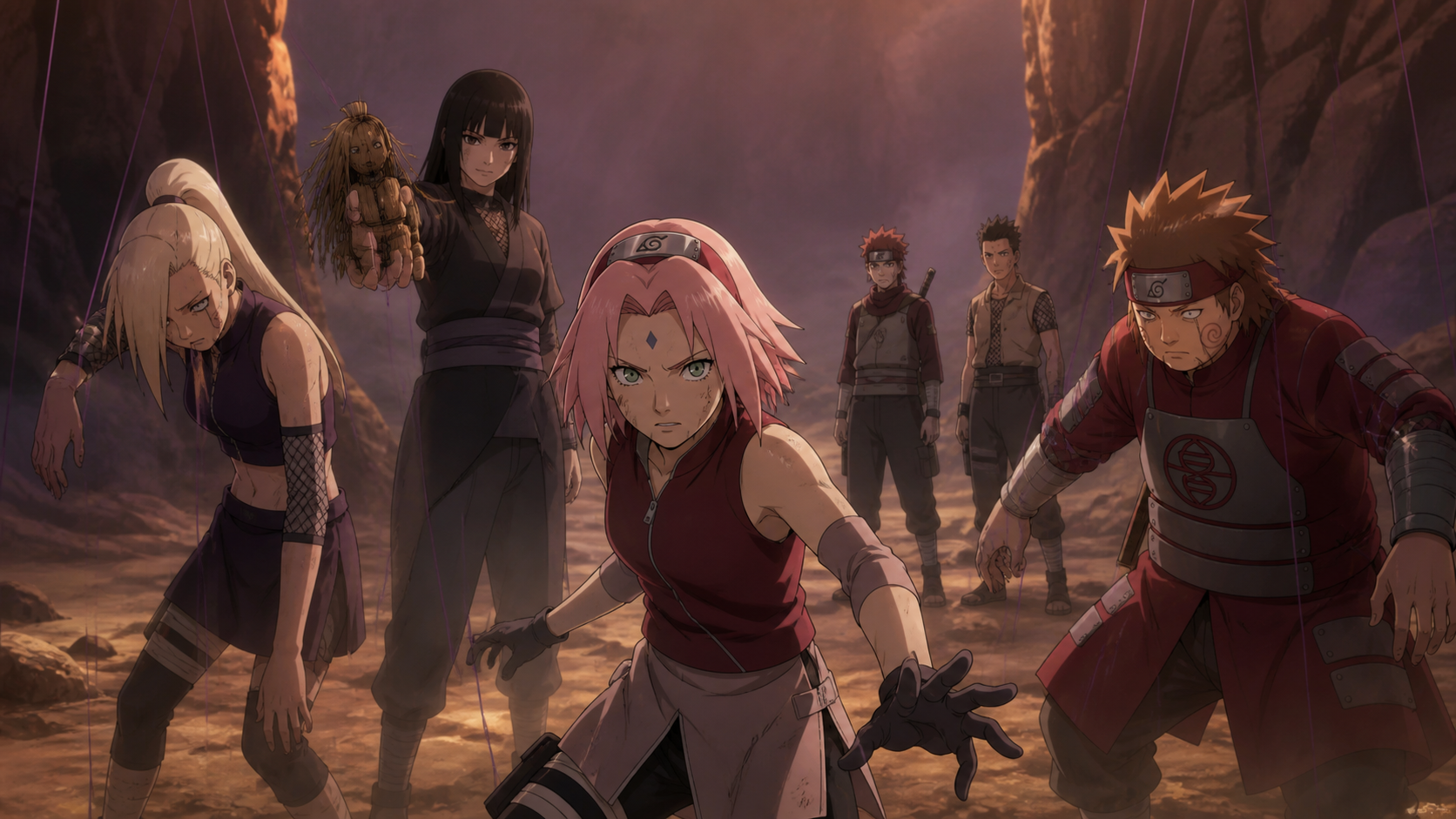
The Cursed Puppet
Saya turns Ino and Chōji into weapons, forcing Sakura to protect her teammates while every reserve of usable chakra is already running thin.
Bottom line
“The Cursed Puppet” puts three exhausted Leaf candidates against an enemy who turns friendship into the weapon. Sakura has been diverting chakra into the Strength of a Hundred Seal while still trying to heal, fight, and lead. Ino has just strained her mental network against Ameno’s team. Chōji has spent repeated expansions across the desert. Saya does not need to overpower all three bodies. Her doll collects hair, establishes a mental link, and forces first Ino and then Chōji to attack the people they are trying to protect. Ino recognizes the supposed curse as a variation on Mind Transfer and enters the contested mind, but the accumulated chakra cost prevents her from expelling Saya cleanly. Sakura faces the ugliest version of the role she has been resisting: standing alone while her friends become threats through no choice of their own. The episode does not resolve that problem. Instead, Sakura remembers why she created separate chakra “dams” for daily work and long-term storage. Power kept for the future cannot excuse abandoning the people in front of her. Episode 409 has to decide whether Sakura can protect the seal, her teammates, and her own body at the same time.
The Leaf team already has both scrolls
Sakura, Ino, and Chōji no longer need to hunt another candidate. Reaching the central building safely should be the remaining objective.
Possession changes every later fight into avoidable risk.
Sakura chooses a detour
The direct route invites ambushes from teams watching the obvious approach. Her alternate path trades speed for reduced exposure.
Leadership means protecting what the team has already earned.
Continuous battles have drained everyone
The scorpion, Ameno’s formation, and travel through the Demon Desert have consumed chakra and stamina. Their last victory did not restore the resources spent.
Success can hide cumulative damage.
Sakura’s exhaustion is different
She is not only spending chakra on current healing and combat. A separate long-term process continuously redirects part of her supply.
The future is drawing from every present decision.
Tsunade explains Mitotic Regeneration
The flashback establishes a technique that restores damaged organs and systems. Hashirama could regenerate through extraordinary natural reserves, but later users need another method.
Inherited legend becomes a technical problem.
Strength of a Hundred stores chakra over years
Tsunade’s solution requires extremely precise control and sustained accumulation. Sakura must maintain the reserve for three years rather than gather power during one crisis.
The seal is discipline measured across ordinary days.
Chakra storage lowers Sakura’s available supply
Diverting chakra leaves less for surgery and battle. Early in training, the tradeoff threatens the work Sakura is already expected to perform.
Long-term growth can temporarily reduce visible performance.
Tsunade considers removing her from duty
If Sakura cannot heal safely or defend herself, ambition cannot justify keeping her on the front line. Medical responsibility sets a minimum standard.
Training goals do not excuse endangered patients.
Sakura creates two chakra dams
She separates the long-term reserve from chakra needed for normal life, surgery, and combat. The additional control lets her keep building the seal without abandoning current responsibilities.
Her answer is architecture, not more raw capacity.
The system still has limits
Two reservoirs do not create unlimited chakra. Repeated battles can exhaust the daily supply while the protected reserve remains inaccessible or incomplete.
Better allocation cannot erase scarcity.
Sakura collapses from strain
Ino and Chōji notice that their leader is no longer functioning normally. The detour becomes a rest stop because continuing would turn fatigue into defeat.
Teams need permission to acknowledge depletion.
Ino and Chōji protect her recovery
They accept the delay despite the risk of ambush. Their decision treats Sakura as a teammate with physical limits, not a permanent source of healing.
Care has to reach the medic too.
The episode remains anime-original
Saya’s team, the cursed doll confrontation, and the exam-era seal flashback framing belong to adaptation-only material. The final React must label the status clearly.
Continuity accuracy matters even when character themes align.
A doll enters the resting area
The object appears harmless enough to investigate. The Leaf team does not immediately see the people controlling the encounter from outside direct range.
Curiosity becomes a targeting channel.
The doll is a scouting instrument
Saya uses the puppet to locate prey and acquire what her technique needs. The object turns physical contact into future mental access.
Reconnaissance and attack share one tool.
Saya leads Sana and Mamushi
The Sand trio treats the encounter as a hunt. Sana and Mamushi follow Saya’s direction while also showing fear of her temper and technique.
Their hierarchy depends on intimidation as much as coordination.
Saya chooses Ino and Sakura
She claims both women as preferred targets and leaves Chōji to her teammates. The division is personal and theatrical rather than strictly efficient.
Predatory attention shapes the formation.
Mamushi and Sana provoke Chōji
They insult his body and try to make anger control his decisions. Chōji corrects their language and answers with Partial Expansion.
Mockery becomes tactical bait.
Chōji’s anger is predictable
His friends know the insult that triggers him, and enemies can discover the same pattern. Emotional certainty can be exploited even when the anger is justified.
Self-respect still needs tactical control.
Sakura identifies a puppet-user problem
The obvious response is to find and disable the controller. That plan assumes ordinary chakra strings and remote object manipulation.
Correct genre recognition can still miss the actual mechanism.
The doll collects Ino’s hair
A physical sample creates the connection Saya needs. The attack bypasses armor and contests control from inside the target.
Small traces can carry disproportionate risk.
Saya activates Puppet Imitation
Ino’s body begins moving under outside influence. The technique resembles a curse because the victim attacks without visible strings.
Presentation hides a mind technique inside puppet language.
Ino becomes a threat to Sakura
Saya forces the team’s communicator and medic to attack her closest ally. Sakura must defend without treating Ino as an enemy responsible for the assault.
Restraint becomes harder than retaliation.
Chōji tries to intervene
He cannot leave Sakura and Ino trapped in the mental attack, but Mamushi and Sana keep him occupied. The enemy formation prevents an easy rescue.
Physical separation protects the controller.
Ino studies the technique from inside
Being controlled gives her direct experience of the chakra relationship. She recognizes that Saya’s method is closer to Mind Transfer than conventional puppetry.
The victim becomes the best analyst of the attack.
Clan knowledge removes the mystique
Calling the technique a curse suggests supernatural inevitability. Naming the mental-transfer mechanics reveals rules, risks, and possible counters.
Understanding turns terror into a problem.
Saya also obtains Chōji’s hair
The doll establishes another link after Chōji overpowers the two supporting attackers. His success creates the contact Saya needs.
Winning one exchange can open another vulnerability.
Chōji falls under Puppet Imitation
His expanded strength now serves Saya. The teammate built to shield Sakura and Ino becomes the largest immediate danger.
Control techniques convert trust into hesitation.
Saya orders him against his friends
The command is designed to injure bodies and morale at once. Sakura and Ino have to survive Chōji without damaging him beyond recovery.
The enemy makes compassion costly.
Ino chooses a mental counterattack
She enters the contested link with Mind Transfer, aiming to expel Saya from Chōji’s mind. The decision uses exactly the clan confidence Episode 407 restored.
Her inheritance gives the team a plausible rescue route.
Two mind users contest one body
Chōji becomes the battlefield rather than a willing participant. Control, identity, and physical safety are tied to which consciousness wins the internal struggle.
Mental combat has an innocent body at the center.
Ino’s previous exertion matters
She already pushed Mind Transmission beyond her comfortable level against Ameno’s team. Entering another high-intensity technique without recovery compounds the strain.
Past victories remain present in the chakra ledger.
Ino cannot force Saya out cleanly
Recognition does not guarantee superior reserves. Her technique meets a prepared specialist while she is depleted.
Expertise needs enough energy to act.
Sakura cannot solve the mental contest directly
Her medical knowledge may protect bodies, but she lacks the Yamanaka tools needed to separate two consciousnesses safely. Raw strength risks harming Chōji.
Every specialist eventually meets a problem outside her lane.
Sakura becomes the only free Leaf fighter
Ino is locked in mental combat and Chōji is controlled. Sakura must face Saya, Sana, and Mamushi while managing two endangered teammates.
Leadership becomes isolation without consent.
The flashback shifts to Karin
The episode parallels another young kunoichi trying to stop being the person protected from behind. Karin trains inside Orochimaru’s network while Sasuke and Suigetsu pursue strength around her.
The comparison is thematic rather than part of the exam encounter.
Karin wants combat capacity
Sensing and healing make her valuable, but she refuses to remain only a resource for stronger fighters. She seeks enough chakra and control to protect herself.
Support roles can carry legitimate offensive ambition.
Orochimaru treats ability as utility
He evaluates Karin, Suigetsu, and Sasuke according to future usefulness. Training opportunities exist inside a system that also objectifies each person.
Access to power does not make the environment safe.
Suigetsu becomes an experimental target
The east-hideout material places Karin’s developing abilities beside Orochimaru’s testing culture. Conflict between the two young shinobi becomes data for someone else.
Institutional exploitation hides inside personal rivalry.
Karin manifests binding chains
Her chakra takes a form capable of restraining a large mass. The ability surprises even Karin because she has not used the power before.
Inheritance can emerge under pressure without prior fluency.
Sasuke stops the escalation
His command prevents the test from becoming uncontrolled violence. Karin responds to him even while resisting Suigetsu.
Authority inside the group remains uneven.
The Karin sequence mirrors Sakura’s concern
Both women reject permanent dependence on male teammates and build hidden reserves or latent capacities. Neither wants support expertise to mean helplessness.
Parallel motivation does not make their situations identical.
Sakura’s power is deliberate construction
Unlike Karin’s sudden chain manifestation, Sakura’s seal requires years of exact accumulation and a self-designed two-dam solution. Her strength grows through maintained control.
Different power systems produce different costs.
The episode delays Sakura’s answer
The flashback explains what she has been protecting but does not let her release the complete reserve immediately. The conflict carries into Episode 409.
Setup remains honest when the payoff waits.
Protecting the reserve has moral limits
Sakura needs the stored chakra for future regeneration and greater threats. If preserving the seal means letting Ino or Chōji die now, the strategy has failed its purpose.
Future readiness exists to protect present people.
Spending ordinary chakra also has limits
Emptying the daily reservoir could leave Sakura unable to heal anyone after the fight. She has to decide where force, treatment, and conservation intersect.
Resource allocation becomes an ethical choice.
Saya’s technique attacks team identity
The puppet does not merely borrow limbs. The attack makes friends question whether they can trust what familiar bodies are doing.
Control warfare damages relationships through uncertainty.
Ino’s resistance protects Chōji’s personhood
Entering the mental contest declares that his body is not neutral territory for two experts. She fights to return agency to her friend.
Rescue is more important than proving clan superiority.
Sakura must attack the controller
The clearest route is to disrupt Saya while avoiding Mamushi, Sana, and the controlled Chōji. Reaching the source requires trusting Ino to hold the internal line.
Teamwork continues even when teammates cannot speak.
The final React should separate the timelines
The exam fight, Sakura’s earlier seal training, and Karin’s Orochimaru-era flashback occupy different moments. Visual cross-cutting should not be rewritten as simultaneous action.
Chronology is part of accurate analysis.
The final React should name coercion clearly
Ino and Chōji do not choose to attack Sakura. Language must keep responsibility with Saya and avoid framing controlled behavior as betrayal.
Agency matters in recap wording.
Japanese performance requires direct evidence
Claims about Sakura’s exhaustion, Ino’s resistance, Chōji’s distress, Saya’s cruelty, or Karin’s frustration require lawful scene-level Japanese listening.
No invented delivery notes belong in publication.
Puppet Imitation is a violation before it is a tactic
Saya takes hair without consent, overrides movement, and converts teammates into weapons against one another. The horror comes from stolen agency, not simply an inconvenient combat matchup.
Naming coercion clearly protects Ino and Chōji from being blamed for actions imposed through their bodies.
Yamanaka practice makes the contrast sharper
Ino’s clan techniques also enter minds and can control bodies, which means ethical boundaries cannot be assumed. Her team relationships depend on training, mission context, and trust.
Saya’s imitation strips those conditions away. Similar mechanics do not produce equivalent ethics.
Ino resists from inside the occupied body
She observes the technique while experiencing it, identifies the foreign controller, and attempts a mental counterattack. That labor is invisible to Sakura but essential to Chōji’s survival.
Resistance does not require immediate victory to matter. Ino preserves information and interrupts total possession under severe strain.
Chōji remains a victim when his strength becomes dangerous
Saya chooses him because his body can harm friends with overwhelming force. The threat belongs to the controller who issued the command.
Sakura must stop the attack while remembering that Chōji is someone to recover, not an enemy to punish. Force should be limited to what rescue requires.
Sakura’s only-free-fighter position creates competing duties
She must evade Ino and Chōji, locate Saya, protect unconscious or depleted teammates, and manage her own restricted chakra. Every option carries cost.
The correct target is the control system, yet immediate defense may still be necessary. Leadership means holding rescue and survival together.
Hair becomes biometric access
The scouting doll does more than observe. It collects a physical identifier that lets Saya establish control from a distance.
Candidates need procedures for unknown objects, trace evidence, and sudden loss of autonomy. The exam organizers should treat involuntary body control as a medical and security emergency.
Sakura’s reserve complicates the demand to spend everything
Strength of a Hundred requires long accumulation while reducing ordinary chakra available during training and missions. Using the reserve early could destroy years of preparation and future survival capacity.
Protecting it is rational until that protection abandons reachable people. The episode must judge the decision under actual alternatives, not heroic slogans.
Exhaustion changes what each teammate can consent to
Continuous fights, hunger, injury, and chakra depletion reduce reaction time and judgment before Saya arrives. The team’s rest site should have included watches and recovery roles.
Rest is not wasted time, but exhausted people need additional safeguards. Sakura’s collapse cannot become a personal moral failure.
The Karin memory is a parallel, not the same event
Karin seeks combat capacity inside Orochimaru’s exploitative environment, while Sakura deliberately stores chakra under Tsunade’s instruction. Their choices arise from different power structures.
The connection lies in bodies treated as useful assets and the pressure to prove value. The timelines should remain clearly separated.
RaeRae’s verdict
“The Cursed Puppet” works best as a resource crisis disguised as possession horror. Saya’s doll collects the physical key, but accumulated exhaustion makes the technique dangerous. A rested Ino might have been able to contest the mental link more decisively. A fully available Sakura might have reached Saya before Chōji became a weapon. Instead, every earlier choice remains in the fight.
Sakura’s two-dam solution is the episode’s most important setup. She refused to let three years of chakra storage make her useless during those same three years. Now both reservoirs are under pressure: the ordinary supply is nearly gone, and the future reserve represents work she cannot casually rebuild. The episode asks the right question by refusing an easy answer. What is stored power for if not the moment when two friends lose control of their own bodies? Episode 409 has to make Sakura’s response costly enough to respect the seal and immediate enough to respect Ino and Chōji.
RaeRae’s call
Saya does not merely outsmart Team Ino-Sakura-Chōji. She steals bodily autonomy and turns trust into a weapon. Ino’s resistance matters because she understands control from inside the occupied body and refuses to let Saya’s technique look mystical or absolute. Chōji remains a person to rescue even when his coerced strength threatens Sakura. Sakura must defend herself, locate the controller, preserve teammates, and decide whether a long-built chakra reserve can remain protected under immediate danger. The answer cannot blame victims for imposed movement. Stop the control system, use only necessary force against friends, and treat every recovered body as needing care, consent, and time.
Episode details and viewing routes
- Official episode reference: Naruto Official episode guide
- Licensed episode route: Crunchyroll licensed episode page
The cruelest part of the trap is that Sakura must read bodies as danger without forgetting the people inside them. Ino and Chōji need her accuracy, not hesitation born from guilt and not violence born from panic. Ino should not have to defeat possession alone. Rescue means combining her knowledge with Sakura’s movement and Chōji’s protection once control breaks. Their friendship matters because it creates obligations when the technique ends: believe them, treat them, and never frame coerced harm as betrayal.
What I am carrying forward
Sakura, Ino, and Chōji possess both required scrolls but are exhausted from repeated battles. Sakura has been building the Strength of a Hundred Seal through a separate long-term chakra reserve while maintaining a second supply for surgery and combat.
Saya, Sana, and Mamushi ambushed the resting team. Saya’s doll used hair samples to activate Puppet Imitation, a mind-control technique disguised as a curse. She controlled Ino and then Chōji. Ino recognized the method as related to Mind Transfer and entered the mental contest, but her depleted chakra prevented a clean rescue. Sakura remains the only free Leaf fighter as Episode 409 begins.