
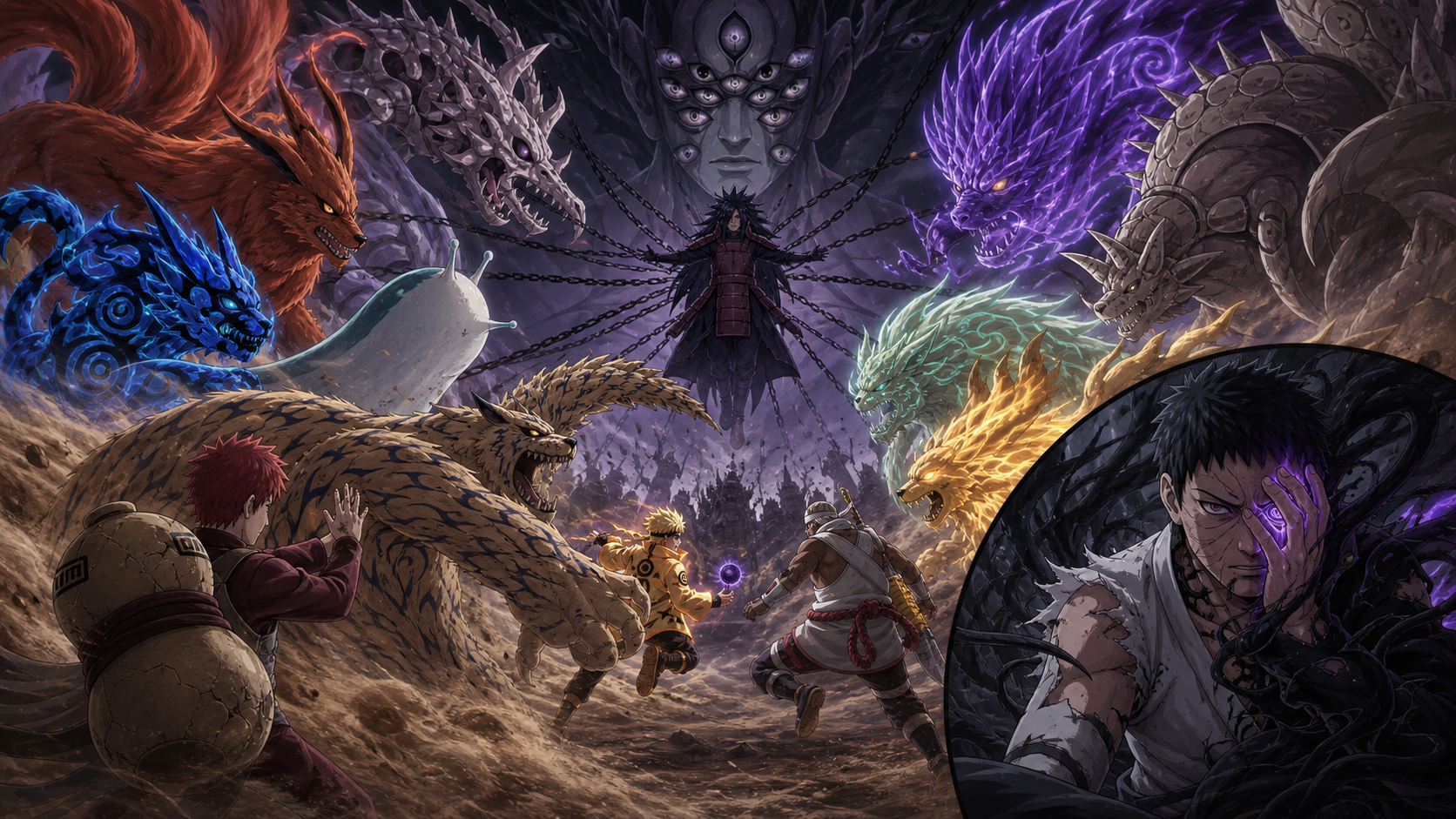
The Hidden Heart
The beasts cooperate without surrendering identity, while Obito proves that domination still has to fight the will inside a captured body.
Bottom line
“The Hidden Heart” lets nine tailed beasts attack as free people for one brief, glorious stretch, then shows how quickly Madara can rebuild the machinery of captivity. Shukaku and Gaara coordinate a seal. Naruto and Bee join the assault. The beasts combine strength without losing their separate voices. Madara answers by reclaiming a Rinnegan, summoning the Demonic Statue through Obito’s body, and throwing chains around every beast at once. The scale is horrifying because freedom lasted long enough to feel real. Meanwhile, Black Zetsu controls half of Obito, yet cannot simply take the remaining Rinnegan because Obito resists from inside his failing body. That resistance is the hidden heart worth caring about. Obito cannot undo the war, but he can deny Madara complete access and protect the people still fighting. The episode’s weakness is raw escalation: Madara becomes so overwhelming that collective effort starts looking decorative. The character logic saves the spectacle. Domination can seize bodies and power, but domination still has to fight the will inside them.
The tailed beasts begin as a free coalition
Their extraction from Obito restores distinct bodies, names, personalities, and tactical choices. They turn toward Madara because his survival threatens every one of them.
Cooperation grows from common danger rather than human ownership.
Madara faces all nine without retreating
Newly living flesh makes him vulnerable, but his confidence barely changes. He reads the group as power waiting to be captured again.
The imbalance between one man and nine ancient beings is deliberately alarming.
Shukaku and Gaara coordinate
The former host asks rather than commands, and Shukaku contributes sealing power. Their cooperation answers the conflict established in Episode 388.
A damaged relationship produces a useful choice without pretending the damage never happened.
Sand becomes shared technique
Gaara’s control and Shukaku’s sealing knowledge combine against Madara. Neither contribution disappears inside the other person’s identity.
Partnership works because the skills remain legible.
The seal briefly contains him
The alliance earns a tactical opening through coordination rather than a single chosen hero. Relief follows because preparation and trust create a visible result.
Madara treats containment as an inconvenience.
Susanoo breaks the comfort
His defensive power tears through the assumption that a strong seal will end the fight. The response establishes how much ability remains even before his full ocular power returns.
Escalation arrives before the coalition can reorganize.
Naruto and Bee join the beasts
Both jinchūriki bring lived knowledge of captivity, negotiation, and partnership. Their presence should connect human strategy with tailed-beast agency.
They are allies among allies, not commanders of a beast unit.
Gyūki urges caution
The Eight-Tails understands that Madara’s apparent vulnerability does not make him ordinary. Experience with shinobi control supports tactical restraint.
Confidence without memory would hand Madara another opening.
The beasts strike together
Their combined physical attack turns the battlefield into a collision of enormous bodies and accumulated anger. Madara is hit by power he expected to own.
The sequence gives captivity’s targets a chance to answer directly.
Freedom changes the meaning of force
Under Obito, tailed-beast chakra served one imposed will. Here, separate beings voluntarily concentrate their attacks on a common captor.
The same scale of power carries a different moral structure.
Madara survives through preparation
He has studied tailed beasts, jinchūriki systems, Hashirama’s abilities, ocular techniques, and the Demonic Statue for decades. His dominance is not random strength dropped into the plot.
Planning makes the power frightening even when the scale feels excessive.
A White Zetsu returns his right eye
The clone delivers Madara’s original Rinnegan. Another manufactured body functions as storage and transport for something he considers his property.
The handoff repeats his habit of turning life into equipment.
The Rinnegan changes the field immediately
Restored ocular power gives Madara direct access to the Demonic Statue and the chains designed to control tailed beasts. One eye reorganizes the entire conflict.
Inherited and stolen power keeps accumulating around him.
The Demonic Statue emerges through Obito
Madara summons the husk from the weakened body that previously contained the Ten-Tails. Obito experiences another violent use after Black Zetsu already seized partial control.
His body remains infrastructure for a plan he rejected too late.
Black Zetsu holds half of him
The possession creates a grotesque split between outward control and inward resistance. Obito can no longer move as a wholly autonomous person.
Agency becomes a contested physical space.
Kakashi and Minato witness the struggle
Teacher and teammate face the boy they mourned, the adult who betrayed them, and the body now being used by Madara’s servant. Their emotional categories cannot stay simple.
Recognition arrives alongside tactical urgency.
Obito protects the remaining Rinnegan
Black Zetsu wants to deliver the left eye to Madara, but Obito prevents an easy transfer. His resistance denies the enemy complete ocular power.
A small refusal can matter when total victory is impossible.
The title points toward concealed resistance
The visible body looks captured. The hidden heart continues making choices underneath the possession.
Control over movement does not guarantee control over purpose.
Obito’s resistance does not erase his past
He used the Rinnegan, controlled jinchūriki corpses, collected tailed beasts, and helped build the current emergency. Protecting the eye now prevents further harm.
Late opposition changes the present without rewriting the record.
Black Zetsu calls servitude loyalty
Madara’s enforcer measures worth through usefulness to the master. Obito’s attempt to choose another path becomes betrayal inside that worldview.
Domination treats autonomy as disobedience.
Madara does not care whether Obito survives
He wants the eye, the statue, and the completed plan. The person who carried his name for years has reached the end of assigned usefulness.
Mentorship reveals itself as asset management.
The statue’s chains target every beast
Madara throws restraints across the battlefield and begins pulling the tailed beasts toward captivity. The visual repetition recalls earlier extractions while increasing the scale.
Freedom becomes physically measurable through resistance to the chains.
One Rinnegan overwhelms a coalition
The imbalance risks making every earlier alliance victory feel temporary by authorial decree. Nine beasts and multiple elite shinobi struggle against one newly revived opponent.
Spectacle can weaken earned teamwork when escalation ignores accumulated effort.
The power still follows established mechanics
Madara has the eye connected to the Outer Path, control over the statue, Hashirama-derived abilities, and deep knowledge of the beasts. The outcome grows from systems the story introduced earlier.
Mechanics make an overwhelming result more coherent, not automatically satisfying.
Shukaku’s participation matters even in defeat
He chooses to help Gaara and the alliance before the chains catch him. Failure does not cancel the agency expressed through that choice.
Moral progress should not depend on winning every fight.
Gaara sees captivity return
His former tailed beast faces the same kind of seizure that defined their childhood bond. Gaara now stands on the side trying to preserve Shukaku’s freedom.
The reversal proves his changed understanding through action.
Bee and Gyūki understand the danger personally
Their partnership grew inside a village that still treated jinchūriki as military resources. Madara’s chains strip away even the partial negotiation available in that system.
Absolute ownership is the endpoint of weapon logic.
Naruto and Kurama face forced separation
Their relationship took years to move from imprisonment and hostility toward cooperation. The chain threatens to tear apart a bond just as mutual trust becomes central to Naruto’s strength.
Extraction attacks relationship as well as survival.
The alliance cannot simply replace the beasts
No reserve army, new technique, or political agreement can substitute for nine captured people. Their loss would restore the exact resource system the war should challenge.
Saving them is not optional support for saving humans.
Madara turns a victory into a supply run
Obito’s defeat freed the beasts, but their gathering in one place makes recapture operationally possible. Madara exploits the alliance’s successful extraction.
Strategic reversals often weaponize the opponent’s achievement.
Collective action needs protection from central capture
Bringing every source of power together creates coordination and a single point of failure. Madara’s statue can target the whole coalition at once.
Unity without safeguards can become convenient for a captor.
Kakashi cannot solve possession with one strike
Killing Obito might stop Black Zetsu’s immediate access while also destroying the person resisting from inside and risking unknown consequences around the eye. Tactical clarity disappears.
Friendship complicates judgment, but mechanics complicate judgment too.
Minato faces another failure of protection
His student’s body has been modified, controlled, drained, and seized across decades. Minato can witness the result without undoing the years of absence.
Regret has to become useful action under present conditions.
Obito’s remaining will creates an opening
Black Zetsu cannot complete every objective instantly because the host pushes back. That delay preserves time for Kakashi, Minato, Naruto, and others to respond.
Resistance can matter before liberation becomes possible.
The episode separates body from allegiance
Obito’s body performs actions under another will while his own intention resists. The distinction matters for current agency without becoming a blanket excuse for earlier conduct.
Readers need both truths at once.
Madara’s confidence becomes contempt
He treats the beasts’ combined attack as a temporary inconvenience and their capture as inevitable. Years of manipulating people have trained him to confuse preparation with moral right.
Power protects the delusion until somebody can make refusal stick.
The animation must sell impossible scale
Nine enormous bodies, sand seals, Susanoo, the Demonic Statue, chakra chains, Naruto, Bee, and Madara occupy one battlefield. Spatial clarity determines whether the action feels tactical or merely loud.
Craft analysis belongs to visible staging rather than generic praise.
Japanese performance remains an evidence gate
The final publication should verify Japanese credits for Madara, Obito, Black Zetsu, Gaara, Shukaku, Naruto, and Bee. Claims about delivery, breath, or timing require lawful direct listening.
No invented performance language belongs in the React.
The ending weaponizes dread
The chains begin undoing a victory viewers watched the alliance earn across multiple episodes. Knowing extraction can kill a jinchūriki makes Naruto and Bee’s danger immediate.
The threat reaches bodies, friendships, and the future political status of every beast.
Nine beasts cooperating is not a return to one beast
Shukaku, Matatabi, Isobu, Son Gokū, Kokuō, Saiken, Chōmei, Gyūki, and Kurama coordinate because Madara threatens all of them. Shared purpose does not dissolve names or histories.
The Ten-Tails project treats plurality as a defect to be corrected through forced recombination. Their coalition proves difference can produce strength without surrendering identity.
Freedom includes the right to fight badly
The beasts choose to attack and still fail to stop Madara. That outcome does not invalidate autonomy or suggest a human controller would have used their power more efficiently.
Consent is not justified only when it produces victory. Free actors can misjudge, lose, adjust, and remain entitled to control their own bodies.
Gaara and Shukaku create technique through negotiation
Sand and sealing power become a joint tactical answer rather than a host forcing a captive reserve into service. The cooperation carries years of hostility and the recent decision to help.
One successful action does not settle trust forever. It demonstrates what becomes possible when authority stops at the boundary of another being’s choice.
Madara treats resistance as inventory testing
He studies attacks, absorbs information, retrieves an eye, summons the statue, and begins converting a battlefield of independent opponents into components of his next form.
His composure is not proof of natural superiority. It comes from preparation built around stolen bodies, implanted cells, designated servants, and mechanisms designed before anyone else knew the contest.
The returned eye carries another person’s history
Madara receives a Rinnegan through the White Zetsu network as if equipment has arrived. That eye passed through Nagato’s body and Obito’s plans, shaping lives that never consented to being storage.
Power cannot be separated from custody merely because the original owner engineered the chain. The route itself is evidence of violation.
The Demonic Statue is captivity infrastructure
Its chains do not persuade the tailed beasts or defeat each one through reciprocal combat. They identify, bind, and drag distinct beings toward a container built for forced assembly.
The device industrializes an old village habit: call sentient lives weapons, then present control technology as necessary security.
Shukaku’s recapture lands differently after consent
He has just chosen cooperation with Gaara on his own terms. Madara’s chains immediately attempt to erase that decision and restore him to a function inside somebody else’s plan.
The sequence makes the ethical contrast painfully clear. Asking created relationship. Binding treats the answer as irrelevant.
Bee and Gyūki understand separation as bodily danger
Their partnership is not merely a strategic alliance between minds. Extraction threatens Bee’s life and Gyūki’s freedom while tearing apart a relationship built through years of difficult coexistence.
Any rescue plan must protect both participants. Saving the host while treating the beast as recoverable energy would repeat the same hierarchy.
Naruto and Kurama face the cost of shared embodiment
Their bond now includes trust, humor, strategy, and mutual defense, but the seal still makes forced separation lethal. A relationship grown inside captivity does not make the original arrangement ethical.
Madara exploits that architecture. The villages built bodies that could be weaponized through extraction, then act surprised when another controller uses the design.
Obito’s resistance is agency under occupation
Black Zetsu controls half his body and tries to deliver the remaining eye. Obito uses whatever movement and will remain to obstruct that transfer.
The resistance deserves accurate credit. It does not rewrite the years when Obito occupied hosts, controlled jinchūriki, or treated other bodies as tools.
Kakashi cannot solve this through recognition alone
He sees his teammate trapped beneath Black Zetsu and may understand the person still resisting. Emotional knowledge does not provide a safe extraction technique or erase the strategic value of the eye.
Care needs technical support, restraint, and attention to Obito’s choices. One dramatic attack could kill the occupied person while leaving the controlling system intact.
Minato confronts protection after the deadline
He could not reach Obito after the cave, failed to identify the masked attacker soon enough, and now watches another force use his student’s body directly.
Regret is real and insufficient. The lesson must travel beyond one teacher into missions, search procedures, child-soldier policy, and institutions capable of tracking missing children before enemies claim them.
Madara’s victory exposes coalition vulnerability
The beasts coordinate openly, while Madara holds specialized capture infrastructure and hidden preparation. Collective strength can still be defeated when it lacks protection against central seizure.
Freedom therefore needs more than goodwill. It needs warning systems, escape routes, distributed safeguards, and plans built around the exact methods controllers use to recapture bodies.
The hidden heart is not hidden innocence
Obito retains a will capable of resisting Black Zetsu and making another choice. That interiority proves occupation is incomplete, not that the crimes committed before occupation were someone else’s.
Personhood contains contradiction. A perpetrator can be harmed, resist a worse plan, help later, and remain responsible for what he freely chose.
The battlefield now owes the beasts a rescue plan
They joined the alliance as participants and are being dragged back toward captivity. Their recapture cannot become background damage while human heroes pursue Madara’s body.
Stopping the statue, protecting hosts, maintaining names, and preserving postwar freedom belong inside the main objective. Otherwise coalition was only another temporary use agreement.
The alliance should remember who warned them about this danger and who was ignored. Jinchūriki lived with extraction risk long before legendary leaders treated it as a world-ending emergency. Their experience belongs in strategy, medical planning, and any future law governing seals. Expertise produced through oppression should not become another resource taken without authority. Bee, Gaara, Naruto, and the beasts must help define the protections, but none should be forced to relive harm publicly before leaders agree that bodily ownership ends here.
RaeRae’s verdict
“The Hidden Heart” gives the tailed beasts a strong opening and then lets Madara crush the celebration with terrifying efficiency. Shukaku chooses to work with Gaara. Nine beasts coordinate. Naruto and Bee join them. That coalition is the moral opposite of the Ten-Tails, even when the combined attack cannot stop the Rinnegan and Demonic Statue.
The episode’s best material stays smaller than the giant battle. Black Zetsu controls half of Obito, but Obito keeps the remaining Rinnegan out of Madara’s hand. He cannot move freely, cannot repair the past, and cannot claim innocence. He can still refuse. That hidden resistance gives Kakashi and Minato time while Madara’s chains begin dragging every beast back toward captivity. The power scaling is ridiculous. The moral line remains clean: Madara sees bodies as doors, storage, and fuel. Everyone else has to prove that a will can survive being used.
RaeRae’s call
The nine tailed beasts do not become one moral unit because they fight together. They choose coalition and keep their names. Madara answers with chains, containers, stolen eyes, and a plan built to turn difference back into inventory. Obito’s hidden resistance matters for the same reason: an occupied body still contains a will. That does not make him innocent. It makes the boundary clearer. Freedom is the right to choose, fail, resist, and remain a person. The alliance must defend that right for beasts and humans after the dramatic attack ends.
Episode details and viewing routes
- Official episode reference: Naruto Official episode guide
- Licensed episode route: Crunchyroll licensed episode page
What I am carrying forward
The nine tailed beasts, Gaara, Naruto, and Bee attacked Madara together. A White Zetsu restored Madara’s right Rinnegan, allowing him to summon the Demonic Statue and deploy chains against every beast.
Black Zetsu continued controlling part of Obito, but Obito resisted surrendering the remaining Rinnegan. Madara began reversing the alliance’s victory by pulling the tailed beasts toward the statue. Episode 393 will determine whether Naruto and Bee can survive the forced extraction.