
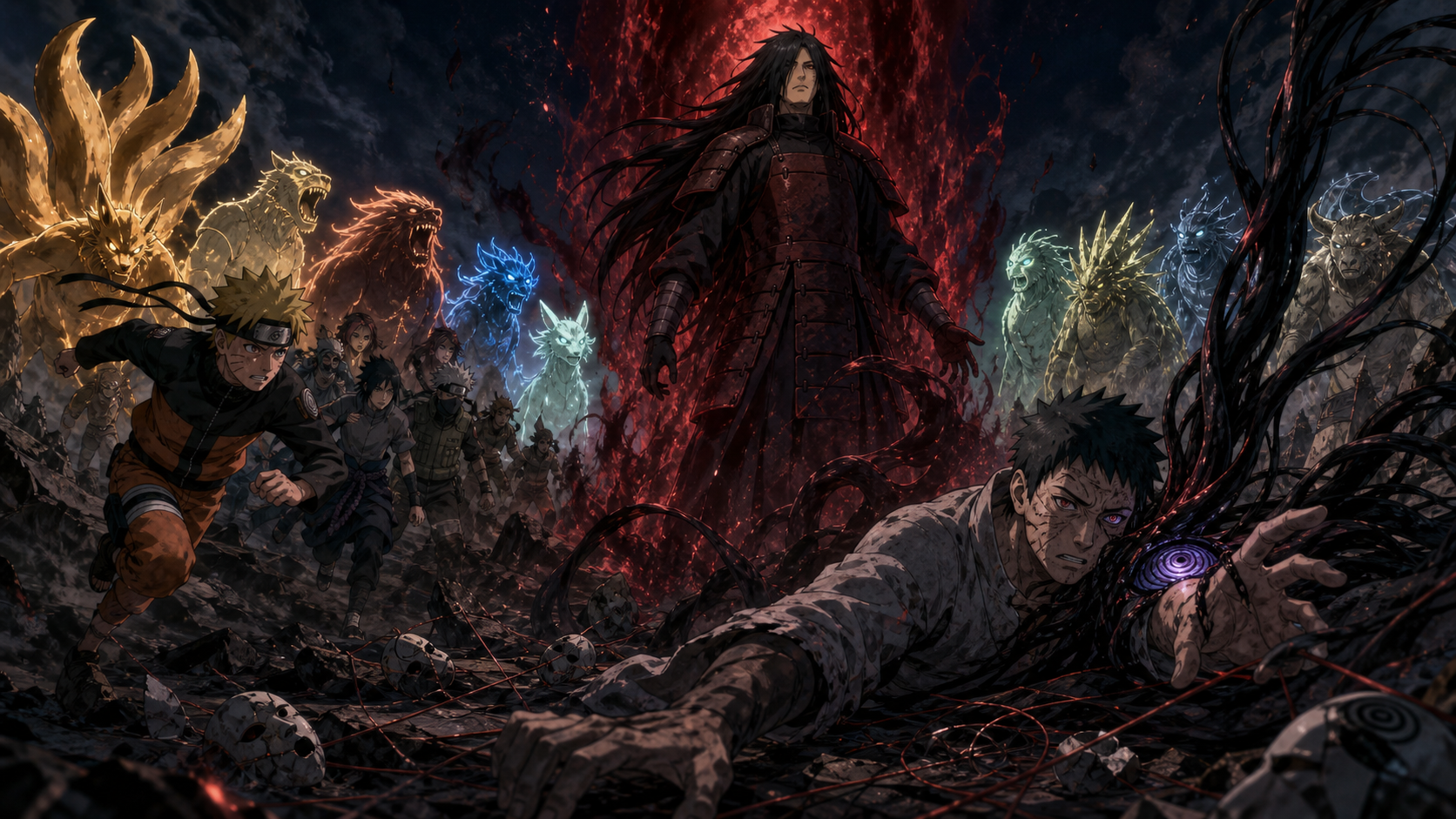
Madara Uchiha Rises
Obito tries to act against the system he built, but Madara turns his body into one last tool and returns through ownership rather than loyalty.
Bottom line
“Madara Uchiha Rises” turns Obito’s first attempt at atonement into one last theft of his body. He watches Naruto keep fighting, admits responsibility for the war, and tries to use the Rinne Rebirth technique to repair some part of the damage. That choice matters because he finally acts against the system he helped build. The choice cannot repay every death, and dying would spare him from the slower work of answering survivors. Before either question can settle, Black Zetsu pins him down and redirects the technique toward Madara. The old architect returns to living flesh by using Obito as disposable infrastructure. Madara’s resurrection strips the war of any illusion that he values the Uchiha, peace, or the wounded child he recruited. He values control. Obito was always a temporary body, name, and pair of hands in somebody else’s plan. Naruto’s answer remains collective resistance. Madara’s answer is ownership all the way down.
The alliance believes the largest obstacle has fallen
Naruto and the Allied Shinobi Forces have extracted the tailed beasts from Obito. The Ten-Tails jinchūriki no longer towers over the battlefield.
Victory feels close because the most visible threat has collapsed.
Madara was always waiting behind Obito
The older Uchiha allowed Obito to carry his name and advance the Eye of the Moon Plan. That arrangement never made them equal partners.
Madara designed a succession in which only Madara truly succeeds.
Naruto attacks the remaining enemy
He moves toward Madara rather than treating Obito’s defeat as the end. The decision recognizes that one captured operator does not dismantle the larger project.
Systems survive when their architects remain active.
Obito watches from a broken body
Losing the tailed beasts leaves him unable to move normally. Physical collapse follows the loss of power he used to dominate everyone else.
Vulnerability forces him to see the battle without a godlike shell.
Naruto gives him a glimpse of another answer
Obito watches someone with similar childhood loneliness keep choosing comrades, shared risk, and an imperfect real world. Naruto’s persistence becomes evidence against fatalism.
Hope arrives through conduct rather than a speech alone.
Obito acknowledges his crimes
The official episode guide identifies his recognition directly. He no longer hides behind the mask, Madara’s name, or the claim that the world made every later choice inevitable.
Admission creates the first honest moral starting point.
Recognition does not complete atonement
Naming guilt cannot restore people killed during the Nine-Tails attack, Akatsuki operations, jinchūriki hunts, or the war. Survivors still carry injuries and consequences.
Truth begins the account. Truth does not close the account.
Obito tries to form a technique
He gathers his remaining strength and begins the hand seals for a jutsu meant to answer the damage. The choice reverses his earlier commitment to Madara’s plan.
Action gives his changed understanding material weight.
Rinne Rebirth carries an enormous cost
The technique can return the dead at the user’s expense. Such power makes sacrifice tempting as a clean narrative solution.
Death can repair lives while also ending the perpetrator’s participation in later judgment.
Sacrifice can be sincere and incomplete
Obito may genuinely want to repay what he can. A final act should not be dismissed merely because full repayment is impossible.
Moral seriousness requires valuing prevented harm without pretending the ledger becomes blank.
Survivors do not get to question him first
Many people harmed by Obito have no place in his inner decision. A battlefield sacrifice can bypass testimony, sentencing, and the slow discomfort of hearing what he caused.
Redemption stories often move faster than victims can speak.
Black Zetsu interrupts the choice
The entity suddenly appears and restrains Obito’s body. His first autonomous action against Madara is met with direct physical control.
The master plan reveals another hidden enforcement mechanism.
Obito’s body becomes contested territory
Madara previously rebuilt him after the cave injury, attached Hashirama-derived material, trained him, and planted control measures around his future. Black Zetsu now claims the weakened body at the decisive moment.
Grooming reaches its ugliest end through possession.
Bodily rescue never meant bodily freedom
Madara saved Obito from death under the boulder, but the rescue created dependence and access. He treated survival as a debt that justified ownership.
Care offered for control is not care.
Black Zetsu functions as coercion made visible
Obito spent years believing he chose Madara’s project after discovering the world’s cruelty. The black mass pinning him shows how much contingency Madara built around that supposed choice.
Manipulators praise free will until the target says no.
The interruption does not erase Obito’s earlier agency
Current possession is real. Previous years of planning, recruitment, murder, and war still include decisions Obito made with significant power.
Coercion and accountability can occupy the same biography.
Madara uses the Rinne Rebirth technique for himself
The jutsu meant to answer death becomes the route for restoring the planner who caused more death. A reparative tool is redirected toward domination.
Control changes the beneficiary while preserving the cost to the person used.
Resurrection has been Madara’s private objective
The Eye of the Moon Plan was never a selfless legacy passed to a younger believer. Madara expected Nagato or another pawn to bring him back in living form.
Every recruit occupied a place in his return strategy.
Nagato was another body assigned a function
Madara arranged for his Rinnegan to reach Nagato and expected the young man’s life to end through the resurrection technique. Nagato’s own grief and politics became useful cover.
The plan treats vulnerable children as delayed-use equipment.
Obito repeated the same treatment
He manipulated Nagato’s organization, used Sasuke’s grief, controlled jinchūriki, and treated tailed beasts as components. Madara’s methods spread through the disciple.
Victims can reproduce the structure that harmed them.
Madara returns to living flesh
Reanimation gave him an immortal body with regeneration and endless chakra access, but living resurrection restores the conditions needed for his larger plan. He accepts vulnerability to pursue complete power.
His confidence comes from preparation rather than caution.
A living body changes the battle
Madara can now be injured and killed in ordinary terms, yet he can also access powers and transformations unavailable under Impure World Reincarnation. The shift makes him more human and more dangerous.
Mortality does not automatically reduce threat.
He rises without gratitude
Obito’s body pays the price, Black Zetsu enforces the transfer, and countless combatants created the conditions. Madara treats the result as fulfillment owed to him.
Entitlement turns other people’s sacrifice into background machinery.
The title restores Madara’s full position
Earlier episodes introduced his reanimated power and historical rivalry. This rise marks the transition from resurrected relic to active living claimant over the world.
The war enters the form he planned decades earlier.
Hashirama remains central to his strategy
Madara’s fixation on his former friend includes ideological rivalry, bodily appropriation, and the pursuit of Senju power. He never accepted relationship without competition for control.
Admiration curdled into possession.
Madara reads people as resources
Hashirama supplies cells and sage power. Obito supplies labor and a body. Nagato supplies eyes and a future sacrifice. The tailed beasts supply chakra.
His world has no partners, only functions.
Naruto represents another use of power
Naruto’s strongest battlefield gains come through negotiated or repaired bonds with Kurama, the tailed beasts, comrades, and former enemies. Those relationships remain imperfect but reciprocal.
Shared power exposes Madara’s isolation as a strategic weakness.
The alliance must adjust immediately
Combatants have spent enormous chakra and attention extracting the beasts from Obito. Madara’s resurrection changes the enemy’s capabilities before they can recover.
War punishes anyone who mistakes a transition for an ending.
The tailed beasts have a direct stake
Freedom from Obito does not protect them while Madara remains capable of recapture. Their resistance concerns survival and autonomy, not loyalty to the shinobi system.
The alliance needs cooperation without assuming ownership.
Obito sees the final shape of Madara’s betrayal
He once believed he inherited a mission that transcended one person. Madara’s return demonstrates that the younger Uchiha was always replaceable.
False mentorship ends by consuming the student.
His attempted change still matters
Black Zetsu prevents the intended action, but the choice to resist separates present Obito from the man who willingly advanced the plan. Failed repair can reveal moral movement.
Outcome and intention both belong in the judgment.
Naruto cannot rescue him through empathy alone
Naruto reached Obito’s conscience, but physical control now requires tactical intervention. Emotional recognition does not remove seals, possession, or enemy power.
Material coercion needs a material response.
Kakashi faces another theft of his friend
He has barely confronted Obito as a responsible adult before Black Zetsu seizes the weakened body. The moment repeats an old pattern of losing access before the relationship can reach resolution.
Grief becomes complicated by interrupted accountability.
Minato sees the cost of delayed recognition
He failed to identify the masked attacker as Obito during the Nine-Tails assault. Now the former student stands exposed as both perpetrator and controlled pawn.
Understanding arrives after damage that understanding cannot undo.
Black Zetsu complicates the villain hierarchy
The entity appears to serve Madara completely and acts as the hand that secures resurrection. Later revelations will change the full explanation, but Episode 391 presents a precise operational role.
Analysis should preserve the knowledge boundary of the episode.
The direction pivots from reflection to threat
Two Hanabi episodes paused the war for family history. The return to Obito’s collapse and Madara’s rise restores urgency through sudden bodily seizure and strategic reversal.
The pacing deliberately denies a comfortable restart.
Visual contrast carries the power transfer
Obito lies drained while Madara regains living presence. Black Zetsu bridges their bodies as control moves from one Uchiha generation to another.
The image explains hierarchy before dialogue finishes the point.
Japanese performance requires verified observation
The final publication should include the credited Japanese performers and staff. Any description of Madara’s confidence, Obito’s exhaustion, Naruto’s urgency, or Black Zetsu’s delivery requires lawful scene-level listening.
Specific evidence outranks invented atmosphere.
The episode rejects a clean redemption death
Obito does not receive immediate control over how his life ends or whom his last act saves. The same system he served turns his body against his revised intention.
Consequences arrive through the architecture he helped preserve.
Madara’s rise is institutional, not merely physical
His body returns because several generations of exploited people, stolen techniques, clan conflict, and tailed-beast captivity converged. One man stands up on top of a structure.
Defeating him requires more than winning one duel.
Madara planned resurrection through other people’s deaths
Rinne Rebirth was never a vague contingency. He expected Nagato or Obito to surrender life so his preferred body could return at the correct stage of the plan.
That arrangement exposes his idea of loyalty. Younger people receive purpose only while their bodies remain useful to a future Madara designed without their consent.
Nagato’s place in the chain cannot disappear
Madara’s Rinnegan entered Nagato’s life before the child could understand the assignment. War, grief, manipulation, and Obito’s intervention later turned that body into another route toward resurrection.
Nagato ultimately used the technique for victims he chose to restore. That refusal broke Madara’s schedule and proved a designated tool could still reclaim purpose.
Obito copied the structure that trapped him
After Madara groomed and reconstructed him, Obito manipulated Nagato, controlled jinchūriki, used Sasuke, and treated the tailed beasts as components. Victimization did not prevent him from reproducing the same ownership logic.
This repetition matters because cycles are maintained through learned practice, not mysterious curses. Breaking one requires naming both what was suffered and what was passed forward.
Black Zetsu turns coercion into physical occupation
Obito attempts a different action, and another will moves through his body to redirect the technique. The takeover makes explicit what Madara’s entire plan has assumed: Obito’s body belongs to the project.
The violation is real even though Obito violated many bodies himself. Justice does not require pretending a perpetrator can no longer experience harm.
Present coercion does not erase past agency
Black Zetsu controls this movement, but Obito chose years of planning, recruitment, murder, and war before the takeover. One involuntary act cannot become a blanket explanation for the whole biography.
Accurate accountability separates which decisions were his, which conditions constrained him, and where another actor directly seized control.
Obito’s attempted reversal has practical meaning
He cannot repair the dead by offering his life. He can still choose a technique aimed away from Madara’s private objective and toward reducing current harm.
The attempt fails physically, yet it reveals a changed intention that may shape later choices. Moral value does not depend entirely on successful spectacle.
Sacrifice is not the only available atonement
Dying can feel cleaner than surviving long enough to testify, rebuild, accept punishment, and encounter people who refuse forgiveness. Obito’s impulse deserves scrutiny alongside respect for the lives he hopes to save.
Accountability should not romanticize death as the quickest route from war criminal to tragic hero.
Madara rises through theft, not destiny
The title gives him grandeur, but the mechanism is an occupied body, a stolen technique, manipulated disciples, and power accumulated across generations. Nothing about the return is naturally owed.
Calling it destiny would hide the labor and violations beneath the event. Madara arrives because he designed a system that converts people into steps.
A living body changes vulnerability and appetite
Resurrection restores physical sensation, blood, growth, and access to powers that Edo Tensei’s constructed form handled differently. The battle must reassess what can injure, restrain, or replenish him.
Strategic adaptation matters more than awe. The alliance cannot afford to treat embodiment as a theatrical entrance without operational consequences.
Hashirama’s cells remain part of the body politics
Madara incorporated tissue taken from Hashirama and built later schemes around reproducing that biological power in others. Yamato, Obito, and many experiments carry consequences of the same extraction culture.
Admiration for a rival became entitlement to his body. The shinobi world repeatedly calls theft research, inheritance, or strength when powerful men benefit.
The tailed beasts recognize another ownership threat
Freedom from Obito does not end their danger when Madara stands ready to recapture them for the Ten-Tails. They have direct knowledge of his willingness to dominate Kurama and instrumentalize every beast.
The alliance needs cooperation that centers their judgment rather than treating them as unsecured weapons waiting for a better human custodian.
Naruto cannot talk this mechanism away
His recognition helped Obito confront identity because some part of Obito remained available to choose. Black Zetsu’s physical control and Madara’s return require restraint, force, intelligence, and coordinated protection.
Empathy is not a universal technique. Caring about personhood includes recognizing when dialogue cannot safely carry the whole response.
Kakashi and Minato witness institutional failure becoming flesh
The student they lost is occupied by the mentor who exploited him, while the war that began through those choices escalates again. Personal grief sits inside failures of missions, secrecy, child deployment, and delayed intervention.
Their sorrow matters. It should produce truthful examination rather than a private family tragedy that leaves the broader system untouched.
Madara’s return resets no moral account
Obito’s defeat does not cancel Madara’s responsibility, and Madara’s manipulation does not cancel Obito’s. The villain hierarchy can explain power without forcing all harm upward into one mastermind.
Each actor retains an accountable record. That clarity protects victims from having their experience simplified whenever a larger antagonist enters the frame.
The alliance needs to protect Obito from Madara without confusing protection with release from custody. Preserving his body may keep testimony, intelligence, and repair possible. It may also stop Madara from extracting more usefulness from him. Rescue and accountability are not opposing goals here. Both reject the idea that the strongest person decides whose body matters, what it is for, and when its story is finished.
RaeRae’s verdict
“Madara Uchiha Rises” works because the resurrection is not presented as a clever power-up floating outside character history. Madara returns through the bodies and choices he arranged decades earlier. Nagato was assigned the eyes. Obito was assigned the mission. Black Zetsu was assigned enforcement. Every relationship becomes a route back to Madara.
Obito’s attempted atonement deserves recognition without a premature halo. He admits guilt and tries to act, which is more honest than another retreat into despair. The technique could save lives, but death would also end his exposure to survivors and judgment. Black Zetsu removes even that choice by using his body for Madara’s benefit. The cruelty clarifies the two competing worlds. Naruto builds power through difficult relationships among separate wills. Madara builds power by deciding that every other will belongs to him.
RaeRae’s call
Madara does not rise because history chose him. He rises because he designed a human supply chain: Nagato carried eyes, Obito carried a technique, Black Zetsu enforced the transfer, and every younger life was assigned a function. Obito’s attempted change matters, but it does not clean his record or make death the only acceptable repair. The episode’s real horror is ownership. Bodies, beasts, cells, grief, and loyalty all become Madara’s resources. Defeating him requires more than greater force. It requires refusing the system that keeps turning people into infrastructure.
Episode details and viewing routes
- Official episode reference: Naruto Official episode guide
- Licensed episode route: Crunchyroll licensed episode page
What I am carrying forward
The alliance extracted the tailed beasts from Obito and shifted toward Madara. Watching Naruto continue the fight gave Obito enough hope to acknowledge his crimes and attempt a reparative technique.
Black Zetsu restrained Obito and redirected his body toward Madara’s resurrection. Madara returned to living flesh as the battlefield’s central threat. Episode 392 must show whether nine newly freed tailed beasts can stop a man who planned for nearly every body around him to become a resource.