
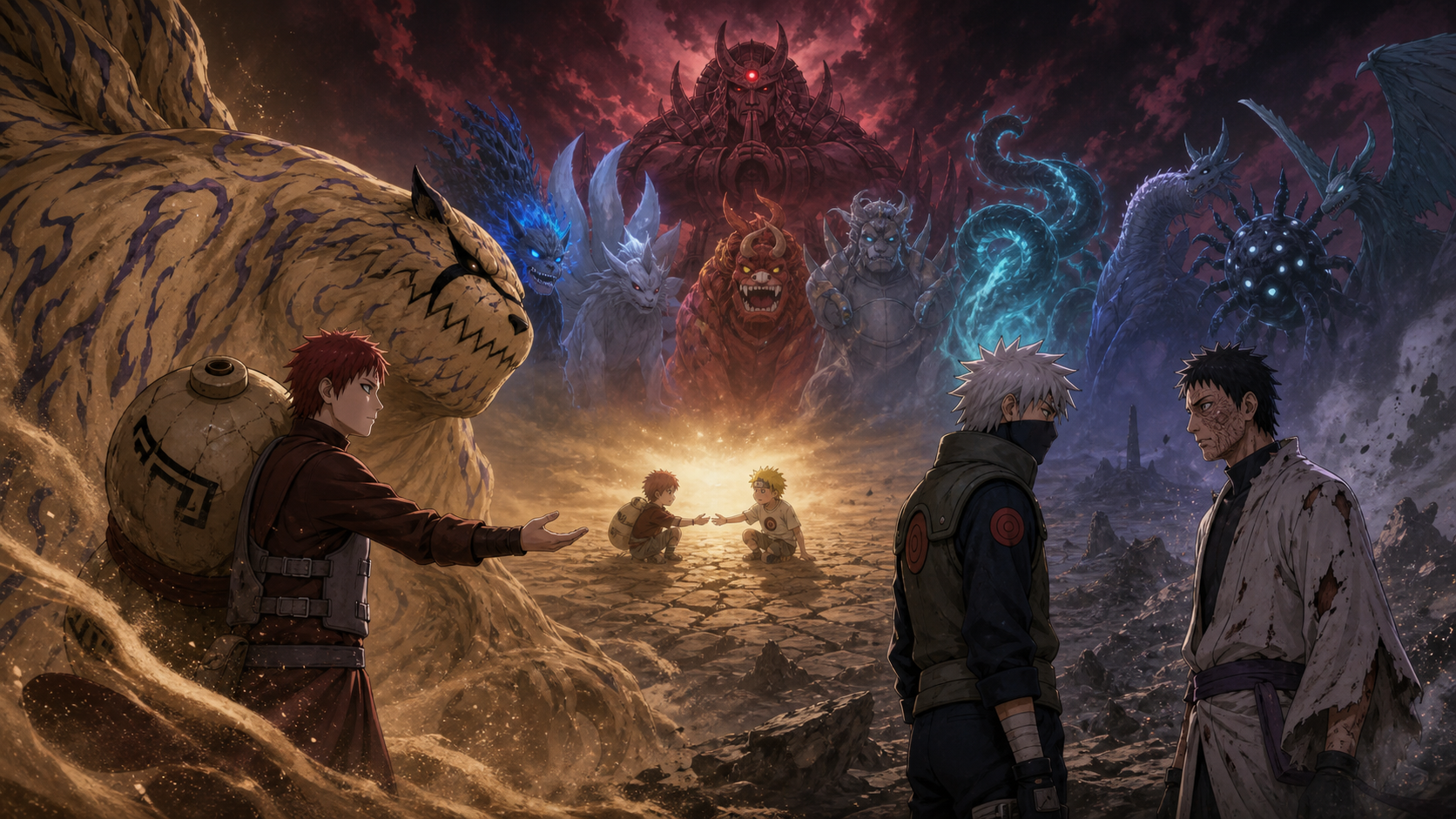
My First Friend
Gaara asks instead of commanding, Shukaku keeps the right to refuse, and Kakashi’s recognition of Obito opens accountability without erasing the war.
Bottom line
“My First Friend” pairs two reunions that refuse easy sentiment. Kakashi faces Obito after helping stop him, while Gaara meets Shukaku after years defined by confinement, fear, and mutual hostility. The episode calls Naruto Gaara’s first friend because Naruto recognized the lonely child beneath the weapon label and then proved that recognition through action. Shukaku does not owe Gaara instant cooperation because another human says the former jinchūriki changed. Gaara must ask rather than command, explain rather than assume, and let their shared concern for Naruto create a new choice. That distinction gives the episode weight. Friendship is not a magic badge that purifies every relationship around Naruto. Friendship teaches Gaara how to approach a being his village once forced inside him. Obito’s side keeps the harsher question alive: when an old friend returns after becoming responsible for mass violence, recognition can begin accountability, but recognition cannot erase the violence.
The battlefield survives Obito’s defeat
All nine tailed beasts have been pulled free, yet Madara remains active. The alliance cannot treat one victory as the end of the war.
Relief has to coexist with immediate danger.
Extraction restores separate bodies and wills
The beasts stand as individuals again after Obito used their combined power to become the Ten-Tails’ jinchūriki. Their freedom reverses a plan based on forced consolidation.
Many voices return where one controller tried to speak for everyone.
Madara becomes the shared target
The Allied Shinobi Forces and the tailed beasts shift their attention toward the most dangerous remaining opponent. Madara’s skill, revived body, and long preparation keep the threat enormous.
Collective focus does not guarantee an easy seal.
Kakashi and Obito face each other again
The former teammates meet after the mask, the Kamui duel, the Ten-Tails transformation, and Naruto’s successful pull. Their reunion contains affection, betrayal, grief, and unfinished judgment.
No single label can hold the whole encounter.
Kakashi has every reason to feel rage
Obito helped cause Minato and Kushina’s deaths, attacked the village, manipulated Nagato’s organization, supported jinchūriki hunts, and launched the war. Kakashi also spent years mourning him as a fallen friend.
The returned person shattered the meaning attached to that grief.
Friendship does not require denial
Recognizing the boy who once saved him does not require Kakashi to minimize the adult record. Honest relationship includes the harm one person caused.
Affection without truth becomes protection from consequence.
Obito has finally lost the god shell
Without the tailed beasts, he looks physically vulnerable again. The change removes the visual scale that helped him hide behind a world-remaking identity.
Power leaves a damaged human body on the ground.
Vulnerability is not innocence
A defeated person can inspire pity while remaining responsible for previous choices. The series often uses bodily collapse to reopen emotional access.
Compassion should not rewrite chronology.
The episode turns toward Gaara and Shukaku
Their reunion brings another former jinchūriki relationship into the center. Gaara once carried Shukaku under a seal imposed before he could consent.
Both experienced the bond as captivity.
The Sand made a child into infrastructure
Village leadership placed Shukaku inside Gaara to create military power. That decision exposed a child to fear, insomnia, surveillance, attempted murder, and public rejection.
Institutional strategy shaped the hostility between host and beast.
Shukaku was also imprisoned
The village treated him as an asset whose will did not matter. His cruelty toward Gaara harmed a child, but human systems created the container and expected obedience from both captives.
Two victims can still hurt each other.
Gaara asks for help
He wants Shukaku’s sealing power used against Madara. The request matters because Gaara no longer has automatic access to the beast’s chakra.
He has to approach Shukaku as another party.
Shukaku refuses first
The refusal protects his agency after extraction restored freedom. Cooperation should not be assumed because the alliance needs his ability.
Urgency does not cancel consent.
Shukaku’s first answer also gives Gaara useful information. Their old relationship cannot be repaired by presenting a worthy emergency and expecting compliance. Gaara has to show that his new respect survives frustration, public pressure, and the possibility of hearing no. Accepting that risk is stronger evidence of change than any speech about friendship.
Their old hostility remains relevant
Gaara and Shukaku lived through years of resentment. A shared battlefield cannot make those experiences disappear on command.
Trust needs a reason stronger than convenience.
Gaara has changed since Part I
Naruto’s example, village relationships, leadership, death, and restoration reshaped how Gaara understands strength. He now protects people instead of proving existence through killing.
The change appears in repeated public choices.
Shukaku deserves evidence
Humans have promised protection while using tailed beasts as weapons for generations. Suspicion toward another request is rational.
Gaara’s title alone should not settle the question.
Naruto becomes common ground
Both Gaara and Shukaku know Naruto through different experiences. Gaara recognizes the person who broke through his isolation, while Shukaku recognizes a human connected to the tailed beasts without reducing them to fuel.
Their concern for Naruto creates a practical bridge.
“First friend” names a life-changing relationship
Naruto was the first peer who understood Gaara’s jinchūriki loneliness and still confronted his violence. He did not offer soft approval.
He fought Gaara, told the truth, and protected other people.
Naruto’s friendship carried accountability
Gaara learned that shared pain did not excuse harming Sasuke, Sakura, or the village. Naruto’s empathy came with resistance.
That combination made change possible without calling cruelty harmless.
Gaara did the work after the fight
One encounter opened a door, but Gaara rebuilt relationships through later decisions. He apologized, protected Suna, became Kazekage, risked himself for the village, and supported the alliance.
Naruto inspired a path that Gaara still had to walk.
The village also changed its response
Suna residents moved from fear toward trust because Gaara’s conduct changed and because people allowed their understanding to change. Community recognition followed visible service.
Reintegration required more than private intention.
Friendship becomes political without becoming fake
Naruto and Gaara influence villages, alliances, and battlefield decisions because both hold public roles. Their bond remains personal while carrying institutional consequences.
Private care can improve leadership when power stays accountable.
Gaara does not own Naruto’s moral authority
Being Naruto’s friend does not make every request correct. Gaara still has to explain the strategy and respect Shukaku’s answer.
Borrowed trust should never become another command.
Shukaku tests the reason behind the request
The beast’s resistance pushes Gaara to name what Naruto means and why stopping Madara matters. A request becomes more honest when the motive can survive challenge.
Need alone does not prove respect.
The seal requires specialized cooperation
Shukaku’s powers make him especially valuable against Madara. The alliance needs ability held by a person they cannot simply order.
Dependence can teach respect when authority no longer controls access.
The tailed beasts are not a replacement arsenal
Freedom would mean very little if the alliance immediately assigned each beast a military job. Their choice to fight must remain voluntary.
Good intentions do not create ownership rights.
Kurama’s development changes the group dynamic
Naruto and Kurama model a jinchūriki bond built through conversation, conflict, shared goals, and revised judgment. Their partnership gives other beasts evidence that cooperation with humans can differ from captivity.
One repaired bond cannot settle every beast’s history.
Gaara and Shukaku need their own terms
Naruto’s success with Kurama offers possibility, not a template that can be copied without adjustment. Shukaku and Gaara carry distinct wounds, temperaments, and memories.
Their next step should belong to them.
The episode places friendship beside freedom
Gaara calls Naruto a friend because Naruto chose connection without controlling him. Shukaku can consider helping because the current request allows refusal.
Voluntary action gives the word friendship moral substance.
Obito’s friendship problem is much harsher
Kakashi cannot approach him as though they merely drifted apart. Obito used their bond as emotional fuel while causing harm across nations.
Reconnection must pass through the record of betrayal.
Kakashi is not required to become gentle immediately
Survivors often carry anger, confusion, love, and a desire for finality at the same time. The story should not use Naruto’s compassion to shame Kakashi for having a different response.
Victims do not owe synchronized emotions.
Obito’s changed choice remains incomplete
Rejecting the Ten-Tails identity begins a turn away from Madara. He still has to decide what help, testimony, sacrifice, surrender, or repair he can offer.
Recognition creates obligation rather than closure.
Madara benefits from every unresolved fracture
He built his strategy through clan trauma, village conflict, tailed-beast captivity, and Obito’s despair. Division gave him recruits, weapons, and cover.
Cooperation threatens his system because cooperation redistributes agency.
The alliance cannot copy Madara’s logic
Forcing tailed beasts into service would repeat the assumption that powerful beings exist for shinobi use. A different future requires different conduct during the emergency.
Methods matter before the war ends.
Gaara’s request shows leadership growth
The younger Gaara treated strength as proof that nobody could approach him. The Kazekage now names dependence and asks another being to contribute.
Admitting need can strengthen public leadership.
Shukaku’s resistance has personality
His pride, suspicion, and abrasive manner prevent the tailed beasts from becoming one agreeable moral chorus. Freedom includes the right to remain difficult.
Individuality should survive alliance.
The title centers Naruto without making him the only actor
Naruto’s friendship changed Gaara, and his tailed-beast relationships affect Shukaku’s decision. Gaara still makes the request, Shukaku chooses, and the alliance carries the battle.
Influence works through other people’s agency.
The episode rewards long continuity
Gaara’s Part I fight, his Kazekage rescue, the Five Kage Summit, and the war all feed this reunion. The story lets early cruelty and later service occupy one character history.
Long-form payoff needs that accumulated record.
The pacing shifts after an emotional climax
Episode 387 concentrated on Obito’s inner break. Episode 388 widens the battlefield and gives Gaara’s history room inside the next tactical problem.
The quieter negotiation prevents nonstop escalation from flattening character meaning.
Japanese performance needs scene-level evidence
The Japanese cast credits should appear in the publication record. Claims about Shukaku’s comic timing, Gaara’s restraint, Kakashi’s hesitation, or Obito’s exhaustion require lawful direct listening.
Bounded credit protects the article from invented observation.
Gaara and Shukaku survived the same system differently
Sunagakure sealed a tailed beast into a child, isolated that child, and treated both lives as military capacity. Gaara experienced fear, assassination attempts, sleeplessness, and public rejection. Shukaku experienced confinement and forced deployment.
Their pain collided inside one body, but neither history should absorb the other. Mutual harm grew from an institution that denied both of them safe agency.
Extraction did not automatically create trust
Akatsuki removing Shukaku nearly killed Gaara and ended their forced physical bond. Separation stopped one form of captivity without repairing years of hostility, fear, and instrumental use.
A request on this battlefield cannot skip that record. Shukaku has reasons to doubt whether humans want help or merely want access to his power again.
Gaara asks because command would repeat the abuse
As Kazekage, he has authority over Sand shinobi. He does not have rightful authority over Shukaku’s body. Asking acknowledges that the beast is not a village asset returning to service.
The request matters even when refusal would complicate the plan. Consent only means something when no remains an available answer.
Shukaku’s first refusal protects personhood
He can be abrasive, suspicious, proud, and difficult without losing the right to decide. A friendly personality is not the admission price for autonomy.
The refusal forces Gaara to give reasons rather than issue demands. It also makes later cooperation a choice with context, not proof that captivity was secretly beneficial.
Naruto is evidence, not currency
Gaara names his first friend because Naruto helped him imagine another way to live. That relationship explains Gaara’s present values and offers Shukaku evidence about the kind of coalition requesting help.
Naruto’s friendship cannot be spent like a moral coupon. Shukaku still evaluates Gaara, the mission, and the risk through his own judgment.
Gaara changed policy as well as attitude
Becoming kinder in private would not have been enough. He entered public leadership, built cross-village trust, protected people who once feared him, and stood against the weapon logic that shaped his childhood.
Institutional repair remains incomplete, but changed governance gives Shukaku more evidence than a sudden emotional speech would.
The Sand owes both survivors a fuller reckoning
Gaara becoming Kazekage does not close the file on adults who ordered assassination attempts, normalized jinchūriki isolation, or treated Shukaku as deterrence. Leadership change is not automatically public accountability.
A real postwar response needs records, apology, protections against resealing, and political space for a tailed beast to refuse village custody altogether.
Kakashi’s reunion carries a different kind of consent
Obito’s loss of power returns a recognizable face, but Kakashi is not required to reopen friendship on demand. He has been deceived, attacked, wounded, and forced to relive Rin’s death through Obito’s ideology.
Recognition can coexist with distance. Kakashi controls whether he listens, speaks, helps, or maintains a boundary.
Obito’s vulnerability changes capacity, not history
Without Ten-Tails power, he looks smaller and more human. That visual shift can tempt the audience to treat him as the child from Team Minato again.
The body is vulnerable now, and the adult record remains. Mercy should prevent revenge from becoming cruelty without pretending consequence suddenly became unnecessary.
Friendship is not a lifetime immunity agreement
Kakashi can remember Obito’s kindness, carry his old words, and still condemn what followed. A real bond survives truthful judgment better than a sentimental bond built on selective memory.
If friendship required Kakashi to erase victims or suppress anger, it would become another form of control centered on Obito’s comfort.
Two friendship stories reveal different work
Gaara uses Naruto’s friendship as a foundation for changed conduct and a respectful request. Obito confronts friendship after years of manipulating, abandoning, and attacking the people connected to him.
Both stories involve recognition. Only sustained action can determine what recognition becomes once the emotional scene ends.
The tailed beasts need freedom beyond this battle
Helping seal Madara or stabilize the war should not return Shukaku and the others to automatic military assignment. Their cooperation is an emergency choice, not a renewed ownership contract.
The alliance’s moral victory depends on whether villages can imagine security that does not begin by imprisoning sentient beings inside children.
Gaara’s leadership is strongest when authority stops
He can coordinate armies, negotiate with Kage, and make battlefield decisions. He becomes more credible when he recognizes the boundary beyond which rank cannot ethically compel another person.
That restraint is not weakness. It is the difference between coalition leadership and the centralized control Madara and Obito keep trying to impose.
Shukaku can help without becoming domesticated
Cooperation does not require him to soften every edge, adore Gaara, or perform gratitude toward humans. He may remain proud, mocking, volatile, and guarded while making a strategically and morally serious choice.
Fandom sometimes treats likability as proof of goodness. Personhood is bigger than being pleasant for the audience.
The title belongs to Gaara’s history without owning Shukaku
Naruto was Gaara’s first friend, and that bond changed the direction of his life. The episode becomes honest when it shows what Gaara does with the change rather than making Naruto responsible for every later decision.
Shukaku enters the story as another possible relationship with separate terms, not as an accessory proving Gaara learned friendship correctly.
The episode needs to remember that Shukaku’s consent is not proven by a cooperative act. Trust can remain conditional, limited to this emergency, and open to revision afterward. Gaara does not earn permanent access because he asked correctly once. He earns the possibility of another conversation by respecting the answer, honoring the agreed purpose, and refusing to let Sunagakure translate help into renewed ownership. Repair lives in repeated boundaries, not one battlefield moment that everyone later uses to avoid the harder political work.
RaeRae’s verdict
“My First Friend” understands that friendship becomes meaningful through behavior. Naruto did not save Gaara by complimenting him. He recognized the loneliness, stopped the violence, protected his own friends, and showed a different use of strength. Gaara then spent years making choices that turned one opening into a changed life.
That history prepares him to ask Shukaku for help without pretending their forced bond was secretly healthy. Shukaku’s initial refusal matters because freedom must include refusal. Kakashi and Obito provide the darker companion story: an old bond can survive terrible betrayal, but survival does not erase judgment. The episode’s best promise is not that friendship fixes everything. Friendship can create enough trust for another honest choice, and honest choice remains work.
RaeRae’s call
Gaara asking Shukaku is the episode’s real measure of growth. The Kazekage has power, history, urgency, and a good reason, yet he still recognizes a boundary. Shukaku may refuse. Kakashi deserves the same protection around Obito: recognition does not create an obligation to forgive, comfort, or restore friendship. Naruto’s influence matters because Gaara turns it into conduct that leaves other people free. Friendship is not ownership with warmer dialogue. It is relationship that survives another person having a choice.
Episode details and viewing routes
- Official episode reference: Naruto Official episode guide
- Licensed episode route: Crunchyroll licensed episode page
What I am carrying forward
The tailed beasts were freed from Obito, and the alliance redirected its effort toward Madara. Kakashi and Obito came face to face with their shared history and the consequences still standing between them.
Gaara asked Shukaku to help seal Madara. Shukaku resisted, forcing their hostile past and Gaara’s bond with Naruto into the open. The next stage depends on voluntary cooperation among people and beasts who have strong reasons to distrust one another.