
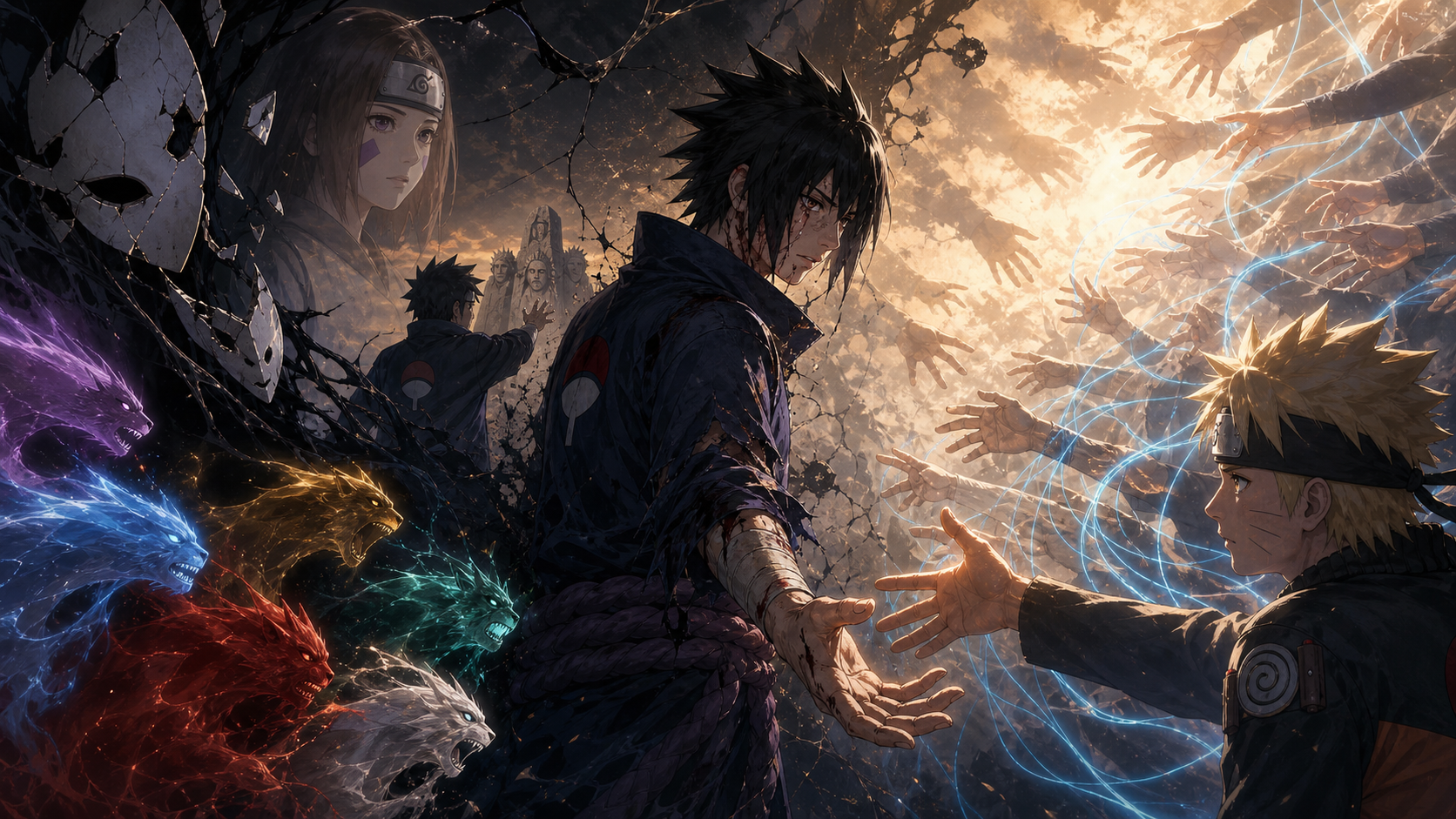
The Promise That Was Kept
Rin’s remembered trust cannot pardon Obito, but the promise she witnessed still demands that he stop hiding and choose responsibility in the present.
Bottom line
“The Promise That Was Kept” finally makes Obito answer the boy whose name he kept trying to bury. Naruto does not defeat him by finding a magic sentence. The Allied Shinobi Forces keep pulling, the tailed beasts resist captivity from inside, and Obito’s own memories refuse to support the lie that his earlier self meant nothing. Rin appears within that struggle because her trust once gave his Hokage dream a witness. Her memory can remind him who he chose to be. Rin cannot pardon mass death, speak for his victims, or turn one changed decision into innocence. The episode works because the promise becomes a demand for present action rather than a sentimental pass. Obito must stop hiding behind Madara’s project, the Ten-Tails, and the claim that pain erased his agency. Naruto offers a hand back toward responsibility. Obito still has to take that hand while the whole record follows him.
Naruto keeps the argument personal
Naruto addresses Obito by name and keeps returning to the child who wanted to become Hokage. He refuses the masked identity that reduces one life to a weapon, title, or theory.
Naming the person makes responsibility harder to escape.
Obito wants the past declared dead
He has spent years insisting that the hopeful Leaf boy no longer exists. That claim protects him from comparing his present conduct with his earlier values.
A dead identity cannot accuse the person who replaced him.
Memory rejects the clean break
Young Obito, Rin, Kakashi, and Minato remain emotionally present because adult Obito still carries them. His grief proves attachment survived beneath the mask.
The past hurts precisely because the connection never disappeared.
The Ten-Tails turns conflict into imagery
The licensed episode summary describes visions created under the Ten-Tails’ influence. Those inner images translate a psychological struggle into a visible battlefield.
Naruto is fighting Obito, and Obito is fighting the evidence inside himself.
Rin appears as remembered recognition
Her presence recalls the teammate who watched his effort, treated his injuries, and believed his dream deserved attention. Obito once wanted to become someone worthy of that trust.
The memory restores a moral standard he chose before Madara reached him.
Rin is not a reward for becoming Hokage
Obito’s childhood affection often turns her attention into proof that he matters. That emotional dependence narrows Rin into a prize inside his rivalry with Kakashi.
She remains a person whose care never transferred ownership of her future.
A promise belongs to the person who made the promise
Obito promised that he would become Hokage. Rin encouraged him, but she did not assume responsibility for keeping his word.
His later suffering explains the break without making her death responsible for his crimes.
The Hokage dream once required service
Young Obito wanted recognition, yet his habits also showed genuine attention to strangers. He stopped to help residents even when poor timing made teammates angry.
Leadership began with seeing people before leadership became a title.
Madara replaced service with control
The Eye of the Moon Plan promises peace by trapping everyone inside a manufactured dream. No resident gets a vote, and no victim gets to define a good life.
Obito turned the wish to protect people into authority over their minds.
Naruto exposes that reversal
Naruto shares the desire to become Hokage, but his path keeps forcing him toward other people rather than above them. Bonds complicate his choices instead of disappearing beneath one perfect solution.
The comparison makes Obito’s shortcut look smaller, not grander.
There is no shortcut to being acknowledged
Naruto once taught Konohamaru that the Hokage title requires a difficult path. Obito tried to skip the work by creating a reality where nobody could reject his answer.
Forced agreement cannot become recognition.
The Allied Forces supply the physical answer
The shinobi alliance keeps hold of the chakra ropes and pulls together. Naruto’s emotional reach matters because thousands of bodies sustain the opening.
Collective labor prevents the episode from becoming one heroic speech that saves everyone.
The tailed beasts are participants
Their chakra is not loose fuel waiting for human ownership. Each beast has a name, history, will, and reason to reject another jinchūriki system built without consent.
Extraction begins returning separate beings to themselves.
Kurama helps coordinate resistance
Naruto’s partnership with Kurama gives the alliance knowledge and power that domination could never produce. Their cooperation grew after hostility, negotiation, and earned trust.
That bond directly contradicts Obito’s forced unity.
Shared chakra does not erase difference
Naruto connects the alliance while each shinobi remains recognizable. The network supports coordinated action without converting everyone into one obedient consciousness.
Unity becomes useful because plurality survives.
Obito imagines a different future
The inner struggle shows the life he abandoned, including the possibility of standing before the village as Hokage. That image does not prove he would have earned the office.
The vision reveals that another direction once remained available.
Kakashi’s place in that future matters
Obito’s imagined path includes the teammate he resented and loved. Kakashi was never merely the rival who received rank and Rin’s attention first.
Their bond survived through imitation, grief, and unfinished accountability.
Minato’s place carries another wound
Their teacher represents care, failure, and the village system that sent children into war. Minato could not save his team from every consequence.
Obito later punished countless people who had no control over that failure.
The dream contains people rather than abstractions
Madara taught Obito to describe the world as hell. His remembered future returns specific faces, relationships, duties, and disappointments.
Concrete people challenge a theory built to flatten everyone.
Naruto offers a hand without legal authority
His reach can ask Obito to stop, return, and choose differently. Naruto cannot erase village law, battlefield judgment, or the claims of families harmed by the war.
Mercy from one opponent is not a universal pardon.
Acknowledging Obito’s humanity is not absolution
Calling a perpetrator human can make judgment more demanding. A monster category allows everyone else to pretend ordinary choices never built the damage.
Human agency keeps both change and blame in view.
Obito has reasons and still has responsibility
He experienced war, crushing injury, isolation, grooming, bodily reconstruction, manipulated information, and Rin’s death. Madara deliberately exploited every wound.
Explanation shows how the path formed. Explanation does not move the bodies out of the path.
Grooming narrowed his choices
Madara controlled Obito’s recovery environment, sources, physical dependence, and understanding of events. That coercive design matters when judging how a child became vulnerable.
Adult Obito later gained power and made further choices across many years.
Shame keeps asking for disappearance
Accepting continuity means admitting that the helpful boy and the masked man share one biography. Obito cannot save the earlier self by declaring the later record belonged to somebody else.
Shame wants annihilation when accountability requires presence.
Naruto refuses disappearance as the solution
He insists that Obito look at the abandoned promise rather than retreat deeper into the Ten-Tails identity. The invitation asks him to remain present long enough to act.
Responsibility begins when escape stops.
The title changes the meaning of success
The kept promise is not a belated claim to the Hokage office. Obito cannot walk from this battlefield into Minato’s cloak and call the childhood goal complete.
The promise survives through one choice aligned with the protector he once wanted to become.
One right choice still matters
Rejecting Madara’s plan and releasing control can save living people. Moral accounting should not become so punitive that preventing further harm no longer counts.
Stopping now matters even when stopping now is painfully late.
One right choice cannot settle the account
The dead remain dead, survivors retain their injuries, and nations carry damage caused by Obito’s campaign. Future help cannot rewrite previous agency.
Repair adds to the record. Repair does not replace the record.
The episode understands the difference unevenly
Naruto’s empathy creates the opening for change, but the story sometimes lets emotional recognition rush past victims who never enter the inner conversation. Obito and Naruto receive enormous narrative space.
The alliance’s bodies keep the cost visible when dialogue threatens to narrow the frame.
Rin cannot consent from memory
Obito’s image of her reflects love, grief, hope, guilt, and the person he remembers. A remembered Rin cannot approve his choices on behalf of the dead.
Private memory can guide conscience without becoming evidence of forgiveness.
Her faith becomes a question
Rin once watched him fail, train, and continue. The adult version must decide whether her belief means anything beyond emotional comfort.
Trust gains weight when the recipient acts under pressure.
Obito’s opponent becomes himself
The licensed synopsis states the central turn directly: Naruto’s persuasion moves his heart, and the inner visions make Obito confront his own emotions. Naruto creates pressure, but the final refusal must come from Obito.
No outside person can choose accountability for him.
The visual splitting exposes instability
The Ten-Tails form promised absolute power and instead leaves Obito struggling to maintain a coherent self. Faces and memories interrupt the godlike shell.
Power that requires self-erasure was never liberation.
The alliance gives him no private ending
Thousands of people witness the consequences even if they cannot see every memory. Obito’s decision happens inside a public war he helped create.
Personal revelation must answer material danger.
Naruto recognizes a distorted mirror
Both boys knew loneliness, wanted the Hokage title, acted out for attention, and depended on bonds that could hurt them. Naruto sees a possible version of himself without pretending their choices became equal.
Similarity explains the urgency of his reach.
Different choices remain the dividing line
Naruto also experienced manipulation, grief, rejection, and pressure from institutions. Other people helped him, and he repeatedly chose to protect those bonds instead of forcing everyone into obedience.
Pain creates risk. Pain does not issue one inevitable command.
The hand represents an unfinished return
Taking Naruto’s hand cannot restore childhood, Rin, Team Minato, or the years lost beneath a mask. The gesture offers movement toward the people still alive.
Return means entering consequence, not returning to innocence.
The episode earns emotion through repetition
Previous episodes rebuilt Obito’s childhood ambitions, rivalry, training, and dependence on Rin’s recognition. Episode 387 uses that groundwork instead of inventing a sudden hidden virtue.
The emotional turn grows from evidence already placed on screen.
The pacing asks for patience
Viewers who want the war to advance may feel the inner conflict stretching across too many episodes. The repetition can become heavy, especially after the series has revisited Rin’s death many times.
The best material adds moral pressure rather than replaying grief as decoration.
The production choice makes psychology physical
Memory, chakra, hands, ropes, and collapsing identity occupy the same dramatic space. The direction refuses a clean separation between internal decision and battlefield consequence.
Obito’s mind changes while other people physically pull power away from him.
Japanese performance needs an honest boundary
The Japanese cast credits belong in the final publication record. Any claim about pitch, breath, pause length, or delivery requires lawful direct listening and scene-specific notes.
Verified credit is better than invented performance analysis.
The extraction restores moral scale
Obito gathered tailed beasts into a single weapon and placed one will over an entire world. The alliance’s pull moves in the opposite direction by separating captive power from his control.
Freedom appears as many beings returning, not one ruler winning.
Victory still depends on what follows
Removing power does not remove Madara, Black Zetsu, the war’s casualties, or the institutions that made generations of children useful to violence. The battlefield remains dangerous after Obito’s inner turn.
No emotional climax gets to cancel the remaining work.
A promise cannot be kept through somebody else’s body
Obito once wanted to protect comrades and become Hokage. He later tried to fulfill his need for connection by placing the entire world inside an illusion nobody chose.
That is not completion of the old promise. It is replacement of the people involved with controllable versions who cannot disagree, leave, or ask what happened.
Rin’s memory can guide without issuing permission
Obito remembers her attention because it once made effort feel visible. The memory can expose the distance between the boy she knew and the choices he made.
It cannot tell survivors to forgive him. A dead girl’s imagined approval has no authority over living victims, and Obito does not get to ventriloquize her into absolution.
Keeping faith with Rin means respecting her agency
Rin chose medical work, cared for both teammates, understood the weapon placed inside her, and made a devastating decision under coercion. She was never merely waiting beside Obito’s finish line.
Honoring her requires ending the habit of making her the explanation, reward, or moral receipt for everything he wants.
Naruto’s hand offers work, not comfort
The gesture asks Obito to stop the plan, release stolen power, face the name he abandoned, and act inside a reality where outcomes are no longer his to control.
If the hand only promised emotional acceptance, it would be dishonest. The path back includes testimony, consequence, grief, and people who may never welcome him.
The alliance keeps the choice from becoming private
Thousands of fighters and the captive tailed beasts continue pulling while Naruto reaches toward Obito. Their labor creates the condition in which reflection can happen without allowing mass harm to continue freely.
That boundary protects everyone. Obito may choose his response, but he does not get exclusive ownership of the stakes or the ending.
One changed decision still has material value
Stopping now cannot restore the dead or undo years of manipulation. It can free the tailed beasts, weaken the Divine Tree plan, reveal Madara’s scheme, and prevent additional deaths.
Refusing false total redemption should never become an excuse for fatalism. Late action matters because living people remain available to protect.
Remorse must survive the loss of admiration
Obito may want Rin, Naruto, Kakashi, or Minato to recognize the better choice. Real accountability continues even if nobody praises him, trusts him, or interprets the act as heroic.
A person who changes only while watched approvingly is still making other people responsible for regulating his conscience.
Kakashi and Minato hold separate claims
Kakashi carries shared childhood, Rin’s death, the inherited creed about comrades, and the wound of fighting Obito directly. Minato carries responsibility as teacher and as Hokage during the Nine-Tails attack.
Naruto cannot settle those relationships for them. Each person deserves space to name grief, failure, anger, and whatever boundary follows.
The promise should become a public obligation
Wanting to protect comrades cannot remain a sentimental line attached only to Team Minato. Obito’s choices harmed jinchūriki, villages, civilians, shinobi, tailed beasts, and children he never knew.
Keeping the promise now means treating all those lives as real, not privileging the small circle whose approval he personally desires.
Reality offers no clean version of return
Obito will not become the untouched child again. Rin will not walk back into the team. Kakashi cannot lose the years of guilt. The alliance cannot unbury its dead.
The real world offers something less comforting and more ethical: the ability to stop, tell the truth, accept judgment, repair what remains possible, and leave other people free.
Accountability also needs records that outlive the emotional scene. The shinobi world will be tempted to simplify Obito into a monster defeated by heroes or a fallen friend rescued by Naruto. Both versions erase people. The public record has to hold Madara’s grooming, Konoha’s failures, Rin’s coercion, Obito’s choices, the alliance’s resistance, the tailed beasts’ captivity, and every later act of repair together. Complexity is not softness. It is how future institutions learn which conditions enabled the harm, which people interrupted it, and why one changed decision cannot become a replacement biography for everyone who paid the cost in full.
RaeRae’s verdict
“The Promise That Was Kept” lands because Naruto will not let Obito use despair as a final identity. He names the child, the dream, and the promise until Obito has to compare those values with the world he tried to imprison. The alliance does the physical work, the tailed beasts resist captivity, and Obito faces a decision no memory can make for him.
The episode also needs a hard boundary around Rin. Her attention mattered. Her death devastated him. Her remembered trust can help him reject Madara’s plan. None of those facts turns Rin into a moral receipt Obito can cash for forgiveness. The strongest reading leaves the promise modest and difficult: stop causing harm, help the living, surrender the fantasy of innocence, and remain present for whatever judgment follows.
RaeRae’s call
The promise was never “become powerful enough to create a world where Rin cannot leave.” It was about comrades, service, and becoming somebody who protected real people. Obito can honor that promise only by respecting the agency he spent years destroying. Rin’s memory can confront him, not forgive for everyone. Naruto’s hand can offer a route, not guarantee acceptance. The alliance keeps pulling because changed feelings are not enough. A promise becomes real again when present action reduces harm and accepts consequence.
Episode details and viewing routes
- Official episode reference: Naruto Official episode guide
- Licensed episode route: Crunchyroll licensed episode page
What I am carrying forward
Naruto’s words and the Ten-Tails’ inner visions forced Obito to confront the hopeful Leaf child he had declared dead. Memories of Rin, Kakashi, Minato, and the Hokage dream exposed continuity between his earlier values and present choices.
The Allied Shinobi Forces continued the collective extraction struggle while Obito’s resistance weakened from within. His next action must show whether recognition becomes responsibility. The war still contains Madara, Black Zetsu, captive power, and a long list of consequences that one emotional turn cannot settle.