
Obito Uchiha
Naruto refuses Obito’s god title and names the person responsible, making mercy compatible with memory, consequence and collective liberation.
Bottom line
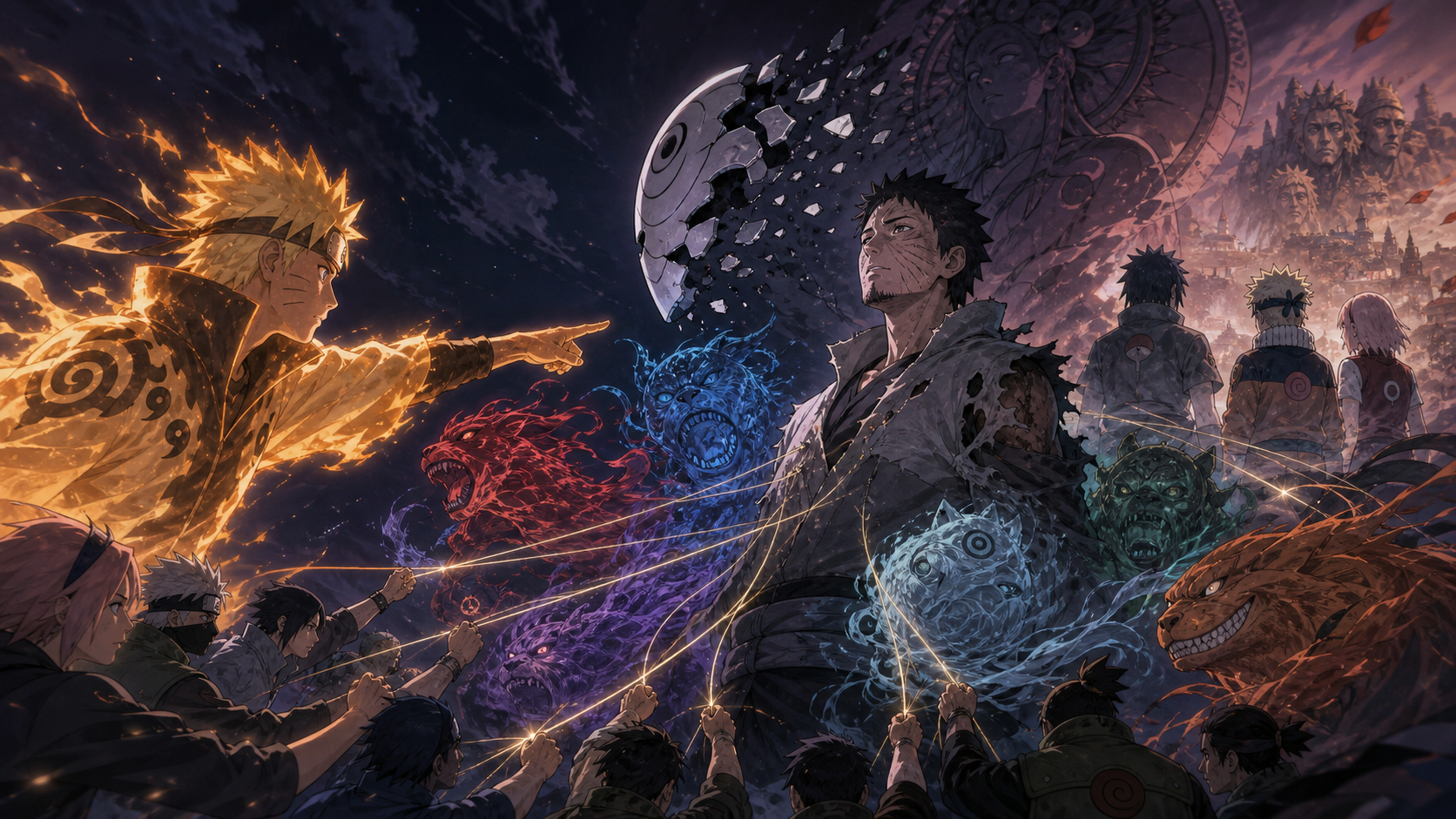
“Obito Uchiha” attacks the false identity Obito built to escape responsibility. He calls himself the second Sage of Six Paths, a being above the shinobi world and ordinary attachment. Naruto refuses the title and names the person in front of him: Obito Uchiha, former Leaf shinobi, member of Team Minato, Kakashi’s teammate, Rin’s friend, and a boy who wanted to become Hokage. Naming him does not forgive the Nine-Tails attack, Akatsuki, manipulated jinchūriki, dead villages, or the current war. Naming him makes those choices belong to someone. As the alliance pulls against the captured tailed-beast chakra, Obito confronts an imagined path where he kept his comrades and pursued leadership. Naruto argues that the hard real path still exists. The episode’s mercy is accountability without dehumanization. Obito cannot hide inside a god title, a mask, Madara’s name, or grief.
The tug-of-war continues across many hands
The alliance pulls against chakra connections binding the tailed beasts inside Obito. Every fighter adds force to a rescue no single shinobi could complete.
Collective refusal becomes physically measurable.
The tailed beasts resist captivity too
Their chakra is not passive rope between Naruto and Obito. Each beast has an interest in separation from the host who forced them into one weapon.
Liberation depends on their agency as well as allied strength.
Naruto holds the central connection
His earlier meetings with the beasts and ability to recognize their names create trust inside the struggle. He provides a relational bridge.
The bridge does not make him their owner.
Obito clings to a grand title
Calling himself the second Sage of Six Paths places him above ordinary shinobi categories. The title turns accumulated stolen power into a claim of transcendent authority.
Self-mythology creates distance from victims.
Naruto calls him Obito Uchiha
The correction restores name, family, village, team, history, and personal choice. Obito is not a force of nature that appeared outside human relationships.
A name becomes the first boundary of accountability.
Personhood does not mean innocence
Recognizing Obito as human prevents the alliance from treating evil as blood, species, or destiny. Humanity includes the capacity to plan enormous harm.
Accountability needs a person who could have chosen differently.
The Uchiha name carries history without dictating action
Clan persecution, war, Sharingan trauma, and Konoha policy shaped Obito’s world. None required him to manipulate Nagato, attack Kushina, or pursue compulsory illusion.
Context narrows judgment without eliminating agency.
Team Minato remains part of his identity
Minato, Kakashi, and Rin knew the child before Madara rebuilt his body and worldview. Their memories contradict Obito’s claim that the earlier self ceased to matter.
Other people carry evidence that a mask cannot erase.
Kakashi’s life preserves Obito’s old words
The lesson about abandoning comrades shaped Kakashi’s teaching and Team 7’s values. Obito’s younger belief continued producing consequences after he rejected that belief.
Legacy can testify against its creator.
Rin remains more than the event of her death
Obito organized his ideology around seeing Kakashi’s hand through her chest. Rin had her own mission, judgment, friendships, fears, and choice under Hidden Mist coercion.
Reducing her to the wound repeats another kind of erasure.
Naruto names the abandoned Hokage dream
Obito once wanted recognition and leadership in Konoha. The dream connected him to service, comrades, and a future where Rin could see him succeed.
Remembering the goal reveals continuity beneath the claimed transformation.
Wanting Hokage never guaranteed ethical leadership
Recognition can become service or control. Obito later chose a plan where nobody could disagree with his reality.
The old ambition matters because the meaning changed, not because the office would have redeemed him automatically.
Naruto represents another route through loneliness
Both boys began underestimated, loud, attached to recognition, and marked by absence. Naruto received relationships that challenged isolation before Madara could define his grief.
Different support conditions matter alongside different choices.
The comparison should not become moral bragging
Naruto cannot claim he suffered better and therefore earned superiority. He can show that pain did not make Obito’s later path inevitable.
The point is possibility, not a trauma contest.
Obito sees an alternate future
He imagines continuing with Team Minato, growing beside Kakashi and Rin, and reaching toward the Hokage office. The vision exposes desire he never fully killed.
An unrealized life can be grieved without replacing the present world.
Alternate futures are not evidence of entitlement
Obito may have become Hokage under different circumstances, or he may not. Rin may have loved him romantically, or she may not. Imagined outcomes cannot become debts reality owes him.
Possibility deserves mourning, not ownership.
Naruto offers the hard path back
He refuses the idea that Obito crossed a metaphysical line beyond personhood. Returning would require admitting harm, stopping the plan, and accepting consequences.
The offer is difficult precisely because the past remains.
Redemption cannot mean emotional comfort first
Victims do not owe reassurance because Obito begins doubting. The immediate duties are release the beasts, stop the tree, protect the alliance, and tell the truth.
Feeling forgiven is not the first priority.
Obito tries to make reversal impossible
He insists the person Naruto addresses is gone and that the current power defines him. Absolute identity claims protect him from the shame of choosing again.
If no old self exists, no promise was abandoned.
Naruto refuses the escape hatch
He recognizes familiar desire and contradiction beneath the title. The recognition denies Obito the comfort of becoming an inhuman category.
Being seen can feel harsher than being hated.
The alliance keeps pulling during the argument
The physical struggle does not pause while two people discuss identity. Thousands maintain pressure because lives and tailed beasts remain at stake.
Conversation matters inside collective restraint, not instead of restraint.
Words work because force created an opening
Naruto could not reach this internal confrontation while Obito held unchallenged control. Senjutsu damage and allied coordination weakened the structure enough for contact.
Ethical persuasion sometimes requires safety and leverage.
Force remains limited by purpose
The alliance aims to separate captured power and stop global coercion. Treating Obito’s body as an object for revenge would reproduce dehumanization.
Necessary restraint needs a defined end.
The beasts begin separating from the host
The balance shifts as collective force and Obito’s internal conflict weaken his control. Captured chakra moves away from the centralized body.
The weapon starts becoming many beings again.
Separation restores difference
The Ten-Tails project combined distinct beasts into one instrument. Extraction allows names, voices, histories, and individual wills to reappear.
Plurality defeats forced unity.
Obito loses borrowed godhood
Power assembled from stolen beasts begins leaving him. The grand title becomes harder to sustain once the bodies beneath the title are freed.
Authority built on extraction collapses when sources withdraw.
Loss of power reveals the unresolved person
Without the Ten-Tails state, Obito still has memory, guilt, skill, injury, and choices. The core moral problem was never the amount of chakra.
Power amplified the path he had already chosen.
Madara watches his plan destabilize
Obito’s defeat threatens the sequence Madara intended for resurrection and Infinite Tsukuyomi. He views the younger man’s body and Rinnegan through usefulness.
The old controller waits for another opening.
Victory over Obito does not end Madara
The alliance’s focus on extraction is necessary, but the reanimated Madara remains a strategic threat with independent goals. Success can create vulnerability during relief.
Battlefield awareness must survive emotional payoff.
Kakashi remains a relevant witness
He knows Obito before and after the cave, fought him directly, and carries injuries from the last confrontation. Any future reckoning cannot belong only to Naruto.
The people most entangled in the harm deserve voices.
Minato has responsibility beyond regret
He sees a former student lose control of the weapon used to condemn the world. A teacher’s sorrow should lead toward truth about the missions and systems that failed Team Minato.
Personal apology cannot reform a war economy alone.
The alliance includes Obito’s victims
Many fighters lost family, villages, tailed beasts, or years of life through Akatsuki and the war. They may not want to hear an argument about the boy he once was.
Their anger remains legitimate during any change he makes.
Mercy belongs beside consequence
Naruto’s refusal to erase Obito’s humanity can prevent revenge from becoming another cycle. Mercy does not require releasing him from responsibility.
Both standards protect the future.
The episode distinguishes explanation from excuse
Madara groomed an injured child, controlled information, and planted a seal in his heart. Rin’s death devastated him. Konoha’s child-war system failed the team.
Those facts explain the route while Obito’s later decisions remain his.
A name can carry accusation and invitation
“Obito Uchiha” identifies the person who did the harm and the person still capable of stopping. Naruto uses the same name for both.
Accountability requires continuity across change.
The Hokage ideal faces its darkest mirror
Naruto wants recognition through protecting a real community. Obito wanted recognition, then sought control through a world that could never reject him.
Leadership fails when service becomes entitlement to obedience.
The real path includes no guaranteed acceptance
Even if Obito stops, survivors may hate him, fear him, imprison him, or refuse reconciliation. Returning to reality means accepting other people’s independent judgments.
That uncertainty is part of consent.
Naruto cannot promise social forgiveness
He can refuse to abandon Obito as a person and demand a different choice. He cannot speak for every victim or determine the legal outcome alone.
Compassion has jurisdictional limits.
That boundary protects the survivors from becoming props in somebody else’s redemption. Their anger, distance, testimony, and demands remain part of the real world Obito must choose.
The alliance’s labor prevents a private salvation story
Naruto reaches Obito because thousands hold the line, medics preserve fighters, Kurama cooperates, Sasuke adds force, and the beasts resist capture.
No one boy saves another in isolation.
The postwar record must keep the full sequence
If Obito changes course, public history still needs the Nine-Tails attack, Akatsuki manipulation, jinchūriki deaths, the war declaration, headquarters strike, Divine Tree casualties, and the people who opposed him. A final helpful act cannot become a shortcut that edits victims out of the biography.
Truthful remembrance can include coercion suffered, crimes committed, choices reversed, and lives saved later without forcing those facts into one simple moral label.
The god title is a shield against ordinary judgment
Calling himself the second Sage of Six Paths lets Obito present his plan as history moving through him. Gods do not have teammates, teachers, victims, or village records that can contradict the story.
Naruto’s use of his name brings the scale back down. This catastrophe was built through human decisions, which means human standards still apply.
A mask can hide a face, not erase continuity
Obito used Madara’s name, the masked-man identity, and the claim that his former self died to separate action from biography. The separations were useful because each one made accountability harder to locate.
The same person remembers Team Minato, attacks Kushina, manipulates Nagato, declares war, and now hears Naruto. Change happened, but continuity never vanished.
Madara’s grooming matters without becoming an alibi
He found an injured child, controlled access to information, cultivated despair, arranged coercive conditions, and offered ideology when Obito was most vulnerable. That is manipulation with enormous moral weight.
Obito later gained power, knowledge, time, and repeated opportunities to choose. Naming the grooming explains how the route opened. It does not transfer every later decision back to Madara.
Konoha’s child-war system belongs in the record
Team Minato should never have been carrying adult military burdens at that age. Rin became a weapon target, Kakashi learned to prioritize rules over people, and Obito built identity around dying correctly for comrades.
Institutional failure shaped the disaster. Personal accountability and systemic accountability can coexist without either being used to cancel the other.
Rin’s death was engineered, but her life was hers
Hidden Mist coercion and Madara’s manipulation created the scene Obito witnessed. Rin also understood what had been placed inside her and made a desperate choice intended to protect Konoha.
That choice should not reduce her to sacrifice or make her responsible for Obito’s response. Her death was not permission for him to seize everybody else’s future.
Kakashi cannot be reduced to the hand in her chest
Obito froze one image and built a world around it. Kakashi was also a child caught inside the same operation, unable to prevent Rin from moving into the attack, then left alive with crushing guilt.
Recognizing Kakashi’s victimhood does not erase later mistakes. It prevents Obito from assigning him a villain role that keeps the full machinery invisible.
Naruto’s comparison has a sharp ethical limit
He recognizes loneliness, the Hokage dream, loud insecurity, and the need for comrades. He did not live Obito’s exact losses, coercion, injuries, or historical position.
The comparison is useful when it proves another path existed. It becomes arrogant if Naruto treats his survival as a universal recipe or claims equal knowledge of every wound.
Victims do not owe interest in the younger Obito
Someone whose family died in the Nine-Tails attack may not care that he once helped an old woman or wanted recognition. A jinchūriki harmed by Akatsuki may reject every sentimental memory.
Those responses are not failures of compassion. The past can explain the offender without requiring harmed people to perform the emotional labor of his return.
Stopping harm is the first proof of change
Obito’s internal doubt matters only if it alters what happens outside. The tailed beasts need release. The Divine Tree must stop. The alliance needs protection. Madara’s remaining plan requires exposure.
Redemption language becomes cheap when remorse arrives before action and then asks victims to celebrate feelings that have not reduced danger.
The alliance provides the boundary around conversation
Naruto can speak because thousands of people keep pulling, Kurama maintains the connection, and the tailed beasts resist from within. Obito does not hold uncontested power while everyone politely waits for insight.
That structure matters. Dialogue becomes safer and more honest when collective force prevents one participant from continuing mass violence during the discussion.
Extracting the beasts is rescue, not redistribution
The coalition is pulling distinct beings out of a centralized weapon. Victory cannot mean handing each beast back to a village that will reseal, assign, and deploy them under another security argument.
Liberation needs an after. Names, movement, relationships, and refusal must remain theirs once the immediate enemy loses control.
Obito’s alternate future is grief, not evidence
He can imagine becoming Hokage, standing beside Kakashi, or receiving Rin’s affection. None of those outcomes were guaranteed. A possible life is not a contract reality violated.
Mourning what might have happened is human. Punishing the world for failing to deliver the preferred version turns grief into entitlement.
Hokage ambition exposes the difference between service and possession
The younger Obito wanted recognition through protecting comrades and becoming visible to the village. The adult version creates a reality where nobody can reject, criticize, leave, or vote against his answer.
Both desires seek connection. Only one permits other people to remain politically and emotionally independent.
Mercy cannot promise reconciliation
Naruto may believe Obito can choose differently and still be human. He cannot guarantee Kakashi’s trust, Minato’s forgiveness, a survivor’s welcome, or a community’s decision about punishment.
Returning to reality means surrendering control over the response. If Obito only changes on condition of acceptance, he is still trying to own everybody’s inner world.
The full name keeps crime and possibility together
“Obito Uchiha” identifies the child crushed in a cave, the teammate who valued comrades, the masked architect of Akatsuki, the attacker who killed, and the adult currently capable of stopping.
One name does not flatten those stages. It prevents him from discarding whichever part becomes inconvenient when responsibility arrives.
Accountability also requires a public record sturdy enough to survive later mythmaking. If Obito helps now, that act belongs in the history beside every harm, not on top of them. Communities need memory that can hold coercion, agency, remorse, repair, punishment, and refusal without turning complexity into innocence.
RaeRae’s verdict
“Obito Uchiha” understands that dehumanizing a villain can become another way of avoiding accountability. A god, monster, mask, or dead former self cannot answer for policy and murder. A named person can. Naruto identifies the child, teammate, Leaf shinobi, failed Hokage candidate, war architect, and wounded adult as one continuous human being.
That recognition offers Obito no clean exit. Returning means losing stolen power, releasing the tailed beasts, stopping the Infinite Tsukuyomi, admitting what he chose, and allowing victims to judge him. The alliance’s many hands make the conversation possible by physically dismantling his control. Naruto gives him a path toward responsibility. Nobody owes him a path away from consequence.
RaeRae’s call
Naruto calling him Obito Uchiha is not soft. It removes every hiding place. Obito cannot blame a god, a mask, Madara’s name, the Uchiha bloodline, or a supposedly dead former self. Madara groomed him. The shinobi system failed Team Minato. Rin was coerced. Those truths matter, and Obito still chose what followed. Change begins with releasing the beasts, stopping the plan, telling the truth, and accepting that victims control their own response. Humanity offers responsibility, not immunity.
Episode details and viewing routes
- Official episode reference: Naruto Official episode guide
- Licensed episode route: Crunchyroll licensed episode page
What I am carrying forward
Naruto rejected Obito’s claim to be a second Sage of Six Paths and named him as Obito Uchiha, connecting the present war architect to the Leaf child who once wanted to become Hokage.
The alliance continued pulling against the tailed-beast chakra while Obito confronted an alternate path built around comrades and service. His control and borrowed power began breaking down. Episode 386 deepens the internal confrontation through Rin’s memory and Obito’s fear of facing the person he abandoned.