
A Heart Filled with Comrades
Naruto and Sasuke create the opening, but the alliance turns that opening into force by carrying separate bonds, skills and choices into one coordinated pull.
Bottom line
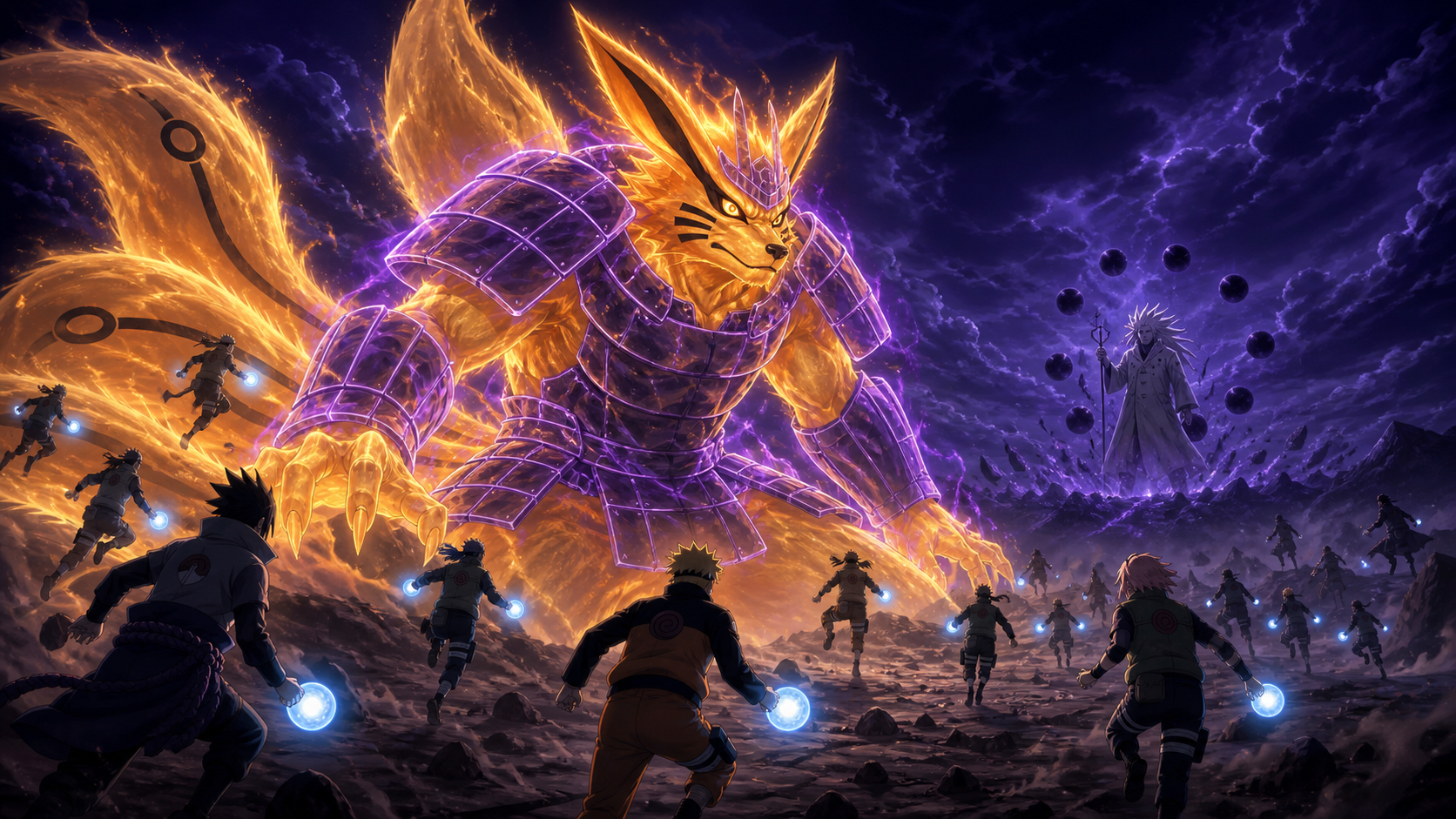
“A Heart Filled with Comrades” gives Naruto the giant heroic image and then makes that image depend on everyone around him. Sasuke wraps Susanoo around Kurama’s chakra form, combining defense, shape, flame, and natural energy against Obito. Naruto carries Konoha fighters on Kurama’s tails and supplies Rasengan through the chakra network so each team can strike from a different route. Their attacks create the opening Naruto and Sasuke need to cut through Obito’s defense. Contact exposes memories and shows Obito the life he abandoned: comrades beside Naruto, a possible Hokage future, and a version of himself that once wanted the same thing. The alliance then begins pulling the captured tailed-beast chakra from Obito. Connection becomes force without making the connected people identical. Naruto may organize the network, but every person has to grab, pull, protect, and choose the real world.
Naruto and Sasuke combine their largest forms
Kurama’s chakra provides scale and mobility while Susanoo supplies armor, weapons, and shaped protection. The result echoes Madara’s use of armored Kurama under very different relational conditions.
Visual similarity makes the ethical difference easier to see.
Madara controlled Kurama
His Sharingan forced the tailed beast into service against Hashirama and Konoha. Kurama’s will had no place in that combined form.
Power looked unified because one participant was enslaved.
Naruto works with Kurama
Their version grows from negotiation, conflict, names, shared risk, and chosen partnership. Sasuke adds Susanoo to a form whose central tailed beast is participating.
Consent changes the meaning of the same silhouette.
Sasuke’s role still requires scrutiny
He contributes protection and offensive shape, but his history includes controlling tailed beasts and treating teammates instrumentally. Cooperation now should not receive automatic moral equivalence with Naruto and Kurama’s bond.
Conduct over time will show which lesson he learned.
Senjutsu remains the necessary ingredient
Obito can cancel ordinary ninjutsu through Yin–Yang Release. Naruto’s natural energy gives the combined form a way to cause real damage.
Spectacle remains tied to the verified mechanism.
Armor helps the opening survive contact
Reaching Obito means crossing black spheres, chakra arms, roots, and high-speed counters. Susanoo increases the chance that the senjutsu-bearing attack reaches the host intact.
Defense becomes delivery infrastructure.
The Konoha teams join the charge
Naruto does not leave everyone behind the giant avatar. Fighters ride Kurama’s tails toward different angles around Obito.
The formation turns his scale into access for smaller bodies.
Kurama’s tails become transport routes
Each tail carries people through a lethal field while maintaining connection to the central chakra form. Mobility is shared rather than reserved for the strongest duo.
The body of a tailed beast supports coalition movement by choice.
Naruto supplies Rasengan through the network
Chakra arms help place prepared attacks in comrades’ hands. Fighters receive a tool suited to Obito’s vulnerability without becoming copies of Naruto.
Distribution accelerates training-dependent capacity during an emergency.
Borrowed technique still needs local action
Each recipient has to hold position, choose timing, navigate defense, and commit to contact. Naruto can provide chakra and shape.
He cannot perform every person’s decision.
Teams approach from different routes
Multiple angles force Obito to divide attention and reshape defenses. The plan converts the alliance’s numbers into tactical complexity rather than a crowded line.
Coordination gives scale a purpose.
Hinata carries grief into the formation
Neji should have been part of the Konoha advance. Hinata’s movement does not close that absence.
She fights with family loss beside her rather than behind her.
Team Guy moves with a missing member
Lee and Tenten contribute while the formation remains permanently changed. Their strength should not become proof that the team has already recovered.
The advance includes visible absence.
Team 10 acts after Shikamaru’s crisis
Shikamaru has only just survived near-total chakra depletion. Ino and Choji have carried fear for him alongside their fathers’ deaths.
Participation comes through medical intervention and team support, not invulnerability.
Medical clearance matters
A revived fighter may still have limited reserves, impaired judgment, or delayed complications. The urgency of the attack should not erase assessment.
Survival work includes knowing who can safely return.
Clan formations support the supplied attack
Sensory, shadow, mind, expansion, animal, insect, and Gentle Fist traditions help fighters approach and protect one another. The Rasengan does not replace their existing expertise.
Shared tools work best when local knowledge remains active.
Sakura’s labor supports the moving front
Healing Shikamaru, maintaining Katsuyu’s network, and managing casualties let fighters rejoin without treating bodies as disposable. Her role remains larger than one strike beside Naruto and Sasuke.
Care keeps the formation from consuming itself.
Sai remains part of the team history
The original Team 7 image receives enormous attention, but Sai spent years serving beside Naruto and Sakura during Sasuke’s absence. He also contributes to the alliance’s movement.
Restoration should not erase the teammate who stayed.
The Konoha focus has limits
Leaf characters receive personal memories and recognizable formations. Shinobi from every allied village are also fighting, rescuing, and dying.
The coalition cannot become Konoha plus an unnamed background.
Other villages bring necessary capacity
Sand control, Stone techniques, Cloud speed and force, Mist coordination, sealing, sensory units, and medical teams support the larger plan. Naruto’s network crosses national lines.
The war’s answer must remain multinational.
The Rasengan assault cracks Obito’s defense
Repeated senjutsu-bearing pressure from different directions forces openings in the protective structure. No single smaller attack carries the final visual weight.
Accumulation makes the central strike possible.
Naruto and Sasuke use the created opening
The armored Kurama form drives through after comrades have divided attention and weakened defense. Their blow lands because others shaped the route.
The finisher belongs inside the chain of labor.
Contact creates an internal connection
Tailed-beast chakra and shared power expose more than physical force. Naruto and Obito encounter images, memories, and possible selves within the struggle.
The battle becomes psychological without leaving mechanics behind.
Obito sees Naruto surrounded by people
The image contrasts with his chosen isolation and the controlled dream he wants to impose. Naruto’s relationships are imperfect, sometimes painful, and independent of his wishes.
Their freedom makes the network real.
Comrades are not decorations around the hero
Each person has a history outside Naruto and relationships that do not pass through him. The image becomes honest only when those separate lives remain visible.
A full heart should not mean an owned crowd.
Obito remembers his Hokage dream
He once wanted recognition, leadership, and a place beside Rin and Kakashi. The goal did not vanish because the child was foolish.
Madara and grief redirected the desire toward control of an unreal world.
Naruto represents a possible fork
Another lonely, underestimated boy moves toward Hokage through relationships and public service. Obito sees evidence that his own pain did not dictate one unavoidable future.
The comparison increases responsibility without erasing different support conditions.
Kakashi remains part of Obito’s living network
Their fight ended with mutual wounds, but Kakashi still exists as someone who remembers the entire child beneath the mask. Obito’s claim of total abandonment was never factually complete.
Damaged connection is still connection.
Minato’s presence complicates the memory
The teacher failed to reach Obito during crucial events and now fights against him. Minato also remembers the student as more than a war criminal.
Accountability and recognition can occupy the same relationship.
Rin cannot be the prize at the end of either path
Obito’s imagined future often places her beside the Hokage version of himself. Rin had her own life and choices beyond validating his success.
The memory should restore her personhood rather than use her as emotional payment.
The internal vision does not force conversion
Seeing another path can create doubt. Obito still has agency over whether he releases the plan, protects others, or clings to control.
Insight is an opening, not mind control performed by the hero.
The captured tailed beasts become reachable
Damage to Obito’s control exposes chakra connections to the beasts sealed within the Ten-Tails. The alliance can attempt extraction rather than only destroy the host.
Rescue becomes part of defeating the weapon.
Extraction reverses Akatsuki’s project
Akatsuki spent years hunting jinchūriki and pulling beasts into the Gedo Statue. The alliance now pulls those beings away from the person who concentrated them.
The direction of force changes from capture toward separation.
The tailed beasts have stakes in the tug-of-war
They are not colored energy parcels waiting to belong to Naruto or a village. Each has a name, memory, relationships, and a right not to remain inside Obito’s weapon.
Liberation should center their autonomy.
Naruto connects through names and prior promises
His encounters with the beasts created recognition before the current extraction attempt. They know he listened to identities the shinobi system often ignored.
Trust established earlier affects cooperation now.
The alliance grabs the chakra connection
Many fighters add physical and chakra force to the pull. The task is simple enough to distribute widely and significant enough that every contribution changes the balance.
Collective action becomes literal.
A tug-of-war is almost too clean a metaphor
One side centralizes tailed-beast power inside a single host. The other side pulls that power back through many hands.
The image makes political structure visible without a lecture.
Strength alone does not decide the pull
Obito’s internal doubt, the beasts’ resistance, Naruto’s connection, and the alliance’s numbers all matter. Psychological and relational conditions alter physical leverage.
Power is never only a measurement of chakra volume.
The alliance must avoid claiming the beasts afterward
Freeing them from Obito should not return them automatically to village storage or new jinchūriki assignments. Rescue that ends in reownership repeats the original structure.
Postwar freedom belongs inside the victory condition.
Obito feels the pressure of many choices
He wanted a world where disagreement would end inside one dream. The tug places thousands of independent refusals against his body.
The resistance is politically as well as physically threatening.
Naruto cannot pull alone
His connection starts the opportunity, but the scale exceeds one person. The alliance’s participation converts relationship into sufficient force.
The hero needs the crowd as partners, not witnesses.
The heart metaphor needs material grounding
Naruto’s heart is filled through remembered people, but those relationships required meals, missions, arguments, teaching, rescue, apology, and time. Emotional fullness did not appear through destiny.
Connection is accumulated labor.
The armored Kurama image carries historical baggage
Madara once wrapped Susanoo around Kurama after taking the fox’s will away. Repeating that silhouette could easily celebrate domination because it looks spectacular.
This version has to be read through Kurama’s consent and Naruto’s partnership. Otherwise the story would be repainting enslavement and calling the new colors friendship.
Sasuke contributes without becoming the moral center
His Susanoo supplies protection, reach, and shape the attack genuinely needs. That usefulness does not settle his motives, repair Team 7, or validate his sudden plan to become Hokage.
Coalitions can accept necessary work without issuing premature absolution. Sasuke gets credit for what he does here and scrutiny for everything still unresolved.
Kurama’s body becomes public infrastructure by choice
His tails carry fighters, preserve routes, and bring smaller bodies into a battle dominated by enormous avatars. The same kind of body villages treated as stored military power now supports people across national lines.
The distinction is agency. Kurama participates in the plan rather than being assigned to it by a seal, village, or Uchiha eye.
Distributed Rasengan does not erase local expertise
Naruto supplies chakra and technique because the moment cannot wait for years of individual training. Recipients still use clan knowledge, formation discipline, timing, movement, and trust to deliver each attack.
A shared tool becomes valuable when it joins existing skill. It should never turn experienced shinobi into temporary copies of the person who handed it over.
The Konoha teams carry visible absences
Neji is missing from Team Guy. Shikamaru has barely survived. Asuma, Shikaku, Inoichi, and many others cannot join this charge. The formation is full precisely because grief occupies space inside it.
Movement does not prove recovery. It shows people acting while loss remains unfinished and painfully specific.
Sai should not disappear when Sasuke returns
Sai lived, worked, and changed beside Naruto and Sakura through years when Sasuke was absent. A nostalgic Team 7 image can quietly reduce him to a substitute whose value expired when the original teammate came back.
That is nonsense. Restoration of one relationship cannot cancel the person who helped carry the team through the missing years.
The other villages are more than reinforcements
Sand, Stone, Mist, and Cloud shinobi bring techniques, medical labor, intelligence, grief, and political histories that do not belong to Konoha. They are not extras inside the Leaf village’s emotional climax.
The tug succeeds as multinational action. Any postwar story that credits Konoha alone would repeat the hierarchy this alliance was supposed to challenge.
Contact does not grant Naruto ownership of Obito’s past
Naruto can recognize the abandoned Hokage dream because their younger selves share painful similarities. He still cannot decide what Rin, Kakashi, Minato, or the child Obito would say on Obito’s behalf.
Recognition creates an opening for accountability. It does not let the hero write another person’s confession before that person chooses it.
Rin deserves a life beyond symbolic rescue
Obito repeatedly treats her death as the proof that reality failed, then imagines her presence as the reward inside a corrected future. Both moves trap Rin inside his emotional argument.
She had convictions, work, teammates, fear, and agency of her own. Remembering her honestly means refusing to make her a prize for either despair or redemption.
Kakashi remains evidence against total abandonment
Their relationship is wounded almost beyond recognition, and Kakashi has his own failures to answer for. Still, he remembers Obito before the mask and refuses the claim that nothing of that child remains.
A damaged bond does not automatically become a safe bond. It can remain a route through which truth, grief, and responsibility finally travel.
The tailed beasts are participants in their extraction
They resist Obito from within and respond to Naruto through names and prior encounters. The alliance supplies leverage, but liberation is not something humans simply perform upon passive chakra objects.
Each beast has a claim to freedom after the pull. Returning them to village arsenals would convert rescue into another transfer of ownership.
The tug-of-war turns politics into a physical image
Obito concentrates many lives and beasts inside one controlling body. Naruto’s side spreads effort across thousands of hands that remain separate. The direction of power tells us what each future values.
One system consumes difference to stabilize a ruler’s answer. The other depends on difference to create enough force for refusal.
Naruto’s comrades retain the right to disagree
A heart filled with comrades sounds beautiful until comrades are treated like permanent approval. Sakura, Kurama, Kakashi, Hinata, Gaara, Sai, Sasuke, and the alliance do not owe Naruto obedience because they care about him.
The relationship becomes real through continuing choice. People can challenge his decisions, change distance, demand repair, and still remain part of the network.
The finishing blow belongs to a chain of labor
Naruto and Sasuke occupy the visual center because their combined scale breaks the defense. That moment rests on medics preserving fighters, sensors sharing positions, teams dividing attention, Kurama carrying bodies, and every smaller attack weakening the route.
Crediting the chain does not diminish the heroes. It tells the truth about how their success became possible.
Obito is confronted by possibility, not perfection
Naruto’s life does not prove that loneliness always ends, institutions always improve, or every grieving child receives enough help. It proves only that Obito’s conclusion was never the sole available conclusion.
That is enough to restore responsibility. Pain shaped his choices, but it did not make mass coercion inevitable or place the world inside his custody.
Care also decides who can remain present long enough to make the pull matter.
RaeRae’s verdict
“A Heart Filled with Comrades” earns its giant heroic imagery by showing the support structure inside the image. Kurama consents to the combined form. Sasuke adds Susanoo. Konoha teams ride separate tails. Naruto distributes Rasengan. Medical and support networks keep people able to move. The alliance creates the opening that Naruto and Sasuke use.
Obito then sees the difference between a network and a prison. Naruto’s comrades remain separate people who may disagree with him. The tailed beasts resist being held inside Obito’s body. Thousands of hands join the extraction without dissolving into one mind. Obito’s Infinite Tsukuyomi promises a heart that never feels empty because nobody inside the dream can leave. Naruto’s heart is full because real people chose to stay, argue, help, and pull.
RaeRae’s call
The giant armored Kurama form only means something because the people inside and around it remain people. Kurama consents. Sasuke contributes without receiving automatic absolution. Sai still counts. Every village brings work. The tailed beasts resist their own capture. Thousands of hands pull without merging into one will. Obito built unity by imprisoning difference. Naruto’s side becomes strong enough because difference survives the connection. That is why the comrades matter, and why none of them should be reduced to proof of Naruto’s importance.
Episode details and viewing routes
- Official episode reference: Naruto Official episode guide
- Licensed episode route: Crunchyroll licensed episode page
What I am carrying forward
Sasuke armored Kurama’s chakra form with Susanoo while Naruto maintained Sage Mode. Konoha teams used Kurama’s tails as approach routes and carried supplied Rasengan into coordinated attacks that opened Obito’s defense.
Contact exposed Obito to Naruto’s network of comrades and memories of his abandoned Hokage dream. The alliance began a collective tug-of-war to extract the captured tailed-beast chakra from Obito. Episode 385 follows that struggle to its result and forces Obito to answer what remains when the imposed dream loses its power.