
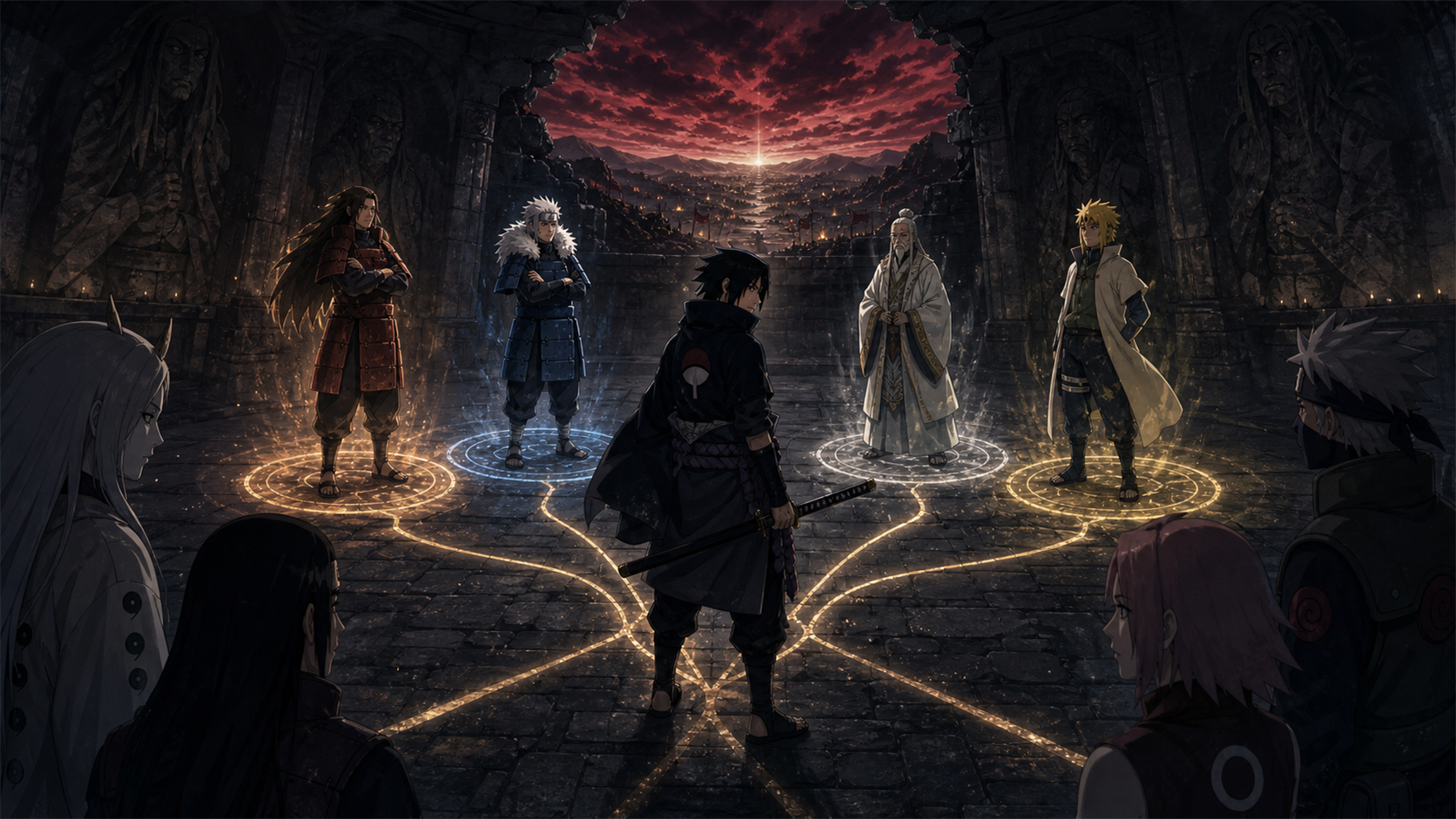
Sasuke’s Answer
Sasuke chooses to protect Konoha after hearing its buried history, but a direction toward the battlefield is not the same thing as political absolution.
Bottom line
“Sasuke’s Answer” gives Sasuke a direction, not a moral graduation certificate. After hearing the four Hokage, he decides that Itachi’s life and the village his brother protected should not be discarded. He will join the war and protect Konoha. That choice prevents collective revenge against residents who did not order the Uchiha massacre. The choice also remains tied to Sasuke’s need to interpret Itachi, which means his political judgment still leans on a dead brother’s sacrifice more than accountable public principles. Orochimaru follows because Sasuke’s changing path interests him. Karin returns despite the violence Sasuke used against her. The reanimated Hokage prepare to fight for a village that outlived each administration’s failures. Everybody is moving toward the battlefield, but movement in the same direction does not make motives, trust, or responsibility identical.
Hashirama finishes the founding account
The story leaves Sasuke with no clean hero and no clean institution. Konoha reduced clan warfare, protected generations, marginalized the Uchiha, and eventually demanded Itachi’s secret crime.
Sasuke receives complexity instead of an order.
The Hokage admit different failures
Hashirama recognizes that his village dream produced outcomes he never intended. Tobirama defends security choices while exposing suspicion. Hiruzen acknowledges Itachi’s mission and his own inability to stop the crisis.
Leadership testimony matters most when leaders name responsibility rather than only necessity.
Minato represents another unfinished inheritance
His administration was short, and his decision to seal Kurama inside Naruto shaped the son now carrying the alliance. Minato turns toward the war with pride and personal debt.
The Hokage title never removed family consequence.
Sasuke hears Minato as both a former leader and a father traveling toward the son who inherited his emergency decision. That overlap matters because the village repeatedly turns private family sacrifice into public infrastructure. Naruto carries Kurama, Itachi carries the massacre, and Sasuke carries the hidden explanation. Protecting Konoha cannot keep depending on children absorbing costs that institutions refuse to name.
Sasuke asks what Itachi protected
The village cannot remain an abstract enemy once Sasuke sees the founding goal, later distortions, and ordinary lives contained within Konoha. Itachi protected people as well as an institution.
That distinction makes total destruction harder to justify.
Understanding motive does not approve method
Sasuke can recognize why Itachi chose Konoha without agreeing that massacring the clan was right. Love, coercion, fear, state pressure, and personal agency coexist inside the decision.
Moral understanding should preserve contradiction.
Sasuke rejects collective revenge
Destroying the village would kill children, civilians, minor clans, and shinobi who never knew the truth. Such violence would repeat the logic that treated Uchiha lives as acceptable costs for stability.
Refusing that repetition is meaningful progress.
He decides to protect Konoha
The answer surprises people who watched him move from vengeance against Itachi to vengeance against the village. Sasuke now sees preservation as a way to honor what his brother chose.
Protection becomes the immediate action while his larger politics remain unsettled.
Itachi still carries too much authority
Sasuke has spent years allowing love, betrayal, and new information about Itachi to reorganize his entire identity. Following his brother’s will is safer than avenging him through mass death.
Sasuke still needs values he can defend without guessing what Itachi would want.
A dead sibling cannot consent to every legacy
Itachi chose death after constructing Sasuke’s hatred and hoped Naruto could redirect him. Sasuke now interprets that life as a command to preserve Konoha.
No final instruction can answer every future political question.
Protecting a village does not excuse the village
Konoha deserves defense from the Ten-Tails and Madara. Konoha also owes truth and accountability for the massacre, segregation, Danzo’s actions, and the conditions that shaped Itachi.
Survival should make reckoning possible rather than cancel the need.
Sasuke chooses action before full repair
The war will not wait for a commission, trial, archive, or public debate. People face immediate extermination.
Emergency defense and later accountability can both be necessary.
Hashirama accepts the answer without demanding loyalty
He wanted Sasuke to understand the village rather than obey a dead Hokage. Sasuke’s decision belongs to him after hearing several accounts.
Respecting that agency gives the conversation purpose.
Tobirama remains wary
One declaration cannot erase Sasuke’s attacks, alliance with Akatsuki, or rapid ideological shifts. Caution is justified when based on conduct.
The danger returns when caution becomes proof that an Uchiha can never change.
Hiruzen hears a consequence of buried truth
Sasuke’s path shows what secrecy did to the surviving child. Lies allowed leaders to preserve Konoha’s image while leaving him vulnerable to Orochimaru, Obito, and his own rage.
The cost of secrecy continued long after Itachi left.
Orochimaru chooses to follow
He does not suddenly become a loyal defender of Konoha. Sasuke’s evolution interests him, and observation remains one of his strongest motives.
Cooperation with a dangerous person can serve the same battlefield goal without creating moral trust.
Curiosity does not erase experimentation
Orochimaru has abducted people, altered bodies, pursued immortality, attacked Konoha, and manipulated children. Helping summon the Hokage does not balance that history.
Useful conduct should be recognized without rewriting accountability.
The Hokage remain under reanimation
They agree to fight, but their bodies exist through a coercive technique and living vessels. Personal willingness now aligns with Orochimaru’s direction.
That alignment does not make reanimation ethical in general.
Hashirama can exceed the restraint
His power limits Orochimaru’s practical control, creating a measure of autonomy. The other Hokage remain more exposed to the technique’s command structure.
Consent backed by an ability to refuse differs from consent without one.
The former leaders return to a changed world
Five villages now fight together, tailed beasts have spoken as people, and their own policies have produced consequences across generations. The war is partly an inheritance audit.
They enter as fighters and as authors of unfinished systems.
Minato anticipates seeing Naruto
The prospect carries warmth, but father and son will meet during catastrophic battle rather than ordinary family life. Naruto has already done years of growing without him.
Pride cannot replace the missed childhood.
The village monument becomes a departure point
The four Hokage stand above Konoha before heading to war. Their carved faces and living forms occupy the same frame, joining myth with fallible people.
They leave the symbol to serve residents on the ground.
Each Hokage reads the village differently
Hashirama sees a dream that survived him. Tobirama sees institutions and threats. Hiruzen sees the home he governed through compromise. Minato sees the place where his son grew up.
One skyline holds four political memories.
Nostalgia cannot become self-congratulation
The village endured, yet endurance alone does not prove every sacrifice was necessary. Konoha’s history includes safety, community, discrimination, secrecy, and repeated child deployment.
Leaders should return with affection and humility.
Karin re-enters Sasuke’s orbit
Karin’s attachment remains intense after Sasuke stabbed through her and treated her as disposable during the fight with Danzo. Her return is emotionally believable within a damaged bond.
Believability does not make the repair adequate.
Sasuke owes Karin direct accountability
An apology, changed conduct, space for anger, and freedom to refuse him would matter more than rapid comic reconciliation. She should not have to convert harm into proof of devotion.
Team reunion cannot erase interpersonal violence.
Karin retains tactical value and personhood
Her sensory ability, healing capacity, endurance, and knowledge make her useful in war. She also has needs beyond what Sasuke’s mission requires.
Returning to the group should remain her decision, not her assigned function.
Suigetsu says what others avoid
His reactions expose the absurd danger of traveling with Orochimaru, four dead Hokage, Sasuke, and unresolved team conflict. Humor gives the episode air without mocking the battlefield’s losses.
Practical fear can be the most honest response in the room.
Jugo follows with steadier attention
Jugo has watched Sasuke move through vengeance, alliance, collapse, and reconsideration. His loyalty often includes observing whether Sasuke still resembles the person he chose to support.
Silence should not be mistaken for lack of judgment.
Team Taka is not repaired by proximity
Karin, Suigetsu, and Jugo travel with Sasuke again, but their group history includes abandonment, instrumental treatment, and competing reasons for staying.
Shared destination creates an opportunity for repair, not proof of repair.
Naruto strains under distributed power
On the battlefield, Naruto continues maintaining Kurama’s chakra across the alliance. The strategy strengthens thousands while placing severe coordination and energy demands on him.
Collective benefit still needs sustainable distribution.
Micromanaging every cloak has a cost
Naruto tracks comrades and adjusts chakra as attacks shift. Central connection enables remarkable protection but risks turning him into another single point of failure.
The alliance needs the added power without surrendering local judgment.
The battlefield cannot see Sasuke’s decision yet
Naruto, Sakura, Kakashi, and the alliance have no reason to know that Sasuke just chose defense. From their perspective, he remains a dangerous missing-nin tied to previous attacks.
Trust will have to survive the shock of his arrival.
A decision becomes credible through conduct
Sasuke’s words matter because they redirect him from destroying Konoha. The battlefield will test whether he protects people, shares information, cooperates, and accepts limits.
Intent begins the answer. Repeated action proves the answer.
Becoming a protector is not the same as becoming Hokage
Sasuke’s emerging political ambition will require public trust, accountability, service, and recognition from people he hopes to lead. Power and insight do not grant the office.
Itachi’s warning to Naruto remains relevant: acknowledgment precedes legitimate leadership.
The four Hokage bring unmatched force
Their arrival can transform the war’s tactical balance. Each carries techniques, knowledge, and command experience from a different era.
Power should support the living alliance rather than displace leaders already fighting.
Dead leaders must not reclaim the whole war
The Allied Shinobi Forces formed through current Kage, commanders, medics, sensors, and ordinary units. The former Hokage can help without turning everyone else into spectators.
History returns to serve the present, not govern the present automatically.
Sasuke’s answer challenges Obito’s solution
Both men learned that Konoha’s reality contains cruelty and betrayal. Obito chooses a dream world that removes consent. Sasuke chooses to enter the flawed real world and affect the outcome.
That choice keeps political change difficult and human.
Protection can coexist with anger
Sasuke does not need to love Konoha’s leadership history before defending residents. Anger can support demands for truth after survival is secured.
Care for people should not require affection for every institution around them.
Sasuke chooses protection without granting absolution
He decides Konoha should survive the current war after hearing how the village began and how Itachi understood his duty. Survival does not mean every Hokage policy becomes justified or every institutional debt disappears.
Sasuke can protect residents from Madara and Obito while preserving his indictment of surveillance, massacre, secret government, and the adults who made a child carry their solution.
An answer is a direction rather than a completed politics
Going to the battlefield settles the urgent question of whether Sasuke will help stop mass destruction. It does not yet explain how he intends to govern, repair the Uchiha record, constrain leadership, or treat people who disagree.
The choice deserves recognition because it prevents immediate harm. Its long-term meaning will depend on methods after victory becomes possible.
Itachi’s love informs Sasuke without binding him
Sasuke understands that his brother chose the village even after leaders exploited him. That knowledge explains Itachi’s priorities, not a command Sasuke must obey forever.
A dead sibling’s sacrifice can become another cage when survivors are told love requires repeating it. Sasuke honors Itachi more fully by understanding the choice, naming its cost, and deciding with information Itachi never received freely.
Hashirama offers history, not a verdict
The First Hokage’s story gives Sasuke a founding purpose centered on protecting children and ending clan war. It also reveals how quickly shared vision became unequal authority and unresolved suspicion.
Sasuke listens without surrendering judgment. A witness serves the inquiry best when testimony becomes evidence the listener can compare, not a moral conclusion backed by legendary status.
Tobirama remains responsible inside his explanation
He can describe fear of Uchiha power, the police force, and the political calculations of an unstable coalition. Explanation places decisions in sequence. It does not make clan-based suspicion neutral.
Sasuke’s answer should carry both truths: Tobirama faced real governance risk, and policies built around ancestry helped make Uchiha residents feel monitored rather than represented.
Hiruzen’s regret cannot substitute for intervention
The Third wanted negotiation and permitted Danzō’s machinery to keep narrowing the route toward it. By the time he opposed the massacre plan, Itachi had already been positioned between clan revolt and village force.
Regret matters because denial would deepen the harm. Repair requires the harder record of what Hiruzen knew, what authority he retained, and why a subordinate’s covert system survived his objections.
Minato joins a crisis created after his death
The Fourth Hokage cannot answer every later failure, yet the institutions he served continued shaping Naruto, Sasuke, and the jinchūriki system. Returning gives him a present responsibility: help stop the war and listen to what the next generation inherited.
Heroism becomes accountable when a leader uses extraordinary power without claiming that power makes his perspective complete.
Orochimaru’s participation remains conditional
He follows Sasuke’s decision because he is curious about the path Sasuke will choose. Curiosity does not erase experimentation, body theft, village attack, or the coercion embedded in Edo Tensei.
The alliance can accept useful action while keeping boundaries and evidence. Temporary alignment is not rehabilitation, and the people he harmed remain stakeholders in any later judgment.
Suigetsu has reason to fear every new alliance
Four resurrected Hokage, Orochimaru, Sasuke, and a war create danger far beyond what he originally agreed to carry. His alarm is practical information, not comic cowardice that can be ignored.
Sasuke should disclose the plan, let companions assess risk, and distinguish leadership from automatic compliance. Protecting Konoha cannot begin by treating nearby people as disposable support.
Jūgo’s loyalty needs room for independent judgment
Jūgo trusts Sasuke because Sasuke connects him to Kimimaro and helps contain dangerous transformations. That bond is meaningful and creates vulnerability. Loyalty should not require silence about destination, purpose, or risk.
A healthier team lets Jūgo ask what the Hokage resurrection means and decide how he participates. Care becomes reciprocal when Sasuke protects the agency offered to him.
The Hokage return as power under constraint
They arrive through a forbidden technique and immediately possess force capable of changing the war. The method raises questions about consent, control, and whether urgency can excuse using dead bodies as strategic assets.
Stopping Madara is necessary. Necessity should not erase the coercive means or turn Edo Tensei into an ordinary tool future leaders feel entitled to repeat.
Moving toward Naruto changes the shape of rivalry
Sasuke is not returning because Naruto won an argument in absentia. He reaches the battlefield through his own inquiry and decides that the world containing their conflict must survive and remain shared.
Protecting a village means protecting residents first
Konoha is not only a symbol, office, wall, or archive of Itachi’s sacrifice. It is civilians, children, shinobi, elders, migrants, clans, and people who never consented to the policies made in their name.
Sasuke’s answer gains moral force when protection attaches to those lives rather than an abstract institution demanding loyalty without review.
The Uchiha record must remain open after battle
Helping Konoha does not require Sasuke to close the case. The district, police structure, coup planning, Shisui’s death, Itachi’s assignment, massacre, and official silence all need preservation and public accounting.
Without a truthful record, later leaders can praise reconciliation while rebuilding the same conditions. Memory becomes infrastructure when residents can use it to challenge power.
Sasuke’s declaration creates obligations to the living
If he enters the war as an ally, fighters need to know his objective, limits, and command relationship. Sakura, Naruto, Kakashi, and people harmed by his earlier actions will have reactions he cannot dismiss as misunderstanding.
Changed direction should appear in transparent conduct: protect people, share information, accept boundaries, and allow trust to develop through evidence rather than demand.
RaeRae’s verdict
“Sasuke’s Answer” succeeds because the answer remains provisional. Sasuke rejects mass revenge and chooses to protect the people Itachi died defending. That shift saves innocent lives from becoming substitutes for the officials who harmed his clan. The episode wisely gives him action before emotional neatness. He still carries authoritarian habits, unstable attachments, and a tendency to build identity around Itachi’s choices.
The returning group is equally complicated. Orochimaru helps for his own reasons. Karin rejoins without receiving enough accountability. The Hokage bring vital force while carrying institutional responsibility. Naruto is already exhausting himself to protect the alliance. Everybody can fight the same enemy without becoming morally interchangeable. The war needs their cooperation, and the future will need harder conversations than a battlefield allows.
RaeRae’s call
Sasuke chooses to protect Konoha without declaring Konoha innocent. That distinction saves the answer. Itachi’s love is evidence, not a command. The Hokage are witnesses, not final judges. Orochimaru is useful, not absolved. Going to war prevents immediate destruction; building anything better will require truth, consent, boundaries, and an Uchiha record that remains open after the battlefield stops moving.
Episode details and viewing routes
- Official episode reference: Naruto Official episode guide
- Licensed episode route: Crunchyroll licensed episode page
What I am carrying forward
Sasuke has decided to protect Konoha and join the Fourth Great Ninja War rather than destroy the village. Orochimaru, Suigetsu, Jugo, and Karin travel with him, while Hashirama, Tobirama, Hiruzen, and Minato prepare to enter the battlefield as reanimated fighters.
Naruto continues distributing Kurama’s chakra across the alliance under increasing strain. Episode 371 returns to Kakashi and Obito, whose confrontation moves into the Kamui dimension while the Ten-Tails battle continues outside.