
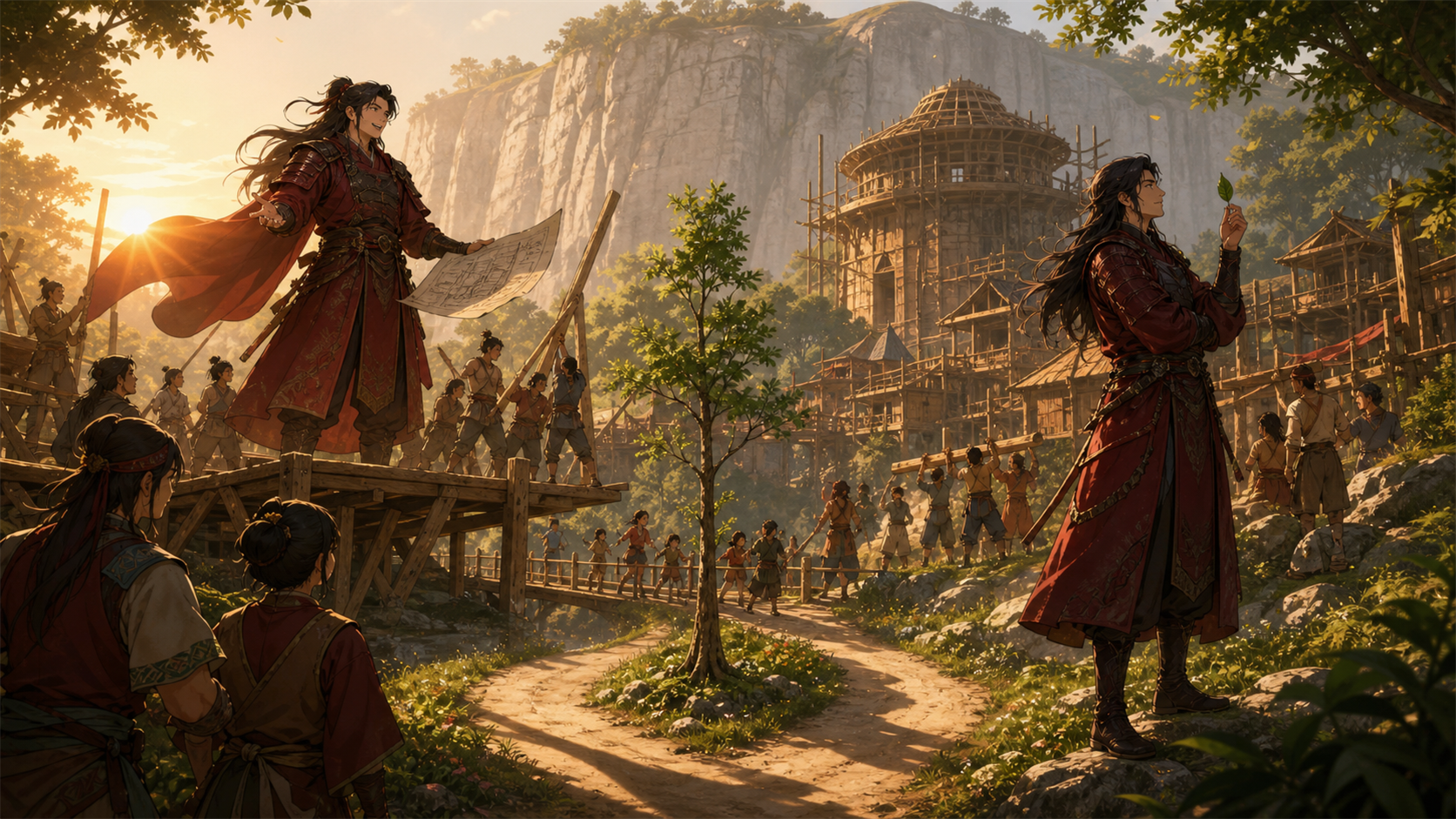
My True Dream
Hashirama and Madara finally build the village they imagined as children, then discover that shared construction does not guarantee shared power, trust or political memory.
Bottom line
“My True Dream” lets Hashirama and Madara build the place they imagined as children, then shows how quickly shared construction can become unequal ownership. The Senju and Uchiha alliance attracts other clans, Madara names the Hidden Leaf, and children gain distance from the old contract-war system. Hashirama wants Madara to become Hokage, but Tobirama insists on a public selection process while openly treating Madara as a danger. Hashirama becomes the First Hokage, Madara loses influence inside his own clan, and the founding partners stop sharing a political future. Madara leaves, returns with Kurama as a weapon, and fights Hashirama at the place later called the Final Valley. Hashirama protects the village by killing the friend who helped imagine Konoha. The tragedy is not that peace was foolish. The tragedy is that Konoha built walls and offices faster than trust, accountability, and equal power.
The clans turn truce into construction
Senju and Uchiha cooperation changes the regional order because the strongest rivals stop selling violence against one another. Other clans join the settlement rather than remaining exposed between them.
The village becomes a material alternative to endless family war.
Children gain a different daily horizon
Homes, schools, streets, shared training, and centralized missions can separate childhood from immediate battlefield deployment. The founding promise concerns ordinary survival before national prestige.
A child living long enough to learn slowly is already a political achievement.
Building together creates shared evidence
Former enemies work on the same physical place. Cooperation becomes more than a private vow between leaders because families can see structures rising through combined labor.
Common work can support trust when credit and authority remain fair.
Madara gives the village its name
He looks through a leaf and names the settlement Konohagakure, the Village Hidden in the Leaves. The moment makes him a cultural founder, not a reluctant rival attached to Hashirama’s project.
Names create belonging and establish whose imagination enters public memory.
Hashirama’s response preserves their old rhythm
The exchange carries the teasing familiarity of the river meetings. Their friendship briefly survives inside the new political structure.
Humor shows the village as a human project before monuments harden the founders into symbols.
The Hokage office needs a first occupant
A settlement of armed clans requires leadership, dispute resolution, mission allocation, defense, and relationships with outside powers. Personal friendship cannot perform all those jobs informally.
Creating an office is necessary, but the selection rules will define whose trust counts.
Hashirama wants Madara to lead
He sees the position as proof that the Uchiha co-founded the village and that Madara’s dream belongs at the center. The proposal also reflects personal faith in a friend.
Representation at the highest level could reduce the fear that Senju victory merely changed names.
A personal promise cannot appoint a government
Hashirama initially speaks as though he can give Madara the office. Tobirama objects that residents and senior representatives need a selection process.
The objection is democratically stronger than private appointment, even when Tobirama’s motive includes distrust.
Procedure can be fair and still carry bias
A vote or council decision does not automatically neutralize social power. The Senju hold broader trust after the war, and Tobirama already frames Madara as dangerous.
Formal process may reproduce an unequal political field while appearing impartial.
Tobirama treats Madara as a security problem
He worries that Madara’s power and temperament threaten the village. Madara has real volatility and enormous force, yet Tobirama often begins from clan suspicion rather than individual evidence alone.
Preventive governance easily becomes exclusion when one identity receives permanent extra scrutiny.
Hashirama becomes the First Hokage
Residents choose the leader associated with cooperation, strength, and a warmer public presence. The outcome makes political sense.
The same result leaves Madara wondering whether the Uchiha will ever be trusted with equal authority.
Popularity does not settle structural concern
Hashirama’s support shows genuine legitimacy. Popular approval cannot answer whether minority representation, institutional checks, and succession plans protect a co-founding clan.
Majority comfort is not the only measure of political fairness.
Madara sees Tobirama approaching power
Hashirama cannot serve forever. Madara expects Tobirama’s influence to shape succession and fears a system built around surveillance of the Uchiha.
Later history gives that fear enough substance that dismissal would be dishonest.
The Uchiha do not follow Madara out
Madara warns his clan that the village will marginalize them, but members choose the settlement over renewed war. They are tired, invested in new homes, and unwilling to gamble their children on one leader’s prediction.
Their refusal is political agency, not proof that every concern was false.
Leadership without followers becomes isolation
Madara helped found Konoha but cannot convince his own clan to leave. The gap between his fear and their decision deepens his belief that nobody understands the coming danger.
Isolation makes correction harder and certainty more attractive.
Clan members choose immediate safety
The village has stopped open Senju–Uchiha warfare and created daily stability. Future discrimination may feel less urgent than the known horror Madara proposes risking again.
People can make a reasonable short-term choice while underestimating a long-term threat.
The stone tablet enters Madara’s judgment
The Uchiha tablet offers inherited knowledge that only certain eyes can read more fully. Madara treats the message as a deeper account of shinobi history and a route beyond ordinary compromise.
Secret texts become dangerous when interpretation lacks witnesses, debate, or source verification.
Knowledge restricted by power resists accountability
If stronger eyes reveal different layers, readers cannot easily compare what Madara sees. Authority comes from exclusive access rather than a transparent method.
Political decisions built on private revelation give everyone else little chance to challenge the conclusion.
Madara names another dream
He no longer believes the village can produce lasting peace. His “true dream” moves toward a solution that escapes ordinary politics and human disagreement.
The desire to end suffering remains understandable while the method moves away from consent.
Hashirama cannot reach him through memory alone
Their childhood bond gives Hashirama emotional access but no guaranteed power over Madara’s decisions. Repeating the old dream cannot resolve newer injuries involving leadership and trust.
Relationships need updated agreements when circumstances change.
Madara leaves the village he named
Departure removes a co-founder without repairing the conflict that drove him out. Konoha keeps his name for the settlement while losing his voice from governance.
Public memory can preserve contribution and still conceal exclusion.
The village continues without open reckoning
Hashirama remains committed to protection, and residents experience real benefits. The political system does not appear to create a serious process for addressing Madara’s claims or Uchiha fears.
Stability can delay a conflict rather than solve the conflict.
Madara returns with Kurama
He weaponizes the Nine-Tails against Konoha and challenges Hashirama through overwhelming force. The attack makes villagers targets in a dispute most did not control.
Valid grievances do not authorize mass violence.
Kurama is captured inside a founders’ conflict
Madara uses the tailed beast as military equipment, overriding Kurama’s will. Hashirama then treats control of that power as a security necessity.
Both sides operate inside a world that rarely asks what Kurama chooses.
The battle transforms the landscape
Their abilities carve the place later called the Final Valley. Physical geography becomes a monument to political failure.
Fans see spectacle, but the spectacle represents a settlement unable to keep two founders in a shared civic argument.
Hashirama fights to protect residents
Madara attacks the village with lethal force, giving Hashirama an immediate duty to defend people. Friendship cannot require civilians to remain exposed while he searches indefinitely for another answer.
Protection creates a legitimate reason to stop Madara.
Defense does not erase the path to battle
The immediate attacker bears responsibility for the assault. Konoha’s earlier power imbalance, Tobirama’s suspicion, and the leadership rupture remain part of the history that preceded the return.
Context explains escalation without excusing the decision to target a village.
Hashirama chooses the village over Madara
He concludes that protecting Konoha requires killing his friend. The choice reverses the earlier moment when he offered his own life to secure peace.
The institution now outranks the personal bond that helped create the institution.
The village becomes a moral category
Hashirama says he will protect the village even from friend, brother, or child. The principle can prevent favoritism and establish public duty above family loyalty.
The same principle can make the institution sound sacred enough to justify any action taken in its name.
Institutions exist for people
Konoha matters because residents need safety, community, education, work, and a future. The village should remain a means of protecting those lives.
When preserving the institution requires people to disappear for reputation or stability, the order has reversed.
Madara’s apparent death closes the partnership
Hashirama leaves the battle believing he has killed the friend who co-founded Konoha. Victory protects the settlement and confirms that their shared political experiment could not hold both men.
Winning cannot restore the trust lost before the attack.
The Final Valley simplifies a complicated history
Statues later present Hashirama and Madara as eternal opponents facing each other across a divide. The image is memorable and incomplete.
They were also children who laughed, planned, built, negotiated, and failed to create durable shared power.
Hashirama tells the story from his position
Sasuke hears a reflective account from the leader who won the battle and became the village’s founding symbol. Hashirama admits pain and failure, which strengthens his credibility.
Madara, Izuna, ordinary Uchiha, and other clans would still tell parts differently.
Founding ideals require outcome checks
The village reduced one form of child warfare, but later generations still trained children for missions and wars. Konoha created belonging while maintaining secrecy, hierarchy, and military dependence.
The dream produced real progress without completing its promise.
Peace cannot depend on one friendship
Hashirama and Madara carried the alliance because both had extraordinary power and personal history. Once their trust broke, institutions could not absorb the disagreement.
Durable peace needs rules that work when founders are absent, angry, wrong, or dead.
Representation must survive succession
Hashirama’s wish to make Madara Hokage offered symbolic equality through one appointment. Madara needed confidence that Uchiha participation would remain meaningful under later leaders too.
A fair system cannot rely on a friendly officeholder protecting one group personally.
Security policy can manufacture the threat feared
Treating Madara and the Uchiha as likely dangers pushed political trust lower. Madara then became an actual attacker, appearing to validate every suspicion.
The attack proves his responsibility and does not prove earlier discrimination was wise.
Madara chooses domination over uncertain consent
When shared governance disappoints him, he moves toward a plan that will eventually eliminate disagreement rather than negotiate with people who may refuse him.
Peace without the freedom to reject the planner is control.
Hashirama’s dream survives in unfinished form
Children live inside a village rather than roaming contract battlefields. Clans share institutions and develop a common identity.
The gains matter, and the exclusions hidden beneath them will shape Sasuke’s question generations later.
The village makes the childhood dream material
Hashirama and Madara can finally point to streets, homes, training space, and children who are not being dispatched as immediate replacements for dead relatives. Construction proves that cooperation can alter daily life, not merely produce a truce between two powerful men.
The achievement deserves joy. A dream becoming visible also makes its exclusions measurable. Residents can now ask who owns land, who sets rules, and whose children receive the promised safety.
Founding together does not guarantee governing together
Madara contributes military power, Uchiha participation, political risk, and the trust required to end the feud. Once the settlement exists, recognition begins concentrating around Hashirama.
Popularity may be genuine, yet institutions must distinguish public affection from fair distribution of authority. A co-founder should not become optional because more residents prefer the other founder’s temperament.
The Hokage selection needs transparent standards
Leadership cannot safely rest on who inspires the loudest approval inside a new coalition. Residents need criteria, nomination rules, representation, voting procedures, term expectations, and a way to challenge conflicts of interest.
Hashirama wanting Madara to lead is not a process. Tobirama objecting to Madara is not a process. A village built from former enemies needs procedures strong enough to survive both men’s preferences.
Tobirama turns risk assessment into political exclusion
He fears Madara’s power and doubts Uchiha stability. Some concerns arise from war experience, but ancestry and emotion become substitutes for individualized evidence.
When suspicion affects office, policing, and access to decision-making, bias becomes structure. Tobirama does not have to announce hatred for Uchiha residents to help create a government where they must repeatedly prove they belong.
Hashirama’s reassurance lacks enforceable protection
He believes friendship and good faith can keep Madara inside the shared future. Madara sees that Hashirama may not control his brother, council, successors, or public opinion forever.
Reassurance would become credible through written rights, shared appointments, review of clan-based policy, and guarantees that Uchiha dissent will not be interpreted as treason. Trust needs somewhere to live after founders die.
Madara’s fear deserves evidence without automatic obedience
He accurately recognizes a risk of Uchiha marginalization. That insight does not make every later conclusion or demand correct. Clan members retain agency and may prefer negotiated participation over departure or renewed conflict.
A leader can identify structural danger while still becoming isolated, coercive, or unable to hear constituents. Madara needs accountability inside the clan as much as the village needs accountability toward it.
The Uchiha are not a single political body
Families who accept village life are not necessarily betraying Madara or forgetting the dead. They may value schools, safety, trade, friendship, and relief from constant deployment.
Their choice deserves respect alongside scrutiny of whether acceptance is fully informed and freely made. Clan consent cannot be claimed solely by Madara, Tobirama, Hashirama, or whichever leader speaks most confidently.
Naming the village distributes symbolic ownership
Madara’s contribution to the name matters because symbols shape who residents remember as founders. The Leaf is not only Hashirama’s creation, even when later monuments and office history center him.
Symbolic credit cannot replace political power, but erasing symbolic credit makes exclusion easier. Public memory should preserve the coalition, labor, and compromises that built the place.
The cliff becomes both playground and monument
The location the boys imagined for child safety becomes the site of leadership faces carved above the village. The transformation is beautiful and dangerous. A public institution can honor a dream while turning leaders into untouchable mythology.
Children need schools and protection more than portraits. Monuments should remind officials of obligations, not teach residents that founders stand beyond criticism.
Madara begins losing a constituency he helped protect
Peace gives Uchiha families something they do not want to surrender. His warnings then sound like threats to a stability they can finally experience.
The widening gap is political, not merely emotional. Madara needs a way to present evidence, organize lawfully, and seek reform without forcing the clan to choose between his authority and their children’s immediate safety.
Hashirama mistakes shared purpose for durable alignment
Both founders wanted children to survive. They do not necessarily agree about institutional design, succession, power, or what evidence should justify distrust.
A healthy coalition expects disagreement and creates a route through it. Treating conflict as betrayal pushes necessary debate into private meetings, rumor, and eventual rupture.
The true dream requires maintenance after victory
Ending the Senju-Uchiha war fulfills the first promise. The village must keep demobilizing children, integrating clans, distributing authority, reviewing police power, and protecting residents from secret government.
Peace is not a structure leaders finish once. Every policy can either widen belonging or teach a family that the wall protects everyone except them.
RaeRae’s verdict
“My True Dream” refuses a clean founding myth. Hashirama and Madara build something genuinely better than the Warring States system. Their village protects children, joins clans, and makes shared life imaginable. Madara contributes the name, power, labor, and political risk of the Uchiha. Yet the first leadership transition already tells him that equal founding does not guarantee equal control. Tobirama’s suspicion, Hashirama’s optimism, majority preference, and Madara’s isolation pull the partnership apart.
Madara bears responsibility for returning with Kurama and attacking residents. Hashirama bears the duty to stop him. Their final clash is still an institutional failure, not destiny written into two bloodlines. Konoha succeeds only if the village remains accountable to the people the founders wanted to protect. Once “protect the village” becomes a reason to bury those people beneath secrecy or sacrifice, the dream starts serving the monument instead of the child.
RaeRae’s call
Hashirama and Madara build the village together, but shared construction does not become shared power automatically. Madara deserves credit, representation, and a fair process. Hashirama’s kindness needs enforceable structure. Tobirama’s fear needs evidence and limits. The true dream is not a monument or one beloved Hokage. It is a village where child safety, clan belonging, and lawful dissent survive the founders’ disagreement. Founding peace becomes credible only when enemies can disagree without losing home or rights.
Episode details and viewing routes
- Official episode reference: Naruto Official episode guide
- Licensed episode route: Crunchyroll licensed episode page
What I am carrying forward
The Senju and Uchiha built Konohagakure, Madara named the village, and Hashirama became the First Hokage through the new selection process. Madara came to believe that Tobirama’s influence and Uchiha exclusion would hollow out the founding partnership, but his clan refused to leave with him.
Madara abandoned Konoha, returned with Kurama, and fought Hashirama at the future Final Valley. Hashirama chose the village over his friend and believed he killed Madara. Episode 370 returns to Sasuke, who must decide what the Hokage testimony means for Konoha, Itachi, and the war already underway.