
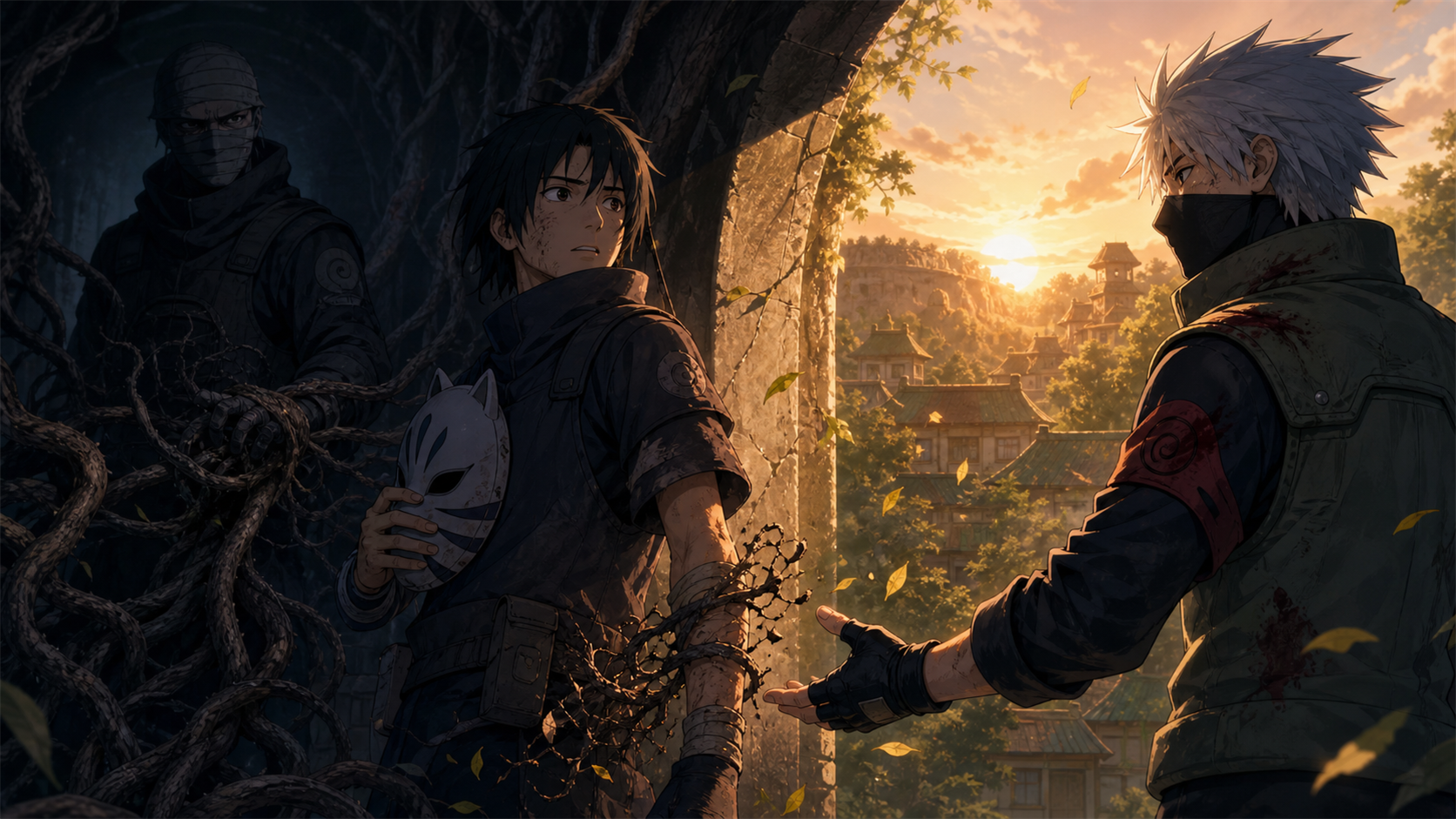
A Shinobi of the Leaf
Kakashi saves the operative sent to kill him, giving Tenzō enough truth to choose comradeship over Danzō’s control.
Bottom line
“A Shinobi of the Leaf” lets conduct answer the label Danzo supplied. Tenzo approaches Kakashi under orders to kill him and take the Sharingan. When danger turns against Tenzo, the intended victim saves his attacker. Kakashi’s choice provides evidence no Foundation briefing could safely include: the man called “Friend Killer” risks himself for a comrade, including one who has come to murder him. Tenzo abandons the assassination and returns to Konoha knowing Danzo will be angry. That return is not surrender to Foundation. Tenzo begins separating loyalty to the Leaf from obedience to a hidden commander who treats Leaf bodies as assets. Kakashi’s rescue does not erase Tenzo’s decision to attack, and Tenzo’s change of course does not erase Danzo’s coercion. The episode’s hope lies in revision. Direct relationship breaks propaganda, and a person trained to execute orders chooses not to complete a harmful one.
Tenzo enters the encounter as an assassin
He has accepted Danzo’s order and approaches Kakashi as a target rather than a colleague. The threat is real even though the evidence behind the mission is manipulated.
Context explains his route into violence without making the attack harmless.
An accepted order has become personal action
Danzo created the mission, controlled the evidence, and trained the operative. Tenzo still crosses from hearing an instruction into approaching a person with lethal intent.
That transition matters because later growth must include what he was prepared to do, not only what he ultimately refuses.
Accountability can begin before completion
Harm does not need to reach the intended endpoint before moral repair becomes necessary. Kakashi faces threat, deception, and the knowledge that another Leaf shinobi was sent against him.
Stopping the attack prevents greater harm while leaving room for acknowledgment of what already occurred.
Kakashi does not know the full mission
He faces another Leaf operative without access to Danzo’s private order or the story used to motivate the attack.
Information asymmetry gives Tenzo initiative and keeps Kakashi from challenging the accusation before conflict.
The ambush repeats Konoha’s internal fracture
Kakashi believes village command establishes allies and enemies. Danzo’s covert order makes that map unreliable.
An operative cannot protect the Leaf coherently when another Leaf authority secretly marks him for extraction.
Uncertainty increases the burden of restraint
Kakashi must respond quickly without knowing whether Tenzo acts alone, under coercion, or as part of a wider Foundation move. Immediate survival encourages a simple enemy category.
Recognizing possible context during danger requires unusual discipline.
The Sharingan remains the hidden prize
Danzo wants the eye after Kakashi dies. Tenzo’s moral justification and the commander’s material objective remain different.
The encounter would transfer power upward while leaving the subordinate responsible for visible violence.
Kakashi’s death would conceal motive
A dead target cannot testify about the attack or ask why a fellow Leaf operative wanted the eye. Danzo could describe the loss through another operational story.
Murder and secrecy work together: one obtains the resource, and the other protects the acquisition.
Tenzo receives no share of the real benefit
He carries the physical and moral risk while Danzo would control the Sharingan. The mission is framed as duty even though power concentrates above him.
This imbalance is a warning whenever leaders demand sacrifice for goals they privately own.
Direct contact complicates the label
“Friend Killer” worked while Kakashi remained a distant reputation. A living person can speak, respond, choose restraint, and contradict the assigned category.
Propaganda becomes harder to maintain when the target has room to act as human.
Observation restores missing context slowly
Tenzo cannot learn the full truth of Rin merely by fighting Kakashi. He can learn that Danzo’s total character judgment fails under present evidence.
One contradiction is enough to justify pausing a lethal conclusion.
A label resists counterevidence
Tenzo could interpret rescue as deception, tactical calculation, or one exception. Propaganda survives by teaching recipients how to dismiss facts that threaten the story.
His willingness to accept the evidence is part of the moral turn.
Kakashi saves Tenzo
When Tenzo faces danger, Kakashi intervenes rather than allowing the threat to solve his own problem. The rescue carries personal risk.
Behavior provides immediate evidence about how Kakashi values another shinobi’s life.
Rescue requires tactical vulnerability
Helping an attacker can expose Kakashi to another strike and distract him from self-preservation. The choice costs more than a kind statement.
Risk makes the act harder to reduce to performance for an audience.
Kakashi protects possibility
By keeping Tenzo alive, he preserves the chance for explanation, refusal, and a future outside the killing order. Death would freeze Tenzo inside the role Danzo assigned.
Rescue creates room where another decision can exist.
The rescue is not transactional
Kakashi does not save Tenzo because compliance or gratitude has been secured. He protects someone who has given him reason for distrust.
Care offered before repayment challenges Foundation’s model of relationship.
Foundation teaches conditional worth
Operatives receive place and approval through usefulness and obedience. Failure threatens belonging.
Kakashi’s rescue communicates that Tenzo’s life can matter before mission success and despite mission betrayal.
Unconditional rescue still permits boundaries
Kakashi can protect Tenzo and remain alert to another attack. Care does not require pretending trust has already been repaired.
Healthy comradeship pairs concern with truthful limits.
A comrade can include a conflicted attacker
Kakashi recognizes Tenzo as more than the present assault. Shared village identity and the possibility of another choice remain visible.
That recognition does not require him to ignore danger or surrender self-defense.
Shared affiliation is not automatic innocence
Calling Tenzo a Leaf shinobi does not erase Foundation violence. Village membership provides a reason to seek the person beneath the order, not a reason to hide the order.
Comradeship becomes accountable when loyalty includes confronting harm inside the group.
Kakashi offers what he once needed
After Rin’s death, Kakashi needed someone to see beyond the visible strike and understand the impossible conditions. Tenzo now appears through a harmful action shaped by concealed context.
The parallel is imperfect but gives Kakashi a route toward extending interpretation rather than immediate condemnation.
Kakashi’s action answers Rin’s rumor
Danzo framed Rin’s death as evidence that Kakashi kills friends. The rescue shows him choosing a comrade’s life under pressure.
One act cannot narrate an entire person, but direct evidence defeats the certainty of the label.
Rin’s truth remains larger than the rescue
Kakashi did not need a new heroic act to become innocent of deliberately murdering Rin. Her coerced choice and the Mist plan already contradict Danzo’s accusation.
The rescue changes Tenzo’s knowledge, not the historical reality.
Tenzo recognizes the propaganda gap
The target’s conduct does not match the commander’s description. Tenzo must decide whether to protect the order or revise his judgment.
Cognitive conflict becomes an opening for moral agency.
The contradiction reaches identity
If Danzo lied or withheld decisive context about Kakashi, other Foundation truths become questionable, including stories about loyalty and Tenzo’s own past.
One failed briefing can destabilize an entire structure of dependence.
Doubt becomes protective
Foundation treats doubt as weakness because doubt slows orders. Here, doubt keeps Tenzo from murdering the person who saved him.
Critical thought functions as a safety mechanism against abusive command.
Revision is a form of strength
Continuing an assassination for consistency would deepen harm. Changing course requires admitting that the mission premise was false or incomplete.
The ability to update judgment is more trustworthy than rigid certainty.
Consistency can become a trap
Tenzo has already prepared, approached, and fought. Continuing may feel easier than admitting those steps rested on manipulated evidence.
Refusal accepts the discomfort of being wrong before the error becomes irreversible.
Changed action is stronger than changed feeling
Private sympathy would not protect Kakashi if Tenzo completed the order. The episode matters because recognition alters behavior.
Ethical growth becomes observable through what stops.
Tenzo no longer wishes to kill Kakashi
Desire shifts before institutional conditions do. Danzo remains powerful, and Foundation expectations remain dangerous.
Internal refusal is necessary but must become action to protect Kakashi.
He abandons the mission
Tenzo stops the assassination rather than merely delaying the final strike. The choice rejects Danzo’s claim over Kakashi’s life and eye.
Abandonment of an unethical order can be fulfillment of a deeper duty.
Kakashi keeps both life and eye
The refusal prevents two linked violations: murder and bodily extraction. Obito’s gift remains with the person he selected.
Tenzo’s decision protects a relationship he learned about only indirectly through the conduct before him.
Mission language loses its authority
Danzo can call the assassination an assignment, but Tenzo no longer lets the category settle the moral question. Official form cannot convert wrongdoing into duty.
This separation is central to becoming more than a tool.
Disobedience protects a Leaf shinobi
Foundation may describe refusal as betrayal. In practice, Tenzo prevents the covert murder of a village operative.
Loyalty to Konoha separates from loyalty to Danzo.
The Leaf is people before hierarchy
Villages often identify themselves through leaders, symbols, and orders. Kakashi’s life reveals another definition: the community members authority claims to protect.
Tenzo serves Konoha by refusing a commander who would spend a Leaf life for private power.
Institutional loyalty needs ethical limits
Without limits, any order can be called necessary and any dissenter can be called disloyal. A durable village must permit refusal when command violates the people constituting the village.
Tenzo’s choice exposes the need for that principle even if Foundation rejects the principle.
Returning to the village takes courage
Tenzo does not simply disappear beyond Danzo’s reach. He returns knowing that his commander will learn the mission failed.
Facing consequences keeps the refusal from becoming only private escape.
Return preserves a claim to belonging
Tenzo does not concede that Danzo owns the meaning of Leaf loyalty. He returns because Konoha remains his home and because one commander should not define every path within that home.
The choice resists both obedience and exile as the only options.
He returns without guaranteed protection
Kakashi’s rescue does not automatically neutralize Danzo’s reach. Tenzo may face interrogation, punishment, or another manipulated assignment.
Courage lies partly in moving toward uncertainty without surrendering the revised judgment.
Danzo’s anger is foreseeable
The commander loses the Sharingan and evidence of Tenzo’s obedience. Anger protects both material ambition and hierarchical control.
Tenzo understands the risk, which gives his return moral weight.
Anger reveals threatened ownership
Danzo reacts not only to a failed objective but to an operative demonstrating a will outside Foundation control. Independent judgment makes Tenzo less predictable as an asset.
The commander’s frustration therefore confirms why refusal was necessary.
Retaliation could restore the old hierarchy
Punishment may be designed to isolate Tenzo, discredit Kakashi, or make future hesitation more costly. Foundation discipline can turn one failure into a lesson for every subordinate.
Protecting Tenzo requires institutional action beyond private gratitude.
Foundation can punish independent judgment
An organization that demands emotional suppression treats conscience as unreliability. Tenzo may face discipline for reaching an accurate conclusion through direct evidence.
Punishment would reveal that obedience, not truth, is the real standard.
Kakashi sees more than an attacker
Saving Tenzo suggests that he recognizes conditioning, conflict, or shared belonging beneath the assault. He does not reduce the younger operative to the worst current action.
That perspective offers the mercy Kakashi rarely gives himself.
Compassion does not make Kakashi gullible
He has survived betrayal, war, and covert conflict. Saving Tenzo can reflect accurate judgment that the younger operative is constrained and reachable.
Discernment is not the same as indiscriminate trust.
The rescue challenges Kakashi’s assigned identity
“Cold-blooded” and “Friend Killer” both tell others that detachment defines him. Protecting Tenzo places care at the center of an ANBU encounter.
Kakashi acts beyond the reputation even before receiving public correction.
Mercy does not erase accountability
Tenzo still needs to acknowledge the attack and the danger created. Kakashi’s rescue does not require silence about Danzo’s order.
Repair needs truth alongside continued life.
Tenzo owes more than silent withdrawal
Kakashi needs to know that Danzo ordered the attack and wanted the eye. Hiruzen needs evidence that Foundation is targeting village operatives.
Disclosure can prevent the same structure from reaching another target.
Kakashi can accept change without denying harm
Working with Tenzo later would not require pretending the assassination attempt was trivial. Trust can be rebuilt through honesty, consistent conduct, and boundaries.
Repair becomes credible when the past remains named.
The title reclaims Leaf identity
“A Shinobi of the Leaf” asks who actually serves Konoha. Danzo claims protection while ordering internal murder for bodily power.
Tenzo protects the village more honestly when he refuses that command.
Comradeship becomes a political standard
Valuing comrades is not merely personal warmth. A village that treats members as disposable assets undermines the bond used to justify sacrifice.
Kakashi’s rescue embodies a version of loyalty Foundation cannot sustain.
A comrade is not an expendable resource
Danzo calls operatives useful while treating their bodies and choices as replaceable. Kakashi’s action asserts that the person matters even when saving the person complicates the mission.
That distinction separates community from inventory.
The episode makes relationship counterintelligence
Direct experience exposes a false briefing. Knowing how Kakashi behaves toward comrades gives Tenzo information Danzo tried to suppress.
Relationship does not replace evidence. Relationship produces evidence authoritarian control could not safely provide.
Refusal is the first repair, not the last
Tenzo prevents Kakashi’s murder, which is the urgent moral victory. Refusal does not automatically restore what the assassination attempt damaged. Kakashi was targeted by a fellow Leaf operative, denied the accusation against him, and treated as a body carrying transferable property.
The next honest steps would include warning Kakashi about Danzō’s objective, documenting the order, identifying anyone who helped authorize the operation, and protecting Tenzo from retaliation. A changed heart matters most when changed conduct makes future harm harder.
Kakashi’s mercy needs institutional backup
Kakashi can save Tenzo in the field, but one person’s compassion cannot dismantle Foundation authority. Hiruzen must know that Danzō used the Friend Killer rumor to pursue Obito’s eye. ANBU leadership needs a rule that covert assignments do not erase review when one Leaf operative is ordered to kill another.
Without follow-through, mercy becomes a temporary shelter inside the same machinery. Tenzo survives this decision while the next child operative may receive another target and another sealed explanation.
Returning home is not returning to obedience
Tenzo’s choice to go back to Konoha refuses Danzō’s preferred trap. Foundation teaches that obedience earns belonging and disobedience deserves erasure. Running forever would leave that definition uncontested.
He returns as someone claiming the Leaf beyond Danzō. Home can include Kakashi, Hiruzen, ordinary comrades, and a duty to protect residents from internal predation. That wider loyalty gives his refusal somewhere to stand.
Kakashi proves character through costly conduct
Danzō offers Tenzo a slogan. Kakashi offers observable behavior under pressure. Saving the person sent to kill him costs time, safety, and tactical advantage, so the rescue carries more evidentiary weight than a speech about comradeship.
The moment does not mean every accused person must perform heroism before receiving due process. Kakashi was entitled to fairness before the rescue. His action simply gives Tenzo immediate proof that the supplied label cannot sustain Danzō’s conclusion.
Tenzo’s name begins to mean a person
Foundation reduces identity to function because interchangeable tools are easier to command. Tenzo’s hesitation, observation, gratitude, fear, and refusal form a self that cannot be summarized by mission status.
Kakashi responds to that possible person before Tenzo fully claims him. The rescue creates a relationship where judgment can be revised and responsibility can be carried without turning one harmful choice into a permanent identity.
What the title requires
A Shinobi of the Leaf is not a title Danzō can award or revoke according to usefulness. Tenzo earns the phrase through a choice that protects Kakashi from unlawful power. Kakashi models that principle when he refuses to let an attacker die for convenience. Their bond begins with danger, not innocence, making honesty essential. The episode offers hope without pretending institutions heal themselves: two people interrupt one order, and that interruption creates evidence, obligation, and a path toward a village actually worthy of the loyalty it demands.
RaeRae’s verdict
“A Shinobi of the Leaf” resolves the assassination order through evidence and choice rather than a sudden declaration that Tenzo was never responsible. He approaches Kakashi intending harm. Kakashi then saves him, forcing the “Friend Killer” label against a reality Danzo did not control.
Tenzo’s refusal matters because he understands the consequences. He returns to Konoha instead of completing the murder or disappearing from the conflict. Kakashi demonstrates that valuing comrades can include protecting someone caught inside coercive command. The episode begins moving both men away from identities assigned by institutions: cold-blooded killer and nameless tool.
RaeRae’s call
Tenzo becomes a shinobi of the Leaf when he refuses to murder one. Kakashi’s rescue breaks Danzō’s propaganda because costly conduct contradicts the Friend Killer label. Now refusal must grow into disclosure, protection, and limits on the commander who made a stolen eye sound like village security.
Episode details and viewing routes
- Official episode reference: Naruto Official episode guide
- Licensed episode route: Crunchyroll licensed episode page
What I am carrying forward
Kakashi has saved Tenzo despite being the target of Tenzo’s assassination mission. The act shows Tenzo that Danzo’s “Friend Killer” label contradicts Kakashi’s conduct.
Tenzo abandons the order to kill Kakashi and take the Sharingan, then returns to Konoha knowing Danzo will be angry. His loyalty is beginning to shift from Foundation obedience toward comrades and the Leaf itself. Episode 357 introduces Itachi Uchiha into Kakashi’s ANBU unit as Danzo and Fugaku seek intelligence through him.