
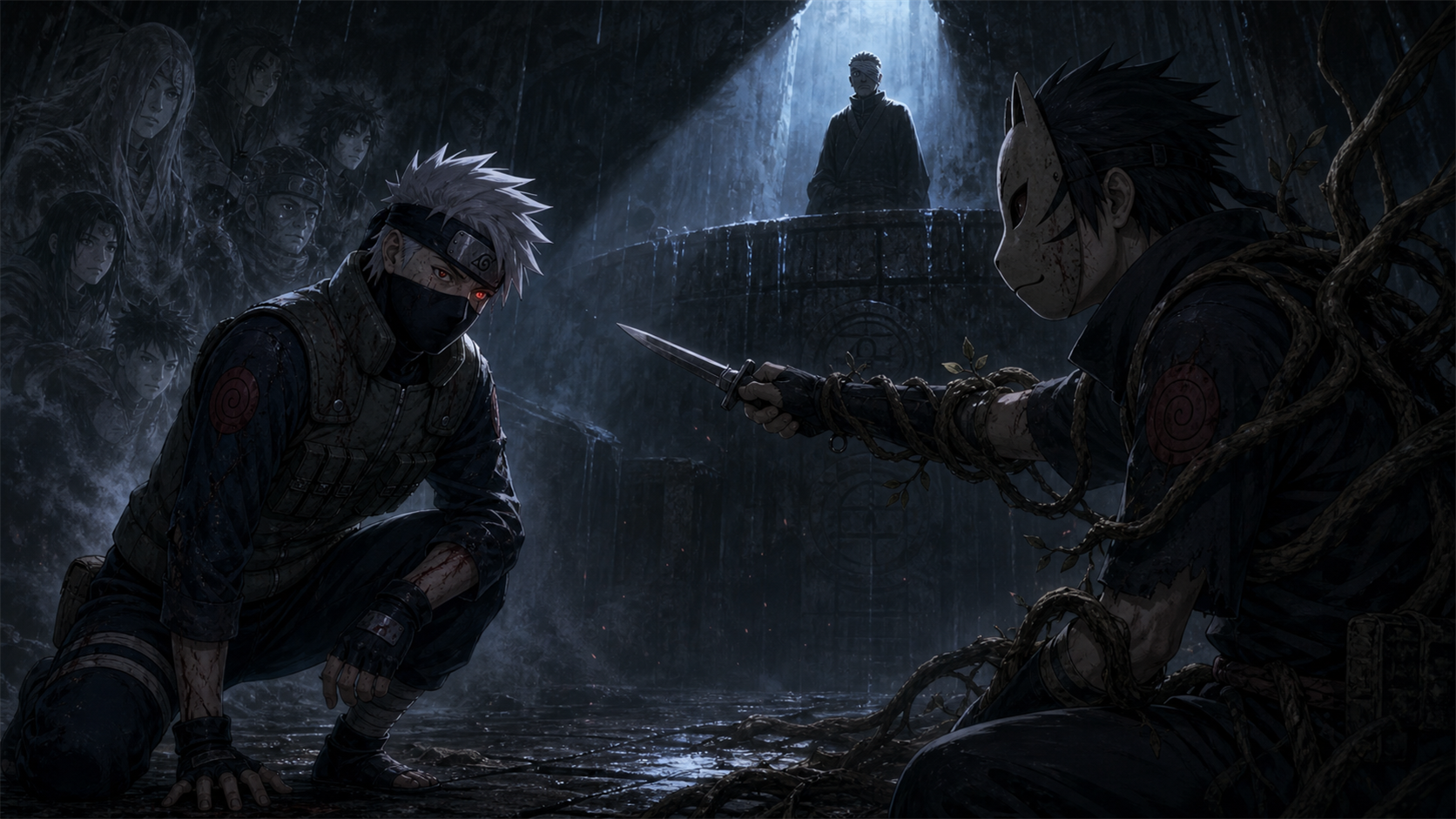
The Targeted Sharingan
Danzō orders Tenzō to kill Kakashi and take his eye, using an ugly rumor to turn obedience into a weapon.
Bottom line
“The Targeted Sharingan” shows Danzo turning rumor, grief, and a teammate’s gift into tools of command. He orders Tenzo to kill Kakashi and take the Sharingan Obito gave him. Tenzo hesitates because recent experience has already complicated Foundation obedience. Danzo answers that hesitation with the name “Kakashi the Friend Killer,” presenting Rin’s coerced death as proof of Kakashi’s character while withholding the context that would challenge the order. The manipulation works by replacing a person with a label and replacing investigation with urgency. Kakashi becomes a target because Danzo wants the eye, not because evidence shows Kakashi betrayed Konoha. Tenzo’s decision to proceed remains consequential, but his judgment has been shaped by a commander who controls information, identity, and punishment. The Sharingan is not unattended military property. Obito chose to entrust the eye to Kakashi, and removing the eye through murder would erase both men’s agency.
Danzo gives Tenzo a killing order
The command is direct: kill Kakashi and recover his Sharingan. A Konoha authority targets a Konoha operative without transparent process.
The order reveals Foundation as a competing power structure rather than a neutral support unit.
No transparent charge precedes the sentence
Kakashi is not questioned, shown evidence, or evaluated by an independent authority. Danzo moves directly from private desire to covert execution.
Removing process lets the commander define danger and benefit from the punishment at the same time.
The order tests loyalty through violence
Tenzo’s willingness to kill another Leaf operative becomes proof that Foundation outranks every competing bond. Obedience matters as much as acquiring the eye.
Danzo uses the mission to reclaim control after Yukimi taught Tenzo to choose a person over an assignment.
Kakashi is reduced to a target
Danzo does not present a colleague with history, relationships, and rights. He presents an objective whose body contains a desired resource.
Target language makes lethal extraction easier to imagine as ordinary work.
Dehumanization simplifies uncertainty
Tenzo does not need to ask how Kakashi teaches, mourns, serves, or understands Rin. A target requires only location, weakness, and method.
The narrower category protects the mission from facts that might produce empathy.
A colleague becomes an internal enemy
Kakashi wears Konoha’s uniform and carries missions for the same village Tenzo has been trained to protect. Danzo resolves that contradiction by redefining loyalty around himself.
Foundation service becomes more important than the life of a fellow shinobi.
The Sharingan drives the mission
Kakashi’s eye offers tactical intelligence and Uchiha power. Danzo sees strategic value that can be transferred after Kakashi dies.
Coveting an ability does not create lawful or moral ownership over the body carrying the ability.
Rare power creates extraction pressure
The eye attracts attention because Sharingan perception can transform intelligence and combat. Strategic institutions may describe acquisition as preventing waste.
That framing hides the violent premise that Kakashi must die so another authority can decide the eye’s use.
Danzo’s interest is not neutral preservation
He already treats exceptional biology as material for covert advantage. Hashirama-cell programs and Foundation control show a consistent preference for power without consent.
The proposed transfer would enlarge his private capacity, not simply protect a public artifact.
Obito gave the eye to Kakashi
The transplant came through Obito’s final conscious choice at Kannabi Bridge. The gift represented trust, shared identity, and a request to keep seeing the future.
Danzo’s order treats that relationship as irrelevant to asset allocation.
The gift answered a relationship
Obito did not place the Sharingan into a general village reserve. He chose Kakashi, marking their reconciliation and trusting him to carry a shared perspective forward.
Respecting the gift means respecting the living recipient rather than worshiping the biological object.
Obito’s later choices do not cancel the gift
The audience knows Obito survived and changed under Madara’s influence. That later history complicates him without retroactively making the Kannabi decision meaningless.
Danzo has no authority to rewrite a personal act of bodily consent for institutional gain.
A gifted organ remains part of a living body
Kakashi’s Sharingan cannot be discussed as inventory separated from him. Removal through murder would violate his life as well as Obito’s intention.
Strategic usefulness never converts a person into storage.
Transplant history demands more care, not less
The eye already crossed bodies through trauma, surgery, and consent under extreme conditions. Another transfer through murder would deepen rather than normalize that violence.
Complex origin is not an invitation for the next powerful person to claim possession.
Kakashi’s adaptation has personal cost
The Sharingan drains chakra because his body is not Uchiha. He has built techniques, habits, and identity around carrying the gift despite that burden.
Danzo calculates utility without accounting for the life that made continued use possible.
Tenzo hesitates
Reluctance shows that Foundation conditioning has not erased every independent judgment. His recent protection of Yukimi created experience that conflicts with automatic obedience.
Hesitation is moral information, not a defect Danzo needs to repair.
Recent care has expanded his evidence
Yukimi showed Tenzo that orders can place vulnerable people in danger and that protection may require refusal. That experience remains available when Danzo names a new target.
Growth does not guarantee the right answer, but growth makes automatic compliance less stable.
Hesitation creates a decision point
Before acting, Tenzo could ask for records, observe Kakashi, or seek confirmation outside Foundation. Each alternative carries risk inside Danzo’s system.
The presence of risk explains why the command narrows his thinking while leaving the moral possibility of inquiry visible.
Danzo treats reluctance as a problem
A commander interested in truth would invite questions and offer evidence. Danzo instead supplies a reputation designed to close reflection.
Control depends on making obedience feel safer than inquiry.
The commander changes tactics
Pure rank does not immediately overcome Tenzo’s reluctance, so Danzo adds an emotionally charged accusation. He studies what the subordinate now values and turns that value toward violence.
Manipulation adapts when conditioning meets resistance.
A trustworthy order would survive questions
If Kakashi truly posed an urgent internal threat, Danzo could provide corroborated evidence and explain why ordinary arrest was impossible. His reliance on a nickname exposes the weakness of the case.
Secrecy protects the desired conclusion from examination.
“Friend Killer” is a weaponized label
The phrase compresses Rin’s death into an accusation about Kakashi. Emotional force arrives before context.
A nickname can move faster than records because repetition feels like corroboration.
Grammar assigns agency falsely
“Friend Killer” makes Kakashi the defining cause and Rin the passive object. The phrase leaves no room for her decision, the Mist plan, or the attack already in motion.
Two words replace a morally complex event with a character verdict.
Reputation offers social proof
Danzo says Kakashi has come to be known by the name, implying broad agreement beyond one commander. Tenzo is invited to trust an imagined consensus.
Popularity of an accusation would not establish truth even if the consensus were real.
Rin’s agency disappears from the rumor
Rin moved into Kakashi’s Chidori to stop the Three-Tails inside her from being used against Konoha. Kakashi did not choose her as a target.
Erasing her decision turns a coerced sacrifice into evidence for another coercive mission.
The Mist operation disappears too
Rin had been made the Three-Tails’ vessel so Konoha would be devastated after her return. Enemy planners created the conditions that made her final choice unbearable.
Removing those actors protects Danzo’s story from the wider reality of weaponized bodies.
Kakashi’s promise is used without context
Obito asked Kakashi to protect Rin, and Kakashi believes he failed. Danzo can exploit the visible result while ignoring every force that constrained both children.
Broken promises are not proof of murderous intent.
Kakashi’s trauma becomes proof against him
The event already drives nightmares and survivor guilt. Danzo converts the same wound into justification for execution.
A traumatized person becomes vulnerable not only through symptoms but through stories powerful people tell about those symptoms.
The label exploits Tenzo’s value system
Tenzo has begun caring about comrades and protecting people from instrumental use. Calling Kakashi a friend killer makes assassination sound consistent with those new values.
Danzo adapts manipulation when emotional suppression no longer guarantees compliance.
Protecting comrades becomes permission to kill one
The accusation suggests that eliminating Kakashi will defend future teammates from betrayal. Tenzo can interpret assassination as consistency with what Yukimi taught him.
Danzo turns a developing ethic of care against the very practice of learning another person’s story.
Moral language launders material desire
The Sharingan is the concrete prize, but “Friend Killer” gives the mission a protective surface. Tenzo receives an ethical justification while Danzo receives the eye.
Whenever the stated reason and private benefit diverge, scrutiny should increase.
Partial truth can be more effective than invention
Kakashi’s hand did hold the Chidori, and Rin did die. Those facts give the accusation a surface connection to reality.
Withholding coercive context produces a lie through arrangement rather than fabrication.
Images can overpower sequence
The sight of Kakashi’s hand through Rin’s body appears decisive when separated from what happened before. Visual evidence feels complete because the physical fact is undeniable.
Accurate interpretation still requires sequence, intention, and available alternatives.
Context is not excuse-making
Restoring the Mist plot and Rin’s choice does not deny that Kakashi carries consequences or that her death occurred through his technique. Context identifies responsibility more accurately.
Danzo rejects context because accuracy would weaken the killing order.
Tenzo lacks an independent record
Foundation controls much of what he knows about Konoha, Kakashi, and his own past. He cannot easily compare Danzo’s claim with trusted sources.
Information monopoly turns command into apparent knowledge.
His own erased history makes verification harder
Foundation has already controlled Tenzo’s name and origin. A person denied access to personal records has little reason to expect open records about someone else.
Dependence on Danzo’s narrative extends from identity into mission judgment.
Direct observation will become counterevidence
Danzo’s label can guide Tenzo toward Kakashi, but the label cannot fully control how Kakashi behaves during the encounter. Lived conduct may challenge the prepared story.
That possibility is why authoritarian systems prefer targets who never get to speak or act as people.
The mission tests his emerging agency
Protecting Yukimi showed that Tenzo can judge an order through relationship. Kakashi is harder because Danzo has made the target appear dangerous to relationships.
Agency develops unevenly when every new choice arrives through manipulated evidence.
Tenzo decides to proceed
His decision matters because hesitation does not prevent harm by itself. Acting on the order places Kakashi at direct risk.
Context explains the pressure without erasing Tenzo’s role in what follows.
Decision is not the end of agency
Accepting the mission creates danger, but Tenzo can still revise his judgment when new evidence appears. A harmful first choice does not require completion for consistency.
Moral courage may arrive after action has already begun.
Preparation deepens responsibility
Planning approach, attack, and extraction moves Tenzo beyond passive receipt of an order. Each operational step offers another point where he can question the premise.
Accountability grows with opportunities to reconsider.
Obedience promises identity security
Foundation gives Tenzo a place, function, and measure of worth. Rejecting Danzo threatens the structure through which he understands himself.
Compliance can feel like returning to certainty after Yukimi opened questions he cannot yet resolve.
Danzo designs choices with punishment behind them
An operative knows that refusal may bring discipline, confinement, or death. Formal freedom to disobey therefore exists inside coercive conditions.
Responsibility must rise toward the commander who created those conditions.
Coercion and agency coexist
Tenzo is neither a freely situated adult with complete evidence nor an object without decision. Foundation pressure narrows him while his hesitation proves some judgment remains.
Editorial fairness requires holding both truths instead of choosing total blame or total absolution.
Danzo benefits from either outcome
Success gives him the Sharingan. Failure can test Tenzo’s obedience, expose Kakashi’s capabilities, or provide a reason to punish the subordinate.
The operative carries risk while the commander remains distant.
Kakashi does not know the accusation
He becomes the subject of a moral judgment without the chance to answer, supply context, or confront the source.
Secret prosecution collapses evidence, verdict, and sentence into one superior’s order.
Foundation bypasses Hiruzen
Kakashi serves the village under the Hokage’s authority. Danzo attempts to kill him and seize the eye through a parallel chain of command.
The mission is another direct challenge to accountable governance inside Konoha.
Internal secrecy makes the village less safe
Kakashi cannot defend against a threat he cannot report, and Hiruzen cannot govern actions concealed by a parallel unit. Danzo’s private security policy creates conflict among Leaf shinobi.
A system built to protect Konoha is actively spending Konoha lives for unreviewed power.
Silence after the mission would preserve the structure
Even if Kakashi survives, treating the attack as an isolated encounter would leave Danzo’s authority untouched. Accountability requires tracing the order upward.
Personal reconciliation cannot substitute for institutional exposure.
The targeted eye reflects a wider pattern
Danzo repeatedly evaluates bodies through rare abilities: Hashirama’s cells, Wood Style, and now Sharingan. People become containers for strategic advantage.
Asset logic makes bodily violation appear administratively rational.
Danzō turns a transplant into recoverable property
Obito gave the Sharingan to Kakashi during a final act of trust. The eye became part of Kakashi’s living body, chakra system, grief, and work.
Danzō ignores that history because rare power looks like inventory. Calling the eye valuable to Konoha does not give one official authority to order murder and extraction without charge, hearing, or medical consent.
The Friend Killer label removes every responsible institution
The rumor makes Kakashi sound like a person who chose to kill Rin because friendship meant nothing. The Mist operation, Three-Tails seal, wartime conditions, Rin’s decision, and Kakashi’s horror vanish.
Labels work by compressing sequence until only the desired moral remains. Danzō needs Tenzo to see a dangerous trait, not another child survivor shaped by impossible orders.
Tenzo’s hesitation is evidence of recovering judgment
Foundation trained him to execute commands before personal attachment or questions could interfere. His experience with Yukimi and Kakashi gives him new information about care, choice, and manipulated bodies.
Pausing before the attack is not weakness. The hesitation shows that direct relationships are challenging Danzō’s monopoly over what loyalty and protection mean.
A lawful accusation would survive verification
If Kakashi posed an immediate threat, Danzō could present evidence to Hiruzen, request detention, secure witnesses, and establish conditions for an investigation. Secret execution avoids every safeguard.
The missing process reveals the real objective. Danzō wants the Sharingan and needs a story that makes extraction sound like village defense.
Tenzo remains responsible inside coercion
Danzō controls his records, rank, belonging, and likely safety. Refusal carries consequences, which limits freedom without eliminating every choice.
Tenzo can still observe Kakashi, compare the accusation with behavior, delay, seek evidence, warn the target, or refuse the final strike. Accountability should recognize pressure and preserve the decision points that remain.
Kakashi deserves to know the charge and the claimant
He cannot answer a rumor he never hears or protect himself from a colleague whose real objective remains hidden. Information asymmetry gives Foundation the first and possibly final move.
Internal security without notice, review, or appeal becomes assassination policy. The village grows less safe when any covert leader can redefine a loyal operative as spare parts.
Protection requires supervision, not faith
Hiruzen’s responsibility does not disappear because Danzō hides the order. A leader who permits a command structure must audit recruitment, intelligence collection, and lethal force. Secrecy can protect an operation, but secrecy cannot replace supervision.
Kakashi cannot solve this system by being more useful. His record includes sacrifice, obedience, and service, yet Danzō converts those qualities into access. The episode makes institutional protection measurable: Does the Hokage know who can issue assassination orders? Can an ANBU operative challenge an unlawful command? Is there a record after a mission? Can the targeted person answer an accusation before punishment? Without those safeguards, loyalty becomes a resource officials consume until the loyal person is inconvenient. Tenzo’s moral awakening matters because he begins to see that protecting Konoha may require protecting its people from Konoha’s own unchecked machinery.
RaeRae’s verdict
“The Targeted Sharingan” is a study in how authority manufactures a killable person. Danzo wants Kakashi’s eye, but desire alone would not persuade Tenzo. The “Friend Killer” label supplies a moral story that makes extraction sound like protection.
That story depends on erasing Rin’s choice, Kakashi’s grief, Obito’s gift, and Danzo’s private motive. Tenzo remains responsible for choosing to act, yet the larger responsibility belongs to the commander who shaped his identity and controlled the evidence. The episode asks whether direct experience with Kakashi can break a reputation designed before the two men meet as enemies.
RaeRae’s call
Obito’s gift is not village inventory, Kakashi is not a spare-parts cabinet, and “Friend Killer” is not due process. Danzō erases Rin, the Mist operation, and every responsible adult so Tenzo will kill a colleague for an eye. Hesitation is the beginning of judgment. Verification, warning, and refusal must follow.
Episode details and viewing routes
- Official episode reference: Naruto Official episode guide
- Licensed episode route: Crunchyroll licensed episode page
What I am carrying forward
Danzo has ordered Tenzo to kill Kakashi and take the Sharingan. Tenzo initially hesitates, then accepts the mission after Danzo identifies Kakashi as “Kakashi the Friend Killer.”
The accusation removes the context of Rin’s coerced death and conceals Danzo’s desire for the eye. Kakashi does not know that another Leaf operative has been sent to murder him. Episode 356 follows Tenzo’s encounter with the target and the evidence Kakashi’s conduct provides against Danzo’s story.