
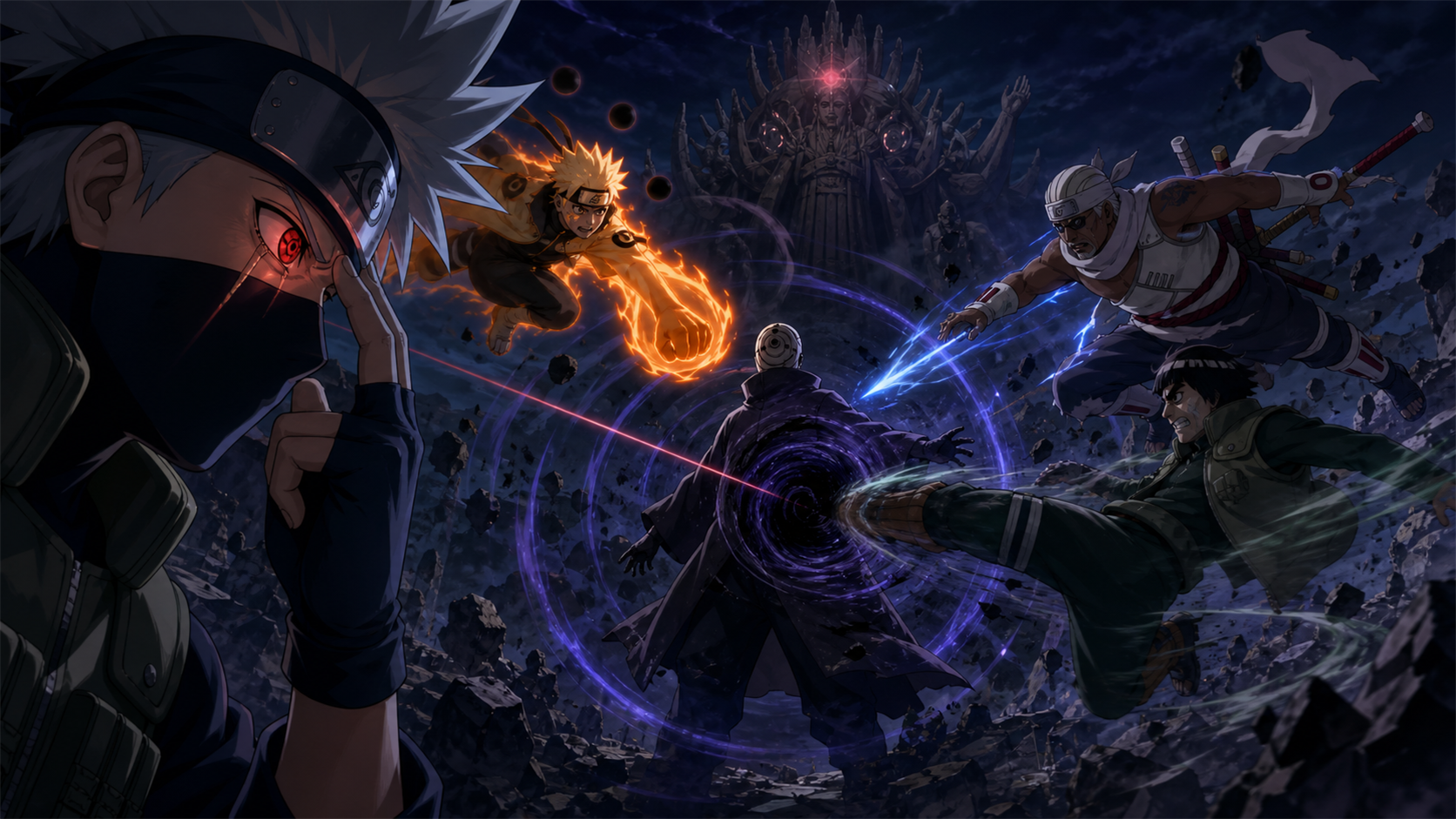
Secret of the Transportation Technique
Matter has not vanished. Matter has moved, and Kakashi finally maps the shared dimension where an untouchable body can still be reached.
Bottom line
“Secret of the Transportation Technique” turns the masked man’s greatest defense from supernatural impossibility into a system that can be tested. The Gedo Statue has absorbed chakra from all nine Tailed Beasts and begins moving toward the Ten Tails, which gives Naruto, Killer B, Kakashi, and Guy almost no time for cautious experimentation. Their attacks continue passing through the masked man whenever he shifts parts of his body into another space. Kakashi notices that damage appears where ordinary contact should have been impossible and begins comparing the enemy’s transportation technique with his own Kamui. The breakthrough is not that intangibility becomes weak. The breakthrough is that phasing and Kamui share one dimension, which means an object warped away by Kakashi can meet the body parts the masked man has temporarily stored there. Coordination turns separate techniques into one cross-dimensional trap. The episode rewards observation under pressure. A defense described as untouchable becomes vulnerable once the team stops attacking the visible body alone and starts mapping where the missing pieces go.
The Gedo Statue has all nine chakra signatures
Chakra from every Tailed Beast has reached the statue, even though the Eight and Nine Tails were not captured in full. Fragments were enough to begin the next transformation.
The enemy plan no longer requires ideal conditions. Partial success across multiple operations has accumulated into a catastrophic threshold.
Transformation creates a countdown
The Gedo Statue starts changing toward the Ten Tails. Naruto’s team cannot treat the masked man as an isolated opponent while that process continues behind him.
Every defensive exchange costs time. The battlefield has become a race against biological and ritual momentum.
Naruto chooses direct pressure
Naruto attacks with the speed and reach of Nine-Tails Chakra Mode. His instinct remains to test the defense through relentless contact.
Direct action supplies data even when the strike fails. Each phased attack reveals timing, posture, and which body region disappears.
Killer B adds another attack scale
B brings the Eight Tails’ mass, tentacles, and combat experience into the coordinated assault. The masked man must manage threats arriving from different directions.
Variation matters because a technique that handles one straight line may expose limits under overlapping pressure.
Guy contributes physical timing
Guy cannot analyze space-time ninjutsu through Sharingan vision, but he understands rhythm, distance, and the instant an opponent must commit.
His close-range pressure keeps the masked man responding while Kakashi watches for a pattern.
Kakashi becomes the battlefield analyst
Kakashi has used Kamui enough to recognize how objects distort and vanish. The enemy’s spiral motion carries a familiarity he cannot ignore.
Recognition begins as discomfort before becoming proof. A shared visual language suggests a shared mechanism.
Intangibility is actually transportation
The masked man does not make matter cease to exist. Threatened body parts are transferred away from the physical battlefield for the duration of contact.
That distinction changes every tactical assumption. The body remains somewhere and therefore may remain reachable through the correct route.
Missing matter needs a destination
An attack passes through because the relevant portion of the masked man occupies another dimension. The visible outline conceals spatial separation.
Once Kakashi asks where the body goes, invulnerability becomes a location problem rather than a metaphysical fact.
Kamui also sends matter away
Kakashi’s Mangekyō technique warps targets into a separate space. He has treated that destination as removal from the immediate fight.
The enemy’s phasing suggests that removal and storage may be occurring inside the same environment.
Damage becomes the first contradiction
The masked man shows injury even though visible attacks appeared to pass harmlessly through him. The wound needs an explanation consistent with both observations.
Good analysis begins by refusing to discard evidence that disrupts the preferred model.
Kakashi compares timing and location
He reconstructs which object entered Kamui, which part of the enemy phased, and when the unexplained contact occurred. Sequence matters more than visual spectacle.
The shared dimension hypothesis connects events that looked unrelated on the surface.
One space links two different eyes
Kakashi’s Kamui and the masked man’s transportation technique access the same pocket dimension from different positions and with different functions.
The connection implies more than tactical overlap. Mangekyō abilities with such precise spatial correspondence point toward related origins.
The implication disturbs Kakashi
Kakashi received his Sharingan from Obito. A matching transportation space raises a personal possibility he is not ready to accept.
Battle analysis collides with grief. The eye Kakashi carries may be identifying the person behind the mask before the mask physically breaks.
Emotion cannot pause the countdown
The Gedo Statue continues changing while Kakashi processes the implication. Naruto and the others still need him to turn recognition into a working plan.
The episode does not allow private shock to replace immediate responsibility.
The team needs controlled testing
A theory about shared dimensions is useful only if a repeatable attack confirms the route. Kakashi must send something into Kamui at the right moment.
Testing during lethal combat requires teammates willing to coordinate without receiving a full lecture.
Naruto becomes part of the experiment
Naruto’s speed and clones create pressure the masked man expects to phase through. Kakashi can use that expected response as the trigger.
The plan works because Naruto’s familiar directness becomes cover for a less visible spatial attack.
A warped attack can arrive from inside
Kakashi removes an attack or object from the visible battlefield through Kamui. When the masked man phases, the supposedly missing body part enters the same space.
Contact happens beyond the dimension the enemy is watching. Defense on one side creates exposure on the other.
The masked man’s own habit becomes predictable
He has relied on phasing so consistently that every threat prompts the same solution. Reliability creates a behavioral pattern.
The technique remains powerful. Habit supplies the opening.
Coordination defeats information asymmetry
The masked man has known the relationship between his technique and Kakashi’s eye. Naruto’s team has operated without that knowledge.
Once Kakashi identifies the shared space, the advantage narrows. Secrecy was part of the defense.
The mask protects more than a face
Concealing identity keeps Kakashi from connecting emotional history to technical evidence. The disguise prevents hesitation and prevents targeted reasoning.
The moment technique and eye become linked, the mask begins losing strategic value even before physical damage appears.
Kakashi’s eye has always carried another person’s story
Obito gave Kakashi the Sharingan as a final gift and asked him to see the future for both of them. Kakashi built his adult identity around that loss.
Discovering the paired eye on an enemy would rewrite the emotional meaning of decades without changing the gift itself.
Survivor guilt enters the tactical problem
Kakashi has blamed himself for Obito’s death and later Rin’s death. The possibility behind the mask activates wounds already central to his life.
The enemy benefits if guilt slows analysis. Kakashi must separate what he fears from what current evidence supports.
Guy supports without Sharingan evidence
Guy cannot see the same ocular connection, but he can trust Kakashi’s call and keep the opponent occupied. Their long partnership supplies operational confidence.
Trust lets specialized knowledge become team action before every member independently verifies the theory.
Killer B keeps the larger threat visible
B understands that the statue’s transformation cannot be ignored while the team focuses on the masked man. His presence ties the duel to Tailed Beast survival.
The battle is personal for Kakashi and existential for everyone.
Naruto refuses untouchable as a final answer
Naruto has faced supposedly absolute defenses before. His strength includes continuing to test what other people describe as impossible.
Persistence becomes most effective when paired with Kakashi’s analysis. Effort and explanation need each other.
The masked man is forced to respond differently
Once attacks can reach the pocket dimension, automatic phasing no longer guarantees safety. He must manage what occupies each space at each moment.
The defense becomes a resource requiring decision rather than a permanent state.
The Gedo Statue remains the strategic center
Exposing the transportation technique does not stop the Ten Tails’ emergence by itself. The team still needs access to the statue.
Understanding the guard is a means toward interrupting the transformation, not the final objective.
Partial Tailed Beast chakra changes the stakes
The enemy extracted enough from earlier encounters to complete the required set. Naruto and B learn that avoiding full capture did not make the plan harmless.
Small losses can become decisive when an adversary is collecting categories rather than quantities.
The episode makes mechanics emotional
Shared dimensional access is a technical revelation. The paired eyes transform that mechanic into a question about Obito, Kakashi, and the life built after Kannabi Bridge.
The best power-system reveal changes character history at the same time.
Identity evidence arrives before identity confirmation
Kakashi has enough information to fear an answer, but the mask remains intact. The episode preserves a boundary between inference and proof.
That boundary matters. Emotional certainty can race ahead of what the battlefield has actually demonstrated.
The next attack targets the mask and the model
Naruto’s team now knows how to create cross-dimensional contact. Damaging the mask would confirm that the opponent can be reached and expose who has been using the paired eye.
The tactical and personal objectives converge.
Shared space creates symmetrical danger
Kakashi can now threaten the masked man inside Kamui’s dimension, but shared access also means Kakashi’s own warped objects enter a space the enemy understands intimately. Discovery does not grant exclusive control.
That symmetry keeps the solution from becoming an effortless counter. The team must coordinate which object is sent, when the masked man phases, and where Naruto’s visible pressure forces the body to move. A timing error could waste Kakashi’s limited ocular stamina or place an attack where the enemy expects the arrival. Knowledge opens the battlefield rather than closing the fight.
Kakashi’s stamina becomes a real constraint
Repeated Kamui use drains Kakashi heavily, especially at the scale and speed demanded by this war. The team cannot test every possible interpretation through unlimited attempts.
Scarcity sharpens observation. Kakashi needs enough confidence to act before the Gedo Statue completes its transformation, yet enough caution to avoid spending the remaining technique on a false model. Naruto, B, and Guy help by creating cleaner evidence through synchronized attacks. Their physical pressure reduces the number of spatial possibilities Kakashi must consider.
Teamwork converts private knowledge into public survival
Kakashi alone understands the eye’s history. Naruto alone supplies the unpredictable force capable of exploiting the opening. Guy and B keep the opponent from choosing a comfortable rhythm.
No member possesses the complete solution. The breakthrough belongs to the relationship between specialized skills, which directly opposes the masked man’s strategy of hoarding identity, information, and control behind one face.
Kakashi solves the problem by naming the missing location
The masked man appears intangible because attacks pass through selected parts of his body. Kakashi stops treating that effect as magic and asks where the displaced matter goes during contact.
The question turns invulnerability into transportation. Once the team knows a pocket dimension receives the phased body parts, they can design attacks around destination and timing rather than wasting chakra against an undefined defense.
Evidence arrives through an injury the enemy cannot explain away
A mark appears on the masked man after Kakashi sends an attack through Kamui. The damage links two techniques that previously looked separate: Kakashi’s ranged warp and the enemy’s selective phasing.
Good battlefield analysis starts with the contradiction. An untouchable opponent should not carry that wound. Kakashi compares sequence, range, and anatomy until the impossible result becomes evidence for a shared space.
The matching dimension carries a personal history
Kakashi’s Sharingan came from Obito, so another eye using the same space immediately points toward a connection he has spent years grieving. The tactical discovery reaches straight into survivor guilt.
He does not yet have enough evidence to name the masked man with certainty. Resemblance, shared mechanics, and emotional fear establish a question, not a verdict. Kakashi must keep testing while the Gedo Statue’s transformation continues.
Naruto accepts danger inside a controlled experiment
The team needs simultaneous pressure in the physical world and Kamui dimension. Naruto participates because his speed, clones, and ability to sustain attacks make the timing possible.
Consent matters here. Kakashi explains the model, Guy supports the sequence, and Naruto acts with a clear objective rather than being used as disposable bait. Shared risk becomes teamwork when each person understands the purpose and timing.
Guy protects Kakashi’s ability to think
Guy cannot inspect the Sharingan link directly, but he watches the field, challenges emotional paralysis, and keeps enemies from exploiting Kakashi’s attention. Support does not require access to every piece of private history.
His role is practical and relational. Kakashi needs enough safety to compare evidence without pretending the possible answer carries no emotional cost. Guy keeps the analysis moving while refusing to reduce his friend to a technique.
Killer B keeps the statue inside the conversation
The mystery of the masked man could easily consume the episode, but the Gedo Statue remains a transforming battlefield threat. Killer B’s attacks force everyone to remember the larger emergency.
A team cannot spend every resource proving identity while a weapon containing nine chakra signatures develops beside them. B provides scale, pressure, and the reminder that personal revelation must fit inside public survival.
The masked man depends on information asymmetry
His defense looked absolute while nobody understood the transport interval, destination, or connection to Kakashi’s eye. Secrecy made a limited technique feel limitless.
Once the team shares observations, the advantage shrinks. Naruto supplies contact, Kakashi supplies dimensional access, Guy protects timing, and B pressures the larger target. Collective knowledge challenges a power built around one person controlling the explanation.
Kamui creates danger on both sides of the boundary
Sending an attack into the pocket dimension can strike the phased body from within, but opening that route also exposes Kakashi’s chakra, attention, and technique to someone who knows the space intimately.
The discovery is not a free counter. Every warp drains Kakashi, and one timing error could strand an attack, miss the transferred body part, or leave a teammate vulnerable in the physical world. Precision matters more than spectacle.
The mask becomes tactical armor and emotional control
Hiding the face prevents opponents from connecting mechanics, history, voice, scars, and motive. The disguise also lets the masked man define every conversation through chosen names and invented authority.
Breaking the mask will not automatically explain the war, but the face can collapse the information gap holding Kakashi in uncertainty. Identity matters because relationships change which questions, memories, and responsibilities become available.
The Gedo Statue proves incomplete chakra can still become catastrophic
The statue contains portions of all nine tailed beasts rather than every complete body. Those fragments are enough to begin transformation, which destroys the assumption that partial capture means partial danger.
Security planning must follow function because stolen fragments can complete a catastrophic system even while Naruto and B remain free.
Kakashi’s stamina is shared team infrastructure
Kamui provides the only known route into the pocket dimension, making Kakashi’s remaining chakra a collective resource. Every use must justify the cost against the statue, the masked man, and the possibility of another unknown phase.
The team must protect Kakashi’s chakra, create clear windows, prevent unnecessary warps, and communicate observations before exhaustion defeats analysis entirely.
Naruto challenges the word impossible through evidence
He refuses to accept the masked man as permanently untouchable, but determination alone does not create the opening. Naruto listens to Kakashi’s model and changes his attack around the dimensional timing.
That distinction preserves what makes his stubbornness useful. Hope becomes strategy when observation, explanation, and coordination shape the next attempt. Repeating the same charge louder would only confirm the enemy’s advantage.
Identity confirmation will change the team’s emotional safety
If the face behind the mask connects to Kakashi’s past, the revelation could interrupt timing, judgment, and communication during an active transformation crisis. The team needs to anticipate that shock before the mask breaks.
Guy can ground Kakashi, B can keep pressure on the statue, and Naruto can continue the planned sequence. Emotional support belongs inside battlefield preparation because grief and disbelief affect bodies as surely as depleted chakra.
RaeRae’s verdict
“Secret of the Transportation Technique” succeeds because Kakashi solves intangibility through basic analytical discipline. Matter has not vanished; matter has moved. Damage appears where visible contact was impossible, so another route must connect the attack and the body. Kamui supplies that route.
The shared dimension also turns mechanics into grief. Kakashi’s eye was Obito’s gift, and a matching space-time ability makes the masked man’s identity a personal threat before the face is shown. The episode lets evidence lead while emotion struggles to keep pace.
RaeRae’s call
Kakashi wins the argument before the team wins the exchange: missing matter needs a destination, shared damage needs a mechanism, and fear is not enough to name the person behind the mask. Test the model, protect Kakashi’s stamina, keep the Gedo Statue visible, and let teamwork turn private eye knowledge into public survival.
Episode details and viewing routes
- Official episode reference: Naruto Official episode guide
- Licensed episode route: Crunchyroll licensed episode page
What I am carrying forward
The Gedo Statue has absorbed chakra from all nine Tailed Beasts and begun transforming toward the Ten Tails. Naruto, Killer B, Kakashi, and Guy cannot reach the statue while the masked man phases through their attacks.
Kakashi has determined that phasing transfers body parts into the same dimension accessed by his Kamui. Attacks warped into that space can strike what appears intangible on the battlefield. The paired dimensional access suggests a connection to Obito’s Sharingan. Episode 343 will test that conclusion and break the mask.