
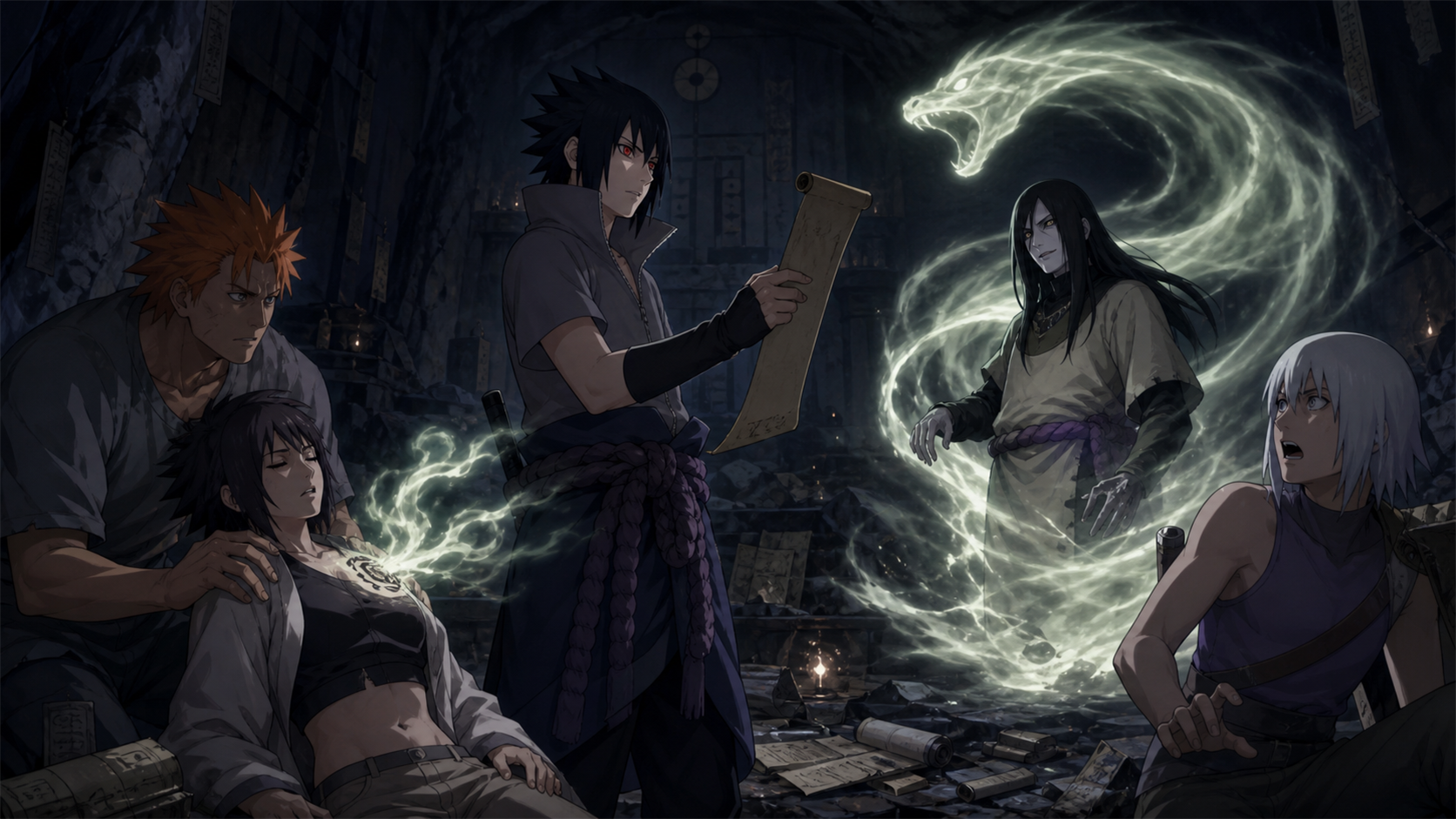
Orochimaru’s Return
Sasuke revives the man who once tried to consume him, not to surrender, but to reach testimony older than Itachi’s tragedy.
Bottom line
“Orochimaru’s Return” is less about a villain coming back than Sasuke choosing a dangerous method for gathering testimony. Itachi’s final honesty removes the simple mission Sasuke had organized his life around. Suigetsu and Jūgo arrive with a scroll containing knowledge from Orochimaru’s research, and Sasuke decides the document is not enough. He wants answers from people who understand why Konoha was founded, what a village is supposed to protect, and how that institution produced the Uchiha massacre. Orochimaru can reach those witnesses, so Sasuke revives the man who once marked his body, tried to consume him, and built laboratories from stolen lives. The choice is risky without being passive. Sasuke does not return as a subordinate. He controls the reason for revival and refuses Suigetsu’s assumption that Orochimaru will automatically reclaim authority. Orochimaru, changed by observing Kabuto’s failed imitation, becomes curious about Sasuke’s unscripted path. Nobody in the room becomes trustworthy. The power arrangement has changed enough for cooperation to become possible.
Silence follows Itachi’s departure
Episode 340 left Sasuke alone with a fuller history and no final instruction. The cave still contains Kabuto, the remains of battle, and the absence of the brother who shaped every earlier objective.
Sasuke does not immediately choose revenge or reconciliation. He identifies missing evidence.
Suigetsu and Jūgo finally reach the cave
The two Taka members catch up after moving through the war on their own. Their arrival reconnects Sasuke with the team he left behind during his pursuit of Itachi.
The reunion is not warm, but presence matters. Sasuke’s next decision will happen in front of people capable of questioning the plan.
Their reactions reveal different loyalties
Jūgo remains oriented toward Sasuke through his bond with Kimimaro and his own need for stability. Suigetsu is more openly skeptical, practical, and afraid of Orochimaru.
Neither response becomes complete moral guidance. Together, the reactions prevent Sasuke’s authority from going entirely unchallenged.
The scroll changes the available question
Suigetsu carries information discovered in one of Orochimaru’s locations. The document contains knowledge significant enough to affect the war and Sasuke’s search.
Written evidence can open a route without answering every motive behind the record. Sasuke needs a source capable of explaining how the knowledge connects.
Sasuke wants more than Itachi’s account
Itachi described the massacre from inside his role as son, brother, clan member, ANBU operative, and secret weapon of village leadership. His testimony is essential and incomplete.
Sasuke wants to understand the institution that made such a choice possible, not only the person who carried the choice out.
The village becomes the real subject
Questions about loyalty now expand into questions about political design. What is a shinobi village, whom does the village serve, and what makes sacrifice legitimate?
Sasuke cannot answer those questions through family grief alone. He needs the history of people who built and governed the system.
“The ones who know everything” are not in the cave
The witnesses Sasuke seeks are unavailable through ordinary conversation. Reaching them requires forbidden knowledge and someone who knows the necessary procedures.
Orochimaru becomes useful because his research crosses boundaries other shinobi refuse or cannot cross.
Utility does not become trust
Sasuke knows Orochimaru tried to take his body and treated human beings as experimental material. Revival does not erase that record.
The decision depends on bounded usefulness, not rehabilitation. Dangerous expertise can be necessary while remaining dangerous.
Suigetsu hears the old hierarchy returning
For Suigetsu, Orochimaru’s return means the possible restoration of captivity, experiments, and command. His alarm is grounded in lived experience.
The fear should not be dismissed as comic cowardice. People harmed by a system recognize risks that a strategist may describe too abstractly.
Sasuke refuses the assumption of subordination
He does not frame revival as returning to Orochimaru’s side. Orochimaru is being brought back because Sasuke has a question and a route in mind.
That reversal distinguishes the present choice from Sasuke’s earlier arrival at the hideout as a teenager seeking power.
The curse mark preserves Orochimaru’s possibility
Anko’s curse mark contains Orochimaru’s chakra and serves as a surviving anchor after Itachi sealed him. His attempt to distribute himself created routes back into the world.
The same infrastructure once designed for influence and possession now makes resurrection possible under someone else’s control.
Anko’s body becomes the ritual site
Anko is unconscious and cannot consent to the use of her curse mark. The revival treats a survivor’s body as access to the person who harmed her.
The episode moves quickly, but the ethical problem remains. Sasuke’s need for information does not make Anko’s bodily history neutral equipment.
Jūgo’s ability helps release the seal
Jūgo’s connection to the biological source behind curse marks contributes to the process. His power interacts with the mark rather than forcing a conventional summoning.
Knowledge, biology, and stored chakra combine to reopen a person everyone assumed was gone.
Kabuto’s transformed body supplies another route
Kabuto incorporated Orochimaru’s cells and chakra during his attempt to surpass his mentor. The imitation contains material that can be reclaimed.
Kabuto’s accumulation becomes part of Orochimaru’s restoration. Borrowed identity creates a literal path for the original influence to return.
Orochimaru emerges without immediate attack
The expected response would be revenge, possession, or renewed combat. Orochimaru instead studies the room and listens to Sasuke’s intention.
Restraint does not prove goodness. Curiosity has become stronger than the impulse to repeat the earlier contest immediately.
Kabuto’s failure interests his former mentor
Kabuto followed Orochimaru’s method of collecting techniques and bodies, then pushed the method further. Izanami exposed the emptiness under that strategy.
Orochimaru sees an experiment in his own worldview reach a limit. Observation creates room for a different question.
Sasuke represents the path not taken
Sasuke once trained under Orochimaru, rejected possession, defeated him, learned the truth about Itachi, and returned with a goal nobody assigned.
Orochimaru becomes interested because Sasuke is no longer following the predictable route of vengeance or obedience.
Curiosity replaces ownership for the moment
Orochimaru says he wants to observe where Sasuke’s choices lead. The language is less controlling than the earlier desire to occupy Sasuke’s body.
Observation can still become manipulation. The reduced claim matters without earning trust.
The war is not Orochimaru’s immediate priority
He expresses little interest in joining the battlefield for its own sake. The global emergency does not automatically create loyalty to either side.
That detachment is morally alarming and strategically useful. A person outside the current alliances may help Sasuke reach witnesses both factions ignore.
Sasuke’s question controls the direction
The group will move because Sasuke wants answers. Orochimaru supplies method and access, while Sasuke establishes purpose.
Power has shifted from master selecting a vessel to former vessel selecting an expert.
This is not a redemption scene
Orochimaru has not accounted for experiments, murders, village attacks, stolen bodies, or the damage inflicted on Anko and countless others.
Cooperation under one set of conditions should not be confused with moral repair. The episode presents changed behavior, not completed accountability.
Sasuke also remains dangerous
He has killed, attacked the Kage Summit, joined Akatsuki operations, and threatened Konoha. Seeking testimony does not erase those choices.
The room contains people with serious harm behind them. Useful alignment emerges without innocence.
Suigetsu’s objection keeps risk visible
His panic insists that Orochimaru cannot be treated like an ordinary consultant. Past power relationships can return quickly when the former controller reappears.
The objection provides a necessary social check even though Sasuke proceeds.
Jūgo’s calm is not complete consent
Jūgo tends to follow Sasuke because Sasuke stabilizes him and carries Kimimaro’s chosen connection. That loyalty limits how freely he challenges the plan.
Agreement inside dependency should always be read carefully. Quiet support does not remove the power imbalance.
Information gathering becomes Sasuke’s new action
For years, Sasuke responded to pain by selecting a target. Itachi, Danzō, and Konoha each became the object that promised closure.
Choosing inquiry interrupts that pattern. The new route remains dangerous, but the goal is understanding before irreversible judgment.
Asking founders does not guarantee objective truth
The people who created and led Konoha will carry their own loyalties, omissions, and justifications. Authority is not the same as neutrality.
Sasuke will still need to compare testimony and decide which principles survive contradiction.
Orochimaru offers access to institutional memory
His forbidden research includes techniques capable of reaching dead leaders and knowledge of Konoha’s hidden structures. He knows where buried procedures remain.
The usefulness grew from unethical practice. The episode refuses the comfort of obtaining necessary information through a clean source.
The cave becomes a threshold
Itachi’s final battle ended one version of Sasuke’s life. Orochimaru’s revival begins a route toward the village’s founding history.
The same location contains closure, danger, and a decision to leave inherited narratives behind.
Resurrection repeats with different control
Kabuto used Edo Tensei to conscript the dead into war. Sasuke revives Orochimaru to request access and information, while retaining the possibility of conflict.
The methods remain ethically compromised, but purpose and agency differ. Those differences matter without making the ritual harmless.
Orochimaru’s survival reflects distributed influence
He persists through curse marks, chakra fragments, research, disciples, and biological traces. Removing one body never removed the network he built.
That persistence is a warning about systems organized around a single person’s methods. Influence survives physical defeat through people and infrastructure.
The title announces return, not restoration
“Orochimaru’s Return” accurately names a physical revival. The old master-student hierarchy does not automatically return with the body.
Everyone has changed. The question is whether changed positions can prevent old harms from repeating.
Sasuke is building an evidence chain
Obito gave him one version of Itachi’s life. Itachi then supplied direct memory and admitted where his plan failed. The scroll adds another record, while Orochimaru provides access to witnesses positioned earlier in Konoha’s history.
That sequence shows more than indecision. Sasuke is learning that a single emotionally powerful account cannot carry every political conclusion. Evidence must be compared across people who benefited from, resisted, designed, and suffered under the village. The process does not guarantee wisdom, but the method is a major change from selecting one narrator and turning that narrator’s pain into an immediate target.
Revival gives Orochimaru leverage too
Sasuke controls the initial purpose, yet bringing Orochimaru back also restores his ability to make independent choices, gather information, and influence the group. A tool with agency never remains only a tool.
The episode leaves that danger open. Sasuke may have reversed the old hierarchy, but reversal is not permanent protection. Every next step will require watching whether curiosity remains stronger than Orochimaru’s appetite for ownership.
Sasuke turns grief into a research question
Itachi’s farewell leaves him with love and evidence, but no living brother who can answer the next question. Sasuke does not rush toward the battlefield or announce a final verdict on Konoha. He asks how the village became capable of the massacre.
That pause is active, not passive. He identifies missing witnesses, locates a method, and accepts risk because every previous answer arrived through someone trying to control his conclusion.
The scroll expands the investigation beyond one family
Suigetsu brings information that points toward people with deeper institutional memory. The document shifts Sasuke from asking what Itachi did toward asking what a village, clan, shinobi, and duty mean.
Those definitions matter because leaders used every word to justify different forms of obedience. Sasuke needs histories from the people who built the system before he can decide whether reform, protection, abandonment, or destruction follows from the truth.
Reviving Orochimaru is dangerous evidence work
Sasuke knows Orochimaru experimented on bodies, pursued his Sharingan, manipulated children, and treated people as containers. Bringing him back creates a threat with knowledge, ambition, and no reason to honor ordinary boundaries.
The decision makes sense only because safer witnesses are inaccessible and the war has already destabilized every route. Understanding the logic should not romanticize the risk. Sasuke needs contingencies, allies, and limits around the person he has restored.
Anko’s body is used without her consent
The ritual depends on her curse mark, which preserves part of Orochimaru after his apparent death. Anko remains unconscious while men decide what to extract from a seal placed on her through earlier abuse.
Her body becomes infrastructure again. The scene should make viewers uncomfortable even when revival advances Sasuke’s investigation. Urgency does not erase Anko’s ownership of her body or the violation built into Orochimaru’s survival system.
Jūgo provides labor under an unclear choice
His ability helps draw the needed chakra from Anko’s curse mark. Jūgo follows Sasuke with calm loyalty, but the episode does not give him a full discussion of the medical, spiritual, or security consequences.
Silence should not be mistaken for informed consent. Jūgo deserves the purpose, risk, expected result, and opportunity to refuse, especially after his own body has repeatedly been treated as a source of useful biological material.
Suigetsu performs the risk assessment nobody else voices
His panic around Orochimaru contains comedy, memory, and good judgment. He understands how quickly old hierarchies can return when the former captor reappears with knowledge everyone wants.
Teams need someone willing to say the plan is dangerous before competence turns into group confidence. Suigetsu cannot veto Sasuke alone, but his objection should trigger clear roles, exit routes, and boundaries rather than eye-rolling dismissal.
Orochimaru returns through people he marked
His survival is distributed across curse marks, cells, memories, research, and bodies altered under unequal relationships. Killing one physical form never removed the network he embedded inside other people.
The method reveals his deepest legacy. Orochimaru built continuity through violations that made subjects carry him whether they wanted the burden or not. Revival is less a miracle than the delayed activation of an abusive system.
Curiosity does not equal rehabilitation
Orochimaru chooses to watch Sasuke rather than seize him immediately. The restraint shows changed interest and practical awareness, but one calm conversation cannot answer for laboratories, kidnappings, murders, village attacks, and stolen bodies.
Redemption requires accountability, repair, limits, and sustained choices when exploitation would still be useful. Episode 341 offers a new alignment of interests. The episode does not provide a moral reset.
Sasuke reverses the old power relationship
He no longer arrives as a child seeking training at any cost. Sasuke holds the question, the scroll, the combat power, and the ability to leave. Orochimaru follows because Sasuke’s next decision interests him.
The reversal matters, though power alone cannot make the relationship safe. Former abusers often adapt when direct control stops working. Sasuke should judge cooperation through observable limits rather than assuming changed posture means changed values.
The founders will offer testimony, not objective truth
People who created Konoha can explain intentions, conflicts, laws, and compromises unavailable in Itachi’s memories. They will also speak from personal loyalties, incomplete knowledge, and responsibility for systems whose later consequences they never lived to see.
Sasuke needs comparison, contradiction, and evidence. No single founder should replace Itachi as the next narrator allowed to define his life. Historical authority remains a perspective, not a command.
Kabuto’s body becomes another disputed archive
Orochimaru retrieves chakra from Kabuto after Izanami has immobilized him. Kabuto’s transformed body contains cells, abilities, and research gathered through a long chain of coercion and theft.
Using that body to restore Orochimaru continues the same argument about ownership. Kabuto caused enormous harm, but guilt does not make every part of his body available for extraction. Accountability and bodily autonomy cannot become mutually exclusive whenever the accused is dangerous.
Team Taka needs terms before the journey continues
Sasuke decides the destination, Orochimaru provides access, Jūgo follows, and Suigetsu objects. The group lacks clear agreement about command, safety, or renewed control attempts.
A functional team would establish who can halt the plan, how Anko will be protected, what information can be trusted, and which actions end cooperation.
The village question is larger than loyalty
Sasuke asks why shinobi accept sacrifice, why clans surrender authority, why leaders conceal violence, and why people continue protecting a system that harms them. A simple choice between loving and hating Konoha cannot answer those questions.
The investigation must examine land, labor, military contracts, clan governance, childhood training, intelligence agencies, and civilian dependence. Villages survive through institutions and ordinary people, not symbols alone. Sasuke needs that complete picture before choosing what deserves preservation.
RaeRae’s verdict
“Orochimaru’s Return” works because Sasuke’s choice is intelligent, disturbing, and genuinely new. He does not revive Orochimaru for power or surrender. He revives him because Itachi’s truth created larger questions than one brother could answer. Seeking broader testimony marks real movement away from target-based revenge.
The episode keeps the method morally compromised. Anko’s curse mark and Kabuto’s altered body become resources in a ritual they did not authorize. Orochimaru’s curiosity is not redemption. The new arrangement is valuable precisely because nobody should pretend safety has arrived.
RaeRae’s call
Sasuke is finally building an evidence chain instead of accepting another man’s mission. Reviving Orochimaru is dangerous, and using Anko’s unconscious body makes the method ethically ugly. Keep Suigetsu’s warning visible, give Jūgo real information, treat the founders as witnesses rather than judges, and never confuse Orochimaru’s curiosity with redemption.
Episode details and viewing routes
- Official episode reference: Naruto Official episode guide
- Licensed episode route: Crunchyroll licensed episode page
What I am carrying forward
Suigetsu and Jūgo have reunited with Sasuke and delivered a scroll connected to Orochimaru’s research. Sasuke has decided that he needs testimony from people who understand Konoha’s creation and the meaning of a shinobi village.
Using Anko’s curse mark and material connected to Kabuto, Sasuke revived Orochimaru. Orochimaru is willing to follow because Kabuto’s failure and Sasuke’s new direction have made him curious. Episode 342 begins the route toward the people Sasuke calls the ones who know everything.