
Return of the Kazekage
Gaara wakes to a village waiting for him, and Chiyo’s cost remains part of the return.
Gaara wakes to proof that he exists in other people's lives
Naruto Shippuden Episode 32 completes an argument Gaara began making in Part I. He once believed existence had to be proven through fear and violence because no one would recognize him through love. He wakes from death surrounded by people who came for him.
The crowd is not a ceremonial background. It is evidence. Sand shinobi, villagers, siblings, allies, and the Leaf rescue team organized their bodies around Gaara's return. His absence mattered to them.
That belonging does not cancel the years when the village treated him as a weapon and a threat. It proves the village changed, partly because Gaara changed and partly because people finally chose to see him. The warmth of the return should sit beside the indictment of how long he had to wait for it.
The Kazekage returns as a person first
The title emphasizes Gaara's office, but the emotional scene depends on the person. The village does not celebrate because a useful military asset came back online. They react because Gaara opens his eyes.
This distinction answers Akatsuki's treatment of him. Deidara and the extraction ritual reduced Gaara to the tailed beast inside his body. Once Shukaku was removed, the remaining body became cargo. Chiyo, Naruto, and the gathered village reject that hierarchy.
Gaara matters without Shukaku. He matters before issuing another order as Kazekage. He matters while lying still and requiring other people to protect him.
The return becomes meaningful because usefulness is not the condition of welcome.
Chiyo's absence belongs inside the celebration
Gaara's life returns through Chiyo's death. The episode gives that cost space rather than allowing relief to consume it.
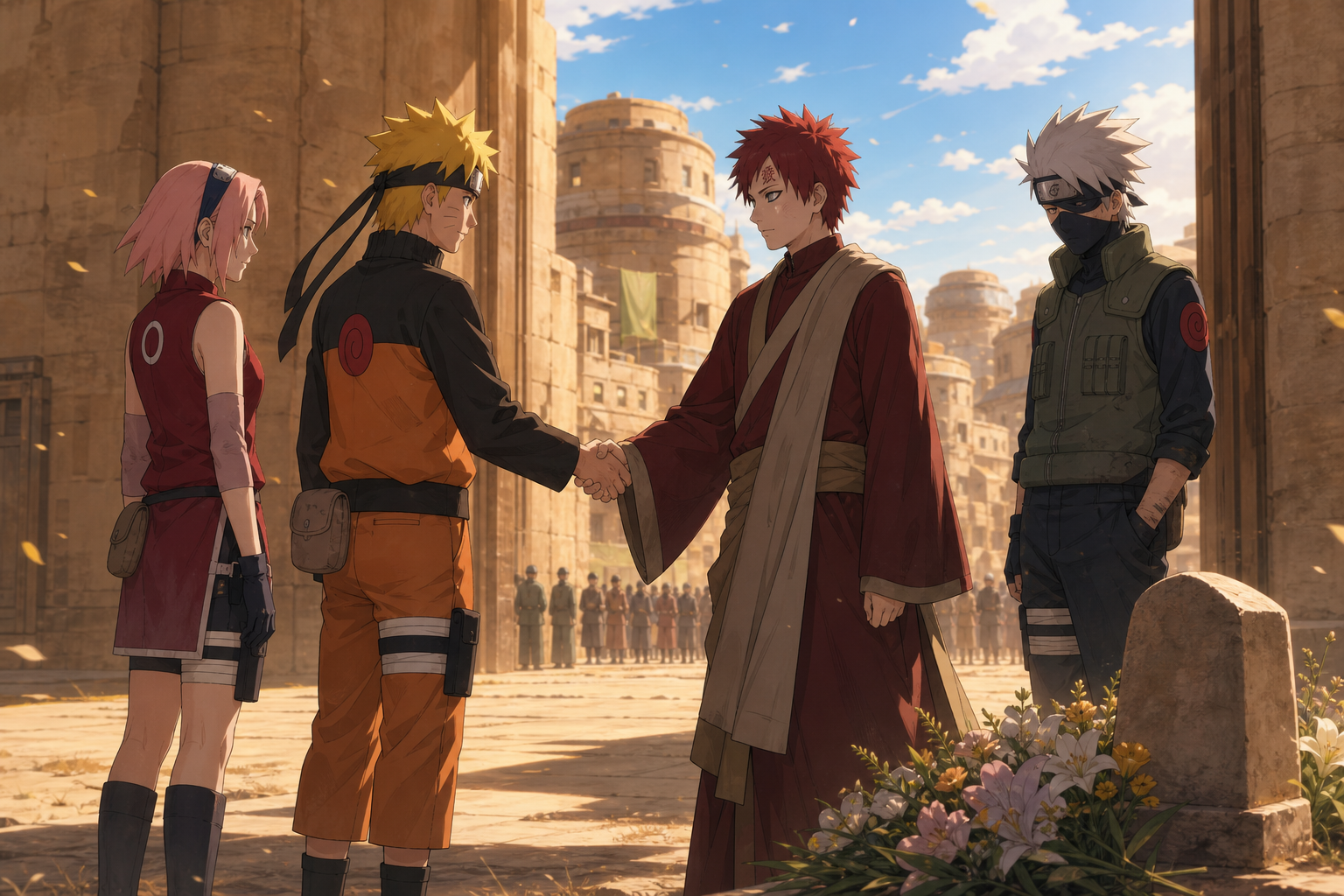
The Leaf team pays respect at her grave before departing. The memorial prevents the arc from framing resurrection as a free correction. Gaara's future carries someone else's final choice.
This does not mean Gaara must live under permanent guilt. Chiyo did not give her life to create a debt she could control. The respectful response is to remember the conditions that made the sacrifice necessary and build something better.
Mourning and celebration can occupy the same day. The village is allowed relief. It is also responsible for grief.
Naruto and Gaara meet as survivors, not symbols
Naruto's bond with Gaara shaped the urgency of the rescue. Both boys were isolated as jinchuriki, but the episode does not reduce them to matching trauma.
Gaara is Kazekage. Naruto still pursues recognition in the Leaf. Their villages responded differently, their coping strategies caused different harm, and their relationships developed along separate routes.
What they share is enough for recognition without making them identical. Naruto understands why Gaara's return matters beyond the office. Gaara understands what Naruto risked to come after him.
Their farewell is quiet because the rescue already made the argument. Neither needs to explain that the other is more than a host.
A whole village waiting changes the past without erasing it
The gathered Sand villagers show genuine affection. That affection does not retroactively comfort the child Gaara was.
Repair cannot travel backward. It can only change what happens now and what future children inherit.
This is why the scene works better when the crowd is not treated as proof the village was always good. The village failed Gaara. It later learned to trust him, and he learned to protect people who once feared him. Both facts belong to the relationship.
The return is evidence of repair in progress, not a declaration that every wound closed.
Team Kakashi leaves with the mission changed
The rescue began as a response to kidnapping and extraction. It ends with Gaara alive, Sasori dead, Deidara escaped, Kakashi depleted, Chiyo gone, and new intelligence pointing toward Orochimaru's network.
Success is therefore real and incomplete. The team recovered the person they came for. They did not dismantle Akatsuki or prevent every cost.
Sakura returns with deeper medical and combat experience, along with knowledge about the spy rendezvous. Naruto returns after confronting how quickly grief can pull the Nine-Tails chakra to the surface. Kakashi returns having revealed an ability his body can barely sustain.
No one leaves the same simply because the main objective succeeded.
Kakashi's exhaustion remains part of the result
Kakashi's Mangekyō saved both teams from Deidara's explosion. The strain does not disappear when the danger passes. He is still exhausted as the Leaf prepares to return home.
This continuity matters. Power should not reset between emotional scenes. The body that paid for Kamui remains the body traveling back.
The team must accommodate him, just as they accommodated Gaara's body and Chiyo's failing reserves. Rescue is a network of temporary dependence.
Kakashi's condition will also shape the next mission. A successful technique can create a tactical absence afterward.
Deidara surviving keeps the victory honest
Deidara escapes the destruction staged through his clay duplicate. The survival prevents the arc from tying every consequence into a neat package.
Gaara returns, but one of the people responsible remains active. Akatsuki still has members, resources, and future targets. Recovery does not equal safety.
Deidara's survival also fits his philosophy. He arranged the instant, watched others respond to it, and preserved himself outside the blast. His art demanded risk from the audience more than from the artist.
The team denied him the deaths he planned. That is a victory even without capture.
Tobi enters through somebody else's remains
Tobi appears with Zetsu while searching Sasori's remains for the ring required to join Akatsuki. The introduction uses comedy around a corpse, creating an intentionally uncomfortable change in tone.
Akatsuki treats vacancy as recruitment opportunity. Sasori's death is not given institutional mourning. His ring becomes the object that matters because membership can be reassigned.
The scene exposes the organization's version of personhood. Members may have private bonds and rivalries, but the structure converts loss into replacement.
Tobi's clowning makes the process look unserious while hiding the danger of someone eager to enter the system. Grief does not slow the organization because the role matters more than the individual.
Chiyo and Sasori leave opposite legacies
Sasori tried to preserve bodies so they would remain available to his will. Chiyo gave up her body so Gaara's will could continue without her.
Both were extraordinary puppet masters shaped by the Sand. Their final choices reveal what their mastery served.
Sasori leaves information and unresolved questions, but his collection was built through possession. Chiyo leaves medical knowledge, changed relationships, and a returned Kazekage through consent.
The contrast does not make Chiyo innocent. It shows that legacy can be redirected even late.
The grave and the village gate belong in the same frame
The return to Sunagakure could be staged only as triumph. The visit to Chiyo's grave insists that the route home includes mourning.
The village gate represents continued public life. The grave represents the private and collective cost that made continuation possible.
Keeping both visible is a form of accountability. Communities often celebrate recovery by making sacrifice disappear into a heroic story. The episode lets the Leaf team pause and acknowledge the person who will not walk through the gate.
Gaara's return is brighter because it does not require forgetting her.
Naruto leaves with recognition already given
Naruto has spent much of his life chasing acknowledgment from his own village. In the Sand, he sees what it looks like when a jinchuriki becomes a leader people openly love.
He also receives Gaara's recognition without needing a title. The relationship validates Naruto through understanding rather than applause.
This matters for the road ahead. Naruto still wants to become Hokage, but Gaara's experience warns that office cannot be the only proof of existence. Belonging has to be built before and beyond the title.
The rescue gives Naruto evidence that his bonds already have public consequences. He helped bring a Kazekage home.
Return is a beginning, not closure
Gaara's restored life creates responsibilities that the episode cannot finish. He must lead without Shukaku, process Chiyo's death, and confront the village policies that shaped him.
The Leaf must follow Sasori's intelligence toward Orochimaru and the possibility of Sasuke. Kakashi must recover. Naruto must face the instability revealed by his chakra transformation. Sakura must carry what she learned beside Chiyo.
The rescue arc closes, but every surviving person inherits unfinished work.
That is what makes the return feel honest. Home is not the place where consequences stop. It is where people decide what to do with them.
Final reaction
Return of the Kazekage gives Gaara the proof he once sought through violence: his existence matters in other people's lives. He opens his eyes to a village that waited for him, and the welcome recognizes the person rather than the tailed beast that is gone.
The episode keeps Chiyo inside that relief. Her grave, Kakashi's exhaustion, Deidara's survival, and Akatsuki's recruitment all prevent a clean victory narrative.
Gaara comes home. Chiyo does not. Naruto and Gaara part with recognition between them, and the villages inherit the responsibility to make that recognition structural. A return is not closure. It is another chance to choose better.
Official episode reference: Naruto Official episode guide
Licensed episode route: Crunchyroll licensed episode page
The village celebration is evidence, not absolution
Sunagakure fills the road for Gaara’s return. People cheer, reach toward him, and openly claim the Kazekage they once avoided as a child. The change is real. It is also late.
The episode earns its warmth by letting both facts stand. Gaara built trust through leadership and protection. The crowd answers that work. Their love does not transform the earlier cruelty into necessary preparation. A community can improve without receiving permission to rewrite the harm that made improvement necessary.
Gaara returns as a person before he returns as an office
The title announces the Kazekage, but the rescue succeeded because people refused to reduce Gaara to his position. Naruto ran for a friend. Chiyo spent her life for a young man her village had failed. Sakura treated a body, not a symbol.
That personal foundation makes the public return meaningful. Gaara can resume office because he came back as himself. Akatsuki extracted the tailed beast and treated the remaining body as waste. The village must answer by recognizing personhood that survives utility.
Naruto struggles to say goodbye because the mission changed him
Leaving the Sand is not a routine departure. Naruto arrived carrying the fear that Gaara’s path could become his own and leaves after watching a whole village gather around that friend. The rescue has given him hope and another grief to carry.
His reluctance makes sense. He does not want the connection reduced to paperwork between allied villages. The bond formed through shared isolation, anger, and stubborn survival. A formal farewell feels too small.
Gaara’s handshake finishes the sentence Naruto cannot
Gaara reaches out and gives Naruto a direct, physical answer. The gesture is restrained because Gaara remains Gaara. It still carries gratitude, recognition, and an agreement that the friendship continues beyond this road.
The handshake matters more than a polished speech because neither of them learned belonging through easy language. They recognize each other through action. Naruto came. Gaara reaches back.
Sand makes the handshake visible without owning it
Gaara’s sand helps bridge the last distance between their hands. The same power his village feared and Akatsuki targeted now supports a voluntary human connection.
That image quietly rejects the idea that dangerous power determines the person carrying it. Sand can kill, defend, lead, and help complete an awkward goodbye. Gaara decides what it means in this moment.
Chiyo’s memorial must hold more than a heroic ending
The group pays respect to the elder who exchanged her life for Gaara’s. Mourning her only as a selfless savior would make the story easier and less honest. She was also an architect and defender of systems that wounded her family and her village.
The memorial should carry the full record: skill, failure, secrecy, love, regret, and a final act of repair. Respect does not require flattening a person into the last good thing she did.
Sakura leaves with knowledge Chiyo cannot supervise
Chiyo recognized Sakura’s medical ability, fought beside her, trusted her antidote, and let her witness the life-transfer technique. Sakura now carries practical knowledge and a moral example complicated enough to question.
That is a stronger inheritance than imitation. Sakura can learn from Chiyo’s brilliance without repeating her compromises. The student’s future does not belong to the elder.
Kakashi’s piggyback ride lets exhaustion stay visible
Guy carrying Kakashi produces comedy after several episodes of death, poison, mutilation, and grief. The joke works because it does not pretend Kakashi recovered the moment danger passed.
He spent his body using Kamui. The team adapts around that fact and keeps moving. Heroism includes being carried after the impossible act, even when the method looks ridiculous.
Humor returns without disrespecting the dead
Naruto and Sakura reacting to Guy’s enthusiastic carrying style gives the audience room to breathe. Chiyo’s death remains real. Gaara’s return remains hard won. Laughter does not cancel either.
Grief rarely occupies every second with the same expression. Bodies get hungry, friends say strange things, and an exhausted teacher ends up on another man’s back. Continuing life is not betrayal.
Temari and Kankuro see a brother the village finally claims
For Gaara’s siblings, the public celebration must carry its own contradiction. They knew the danger and fear inside their home long before the crowd embraced him. They also participated in a family structure shaped by their father’s decisions.
Watching Gaara return as Kazekage offers relief without erasing those roles. Family repair, like village repair, needs more than one triumphant afternoon.
Naruto receives hope without receiving a shortcut
Gaara’s acceptance proves that a jinchuriki can become publicly loved, but Naruto cannot simply copy his path. Konoha has its own history, leadership, and habits. Recognition built on becoming indispensable can also place another burden on the harmed child.
Naruto deserves belonging before saving everyone. The Sand celebration is hopeful, but the political lesson should be that villages must change, not that isolated children must earn humanity through exceptional service.
The rescue mission ends with relationships reorganized
The teams did more than recover one leader. Sakura and Chiyo built trust across generations and villages. Naruto and Gaara made their connection public. Team Guy returned from isolated battles to collective responsibility. Kakashi exposed a power that will affect future missions.
An arc matters when the return route does not restore the opening arrangement. Everybody goes home carrying new obligations.
Gaara’s office now rests on consent rather than fear
The crowd does not gather because the Kazekage ordered attendance. They come because his absence mattered to them. That voluntary presence changes the meaning of authority.
Gaara once controlled rooms through terror because terror was the only relationship his upbringing taught him. Now people approach willingly. The shift belongs to his choices and to their decision to answer those choices.
A successful rescue still contains a funeral
The mission brought Gaara home alive, yet the teams leave Chiyo behind. Calling the operation successful cannot mean pretending every cost balanced neatly.
Victory and mourning share the episode because collective care sometimes saves one future through another person’s final choice. The honest response is gratitude without treating sacrifice as an ideal system for solving preventable harm.
The road home tests whether the alliance can outlast the emergency
Leaf and Sand cooperated because Akatsuki created a crisis neither village could dismiss. The harder test begins after the rescued Kazekage is standing again. Emergency solidarity can disappear quickly once leaders return to routine, borders regain importance, and everyone starts protecting an official version of what happened.
Naruto and Gaara’s goodbye offers a more durable connection because it does not depend on a temporary order. They understand what the villages did to children like them and what it costs to build relationships anyway. Sakura leaves with medical knowledge earned beside Chiyo. Kakashi and Guy leave with practical experience coordinating teams across village lines. Those bonds can make the alliance more than a mission file, but only if people keep choosing them after the danger stops forcing cooperation.
The celebration gives Gaara witnesses to his own return
Gaara does not wake alone and receive a report that people cared. He sees the crowd. He hears the welcome. His siblings and rescuers stand close enough for the moment to become shared memory.
That matters for someone whose childhood taught him that other people only approached under orders or with violent intent. The village cannot replace the missing years in one afternoon. It can give him evidence that the present has changed. The evidence is public, imperfect, and finally addressed to Gaara rather than spoken about him behind a closed door.
RaeRae’s full take
I love the crowd waiting for Gaara, and I refuse to let that love clean Sunagakure’s record. This village helped turn a child into a weapon, feared the result, and now celebrates the leader he chose to become anyway. Gaara earned the trust. The adults do not get to claim their cruelty built him correctly.
Naruto and Gaara’s handshake is the perfect goodbye because neither boy needs a speech explaining what the other already knows. Naruto came for the person. Gaara reaches back as that person, not merely as Kazekage.
Chiyo’s memorial keeps the ending from becoming easy. One life returned, one life ended, and an entire younger generation leaves with the responsibility to stop calling children containers. That is a return worth celebrating and a history nobody should bury beneath the cheering.
RaeRae checkpoint: Gaara comes home to love he should have received before he became useful. Celebrate the return. Keep the village’s paperwork open.
Receipts and official routes
- Episode placement, Gaara’s return, Chiyo’s memorial, and the Leaf team’s departure: Naruto Official Site episode guide.
- Licensed episode route: Crunchyroll.