
The Legacy
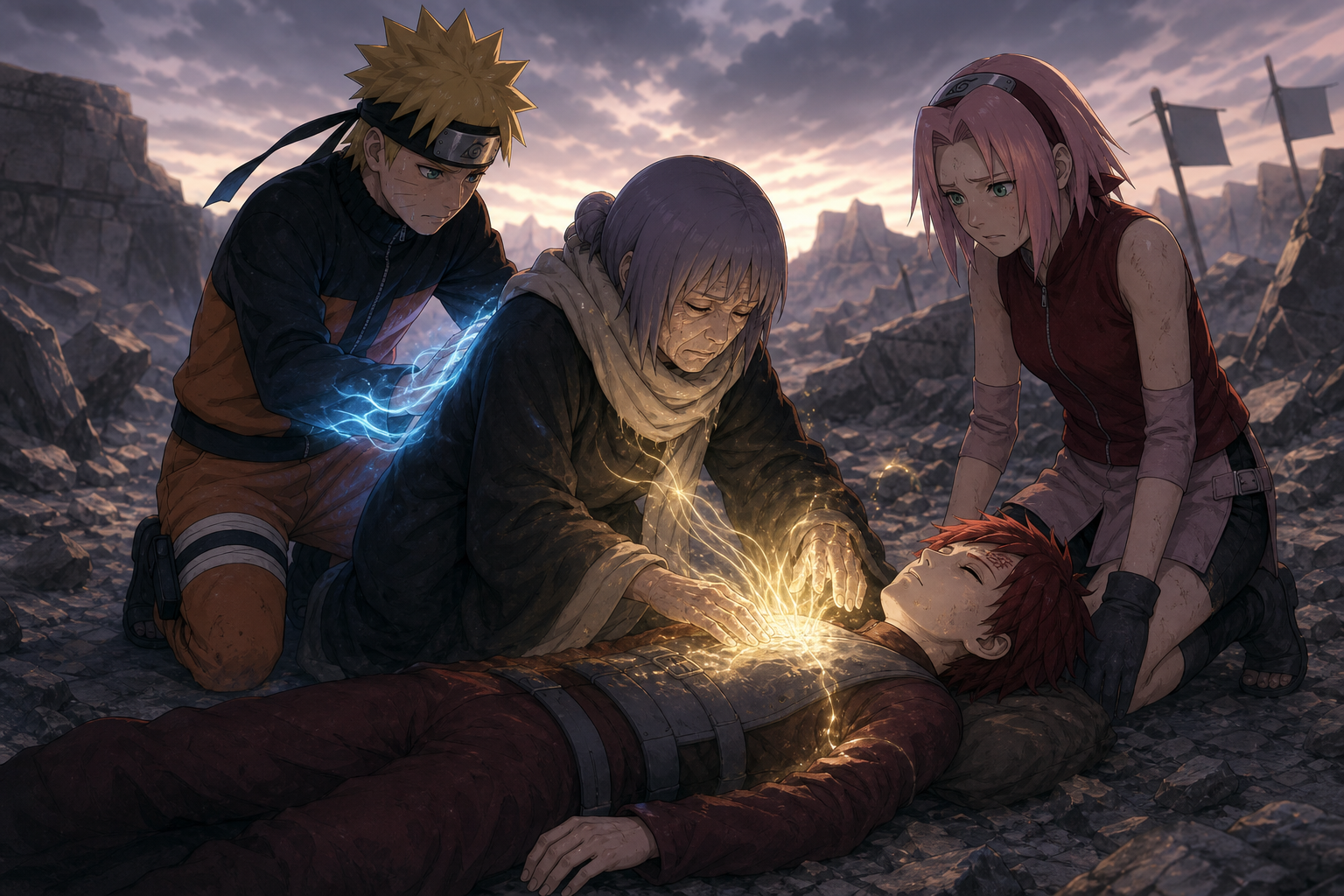
Chiyo gives Gaara her remaining life, and Naruto becomes the chakra that lets another jinchuriki come home.
Chiyo cannot undo the system, but she can choose what her life serves
Naruto Shippuden Episode 31 gives Chiyo a final act with material consequences. She cannot return the childhood Sasori lost. She cannot erase the wars, village policies, and adult decisions that turned children into weapons. She can give Gaara her remaining life.
The sacrifice is powerful because it is not a magical apology button. One death does not balance every failure. Chiyo's choice matters as an action in the present, not as a transaction that cleans the past.
Gaara lies before her as another young person shaped by the Sand's willingness to weaponize children. Chiyo recognizes the pattern and refuses to let it end the same way. She spends herself to interrupt a system she once accepted.
A life-transfer technique makes the cost literal
Many acts of sacrifice are described metaphorically. Chiyo's jutsu removes the metaphor. Life moves from one body into another, and reviving someone who has died requires the giver's life in full.
The technique does not let anyone pretend the outcome arrived for free. Gaara's return will be carried by Chiyo's death. Every celebration must contain that knowledge.
This cost also distinguishes the moment from her earlier use on Sakura. Sakura was still alive, so Chiyo could stabilize her without completing the fatal exchange. Gaara has crossed the boundary. The same jutsu now demands everything.
Chiyo understands the rule before she begins. Her consent is the moral center of the technique. No one extracts her life or assigns her to the role. She chooses.
Naruto becomes the energy that brings another host home
Chiyo's chakra reserves begin to fail, and Naruto supplies his own. The image is one of the arc's strongest reversals. Villages treated jinchuriki as dangerous containers. Here a jinchuriki provides the energy that lets another host return as a person.
Naruto is not helping because Gaara contains Shukaku. Shukaku is gone. He helps because Gaara matters without the beast.
That distinction rejects Akatsuki's logic and the villages' older logic at the same time. Akatsuki extracted the valuable creature and discarded the body. The Sand once measured Gaara through the creature sealed inside him. Naruto invests chakra in the person who remains.
The act also turns Naruto's enormous reserves away from rage. In the previous episode, chakra threatened to consume his judgment. Here chakra is offered deliberately, through cooperation, toward restoration.
Sakura recognizes the cost before the others
Sakura understands enough medical ninjutsu to recognize what Chiyo is doing. Her sadness is not confusion about whether the technique will work. It is knowledge that success and loss are arriving together.
This is one of the burdens of expertise. Sakura can see the invoice while others are still watching for a miracle.
She cannot solve the problem with another antidote. Chiyo's life is not a toxin to neutralize. The jutsu is functioning exactly as intended.
Sakura's role is therefore to witness accurately. She respects Chiyo's decision without pretending it is painless. Medical knowledge does not always provide rescue. Sometimes it provides the language to understand what rescue costs.
Gaara's body remains a person before he wakes
The team handles Gaara with care throughout the episode. He does not need to open his eyes first to regain personhood. The rescue was meaningful while he was dead because his body was never cargo.
This respect answers Deidara's provocation. Deidara treated the body as bait after extracting Shukaku. Naruto, Chiyo, and Sakura organize themselves around Gaara's future even when that future appears impossible.
Chiyo's technique intensifies the principle. She gives life to Gaara, not to the Kazekage title or the missing tailed beast. The person is the recipient.
That is why the gathered Sand shinobi matter. They are waiting for Gaara rather than for a weapon to be restored.
Chiyo's legacy is not innocence
The title invites us to ask what Chiyo leaves behind. Her legacy cannot be reduced to this sacrifice. It includes secrecy, militarized village policy, old resentment, failures toward Sasori, and knowledge used in service of systems that harmed children.
The final act does not remove those facts. It changes what she contributes at the end.
This is a more demanding form of redemption than being declared good. Chiyo recognizes harm, changes allegiance, protects Sakura, opposes Sasori, and gives Gaara a life she cannot share. The actions matter even though they cannot produce innocence.
Legacy is the full pattern other people inherit. Chiyo leaves mistakes to examine and a final refusal to repeat them.
The village must not make the sacrifice comfortable
Gaara's return gives Sunagakure relief, but the village should not use Chiyo's death to avoid examining its policies. A moving sacrifice can become a convenient ending if everyone praises the individual and forgets the system.
Chiyo gives her life because Gaara died after years of being treated as a host first and a child second. Akatsuki committed the immediate violence. The village helped create the conditions of isolation that made Gaara's life so precarious.
Honoring Chiyo should mean changing what future children inherit, not merely placing her inside a heroic story.
The gathered shinobi have evidence that their Kazekage mattered to them. Their next responsibility is building a village where belonging does not require a child to become indispensable first.
Naruto sees a future return
Naruto's identification with Gaara made the loss unbearable. Helping the life-transfer technique lets him participate in a different outcome.
He cannot punch death. He cannot command Chiyo's jutsu. He can offer chakra when her body begins to fail. The role demands cooperation rather than domination.
This is important growth after the Nine-Tails escalation. Naruto's love for Gaara remains intense, but it is now organized through another person's expertise. He follows Chiyo's process and supplies what she needs.
The future returning to Gaara also returns something to Naruto. If Gaara can come home to people waiting for him, Naruto's belief in bonds is not only a source of pain.
Chiyo chooses the younger generation without owning it
Chiyo's final journey has been shaped by Sakura and Naruto, two Leaf shinobi she might once have reduced to inherited enemies. They fought for the Sand's Kazekage without demanding control of the village he leads.
Her sacrifice trusts that younger people can build relationships beyond the boundaries their elders maintained. She gives them a future she will not supervise.
That absence of ownership matters. Chiyo does not demand that Gaara govern according to her wishes in exchange for life. She does not ask Sakura or Naruto to repay her. The gift is complete because she will not control what follows.
Sasori preserved bodies to keep them available to his will. Chiyo spends her body so other wills can continue without her.
A sacrifice can be loving and still tragic
The episode does not need to decide whether Chiyo's death is purely triumphant or purely devastating. It is loving because she chooses another person's future. It is tragic because that future requires her absence.
Treating the act as only beautiful would hide the structures that made it necessary. Treating it as only wasteful would deny Chiyo's agency.
The emotional truth sits in both. Sakura can respect the choice and grieve it. Naruto can help the technique and wish the price were different. Gaara can wake because Chiyo died without owing his life to guilt.
The best legacy will be using the returned life well, not turning it into a permanent debt.
The crowd changes the meaning of Gaara's return
Sand shinobi gather around their Kazekage as the technique completes. Their presence shows how far Gaara's relationship with the village has moved. He once stood alone as an object of fear. Now people came because his absence injured the community.
That change is real, though it arrived late. Gaara had to prove himself repeatedly before the village offered the belonging other children receive without earning it.
The crowd should therefore be read as both comfort and indictment. They love him now. He deserved care before becoming Kazekage.
Chiyo's sacrifice gives the village another chance to make that love structural rather than ceremonial.
Legacy moves through people, not monuments
Chiyo's knowledge passes through Sakura. Her changed understanding passes through the alliance with Naruto. Her final life passes into Gaara.
None of these legacies are static objects. They become choices other people must continue making.
Sakura can carry medical knowledge without inheriting Chiyo's resentments. Naruto can carry the lesson of Gaara's rescue into his own relationship with the Nine-Tails. Gaara can lead the Sand without repeating the policies that shaped him.
This is the opposite of Sasori's preservation. A living legacy changes in the hands of the people who receive it.
Final reaction
The Legacy makes Chiyo's sacrifice meaningful without pretending it erases her history. She recognizes Gaara as another child used by systems that weaponized the young and gives her remaining life to interrupt that pattern.
Naruto's role completes the reversal. The jinchuriki villages dismissed becomes the chakra that lets another former host return home. He supports Chiyo's expertise rather than allowing grief to become uncontrolled force.
Gaara's revival is not a free miracle. Chiyo dies, Sakura understands why, and the Sand inherits both the returned Kazekage and the responsibility to change. A life comes back. The work of deserving that gift begins after he opens his eyes.
Official episode reference: Naruto Official episode guide
Licensed episode route: Crunchyroll licensed episode page
Chiyo chooses repair where she once accepted policy
Chiyo’s final technique does not arrive from nowhere. She helped build the system that placed a tailed beast inside Gaara, watched Sunagakure treat him as a military asset, and spent years living beside the consequences. Reviving him cannot erase that history.
What it can do is make regret active. Chiyo stops asking whether the past can be defended and uses the life still available to protect someone the old policy endangered. Repair remains incomplete, but it becomes real because it costs her more than an apology.
Gaara receives life without owing Chiyo obedience
The life-transfer technique could be framed as a debt large enough to own the recipient’s future. Episode 31 avoids that trap. Chiyo does not revive Gaara so he will carry her politics, preserve her reputation, or become proof that she was secretly good all along.
She gives him possibility. What Gaara does with that possibility remains his decision. The gift becomes ethical because control does not travel with it.
Naruto supplies chakra because relationship crosses village lines
Naruto does not know the technique, but he understands the person lying in front of him. He gives Chiyo the chakra she needs because Gaara’s life matters beyond Sand policy, Leaf orders, and the category of jinchuriki.
That cooperation is the future the older system failed to imagine. A Leaf shinobi, a Sand elder, and a dead Kazekage become connected through care rather than alliance paperwork. The bond does not erase village history. It creates a reason to change it.
Sakura recognizes the cost before Naruto does
Sakura understands medical limits and reads Chiyo’s body with a clarity Naruto cannot yet share. She knows this is not ordinary healing. Her knowledge turns the miracle back into a decision made by a mortal person.
That perspective keeps the scene from consuming Chiyo as a plot device. Sakura sees the elder who is choosing to die, not merely the technique that may save Gaara. Grief enters before the transfer has finished.
Chiyo does not ask the young to carry her innocence
Her final words focus on what Naruto and his generation might do differently. She does not demand that they declare her absolved. She names hope while accepting that she will not supervise the result.
This is what separates legacy from reputation management. Reputation wants future people to protect the elder’s image. Legacy gives them knowledge, warning, and room to refuse the elder’s mistakes.
The jutsu reverses Sasori’s definition of mastery
Sasori used technical brilliance to turn other bodies into extensions of his will. Chiyo uses technical brilliance to return will to a body that can no longer act. Both manipulate life at its boundary, but their purposes point in opposite directions.
One craft preserves the controller by taking futures. The other spends the controller so another future can reopen. Technique alone never decided the moral meaning.
Gaara’s revival does not make the extraction harmless
He returns after Akatsuki killed him, but resurrection cannot retroactively transform the operation into a close call. His body endured forced extraction. His village lost its Kazekage. Naruto experienced the shock of reaching a friend too late. Chiyo dies to reverse the final result.
A miracle can change what happens next without cancelling what happened. The episode lets relief and consequence occupy the same field.
The Sand villagers arrive because Gaara changed the meaning of leadership
Gaara once stood apart from his village as the weapon people feared. Now shinobi gather around him because his leadership created relationships the old system never gave him. Their presence proves that the office became more than authority.
He earned trust by protecting people who had not protected him. That choice should indict the adults who isolated him, not excuse them. Gaara’s generosity is his achievement, not evidence that the abuse somehow produced a better leader.
Naruto sees proof that isolation is political, not natural
Gaara wakes surrounded by people who came for him. Naruto has spent years wanting that same recognition in Konoha. The scene confirms that public belonging can change, but it does not happen through personal charisma alone.
People must revise institutions, stories, and habits that taught them to fear the child carrying the beast. Gaara did the emotional labor of reaching outward. His village still had to answer.
Chiyo’s death belongs to her choices, not Sasori’s shadow
It would be easy to describe her only as the grandmother who lost Sasori and followed him into death. Episode 31 gives her a different final agency. She chooses Gaara, Naruto, Sakura, and a future no longer organized around recovering her grandson.
Sasori remains part of the grief, but he does not own the meaning of her last act. Chiyo ends her life facing forward.
The episode asks what one generation actually passes down
Legacy is not blood alone. Chiyo passes knowledge to Sakura, warning to the villages, trust to Naruto, and life to Gaara. She also passes the record of her failures, whether anyone finds that comfortable or not.
The younger generation inherits tools and damage together. Their responsibility is not blind gratitude. It is deciding what deserves continuation and what must stop with them.
Responsibility survives the person who begins it
Chiyo cannot oversee Gaara’s next decision or Sakura’s future medicine. The work continues because other people accepted part of it while she was alive. Naruto lends chakra. Sakura witnesses the cost. Team Guy and Kakashi protect the space around them.
Repair becomes collective without dissolving personal accountability. Chiyo owns her choice, and the others make it possible.
The miracle depends on bodies, training, and consent
Naruto provides chakra willingly. Chiyo knows the price. Sakura understands enough to recognize what is happening. Gaara cannot consent while dead, but the technique restores his capacity to choose rather than replacing it.
Those details matter in an arc full of bodies treated as containers, materials, and trophies. The revival returns a person to himself.
Hope arrives without demanding perfection
Chiyo does not become flawless in her final minutes. Naruto does not suddenly understand every political system that produced Gaara. Sunagakure does not repair its history by gathering in one place.
The scene works because change begins before anyone becomes pure. People choose a better action with the damaged selves and incomplete knowledge they actually have.
Gaara wakes into community, not a reset button
The people gathered around him do not erase the years when the same village crossed streets to avoid him. Their relief matters because it shows a changed relationship, not because it rewrites the old one. Gaara opens his eyes inside evidence that public feeling can move, even after institutions taught fear for most of his childhood.
That distinction protects the scene from cheap forgiveness. Sunagakure can love its Kazekage now and still owe an honest account of how it treated the child who became him. Gaara can accept the hands reaching toward him without declaring every earlier wound useful. Belonging should not require victims to praise the road that denied it.
Naruto watches the crowd and sees something he has wanted for himself, but this is not envy dressed as friendship. He understands what the gathering means because he knows the cost of its absence. His joy for Gaara becomes another refusal of the scarcity both villages taught them. One jinchuriki receiving love does not take recognition away from the other. It proves isolation was never the natural price of carrying a beast.
RaeRae’s full take
Chiyo cannot give Gaara back the childhood her village helped steal. She cannot undo sealing Shukaku into a baby, bring Sasori’s parents home, or make years of official cruelty disappear. The episode does not need her to perform impossible innocence before her final act can matter.
She uses everything left to return Gaara’s future without claiming it. Naruto supplies chakra because he refuses the village borders that once made two lonely children look like separate problems. Sakura sees the cost and carries the knowledge forward.
That is the legacy worth keeping: not the elder’s reputation, not obedience, and not a polished story where sacrifice balances every account. Chiyo leaves the young a life, a warning, and the freedom to build something she will never control.
RaeRae checkpoint: A real legacy does not order the future to praise you. It gives the future more room to choose than you had the courage to protect before.
Receipts and official routes
- Episode placement, Chiyo’s life-transfer technique, Naruto’s chakra, and Gaara’s revival: Naruto Official Site episode guide.
- Licensed episode route: Crunchyroll.