
Power – Episode Final
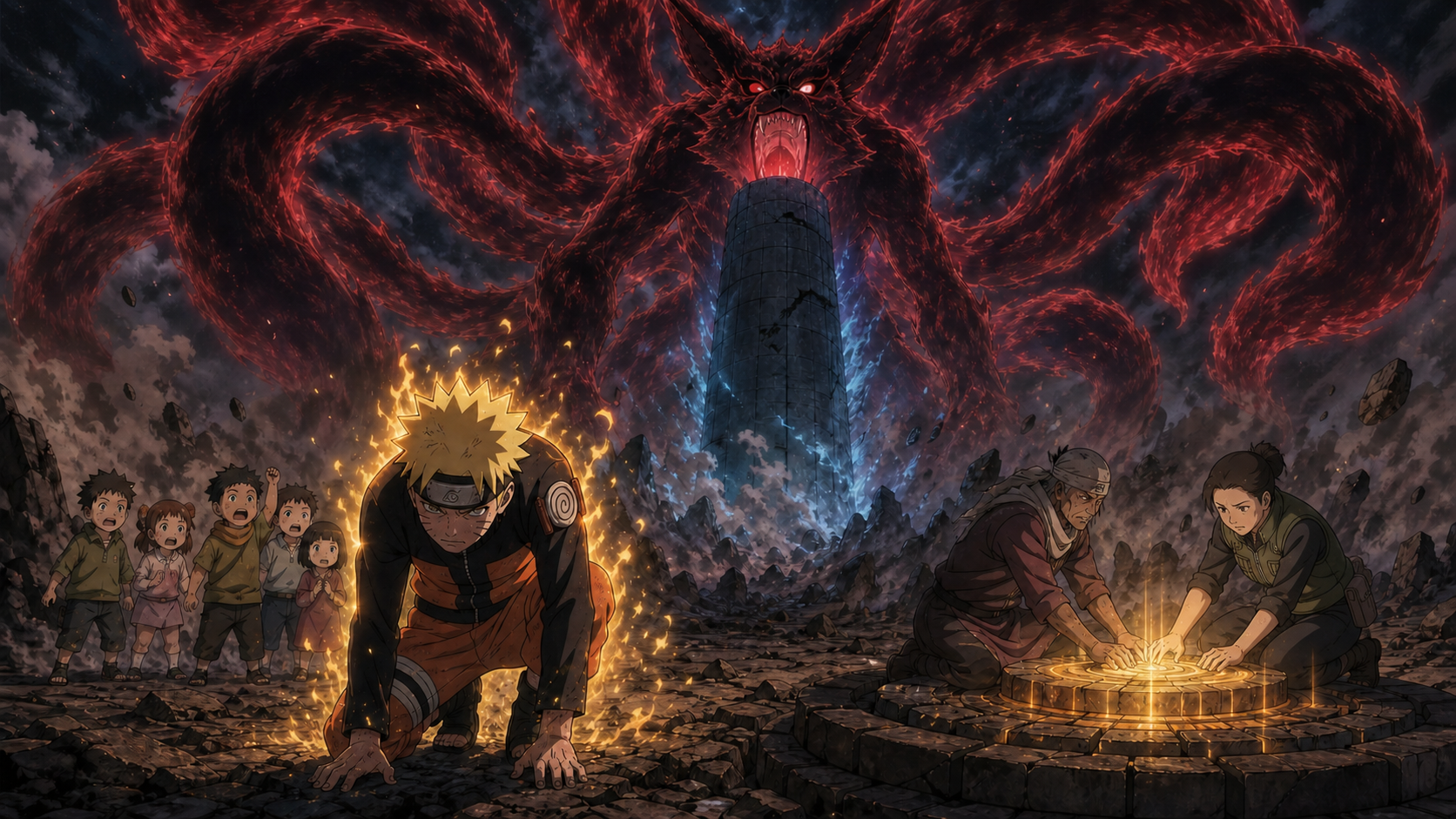
The children’s call brings Naruto back while Dokku and Shiseru reject sacrifice and shut down the weapon feeding the false Nine-Tails.
Bottom line
“Power – Episode Final” closes the six-part story by proving that raw force cannot solve a crisis built from stolen bodies, stolen memory, and stolen authority. The Ama no Hoko feeds the false Nine-Tails until the creature becomes a hydra-tailed disaster, then Naruto falls beneath the pressure of an enemy designed from his own chakra. Dokku and Shiseru answer with sacrifice, but Miina and the other children refuse a future purchased through losing both caregivers. Naruto returns because their voices reach the person beneath the weapon. Victory belongs to connection, coordinated action, and the survivors whose knowledge Disonasu tried to erase.
The finale begins with power feeding power
The Ama no Hoko does not calm after rising. The ancient structure pours stored energy into Kabuto’s Nine-Tails clone and enlarges every danger already present.
The official routes establish the final emergency
Naruto Official catalogs “Power – Episode Final” as record `01_739`. Crunchyroll lists the chapter as Shippuden Episode 295 under watch ID `GRGGPVW8R`, released January 10, 2013. Both official summaries identify the same threshold: the Ama no Hoko gives the false Nine-Tails enough destructive power to threaten the world, and Naruto lies unconscious after facing that force.
That framing matters. The episode does not open with a clean rematch. Naruto first loses consciousness, so everyone else must act while the strongest defender cannot answer.
The clone becomes a hydra-tailed catastrophe
Absorbing the Ama no Hoko’s energy mutates the Naruto copy into a many-tailed fox shape. The creature no longer resembles a controllable experiment.
Every additional tail increases reach, impact, and the number of simultaneous attack angles. Evacuation teams need wide spacing, protected corridors, and spotters assigned to different sides of the creature.
Disonasu is consumed by the weapon he wanted
The transformed clone appears to kill Disonasu. His end follows the logic of the conspiracy: he treated Tonika, Kabuto, and the Ama no Hoko as tools under personal command, then learned that stolen power offers no loyalty.
The apparent death does not erase the investigation. Records, payments, orders, and testimony still matter to survivors who deserve a public account.
Kabuto abandons responsibility again
Kabuto built the experiment, supplied stolen bodies, and helped activate the mechanism. Once control breaks, his interest remains observation and escape rather than rescue.
That pattern separates scientific curiosity from ethical research. An experimenter who leaves civilians to absorb failure has converted a community into disposable material.
Naruto’s collapse changes the command structure
Naruto cannot remain the only answer to every threat. Kakashi, Sakura, Yamato, Sai, Lee, and Guy need independent assignments that continue without waiting for him to wake.
One unit should draw the clone away from homes. Another should protect the children and injured residents. A third should reach the Ama no Hoko controls with Dokku and Shiseru.
The team needs containment before victory
A creature absorbing energy may grow stronger when struck with the wrong attack. The first objective should be limiting movement and learning which techniques feed the transformation.
Earth barriers, controlled water, wire routes, decoys, and coordinated taijutsu can buy time without flooding the target with more chakra. Restraint is tactical intelligence, not hesitation.
Sakura’s medical command belongs at the center
Naruto’s unconscious body requires immediate evaluation for chakra depletion, internal damage, and contamination from the clone. Civilians injured by the rising tower need triage at the same time.
Sakura should delegate named treatment teams so Naruto’s importance does not pull every medic away from residents. A famous patient and an unknown villager receive the same urgency when injuries match.
Dokku and Shiseru choose the shutdown route
The caregivers understand that stopping the Ama no Hoko may require entering the most dangerous part of the mechanism. Their decision grows from responsibility toward the children and the villages, not a desire for glory.
Still, courage does not make self-sacrifice the only honorable plan. Command should search for remote triggers, replacement operators, shielding, and extraction routes before accepting two deaths.
Their sacrifice cannot become romantic shorthand
Dokku and Shiseru have five children depending on their return. Any plan that treats their deaths as emotionally satisfying ignores the aftermath left for Mina, Leo, Faz, Sora, and Miina.
The children already survived mass killing and displacement. Losing both caregivers during the rescue would repeat abandonment through heroic language.
Miina’s voice interrupts the death plan
Miina has carried the Saezuri’s sound throughout the arc. In the finale, her voice also carries a demand: the adults she loves must come back.
Her intervention refuses the assumption that children should silently accept whatever protectors decide. Love becomes testimony about the cost of a mission plan.
The other children create a chorus of witness
Each child knows what Tonika’s destruction removed. Their shared call reaches beyond strategy because Naruto recognizes the loneliness beneath their fear.
The group does not become a magical tool. Their voices restore purpose to someone overwhelmed by borrowed hatred and engineered power.
Naruto returns through connection
The clone was manufactured from Naruto’s chakra and rage-shaped image. Naruto recovers by remembering relationships that cannot be copied through tissue, snakes, or laboratory technique.
Kabuto can reproduce an outline of power. He cannot reproduce consent, trust, memory, or the choice to answer another person’s call.
Kurama’s presence remains complicated
The false fox turns the Nine-Tails image into spectacle, while the real Kurama remains inside Naruto with his own history and will. The contrast exposes the danger of reducing a tailed beast to fuel.
Naruto’s growing relationship with Kurama matters because partnership can do what extraction cannot. Control without recognition creates another Ama no Hoko.
The final attack needs a rescue purpose
Naruto’s return should not be measured only by the size of his technique. Success means separating the clone from the energy source, preventing civilian deaths, and giving Dokku and Shiseru time to escape.
A finishing blow that destroys the village would preserve the weapon’s logic. Protection must shape the attack.
The Ama no Hoko must be disconnected
As long as the tower feeds the clone, defeating one form may produce another. The response needs simultaneous action against the creature and the source.
Sealing specialists should interrupt the energy path while structural teams stabilize the rising chamber. Those tasks require shared timing and a clear signal for withdrawal.
The Saezuri carries both danger and remedy
The sound sequence helped awaken the weapon, but survivor knowledge may also guide shutdown. That dual role makes the Saezuri more than a key.
Any record should separate activation, interruption, and sealing patterns. Access belongs under divided custody so no single official can repeat Disonasu’s abuse.
Tonika’s memory defeats attempted erasure
Disonasu ordered a massacre to clear access and remove witnesses. The finale answers through the surviving children, Dokku, Shiseru, and the remembered song.
The conspiracy fails because cultural memory survives outside official archives. A melody carried by a child proves harder to erase than a ledger locked by a leader.
The children need reunion without interrogation
After the danger passes, the five children should see Dokku and Shiseru before investigators ask for detailed statements. Safety must become physically believable again.
Food, water, sleep, familiar blankets, and permission to remain together come before formal testimony. Adults can preserve initial facts without turning the reunion into a hearing.
Dokku and Shiseru need medical care too
Caregivers often disappear inside relief work because everyone assumes they will keep functioning. Dokku endured capture and renewed confrontation with Tonika’s killer. Shiseru entered a lethal shutdown plan while responsible for frightened children.
Both need injury checks, private emotional support, and relief from immediate decision-making. Survival does not create unlimited capacity.
Naruto needs recovery beyond praise
Waking and winning do not cancel chakra trauma, unconsciousness, or the psychological strain of fighting a corrupted copy. Naruto needs monitoring after the applause ends.
The team should record symptoms, arrange rest, and make room for fear without treating vulnerability as failure. Future missions benefit from honest medical history.
The site remains an environmental hazard
Collapsed tunnels, unstable foundations, chakra residue, and fragments from the clone can continue harming residents. Nobody should reopen the area because the visible creature vanished.
Engineers, medics, sealers, and survivor representatives should define exclusion zones together. Water and soil testing belong beside chakra inspection.
Evidence survives Disonasu’s apparent death
His confession, official books, contracts with Kabuto, guard assignments, and the mechanism itself can establish responsibility. A dead suspect cannot become an excuse for institutional silence.
Investigators should identify who enabled access, who noticed irregular orders, and who tried to resist. Accountability must distinguish command, assistance, coercion, and negligence.
Kabuto’s role requires a separate case file
Kabuto’s conduct spans grave robbery, reanimation, experimentation, abduction, restraint, and creation of the false Naruto. Combining every act under a vague label would hide victims.
Each body and each affected family deserves an individual record. The scale of his crimes should never erase specific names.
Public communication must protect survivors
Residents may see Naruto’s face in the clone and blame him for destruction. Officials should state clearly that Kabuto engineered the copy and Disonasu activated the conspiracy.
The children’s medical details and Miina’s connection to the Saezuri should remain private. Transparency about responsibility does not require exposing a child.
The villages owe Tonika a truthful memorial
Tonika was not lost to an unexplained curse. Residents were deliberately killed so powerful men could reach a buried weapon.
A memorial should name victims when families consent, describe the conspiracy accurately, and preserve survivor accounts in their own words. The Ama no Hoko should never become the only story visitors remember.
The weapon’s future belongs to shared governance
Possible choices include dismantling, resealing, guarded preservation, or destruction. Each path affects safety, cultural memory, and the risk of future misuse.
Tonika’s survivors need real authority in that decision. Military experts can explain technical consequences without claiming ownership.
The arc ends where care begins
The battle resolves an immediate threat, but rebuilding housing, guardianship, schooling, health care, and public trust will take longer. A finale should not confuse silence after combat with recovery.
Named agencies need deadlines and budgets. Survivors need a route for challenging decisions without facing the same authority that failed them.
Recovery also needs milestones the children can understand. A repaired classroom, a permanent kitchen, safe paths between homes, and a public remembrance day make institutional promises visible. Progress reports should name delays, funding gaps, and responsible offices in plain language. Celebration can mark each return without pretending grief has ended. Tonika’s survivors should decide which traditions resume immediately, which need private space, and which should change after the violence. Rebuilding culture means protecting choice, not freezing a community at the moment of loss.
The hydra body exposes Kabuto’s idea of progress
The false Nine-Tails grows more heads, more appetite, and more destructive reach as the Ama no Hoko feeds it. Kabuto reads escalation as useful data because he has already removed every person from the calculation.
Nothing about that growth resembles mastery. The creature cannot choose a limit, protect a bystander, or recognize the people its power came from. More chakra only makes Kabuto’s failure harder for everyone else to survive.
Disonasu is consumed without repairing what he destroyed
The weapon turns on the man who wanted ownership, which offers the quick satisfaction of watching greed bite back. His apparent death still does not answer Tonika’s survivors.
They deserve the records, the names of collaborators, the recovery of remains, and a public account of why their village was targeted. A villain disappearing into his own machine is an ending for him, not justice for them.
Kabuto leaves because abandonment is part of his method
He treats an unstable experiment like a room he can walk out of once the result becomes inconvenient. Civilians, reanimated bodies, exhausted shinobi, and the damaged land all remain behind.
The case file should name that pattern. Kabuto does not merely lose control. He designs without responsibility and makes other people absorb the cost of every question he wanted answered.
Naruto’s unconscious body changes everybody’s job
Once Naruto falls, the team loses its strongest fighter and gains a patient who must be protected from the same construct built with his chakra. Carrying him out cannot wait until the battlefield looks tidy.
One squad needs to shield evacuation, one needs to move Naruto, and one needs to keep the clone from following. Clear roles matter because panic will pull every available person toward the largest visible threat.
The children call Naruto back without becoming magic batteries
Their voices reach him because relationship gives the sound meaning. The episode is not saying frightened children should supply emotional labor whenever an adult hero collapses.
They already survived Tonika, displacement, pursuit, and Dokku’s capture. Their call is a choice rooted in trust. Afterward, adults owe them care without demanding another performance, another melody, or another brave face for the mission report.
Miina’s knowledge works because the others stand with her
She carries the Saezuri pattern, but the final answer does not leave one child isolated in front of a weapon. The other children join her, and Dokku and Shiseru act below.
That shared structure matters. Miina remains important without becoming a solitary chosen tool. The people around her turn knowledge into protection by sharing risk, attention, and responsibility.
Dokku and Shiseru choose together
Their attempt to shut down the Ama no Hoko can look like a romantic sacrifice if the aftermath skips too quickly. The stronger reading is partnership under impossible pressure.
Both understand the children, the village, and the cost of waiting. Both deserve rescue planning and medical care. Love does not make their lives expendable, and courage does not excuse command from trying to bring them home.
Sakura needs authority before the final strike
Naruto’s recovery cannot depend on whether fighters remember to call the medic after the spectacle. Sakura should control movement, stabilization, exposure screening, and the decision about when he can return to combat.
Her authority also protects civilians and Dokku’s household from being pushed behind the famous patient. Medical command is how the episode’s many injuries become one organized response instead of a contest for attention.
Kurama’s help does not erase the coercion before it
The fox’s chakra becomes part of Naruto’s return, but the earlier pressure through hatred still matters. Cooperation is meaningful because Naruto does not simply submit to the first offer placed in front of him.
The relationship is changing through boundaries, recognition, and shared danger. Calling every burst of power friendship would flatten the work required to reach genuine partnership.
The final attack matters because somebody is being saved
A giant finishing move can become empty punctuation. Here the purpose is to stop a construct that is feeding on a stolen mechanism while Dokku and Shiseru work inside the danger zone.
The team should judge the attack by cleared routes, interrupted absorption, and lives protected. Destruction alone would repeat the same obsession with power that created the crisis.
The Saezuri cannot return to one locked office
Disonasu proved what happens when public authority, secret history, and weapon access sit in one pair of hands. Rebuilding the same arrangement under a nicer official would preserve the vulnerability.
Tonika’s survivors, sealing specialists, civilian leaders, and independent record keepers need divided custody. Activation knowledge and shutdown knowledge should not travel together without oversight.
Recovery must include the land beneath the battle
The Ama no Hoko tears through foundations and leaves chakra contamination, unstable tunnels, damaged water, and displaced households. A victory report that counts only defeated enemies would hide half the emergency.
Engineers, medics, environmental specialists, and residents should map the damage before anyone reopens roads or homes. Compensation must follow documented loss without forcing survivors to prove the conspiracy all over again.
Tonika needs names, not a heroic shorthand
The village should not become the tragic place that motivated Naruto. People lived there before Disonasu decided their homes blocked his access to power.
A memorial needs names, family testimony, community history, and an honest account of the officials and experiments involved. Naruto can stand beside that record. He should not replace the people the record exists to remember.
The Power arc ends by rejecting solitary heroism
Naruto lands the visible blow, but Dokku and Shiseru enter the mechanism, Miina preserves the sound, the children call together, and the shinobi team holds the battlefield.
The finale works when those actions remain connected. No single person owns the rescue, which is exactly why Kabuto and Disonasu lose. They collected power. Everybody else built relationships strong enough to direct it.
RaeRae’s verdict
“Power – Episode Final” earns its scale by bringing the spectacle back to the children. The hydra-tailed clone and rising tower create the danger, but a chorus asking loved ones to return gives the climax meaning.
The strongest answer to Kabuto and Disonasu is not a larger machine. The answer is a network of people who refuse to let power erase personhood.
RaeRae’s call
The Power finale earns its spectacle because the rescue belongs to more than Naruto. The children call, Miina carries Tonika’s memory, Dokku and Shiseru choose together, and the team turns strength toward getting people home. Kabuto collected power. Connection decides what power is for. Tonika’s survivors must also decide what happens to the weapon afterward.
Episode details and viewing routes
- Official episode reference: Naruto Official episode guide
- Licensed episode route: Crunchyroll licensed episode page
What I am carrying forward
I am carrying forward Miina’s voice, the children’s refusal to accept another abandonment, Naruto’s return through connection, and the obligation to document Tonika’s massacre after the battlefield clears.
I am also carrying forward the question the entire arc leaves behind: who controls dangerous knowledge after corrupt leadership falls? The only defensible answer begins with survivors, divided authority, transparent records, and care that lasts longer than the celebration.