
Power – Episode 5
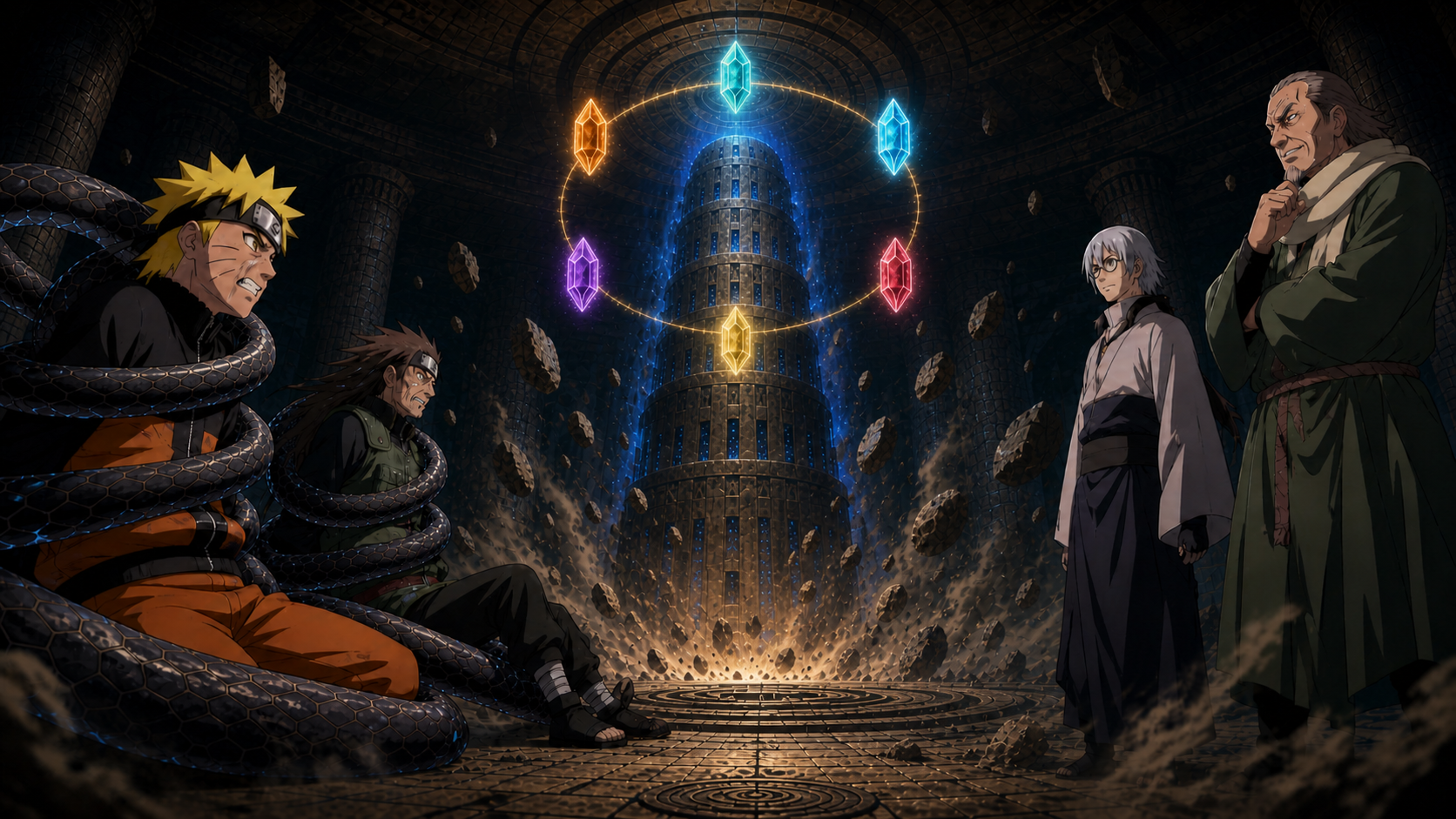
Naruto and Dokku face Kabuto’s draining restraints while Disonasu uses the completed Saezuri to raise a weapon buried beneath the village.
Bottom line
“Power – Episode 5” reveals that Tonika Village was not destroyed by random violence. Disonasu hired Kabuto to erase residents and clear access to the Saezuri, the sound-based key that raises the Ama no Hoko. Naruto and Dokku enter captivity as different kinds of targets: Naruto carries chakra Kabuto wants to exploit, while Dokku carries local knowledge and a direct claim against the official who ordered the massacre. Miina’s humming becomes the first clue that the weapon’s activation can also be interrupted. The episode turns survivor memory into counter-intelligence.
Captivity separates Naruto from the team
Kabuto’s giant snake takes Naruto and Dokku underground after the clone defeats them. Isolation removes medical support, command communication, and the children’s protection network.
The team above ground needs a last-known position, chakra tracking, scent tracking, and a rule against collapsing underground passages before confirming prisoner locations.
The official routes confirm the capture
Naruto Official catalogs “Power – Episode 5” as record `01_738` in the Power sequence. Crunchyroll lists “Power – Episode 5” as Shippuden Episode 294 under watch ID `GY5VEJDQY`, released December 20, 2012. Both summaries state that Kabuto captures Naruto and Dokku after the Nine-Tails chakra clone defeats them.
The official framing identifies captivity as the chapter boundary. The larger weapon reveal grows from that loss of control.
Kabuto uses the underground site as a laboratory
The hidden chamber protects Kabuto from observation and places prisoners near the mechanism he wants to test. Architecture becomes part of coercion.
Investigators should map air flow, water, vibration, exits, seals, and load-bearing structures. A rescue attack that damages the Ama no Hoko could activate or bury the device.
Naruto’s chakra-draining restraints require caution
Kabuto’s snakes consume or suppress chakra, reducing Naruto’s ability to break free through ordinary power. The restraint system also creates medical risk.
Sage Mode offers a path because natural energy changes the equation, but uncontrolled intake could injure Naruto or affect the snakes unpredictably. Escape needs precision.
Kurama offers power through hatred
Inside Naruto, the Nine-Tails encourages him to answer the clone with greater rage. The offer targets fear, humiliation, and the need to protect people quickly.
Naruto’s refusal matters because power that destroys judgment would repeat Kabuto’s logic. The goal is not simply producing a stronger beast.
Dokku learns who ordered Tonika’s destruction
Disonasu’s confession turns suspicion into responsibility. The local leader used public authority while arranging the massacre through Kabuto.
Dokku’s anger is justified. Charging Disonasu while restrained and surrounded still gives the conspirators control of the outcome.
Disonasu weaponizes official trust
As Hachō’s leader, Disonasu could guide investigators, manage survivors, and control access to local history. That position let him shape the response to a crime he commissioned.
The case proves why one official should never control evidence, survivor access, and public communication at once.
Investigators should immediately freeze Disonasu’s authority over guards, archives, transport, and survivor placement. A temporary council can maintain services while preserving records. Removal from command is not a final verdict. Removal prevents the suspect from shaping the evidence used to reach one.
Hachō officials need independent interviews
Disonasu could not operate without leaving patterns around schedules, money, sealed rooms, missing patrols, or unusual visitors. Staff members may hold fragments without understanding the full scheme.
Interviewing them separately reduces coordinated stories and protects junior workers from answering under a superior’s gaze. Investigators should distinguish willing assistance, negligence, coercion, and direct participation rather than treating an entire village administration as one suspect.
Tonika was cleared for access to power
The residents died because their village stood over or near the Ama no Hoko and Saezuri. Their lives became obstacles in another person’s plan.
The final record should state that motive plainly. Calling the event collateral damage would hide deliberate removal.
Property maps can show which homes, shrines, tunnels, and public spaces stood closest to the target. Comparing damage intensity with the underground route may reveal where Kabuto searched before the visible attack. The massacre and excavation should be reconstructed as one operation.
Contracts and payments belong in the evidence trail
Hiring Kabuto required contact, terms, and compensation. Disonasu may have used money, artifacts, bodies, intelligence, or access to the Ama no Hoko as payment.
Financial ledgers, messenger routes, coded correspondence, and missing village assets can establish planning before the massacre. Motive becomes stronger when linked to preparation.
The Saezuri is a key made from sound
The device uses a set of sounds to activate the buried power. Sound-based control makes sequence, pitch, rhythm, and resonance evidence.
Investigators need recordings, diagrams, and independent witnesses. Memory alone is vulnerable to stress and manipulation.
Miina hums the mechanism
Miina reproduces or responds to the Saezuri’s sounds without formal explanation. Her melody may preserve knowledge that adults overlooked.
She should not be forced to perform near the active weapon. Safe recording can capture the pattern while protecting her.
A child’s memory becomes counter-intelligence
The massacre tried to erase Tonika’s witnesses. Miina’s humming proves that knowledge survives in forms the attackers did not value.
Songs, games, stories, and routines can carry technical or cultural information. Archives should respect oral memory.
The Ama no Hoko rises beneath Naruto
Activation lifts the structure from the ground, transforming an underground chamber into a regional threat. Movement can collapse buildings, break roads, and expose civilians to energy release.
Evacuation zones need to expand beyond Hachō Village. Command should alert neighboring communities before visible damage reaches them.
Regional warnings should include ground movement, chakra surges, falling debris, and possible communication loss. People need routes that avoid bridges, tunnels, and slopes vulnerable to the rising structure.
Engineers belong beside sealing specialists
The Ama no Hoko is both a chakra mechanism and a massive physical structure. Engineers can assess collapse, foundations, and load transfer while sealers examine energy flow.
Neither discipline should work alone. Shutting down chakra without stabilizing the tower could crush the chamber. Supporting the tower without stopping activation could prolong the threat.
Dokku should preserve the confession
If no recording exists, Dokku’s testimony still matters. He should document exact words, location, witnesses, and the circumstances of restraint as soon as safe.
Trauma can affect sequence without invalidating the account. Corroboration should support the witness rather than replace him.
Disonasu uses reanimated guards
Reanimated fighters restrain Dokku and block direct action. Their presence ties the local conspiracy to Kabuto’s broader system of stolen bodies.
Sealing teams must reach the underground site, but tunnel stability and the Ama no Hoko limit explosive entry.
Naruto and Dokku need different rescue care
Naruto faces chakra depletion, restraint injury, and psychological pressure from Kurama. Dokku faces physical captivity, the confession, and renewed grief over Tonika.
One medical check cannot cover both. Care plans should reflect the harm each person experienced.
The children need immediate truth about Dokku
If Dokku disappears without explanation, the five children may believe another caregiver abandoned them or died. Shiseru should tell them that he was taken, adults are searching, and they remain together.
Promises about return should remain honest. Hope does not require certainty.
The children should choose whether to wait together in one room, continue routine, draw maps for rescuers, or rest. Giving them a safe task can restore agency, but participation must remain optional. Nobody should imply that Dokku’s rescue depends on their performance.
Miina needs protection from becoming the plan
Once adults realize her humming interacts with the Saezuri, every command decision may begin revolving around getting Miina closer to the device. That pressure repeats the logic used by Kabuto and Disonasu.
The team should first use a recording, a trained adult reproducing the melody, or remote transmission. Bringing Miina near the tower should remain a last resort with her assent and multiple safeguards.
Shiseru needs authority during Dokku’s absence
She should have recognized temporary guardianship, access to supplies, and a direct command contact. Informal caregiving becomes fragile when the other adult vanishes.
The children should know that her authority is real and temporary plans will not separate them.
The team above ground needs two objectives
One group must rescue Naruto and Dokku. Another must stop the clone and protect civilians. Combining both under one leader without deputies creates delay.
Shared updates can keep the objectives aligned while allowing independent action.
Each group also needs an abort condition. The rescue team should withdraw if the chamber destabilizes beyond structural tolerance. The containment team should rotate if the clone begins absorbing their attacks. An abort condition is not surrender. An abort condition prevents one failed tactic from consuming every responder.
Sakura should prepare for mass-casualty triage
The rising tower and rampaging clone can injure villagers, shinobi, prisoners, and even reanimated bodies requiring containment. Sakura needs treatment zones organized by urgency and contamination risk.
Patients exposed to the clone’s chakra should remain separate until medics understand transfer or absorption effects. Naruto and Dokku need named clinicians so famous-patient attention does not pull every medic away from civilians.
Kabuto and Disonasu have different motives
Disonasu wants the Ama no Hoko’s power. Kabuto wants experiments, bodies, chakra behavior, and leverage. Their alliance is transactional.
Conflict between them may create an opening, but civilians should not be placed inside a plan that depends on betrayal.
The clone can turn on its creators
An unstable chakra construct that seeks power may attack Disonasu or Kabuto as readily as Allied shinobi. Control failure is predictable.
Containment plans should assume no safe controller proximity.
The device needs a shutdown sequence
Knowing activation sounds is only half the problem. Dokku and Miina may be able to reverse or alter the sequence.
Testing should begin with recordings and models when time allows. Playing unknown sounds into a world-threatening device is not a neutral experiment.
Tonika’s survivors own part of the Saezuri history
Disonasu treats the sounds as a key to possess. The community may understand them as heritage, warning, ritual, or responsibility.
Any later sealing decision should include survivors rather than transferring the device automatically to a military archive.
The community may choose resealing, dismantling, guarded preservation, or destruction. Each option carries risks and cultural consequences. Experts should explain those consequences in language survivors can evaluate.
The Saezuri should have redundant records
One child’s memory cannot remain the only barrier against a world-threatening mechanism. Once Miina’s melody is safely documented, encrypted copies should be stored with separate custodians.
Access rules must prevent the activation sequence from spreading freely. A shutdown record and an activation record may need different clearance.
The confrontation needs evidence custody
Books, mechanisms, talismans, restraints, and reanimated remains all require separate labeling. Disonasu’s records may connect payment, orders, and timing.
A spectacular tower cannot become an excuse to abandon ordinary proof.
The custody log should record who touched each object, which seal protected the container, and whether chakra residue changed during transport. Defense counsel, survivor representatives, and investigators all need confidence that evidence was not altered by the same institutions seeking control of the weapon.
Public communication must name the conspiracy
Residents will see a tower rise and may blame Naruto, Tonika survivors, or an ancient curse. Leadership should state that Disonasu and Kabuto activated a planned operation using stolen bodies and stolen chakra.
Clear attribution reduces panic-driven retaliation. Details can remain restricted without hiding responsibility.
Disonasu’s confession changes the whole rescue
Dokku is not only a prisoner after hearing who ordered Tonika’s destruction. He is a witness standing beside the man who arranged the deaths of his neighbors.
Naruto cannot carry that burden for him. Dokku needs a safe debrief, a survivor advocate, and the freedom to decide when the children hear the full account. The episode gives him rage, but justice requires more than letting rage explode in Kabuto’s laboratory.
Kabuto built a trap around Naruto’s oldest wound
The snakes drain chakra while Kurama offers a brutal shortcut. Kabuto’s restraint system does not merely hold Naruto in place. The system pressures him toward the version of power that once frightened his friends and injured Sakura. That is calculated cruelty disguised as an experiment.
Naruto’s refusal deserves more weight than a standard willpower beat. He chooses judgment while exhausted, restrained, and watching another survivor suffer. The choice proves that Kurama’s chakra is never the whole explanation for who Naruto becomes under pressure.
Dokku’s anger does not cancel his right to care
He lunges because Disonasu finally gives a face and a voice to the decision that destroyed Tonika. That reaction is human. Nobody should use the outburst to dismiss his testimony as unstable or claim he cannot participate in later decisions.
Trauma-informed care means recording his account without demanding perfect order, allowing pauses, and separating contradictions caused by shock from deliberate falsehood. Dokku can be furious and reliable at the same time.
Miina’s song belongs to Tonika before any military archive
The Saezuri is not a convenient code that appeared for the shinobi alliance to collect. Miina carries the sounds through a community that Disonasu tried to erase. Her humming may be technical evidence, cultural memory, or both.
Recording the melody can protect lives, but ownership still matters. Tonika’s survivors should determine who hears the complete sequence, where copies are held, and whether parts of the record remain restricted after the weapon is sealed.
A child cannot become the emergency key
Adults will be tempted to move Miina closer because her response appears useful. That is exactly where protection can turn into exploitation while everybody insists the stakes leave no choice.
The team should try recordings, remote transmission, and an adult reproduction first. If her presence becomes unavoidable, Miina needs a trusted caregiver beside her, a clear explanation, the ability to stop, and an evacuation route that does not depend on the weapon behaving.
Shiseru is doing command work without the title
With Dokku missing, she becomes the stable adult for five frightened children while a chakra weapon rises beneath the region. That is logistics, emotional care, and emergency leadership at once.
The village should give her supplies, transport authority, medical access, and a direct line to the rescue command. Praising her strength while leaving every decision informal would be another way of making a woman absorb institutional failure for free.
The Ama no Hoko turns secrecy into public danger
Disonasu and Kabuto benefited from hidden tunnels, restricted knowledge, and a community whose destruction could be misnamed as random violence. Once the tower rises, the private conspiracy becomes a regional emergency.
Public warnings should identify ground movement, chakra exposure, unstable structures, and safe routes. Officials do not need to release the Saezuri sequence, but they do need to name the human decisions behind the danger. Mystery should not protect the perpetrators.
Rescue teams need evidence specialists beside fighters
A shinobi who cuts Naruto free may destroy residue showing how the restraints drained chakra. A sealing expert who dismantles the mechanism may erase the sequence Disonasu used. Saving lives comes first, yet evidence preservation can happen alongside rescue when somebody owns that job.
Photographs, seal impressions, labeled fragments, and witness notes can survive the chaos. The future case should not depend only on whether Dokku remembers every word after nearly dying underground.
Kabuto and Disonasu are allies only while profit holds
Disonasu wants the buried weapon. Kabuto wants bodies, chakra, data, and the freedom to test whatever crosses his mind. Their goals overlap for one operation, not for one future.
The rescue team can exploit that mistrust, but civilians cannot become bait for a hoped-for betrayal. Any plan based on turning the men against each other needs barriers, evacuation, and a second option when both choose destruction instead.
Sakura’s triage cannot orbit Naruto alone
Naruto needs treatment for chakra loss, restraint damage, and seal stress. Dokku needs care after captivity and traumatic disclosure. Villagers may arrive with crush injuries, burns, panic, and exposure to unstable chakra.
Sakura should lead a system with delegated teams, not become the only competent medic in every room. Naruto’s fame cannot pull resources away from civilians, and civilian numbers cannot justify treating Naruto as a recoverable weapon instead of a patient.
Naruto’s restraint is the episode’s real power
Naruto refuses hatred and keeps his power connected to protecting people.
That refusal does not make him calm or untouched. He remains angry, afraid for Dokku, and desperate to escape. Control means acting with those feelings present, not pretending they disappeared.
Tonika’s survivors must shape the aftermath
After the battle, powerful institutions will want custody of the Ama no Hoko, the Saezuri, Kabuto’s notes, and Disonasu’s records. Technical expertise will be necessary, but expertise does not erase the community’s claim.
Survivors should hold seats in every decision about dismantling, resealing, study, memorialization, and public disclosure. The weapon was uncovered through their dispossession. Recovery cannot repeat that dispossession with cleaner paperwork.
RaeRae’s verdict
“Power – Episode 5” makes the arc’s conspiracy legible. Tonika was erased because Disonasu wanted access, and Kabuto accepted the village as material for experimentation.
Miina’s humming offers the strongest counterpoint. A child the conspirators tried to erase carries the knowledge that can stop their weapon.
RaeRae’s call
Disonasu ordered Tonika cleared, Kabuto turned Naruto and the dead into laboratory material, and Miina carries the sound their conspiracy failed to erase. Stop the Ama no Hoko, rescue Naruto and Dokku, and do not make a child pay for the adults who wanted her knowledge.
Episode details and viewing routes
- Official episode reference: Naruto Official episode guide
- Licensed episode route: Crunchyroll licensed episode page
What I am carrying forward
I am carrying forward Disonasu’s confession, the exact Saezuri sounds, Naruto’s refusal to answer the clone through hatred, and the need to rescue Dokku without separating the five children.
I am also carrying forward the ownership question. If Tonika’s memory contains the shutdown key, Tonika’s survivors belong in every decision about what happens to the Ama no Hoko after the battle.