
One Worth Betting On
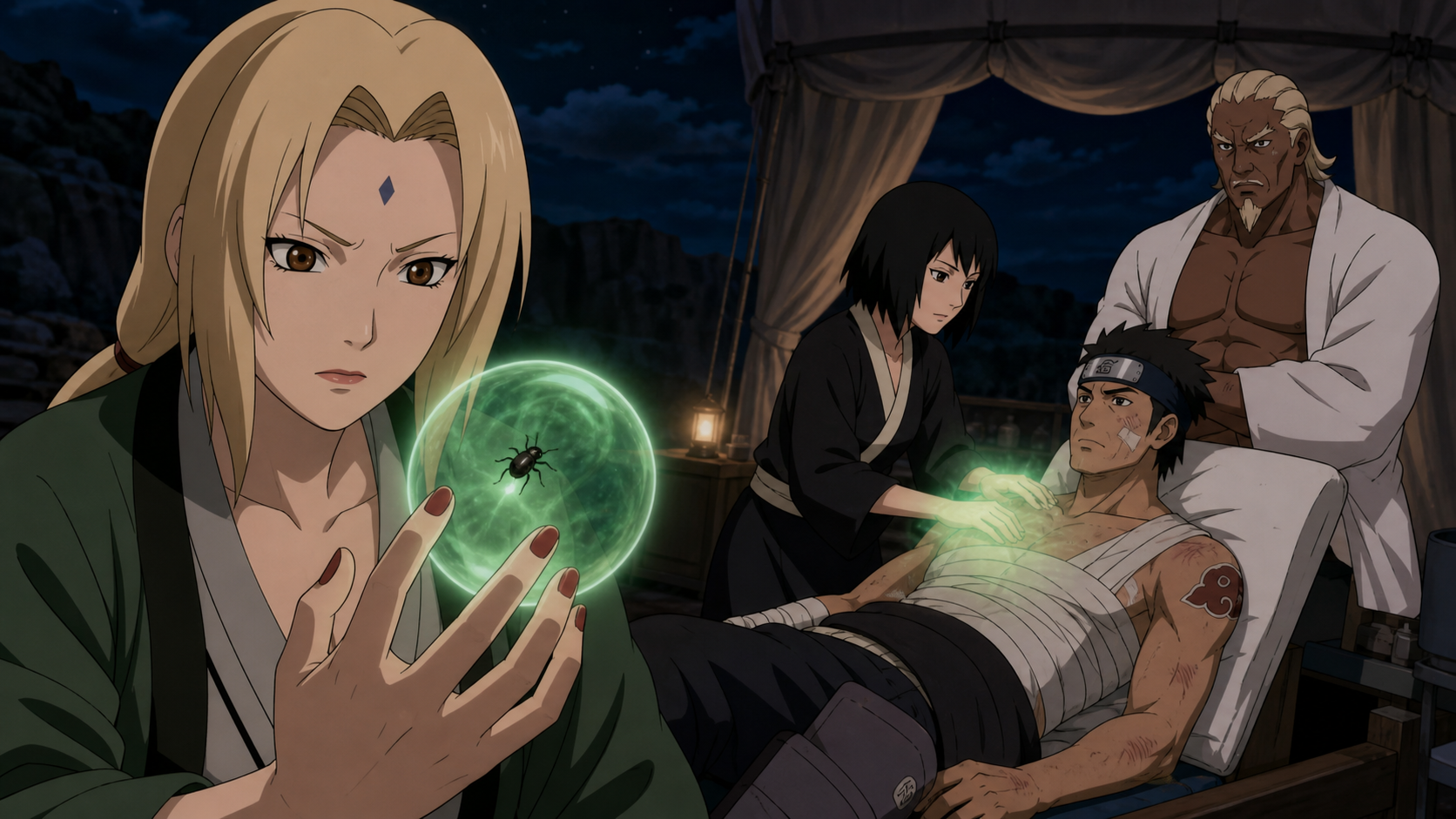
Tsunade detects the hidden weapon, Shizune leads Karai’s surgery, and Ay learns why medical trust depends on teamwork rather than fame.
Bottom line
“One Worth Betting On” completes the medical story by making trust more demanding than confidence in a famous name. Tsunade identifies the hidden explosive insect threatening Ay and Karai, but Shizune leads the surgery while her teacher manages a trauma response. Ay has to bet on a medic he did not request. Tsunade has to bet on the student whose skill continued growing during her withdrawal. The episode’s best decision is refusing to frame recovery as solitary heroism. Karai survives because diagnosis, surgery, intelligence, protection, and mentorship work together.
The hidden weapon changes the diagnosis
Ay explains how the Nokizaru Group ambushed his team after the scroll theft. Visible wounds suggest a brutal fight, but Tsunade listens for details that do not fit ordinary trauma. The enemy used an insect as a delayed explosive device, placing danger inside the body where speed and armor cannot solve the problem.
Tsunade realizes that Ay may carry the same threat. That insight turns a single-patient emergency into a containment problem. The team must protect Karai, assess Ay, prevent hostile surveillance, and prepare for an attack by enemies who may know exactly where the wounded shinobi have stopped.
The official routes confirm the second half
Naruto Official catalogs “One Worth Betting On” immediately after “Things You Can’t Get Back” in the Seven Ninja Swordsmen sequence. Crunchyroll lists the episode as Shippuden Episode 287 under watch ID `GRX04MNN6`, released November 1, 2012. Both summaries center Ay’s refusal to sacrifice more of his people and his decision to seek Tsunade’s medical help.
The official archive uses a franchise-wide episode number because the record continues across the broader Naruto television run. The title and narrative sequence remain exact. This episode cannot be evaluated honestly as an isolated rescue because every major choice answers a problem established in Episode 286.
Listening becomes Tsunade’s first procedure
Before touching a patient, Tsunade reconstructs the attack. Who was struck first, what technique appeared, how symptoms changed, and what followed the team after escape all matter. Her diagnostic authority comes from connecting testimony to anatomy and hostile intent.
That work proves trauma has not erased her expertise. Tsunade may struggle with direct blood exposure, but she can still see the clinical pattern nobody else recognizes. A functioning team builds around both capacity and limitation.
The insect weapon makes secrecy physically dangerous
The Nokizaru Group relies on a device hidden inside the victim. Their tactic punishes teams that treat mission intelligence as separate from medicine. If Ay withholds details to protect the stolen scroll, clinicians lose the information needed to identify the mechanism.
Karai’s body becomes a contested archive. Symptoms record what the attackers did even when nobody witnessed every step. Medical examination can recover that evidence, but only if the patient and commander provide a truthful account.
Ay must accept that strength cannot operate inward
Ay can break obstacles, outrun opponents, and carry an injured subordinate to safety. None of those abilities can remove a tiny explosive parasite without killing the host. His power reaches the edge of the treatment table and stops.
That boundary is humbling, especially for a leader accustomed to solving danger through force. Trusting medicine means surrendering control to people whose methods look slower and less dramatic. Ay’s courage is measured through restraint as much as aggression.
Shizune receives responsibility before recognition
Tsunade directs Shizune to lead the operation. Ay objects because he came for the legendary Sannin, not the apprentice. His concern for Karai is understandable, but his standard confuses fame with current fitness.
Shizune has trained for this responsibility. Her steady medical chakra, anatomical judgment, and familiarity with Tsunade’s methods make her the working surgeon the room actually needs. Leadership means letting prepared people do the work instead of using rank to satisfy fear.
Tsunade supervises without stealing the procedure
Tsunade’s presence still matters. She identifies the threat, defines the surgical objective, monitors the team, and can intervene through knowledge even when blood limits her direct role. Supervision is not abandonment.
The episode gives mentorship a mature shape. A teacher does not prove greatness by taking every difficult case away from a student. A teacher proves greatness by preparing the student, naming the moment of readiness, and remaining accountable while the student leads.
Blood brings the past into the room
When blood reaches Tsunade, her body reacts before professional reasoning can restore distance. Dan and Nawaki are not abstract memories. Their deaths live inside a sensory trigger that transforms the present into an earlier emergency.
The response should not be mocked or hidden. Tsunade steps away because remaining frozen beside an open procedure would endanger Karai. Recognizing a limit and transferring responsibility is a clinical decision, not a moral failure.
Shizune protects her teacher without exposing private grief
Shizune explains enough for the Cloud team to understand why Tsunade cannot simply force herself through the procedure. She has to balance patient safety, inter-village trust, and Tsunade’s right to personal dignity.
Nobody should need to disclose every traumatic detail to earn accommodation. The relevant facts are present capacity, known triggers, and the backup plan. Shizune’s explanation works because she keeps the treatment moving rather than turning Tsunade’s history into spectacle.
Ay’s demand becomes a wager on Shizune
The title’s wager is not a gambling-table joke. Ay has to decide whether Shizune’s hands are worth trusting with someone he refuses to lose. Tsunade’s confidence in her student supplies evidence, but Ay still bears the emotional risk of consent.
That risk is what patients and families face whenever care depends on a practitioner they did not choose. Ethical trust should rest on training, clear communication, and team support. Reputation can open the door, but demonstrated competence carries the procedure.
Karai remains a person inside the lesson
The episode uses Karai’s condition to reveal Tsunade and Ay’s history, yet the medical team must resist treating him as a device for their growth. His pain, fear, and future matter independently of what either leader learns.
Care after surgery should include monitoring for residual insects, infection, chakra disruption, and trauma from becoming a living bomb. Survival is the beginning of recovery, not the entire outcome.
Amai’s role makes collaboration practical
Amai brings local knowledge and medical assistance into a room dominated by legendary figures. His work helps translate between the Cloud mission, Tsunade’s diagnosis, and Shizune’s procedure. Necessary support rarely receives the same narrative attention as the person making the decisive discovery.
A reliable record should name every contributor. Invisible assistance creates the illusion that exceptional leaders solve crises alone. The actual rescue depends on a network.
The hovering insect reveals ongoing surveillance
Tsunade catches and destroys the insect watching Ay, proving the Nokizaru threat never ended at the ambush. The attackers use the wounded team’s desperation to track their response. Medical refuge has become part of the battlefield.
Security should establish a clean perimeter, inspect equipment and clothing, control entry, and separate the stolen scroll from the treatment area. A clinic cannot protect patients when hostile observation remains active.
The episode gives trauma a workplace consequence
Tsunade’s fear affects more than her private life. Shizune assumes greater procedural responsibility, Ay questions the team, and Karai’s care plan changes. Trauma moves through systems even when the original pain belongs to one person.
That truth should produce support rather than blame. Institutions need staffing depth, confidential accommodation, and clear transfer protocols. Depending on one brilliant clinician without protecting that clinician creates preventable fragility.
Shizune’s success belongs in her own record
If Karai’s survival is later summarized as “Tsunade saved a Cloud shinobi,” history will repeat a familiar erasure. Tsunade’s diagnosis deserves credit, and Shizune’s surgery deserves equal specificity.
Mentorship becomes healthier when student achievement is not folded into the mentor’s brand. Shizune should leave this case with documented authority that strengthens future cross-village trust.
Ay learns what protective leadership requires
Ay begins with a clear instinct: no more subordinates will be sacrificed. The promise sounds powerful, but no leader can guarantee that outcome through force alone. He needs clinicians, intelligence, and the humility to accept expertise from outside his command.
Protective leadership also means giving the wounded person a future beyond usefulness. Karai should not be rushed back toward another mission simply because the scroll remains contested. Recovery time is part of the rescue.
Tsunade does not need to be cured to contribute
The episode avoids a neat transformation. Tsunade does not see blood, conquer fear through willpower, and return instantly to full surgical practice. She contributes through diagnosis, supervision, and trust in Shizune while the trauma remains real.
That portrayal is more honest than a sudden cure. Recovery can include building a life around limits while gradually changing them. Useful work does not have to wait for perfect healing.
The past explains Tsunade’s later faith in Naruto
In the present, allies question why Tsunade bets so heavily on Naruto. Her answer grows from experiences like this one. She has seen what happens when a leader values only proven reputation. She has also seen a student become ready before outsiders are willing to believe.
Naruto receives trust because Tsunade understands development, not because she ignores danger. Her wager is informed by watching people grow into responsibilities that older authorities would reserve for established names.
A medical alliance begins before the military alliance
Leaf and Cloud later stand together in war, but cooperation here begins with Karai’s vulnerable body. Ay brings the patient. Tsunade supplies diagnosis. Shizune performs the procedure. Amai supports the room.
This shared success becomes quiet evidence that villages can exchange care without surrendering identity. Treating an outsider is not charity. Mutual medical responsibility strengthens every community that participates.
What the official report should contain
The case record should document the insect mechanism, surveillance behavior, removal procedure, all clinicians, Karai’s response, Ay’s screening, and the Nokizaru connection. Security and medical versions can protect sensitive details while preserving the lessons needed for future teams.
The report should also record Tsunade’s supervisory role and Shizune’s surgical lead separately. Precision prevents fame from swallowing labor.
Follow-up should travel with Karai when the Cloud team leaves. A discharge plan needs warning signs, activity limits, wound care, repeat examination, and a secure way to contact the treating medics. Cross-village care fails when a successful procedure ends at the doorway. Shared documentation gives Cloud clinicians enough context to continue recovery without forcing Karai to retell a traumatic mission from the beginning.
Tsunade’s diagnosis is action even when she never holds the scalpel
The story could frame direct surgery as the only meaningful medical labor and reduce diagnosis to setup. Instead, recognizing the hidden insect changes every decision in the room.
Tsunade connects attack history, symptoms, surveillance, and anatomy before the device kills Karai or Ay. That intellectual work is intervention. Medicine begins with knowing what danger the team is actually treating, not with whichever pair of hands receives the closest camera.
Shizune leads because preparation met the emergency
She is not suddenly talented because Tsunade freezes. Years of study, practice, observation, and uncredited care already built the capacity. The crisis makes outsiders see what existed.
That distinction protects Shizune from becoming a convenient replacement woman. She leads because she is a medic with present competence. Tsunade’s limitation creates the opening, but Shizune’s own labor makes the opening survivable for Karai.
Ay has to release the fantasy of the single savior
He arrives believing one legendary healer stands between Karai and death. The belief gives hope a name, but it also narrows the room until everyone else looks inadequate.
Karai survives through a team: Tsunade diagnoses, Shizune operates, Amai assists, Ay supplies history and protection, and the patient endures. Trust becomes stronger when no reputation has to carry every function.
Karai’s body holds evidence nobody should own
The hidden insect is medical danger, hostile intelligence, and part of Karai’s private bodily experience. Cloud command needs information. Clinicians need detail. Karai retains dignity and a right to understand what was removed.
A responsible record separates access by purpose. The case cannot become a public legend about Ay or Tsunade while the wounded person disappears behind the technique discovered inside him.
The surveillance insect makes the treatment room contested space
The attackers anticipate that injured shinobi will seek help. Following that need turns care into another route toward the stolen scroll and the Cloud team.
Security must protect entry, airspace, clothing, equipment, and communication without disrupting surgery. The threat demonstrates why medicine cannot be placed outside mission planning. A refuge remains a battlefield when the enemy understands where vulnerable people have to go.
Destroying the observer does not end the privacy breach
Tsunade catches the insect watching Ay, but nobody knows immediately what information already traveled. The team should assume location, personnel, and some treatment activity may be compromised.
Response requires moving sensitive material, changing routes, warning nearby support, and documenting exposure. Smashing the visible device provides relief. Operational repair begins after the pieces stop moving.
Trauma accommodation becomes proof of team strength
Tsunade stepping back does not collapse the procedure because Shizune can lead and Amai can assist. Redundancy transforms one person’s limit from catastrophe into a managed handoff.
That is what institutions should build before crisis. Accommodation is not a favor granted after someone proves enough suffering. Staffing depth, role transfer, and confidential planning protect patients while allowing skilled people to contribute without concealing danger.
Shizune should not have to inherit Tsunade’s impossible standard
Once Ay accepts her, another trap appears: expecting the apprentice to perform the legend perfectly and without visible strain. Trust should not become pressure disguised as praise.
Shizune needs support, questions, and room to name uncertainty. Competence includes consultation. If success requires her to imitate Tsunade’s mythology, the room has changed names without changing its harmful expectation.
Tsunade’s supervision preserves accountability
Delegating does not mean vanishing. She defines the threat, confirms Shizune’s authority, remains available for judgment, and owns the decision to transfer direct work.
That model matters for every senior practitioner. A mentor can protect a patient by recognizing when another person is better positioned to act. Authority is not measured by how tightly one holds every task.
Ay’s restraint is another kind of physical courage
He can attack an enemy faster than most people can react. During surgery, that strength cannot help unless he uses it to guard space and tolerate waiting.
Waiting while somebody else controls a loved subordinate’s outcome can feel unbearable. Ay’s growth appears when he stops converting that fear into demands that destabilize the team. He protects Karai by letting medicine proceed.
The wager belongs to several people at once
Tsunade bets that Shizune is ready. Shizune bets that training can hold under scrutiny. Ay bets that care from another village can save Karai. Karai, conscious or not, bears the largest physical stake.
No single person gets to claim the title as private heroism. The wager is a network of trust backed by preparation. That is why success feels earned instead of miraculous.
One saved patient cannot settle Tsunade’s recovery
The procedure may restore confidence and reconnect her with clinical purpose. Blood can trigger her again tomorrow. Grief does not sign a discharge form because one emergency ended well.
The episode respects Tsunade when it lets contribution coexist with continuing trauma. Recovery becomes a changing practice of boundaries, support, and chosen risk rather than a clean before-and-after transformation.
Shizune’s credit changes future patient safety
Documenting her as surgical lead is not only fair recognition. Future commanders will know another capable medic exists when Tsunade is absent, injured, or needed elsewhere.
Accurate credit maps institutional capacity. Erasing Shizune behind the Sannin legend would make later teams slower to trust the practitioner already qualified to help them. Visibility can be a safety resource.
Cross-village medicine creates obligations after departure
Karai needs monitoring, warning signs, records, and a secure line back to the treating team. Cloud clinicians need enough detail to continue care without reopening every mission secret.
Cooperation fails if everyone celebrates the surgery and abandons recovery at the border. A shared handoff turns one emergency alliance into durable medical trust, which may save people neither village has met yet.
The episode also leaves a receipt for every institution that mistakes famous authority for complete capacity. A safe team knows who can diagnose, who can operate, who can guard, who can assist, and who needs accommodation. Trust becomes credible when those roles remain visible after the emergency, with Karai’s recovery placed ahead of anybody’s legend or political comfort.
RaeRae’s verdict
“One Worth Betting On” earns its title by making several people risk trust in somebody else. Ay trusts Shizune. Tsunade trusts the student she trained. Shizune trusts her own preparation. Karai trusts a team assembled across village lines.
The medical resolution matters more than the villain plot because the rescue demonstrates how institutions should respond when brilliant people are injured, grieving, or underestimated. Nobody in the room is sufficient alone.
RaeRae’s call
Tsunade sees the hidden danger. Shizune performs the surgery. Amai supports the room. Ay learns to protect by waiting. Karai survives because the episode refuses the fantasy that one legendary name is the whole medical system.
Episode details and viewing routes
- Official episode reference: Naruto Official episode guide
- Licensed episode route: Crunchyroll licensed episode page
What I am carrying forward
I am carrying forward Shizune’s successful leadership and Tsunade’s decision to name that readiness. I am also carrying forward Ay’s growth from demanding a legend to accepting the practitioner capable of saving his subordinate.
The people we lose cannot return. The trust, knowledge, and care they helped shape can still become protection for someone living. That is the wager this episode makes, and that is why the story belongs in Tsunade’s leadership record.