
Things You Can’t Get Back
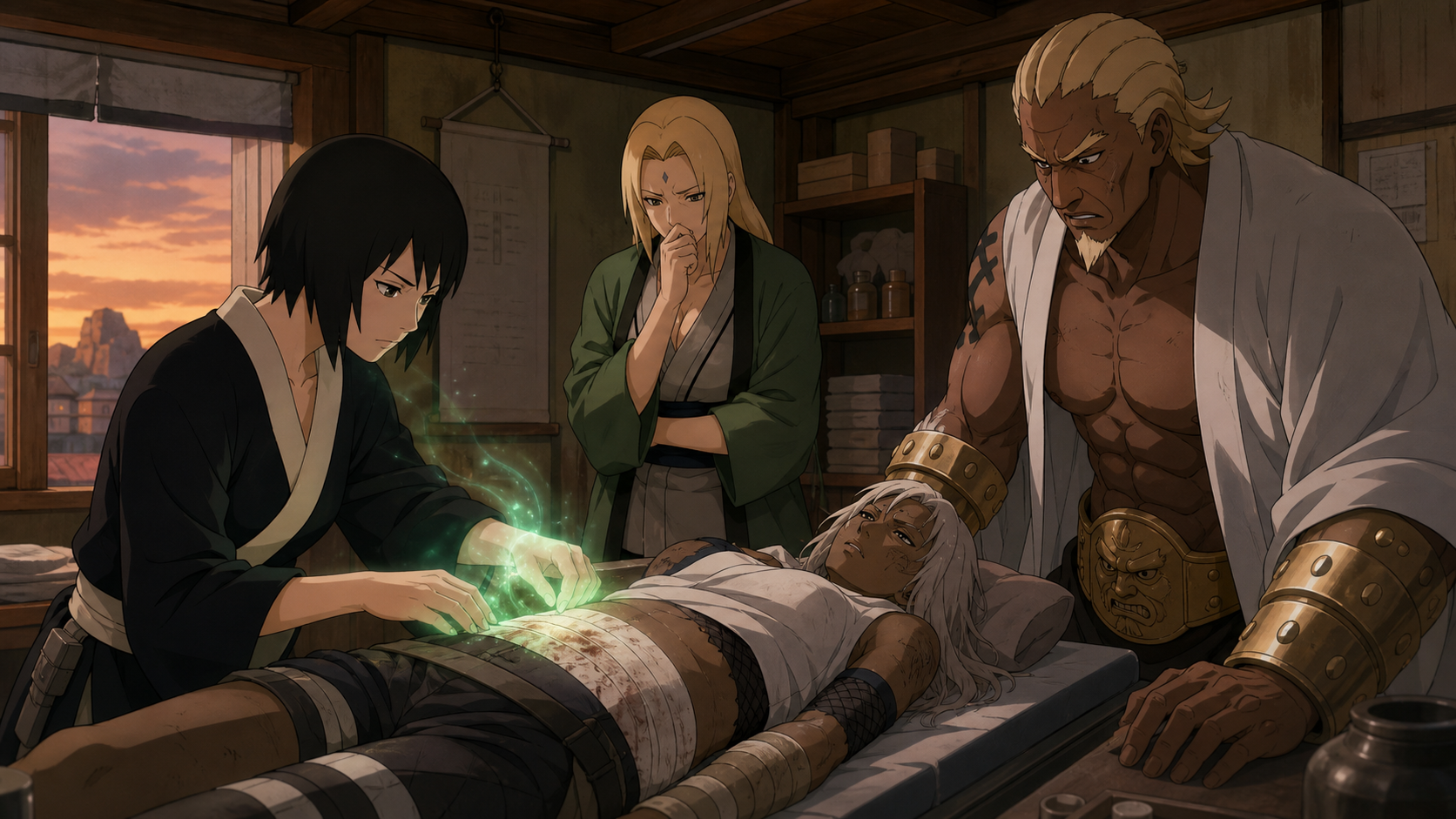
A wounded Cloud shinobi forces Tsunade, Shizune, and Ay to separate medical responsibility from grief, pride, and reputation.
Bottom line
“Things You Can’t Get Back” revisits Tsunade before the Hokage office, before Naruto restored her willingness to gamble on a future, and before the Fourth Raikage learned why her judgment deserved respect. A wounded Cloud shinobi puts medical responsibility directly against Tsunade’s grief and fear of blood. Ay wants the legendary medic, Shizune needs room to practice, and Karai needs care without becoming a test of anyone’s pride. The episode understands that lost people cannot be restored, but the skills, trust, and duties they shaped can still move forward.
The present-day argument begins with Naruto
As Naruto and Killer B head toward the war, Cloud and Leaf companions question Tsunade’s faith in Naruto. Her confidence looks reckless to people who measure safety through containment. Tsunade knows that protecting Naruto from every risk would also deny the growth that made his strength usable.
The conversation sends her back to a period when faith felt much harder. Dan and Nawaki were gone, gambling had become a route away from stillness, and medical work could bring blood too close to memories she could not control. Before Tsunade bet on Naruto, somebody else had to ask whether Tsunade remained worth betting on.
The official routes place the hidden history
Naruto Official catalogs “Things You Can’t Get Back” as the next Seven Ninja Swordsmen record after Pakura’s story. Crunchyroll lists the title as Shippuden Episode 286 under watch ID `GY7521JN6`, released November 1, 2012. The licensed summary identifies Tsunade’s grief and Ay’s scroll mission as the two lines that converge.
The franchise-wide numbering on Naruto Official differs because that archive counts across the broader television run. The title, story, and sequence still match. Using both routes gives readers a stable identity for an anime-original memory framed inside the Fourth Shinobi World War.
Gambling keeps Tsunade moving without asking her to heal
Tsunade reaches another gambling den with money, confidence, and the reputation of the Legendary Sucker. The ritual offers noise and immediate stakes. A lost hand hurts briefly, then another wager replaces the feeling. Grief has no such clean reset.
The behavior is not harmless, but the episode treats gambling as a coping pattern rather than a cute character label. Tsunade is avoiding the medical spaces where her talent once connected directly to people she loved. A card table asks for money. A patient asks her to face the possibility of another death under her hands.
Shizune stays close without pretending closeness is a cure
Shizune follows, worries, and tries to keep daily life from collapsing. She cannot command Tsunade out of trauma. She also cannot abandon the person who trained her. That position creates exhausting care work, especially when the senior medic still holds more authority and fame.
The episode shows why Shizune’s later competence matters. She learned medicine while also learning how grief can distort a workplace, a household, and a teacher-student relationship. Her patience is not passive. She continually searches for a path that keeps Tsunade connected to other people.
Ay’s mission turns strength into responsibility
Ay and his Cloud team have stolen a valuable ninjutsu scroll from Sugi Village. The mission places them against the Nokizaru Group, whose tactics depend on ambush, surveillance, and delayed harm. Raw speed and power can win a clash while leaving a hidden threat inside the body.
When Karai is critically wounded, Ay retrieves him rather than treating the mission objective as more important than the person. That decision reveals the leadership underneath his aggression. Ay demands strength from subordinates, but their lives are not disposable equipment.
Karai deserves care without becoming a loyalty test
Karai protests when Ay seeks outside help. A proud Cloud shinobi may see treatment from a Leaf legend as weakness, political exposure, or an unnecessary delay. Severe injury narrows those choices. The leader has to decide before the wounded person can fully evaluate the danger.
Medical consent during crisis requires honesty, not theatrical command. Karai should know who will treat him, what risks are visible, and what remains unknown. Ay’s urgency is understandable, but urgency must still protect the patient’s dignity.
Amai recognizes the resource nobody expected
Amai spots Tsunade in town and understands what her presence could mean. Recognition alone does not solve the crisis. The legendary medic he identifies is also a grieving woman who has withdrawn from practice and developed a disabling response to blood.
Calling for a famous specialist can reassure a team, yet reputation may describe past capacity rather than present readiness. Amai’s responsibility is to give accurate clinical information and help create a safe treatment environment. Hero worship cannot replace assessment.
Ay asks for the legend while Shizune offers the medic
Ay wants Tsunade because her name represents unmatched medical success. Shizune stands beside that reputation with current training, steady hands, and knowledge of Tsunade’s condition. The disagreement exposes how institutions often undervalue the practitioner who lacks the famous title.
Shizune should not have to prove herself through humiliation. A patient needs the best functioning team available, not the most celebrated individual at any cost. Tsunade’s real contribution may include diagnosis, supervision, or recognizing when her student should lead.
Trauma does not erase expertise
Tsunade’s fear of blood limits her ability to operate, but her diagnostic knowledge remains. Trauma can interrupt performance without deleting years of learning. Treating her as either completely capable or completely useless misses the actual situation.
A safer medical response divides responsibility. Shizune can perform tasks that require direct exposure while Tsunade evaluates symptoms, anticipates complications, and guides the plan. Shared practice protects the patient and respects both women’s abilities.
The title refuses a false promise
Dan and Nawaki cannot return. No successful surgery, winning wager, or later political achievement changes that boundary. Tsunade’s suffering grows partly from fighting a fact no amount of strength can reverse.
Acceptance does not mean approving the losses or forgetting them. Acceptance means building decisions around the world that remains. Karai’s injury gives Tsunade another chance to use knowledge shaped by love without pretending every patient can become a substitute for the people she misses.
Blood carries memory before medicine
For Tsunade, blood is not only a clinical sign. Blood collapses time. A treatment room can become the place where earlier promises failed, and the body responds before reason restores the present.
The reaction deserves accommodation rather than shame. Grounding, clear role assignment, controlled exposure, and permission to step back can keep a trauma response from becoming another emergency. Medical culture harms both patients and clinicians when suffering is treated as weakness that should be hidden.
Ay’s certainty can protect and pressure
Ay’s refusal to give up on Karai is admirable. The same intensity can overwhelm the people trying to help. When a leader demands a specific healer, the medical team may feel pushed to perform beyond safe limits.
Good command means stating the urgency, supplying mission details, and then listening to clinical judgment. Ay knows combat, movement, and his subordinate’s value. Tsunade and Shizune know bodies, procedures, and the difference between decisive action and reckless intervention.
The stolen scroll complicates every medical choice
Karai’s wound cannot be separated from the mission. The Nokizaru Group may have used unfamiliar techniques, delayed triggers, or surveillance tools. A visible injury may be only the first layer. The medical history has to include the ambush, contact sequence, sensations, and any unusual insects or chakra effects.
This is why battlefield medicine needs intelligence support. The team treating Karai should receive the full mission account, not a simplified statement designed to protect operational secrecy. Withholding relevant facts can turn classified information into a lethal obstacle.
Shizune’s apprenticeship needs documented authority
Shizune has trained beside Tsunade long enough to recognize patterns and follow complex instructions. Still, Ay’s skepticism shows how easily a student’s competence disappears behind a famous mentor. Informal trust is not enough when another village controls the patient.
A written chain of clinical authority would clarify who leads, who assists, and when responsibility transfers. Documentation protects Shizune from being treated as a substitute of last resort. Her work should be credited as practice, not absorbed into Tsunade’s legend.
The episode links medicine to political trust
Cloud and Leaf cooperation begins here through a wounded body rather than a treaty table. Ay must trust outsiders with a subordinate. Tsunade must decide whether her knowledge still creates obligations beyond village boundaries. Shizune must work under scrutiny from shinobi who did not choose her.
Successful care can become diplomatic evidence, but the patient should never be reduced to a symbol of cooperation. Karai’s recovery matters first because Karai is a person. Political value follows from humane action, not the reverse.
Grief changes how Tsunade understands risk
After losing Dan and Nawaki, every medical decision carries the possibility of repeating helplessness. Avoidance lowers that immediate emotional risk while allowing other dangers to grow. Tsunade loses practice, Shizune carries more responsibility alone, and patients lose access to rare expertise.
The answer cannot be forced exposure. Recovery needs consent, support, and meaningful reasons to return. Karai’s crisis offers a reason, but the episode wisely leaves the deeper transition unfinished. Episode 287 must show whether Tsunade can participate without being consumed by the past.
That unfinished boundary also keeps Naruto from becoming a magical cure in retrospect. His later promise matters because Tsunade has already spent years negotiating fear, responsibility, and the expectations attached to her name. A young shinobi can reopen possibility, but recovery still belongs to the person doing the daily work. Shizune’s steady presence and this earlier medical crisis give that work a history.
What the team should document after treatment
The record should include Karai’s initial condition, the suspected mechanism, the names and roles of every clinician, all observed trauma responses, and any evidence of hostile surveillance. Medical notes and mission intelligence need separate protections with a controlled bridge between them.
The team should also record why Shizune led particular procedures. That detail turns invisible apprenticeship into professional history. Future patients should not depend on whether a famous leader happens to be available.
Naruto inherits a lesson Tsunade learned earlier
The present frame centers faith in Naruto, but Tsunade’s confidence did not appear from nowhere. Long before Naruto asked her to believe in his future, Ay’s wounded subordinate forced her to confront whether grief had ended her usefulness.
Naruto later gives Tsunade a larger reason to choose hope, yet Shizune and Karai belong to that path too. Recovery rarely begins with one grand revelation. Smaller obligations gather until a person can imagine a future large enough to enter.
Tsunade’s reputation arrives before her consent
Amai recognizes the legendary medic and immediately converts recognition into possibility for Karai. The patient’s need is urgent. Tsunade’s name still does not make her body, trauma, or labor public property.
People in crisis reach for the best-known specialist because hope needs somewhere to land. Ethical care requires asking what she can safely provide now. Diagnosis, instruction, and supervision may be available even when direct blood exposure is not.
Shizune is not the consolation prize after a legend says no
Ay wants Tsunade because fame promises certainty. Shizune offers current practice, attention, and hands capable of following the case. Treating her as a disappointing substitute adds hierarchy to an emergency that needs teamwork.
A mentor’s reputation should expand trust in the student she trained, not erase the student. If Tsunade judges Shizune ready for a procedure, Ay must evaluate that clinical judgment instead of demanding a famous name perform beyond safe capacity.
Karai’s pride belongs inside the medical history
His reluctance may reflect Cloud loyalty, fear of appearing weak, uncertainty about Leaf medicine, or concern that the stolen scroll matters more than his body. Those beliefs affect what symptoms he reports and what help he accepts.
Consent under severe injury may be limited, but listening remains useful. A patient is not an obstacle between commanders and treatment. Karai’s words provide clinical and political information the team needs to understand why care feels threatening.
Ay’s protection becomes pressure when he selects the healer
Retrieving Karai proves Ay values his subordinate. Insisting only Tsunade can save him risks turning care into a contest between leaders. The wounded man cannot afford that argument.
Ay should state urgency, disclose the mission, secure the room, and let clinicians assign roles. Protective leadership creates conditions for medicine. It does not become medicine because the leader’s voice is louder than everyone holding the instruments.
Blood collapses time without asking permission
Tsunade can know she is in a new room with a different patient and still experience the losses of Dan and Nawaki as present danger. Trauma response does not wait for rational agreement.
Telling her to remember her rank adds pressure without restoring orientation. Grounding, distance, clear tasks, and Shizune’s steady communication help the present become distinct enough for Tsunade’s expertise to return.
Accommodation protects the patient as much as the clinician
A team that ignores Tsunade’s trigger risks freezing, error, or sudden withdrawal during a critical procedure. Adjusting roles is not indulgence. It is risk management.
Shizune can handle direct exposure while Tsunade interprets changes and advises. Amai can supply case history. Ay can protect access and retrieve missing information. The safest response uses actual capacities instead of demanding every person perform an idealized role.
The mission secret can become a clinical hazard
Cloud may want the stolen scroll and opposing technique kept confidential. Karai’s body contains evidence from that mission. Withholding contact details, delayed effects, or suspected agents can lead clinicians toward the wrong intervention.
Information does not need to become public. The treating team needs a protected channel for relevant facts. Secrecy that prevents correct care has stopped protecting the village and started protecting the enemy’s work.
Gambling offers a loss Tsunade can choose
Cards and wagers let her enter risk with rules, limits, and another round waiting. Dan and Nawaki disappeared through losses she could neither control nor reverse. Gambling creates the shape of uncertainty without the same intimacy.
It explains why simply ordering her to stop misses the function. Recovery needs other ways to tolerate uncertainty, connection, and consequence without forcing medicine to become an immediate test of worth.
Shizune’s care needs boundaries to remain care
Following Tsunade, managing money, watching symptoms, and maintaining medical knowledge can consume Shizune’s own development. Loyalty does not make infinite responsibility fair.
She deserves colleagues, authority, rest, and a life larger than monitoring her mentor’s grief. Tsunade’s recovery cannot depend on Shizune never becoming tired or angry. Sustainable care distributes responsibility instead of rewarding one devoted person with more invisible work.
The title names irreversibility without declaring the future empty
Some losses cannot be repaired into the original shape. Dan will not return to complete his dream. Nawaki will not grow into the adulthood promised around his necklace.
Tsunade’s future therefore cannot be restoration. She can carry changed love into medical ethics, leadership, teaching, and later trust in Naruto. The new life does not replace the people lost. Continuing becomes meaningful precisely because replacement is impossible.
Karai should not become proof that Tsunade is healed
If treatment succeeds, the episode must not use one patient as a certificate erasing trauma. A clinician can participate effectively and still struggle later. Progress does not require permanent cure after one brave choice.
Karai’s survival belongs to him first. Tsunade’s role can reopen a path without turning his injured body into therapy assigned for her growth. Both people deserve outcomes larger than what they symbolize for the other.
The flashback complicates Tsunade’s later faith in Naruto
When she finally bets on Naruto, she is not a broken woman repaired by one determined boy. Shizune’s constancy, earlier patients, repeated choices, and unfinished encounters already shaped the ground beneath that decision.
Naruto matters enormously without owning the whole recovery. That distinction protects Tsunade’s agency and credits the women and patients whose less famous relationships kept possibility alive before he arrived.
Medical leadership means naming what the team can do today
A legend may have unmatched historical skill and limited present capacity. An apprentice may lack fame and possess the steadiest hands in the room. Honest leadership assigns work from those truths.
Tsunade does not lose authority by letting Shizune lead a task. She exercises authority responsibly. The goal is Karai’s care, not preserving a hierarchy where every success must travel through the most celebrated person.
RaeRae’s verdict
“Things You Can’t Get Back” works best when read as a medical leadership story rather than a detour from the war. Tsunade’s gambling, Ay’s urgency, Shizune’s undervalued skill, and Karai’s hidden injury all ask who gets trusted when reputation and present capacity diverge.
The episode does not resolve the surgery or Tsunade’s trauma. That incompleteness fits the title. Healing cannot restore Dan, Nawaki, or the years Tsunade spent running from blood. The next decision can still protect somebody who remains.
RaeRae’s call
Tsunade cannot retrieve the people or body she had before loss. She can name present capacity, trust Shizune’s practiced hands, and let medicine become shared responsibility instead of a test of whether grief vanished. Karai needs care, not a legend forced to perform certainty.
Episode details and viewing routes
- Official episode reference: Naruto Official episode guide
- Licensed episode route: Crunchyroll licensed episode page
What I am carrying forward
I am carrying forward Shizune’s right to be recognized as a working medic, not merely Tsunade’s assistant. I am also carrying forward Ay’s obligation to let medical expertise guide his protective instinct.
Most of all, I am carrying forward the difference between recovery and restoration. Tsunade cannot retrieve the life she had before loss. She can build a practice, a leadership ethic, and a new reason to place careful bets on living people.