
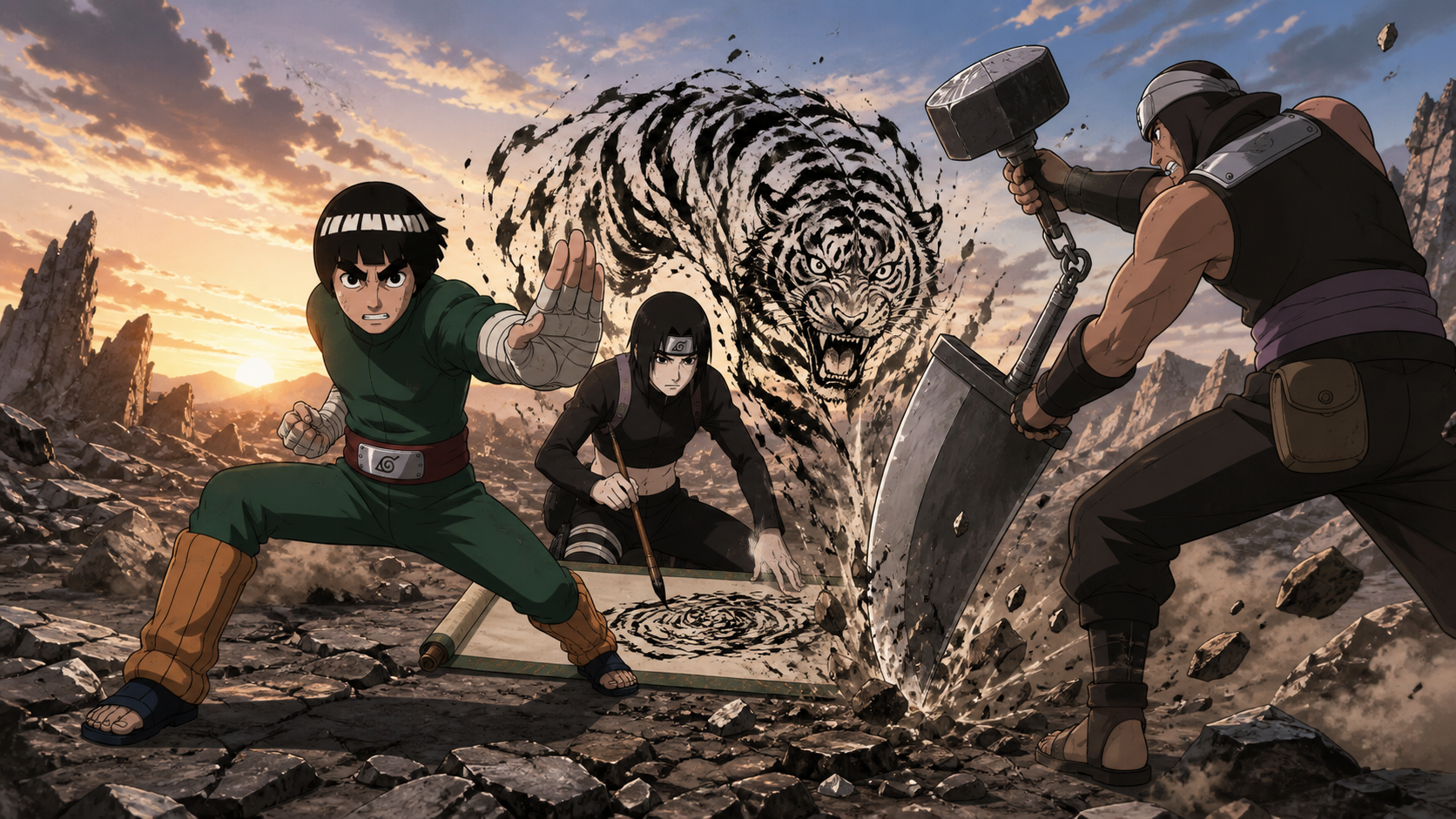
Helmet Splitter: Jinin Akebino!
Sai accepts that emotion can strengthen discipline while Lee protects the time his Tiger Vision sealing technique needs.
Bottom line
“Helmet Splitter: Jinin Akebino!” gives Sai a sealing technique that grows stronger through the emotions Root taught him to suppress. That contradiction is the episode. Jinin can break armor, stone, and formation lines with Kabutowari, but Sai’s real obstacle is the training that separated feeling from useful action. Rock Lee protects the time Sai needs, Kakashi keeps the division together, and Sai learns that emotion does not have to replace discipline. Feeling can direct discipline toward somebody worth protecting.
The second war day changes the assignment
Kakashi’s division survives the first night after sealing Zabuza and Haku, but the sealing corps cannot maintain the same pace without rest and replacement supplies. Headquarters sends a scroll that allows Sai to assume part of the sealing job. The transfer makes practical sense because Ink Release already gives him distance, shape, and controlled movement. A new assignment still needs training time, protection, and an honest assessment of what Root conditioning did to the technique.
The official routes identify the swordsman
Naruto Official catalogs the episode on the next Seven Ninja Swordsmen record after “Two Suns.” Crunchyroll lists “Helmet Splitter: Jinin Akebino!” as Shippuden Episode 284 under watch ID `G6WEXMJK6`, released October 18, 2012. The licensed summary states that Kakashi assigns Sai to replace recovering sealing personnel before Jinin attacks the Third Company. The title names Jinin, but Sai’s readiness controls the outcome.
Sai receives responsibility before confidence
Sai knows the technique and understands the scroll. Knowledge does not automatically create readiness. He must draw under pressure while an Edo Tensei fighter attacks people protecting him. The assignment exposes an institutional habit: leaders identify a rare skill and assume the skilled person can perform on demand. Kakashi gives Sai the mission because the division needs him. The division also owes him enough protection and time to turn knowledge into action.
Root trained emotion out of the hand
Danzō wanted operatives who could obey without hesitation, attachment, or visible grief. Sai learned to flatten reactions because emotional bonds could interfere with orders. His sealing art creates the opposite requirement. The tiger gains strength from emotional energy invested in the drawing. Root therefore damaged the exact human capacity that makes the technique effective. Sai carries a tool his former institution taught him not to power.
The tiger is more than an ink animal
Sai’s ordinary ink creatures scout, carry, restrain, and attack. The Tiger Vision Staring Bullet has a different job. The drawn tiger emerges to drag a reanimated target into the sealing scroll. The technique needs precision because a missed or interrupted attempt wastes time and exposes the user. The tiger’s visible ferocity comes from controlled intention. Sai must commit enough feeling to give the drawing purpose without losing the careful lines sealing requires.
Lee becomes a bodyguard for concentration
Rock Lee receives the job of protecting Sai while Sai draws. That assignment respects the difference between combat power and protected work. A sealing specialist cannot watch every angle while completing a complex technique. Lee’s speed and close-range defense create a moving boundary around Sai. His contribution may look less glamorous than the final tiger, but no seal lands if Jinin reaches the artist before the drawing becomes active.
Jinin turns two tools into one brutal answer
Kabutowari combines a large axe with a heavy hammer. The axe creates a point of contact, then the hammer drives force through the back of the blade. Armor and defensive surfaces fail because the weapon does not depend on one clean cut. Jinin can keep applying impact until the barrier splits. The design suits a swordsman who treats defense as material waiting for enough force rather than as a reason to change direction.
The name Helmet Splitter describes a method
Jinin’s title is not decorative intimidation. Kabutowari was built to break protection other weapons struggle to penetrate. A helmet represents the last object between a fighter’s skull and lethal force. Splitting that object turns defense into evidence of the wielder’s power. Jinin’s reputation therefore attacks morale before the weapon lands. Soldiers who trust armor must suddenly decide whether the next block will hold.
Edo Tensei makes blunt force harder to answer
An ordinary fighter using a heavy paired weapon would still face exhaustion, injury, and death. Reanimation removes those normal stopping points. Jinin can absorb damage, regenerate, and continue swinging while the alliance spends living bodies and chakra to slow him. Defeating him through injury becomes a delay. Sai’s seal matters because containment answers the regeneration problem rather than trying to win a contest the dead body was designed to repeat.
Kakashi orders the division to stay together
The remaining reanimated fighters use guerrilla attacks to isolate smaller groups. Separation makes each specialist easier to overwhelm and prevents shared techniques from covering weaknesses. Kakashi recognizes the pattern and tells the division to maintain contact. The order protects more than combat formations. Medics, sensors, messengers, and sealing personnel need a connected unit around them. Jinin’s power becomes worse when one squad meets him without the support required to finish the encounter.
Gari’s attack shows why a seal needs layers
Explosion Release user Gari attacks the division alongside the swordsmen, creating threats from different distances and directions. Lee cannot focus only on Jinin. Kakashi cannot personally intercept every revived fighter. The division needs overlapping defense: sensors identify movement, frontline fighters redirect attacks, Lee protects Sai, and Sai prepares containment. A single heroic duel would leave the support system open. The episode’s strongest battle logic comes from assigning different people to different failure points.
Sai’s first hesitation is not cowardice
Sai has fought Akatsuki members, infiltrated dangerous spaces, and stood beside Team 7. Fear of ordinary combat does not explain the stalled drawing. The technique demands access to feelings he learned to disconnect from performance. He must recognize attachment while people depend on him immediately. That internal demand can freeze a trained operative because the old survival rule says emotion produces vulnerability. The new mission says emotion produces the seal.
Shin remains part of Sai’s hand
Sai’s relationship with his adoptive brother Shin broke through Root’s attempt to erase attachment. Shin’s death, their unfinished picture book, and their reunion during the war gave Sai proof that feeling can survive conditioning. Remembering Shin does not magically solve every task. The memory gives Sai a route toward the emotional force Danzō once treated as contamination. Grief becomes usable without becoming cheap fuel because Shin already shaped how Sai learned to choose people.
Team 7 taught Sai another kind of discipline
Naruto, Sakura, and the others did not teach Sai to abandon control. They taught him that control can serve relationships rather than hide their absence. Sai learned names, loyalty, awkward honesty, humor, and responsibility through repeated mistakes. The sealing assignment draws on that history. His emotions are not sudden power borrowed for one episode. They are capacities he rebuilt after Root trained him to mistake numbness for strength.
Lee does not demand an emotional speech
Lee protects Sai through action. He does not pause the battlefield to ask for a polished explanation of trauma. His job is to keep threats away long enough for Sai to work. That support respects Sai’s pace while recognizing the immediate danger. Friends do not always need the perfect sentence. Sometimes support means holding the line, trusting the specialist, and refusing to make another person perform recovery for an audience.
Jinin punishes incomplete preparation
Every interrupted stroke delays the tiger and gives Jinin another approach. Sai needs the scroll positioned, ink available, brush controlled, and target path clear. Those details make the sealing work more credible. A rare technique does not appear because Sai decides to believe in himself. People move, defend, signal, and absorb pressure so he can complete the physical process. Emotional access matters inside a coordinated production chain.
The final tiger turns feeling into a boundary
When Sai releases the technique, the tiger does not explode in uncontrolled rage. The drawing takes defined form, reaches Jinin, and pulls the reanimated swordsman into the scroll. Emotion strengthens a precise boundary. That image directly challenges Root’s lesson that feeling makes an operative unreliable. Sai succeeds because attachment gives the technique enough force while training gives that force a job.
Sealing respects the war’s problem
Jinin is dead, controlled by Kabuto, and able to regenerate. Killing him again through ordinary damage cannot end the threat. Sealing stops access to the reanimated body without pretending the alliance has resolved every moral question surrounding Edo Tensei. Sai’s technique separates battlefield necessity from revenge. He does not need to hate Jinin. He needs to deny Kabuto continued use of him.
The swordsman still deserves a clear record
Jinin Akebino belongs to the Seven Ninja Swordsmen of the Mist and wields Kabutowari, the Helmet Splitter. The anime gives him more combat space than the manga’s compressed battlefield account. That expansion is anime-original material, not a new manga chapter hidden inside the adaptation. Fans following the direct canon road may skip, while fans interested in the swordsmen, Sai, or sealing mechanics receive meaningful character and technique detail.
Anime-original does not mean consequence-free
The episode fills a gap around how Sai becomes capable of sealing revived shinobi during the larger war. The manga can move past that training because pacing has different priorities. Animation chooses to dramatize the missing labor. The added story does not radically change the central outcome, but the episode gives Sai’s later competence a human cost and a support structure. That is a useful expansion even when the episode remains skippable for the shortest route.
The division should document the new procedure
Sai’s success creates a repeatable battlefield asset only if the alliance records the conditions. He needs protected drawing time, a clear target lane, backup ink and scrolls, a bodyguard, and early warning when another attacker enters range. Command should not remember only that Sai can seal people now. Command must remember what Lee, Kakashi, the scroll team, and the surrounding division supplied to make the technique reliable.
The debrief should record failure signs too. A shaking brush, broken sight line, damaged scroll, interrupted current, or exhausted bodyguard changes the success probability before the tiger appears. Another commander should know when to delay the attempt, rotate protection, or switch to a different sealing team. Calling Sai a new solution without documenting those limits would turn one earned success into a dangerous promise he never made.
Repeated use also needs an emotional recovery plan. Sai cannot be ordered to reopen grief for every target as though Shin’s memory were ammunition stored in a pouch. Trusted relationships may strengthen the art, but command should protect those relationships from exploitation. The technique becomes sustainable when Sai can choose the feeling and focus that serve the moment, then rest without an officer demanding another trauma performance.
Danzō’s training fails on its own terms
Root tried to produce efficient tools by removing attachment. Sai becomes more effective after rebuilding the human capacities Danzō suppressed. The irony should not become a tidy claim that every emotion improves every mission. Panic, grief, and anger can disrupt concentration. Sai’s growth lies in integration. He can notice feeling, choose a purpose, and still draw the line the operation requires. Root offered obedience. Sai develops judgment.
The alliance assigns Sai a technique and inherits the conditions
Leadership can order Sai to use the sealing scroll. Leadership cannot order concentration, emotional access, protected space, and physical steadiness into existence. Those are production requirements the division must supply.
When rare skill becomes urgent, institutions often place every consequence on the specialist. If the seal fails, Sai appears deficient. If the seal succeeds, command calls the assignment correct. Honest accountability includes whether planners gave him time, information, backup, and a survivable workload.
Lee protects work viewers are trained not to see
The tiger receives the visual payoff, while Lee’s defense occurs in the waiting around each brushstroke. That waiting is active. He reads distance, redirects danger, and accepts that somebody else’s completion defines success.
Support without the final blow is still authorship of the outcome. Lee does not need to become the sealing hero. His body creates the uninterrupted minutes that let Sai’s hand finish. The episode understands teamwork whenever it keeps that dependency visible.
Fear does not disqualify Sai from specialized responsibility
Sai’s hesitation carries information about the task. He knows an unfinished drawing leaves people exposed, knows the technique asks for feelings Root punished, and knows Jinin will not pause while he finds the correct internal state.
Competence does not mean a nervous system stops responding to stakes. The professional question is whether Sai can recognize fear, communicate limits, and continue with support. Treating fear as shame would drive the warning underground exactly when teammates need to know what protection he requires.
Root made numbness look like reliability
Danzō’s system rewarded operatives who could receive an order without attachment complicating obedience. That version of reliability serves the commander, not necessarily the mission or the person carrying the mission.
Sai’s tiger exposes the cost. Emotional suppression narrowed what his art could do, weakened judgment rooted in care, and isolated him from people capable of supporting performance. Root did not remove vulnerability. Root removed many of the relationships that could help him survive vulnerability.
Shin’s memory belongs to Sai before the military uses it
Remembering Shin gives Sai access to grief, affection, and a promise interrupted by death. The alliance benefits when that feeling strengthens the seal. Benefit does not create ownership.
No commander should demand the same memory every time a revived enemy appears. Trauma is not a chakra cartridge. Sai needs freedom to choose what feeling directs the drawing and when repeated use requires rest. Otherwise the new institution repeats Root’s extraction with warmer language.
The tiger gives emotion a shape instead of giving emotion control
Sai does not explode, abandon technique, or let grief decide the target. He draws a boundary with exact lines and sends the tiger toward the reanimated body command identified.
That integration is the growth. Feeling supplies force and purpose. Training supplies form. Judgment connects both to a necessary action. The episode rejects the false choice between emotionless discipline and uncontrolled emotion by showing a disciplined act that would be weaker without attachment.
Jinin’s weapon makes protection look temporary
Kabutowari attacks the confidence behind armor. Axe and hammer say every barrier is merely material waiting for the next impact. Soldiers facing him may stop trusting equipment before equipment actually fails.
Lee’s defense answers differently. Protection is not one permanent wall. Protection moves, communicates, adjusts, and buys another second. Jinin can split an object. He has more difficulty breaking a team that treats defense as repeated coordination rather than faith in one shield.
Sealing is care for living soldiers and the stolen dead
Containing Jinin prevents further casualties. The seal also stops Kabuto from forcing a dead person’s body through endless violence. The alliance does not need to call Jinin innocent to recognize that Edo Tensei violates him.
Sai protects living comrades and interrupts an enemy’s ownership of the dead. The scroll is a battlefield necessity carrying a moral distinction ordinary damage cannot provide.
Kakashi’s job is to organize the conditions around courage
He cannot personally draw Sai’s tiger or absorb every strike. Command matters through assignment, formation, communication, and knowing which person needs cover before asking for output.
Kakashi succeeds when the division makes individual bravery less lonely. Sai still has to commit. Lee still has to hold. Their courage becomes more usable because leadership connects the actions instead of hoping two gifted shinobi improvise the same plan under attack.
The debrief should count emotional load as operational load
Scrolls, ink, chakra, injuries, and bodyguard fatigue are easy to inventory. Reopening grief also consumes capacity. The effect may not appear as a clean number, but ignoring the cost does not remove the cost.
Sai needs rotation, recovery, and permission to report when concentration changes. Sustainable technique use protects him from becoming another tool whose apparent calm invites endless assignment. Root already taught everyone around Sai to mistake silence for unlimited capacity.
Anime expansion earns space by showing how competence was built
The manga can reveal that Sai seals enemies and keep moving. Animation has time to ask what training, emotional change, and team protection made that ability reliable.
The expansion loses value if every swordsman encounter becomes interchangeable combat. Jinin matters here because his pressure makes Sai’s process visible. The episode earns the detour when the battle illuminates labor the main plot assumes rather than merely adding another name to the defeated list.
RaeRae’s verdict
“Helmet Splitter: Jinin Akebino!” gives Sai a victory that belongs to more than a new jutsu. Lee protects his concentration, Kakashi keeps the division connected, Shin’s memory gives emotion a route into the drawing, and Sai turns that feeling into a precise seal. Jinin brings a weapon built to break every defense through force. Sai answers with a boundary powered by the part of him Root failed to erase.
RaeRae’s call
Sai does not defeat Root by becoming less disciplined. He defeats Root by reclaiming the feeling that gives discipline a chosen purpose. Lee protects the time, Kakashi organizes the team, and Shin’s memory remains Sai’s before the alliance benefits from the tiger.
Episode details and viewing routes
- Official episode reference: Naruto Official episode guide
- Licensed episode route: Crunchyroll licensed episode page
Next on the road
Episode 285, “User of the Scorch Style: Pakura of the Sand!,” follows another reanimated fighter whose village history carries betrayal into the war. Maki must face the teacher she admired while Pakura learns that the Sand’s political decision used her life as a disposable diplomatic tool.