
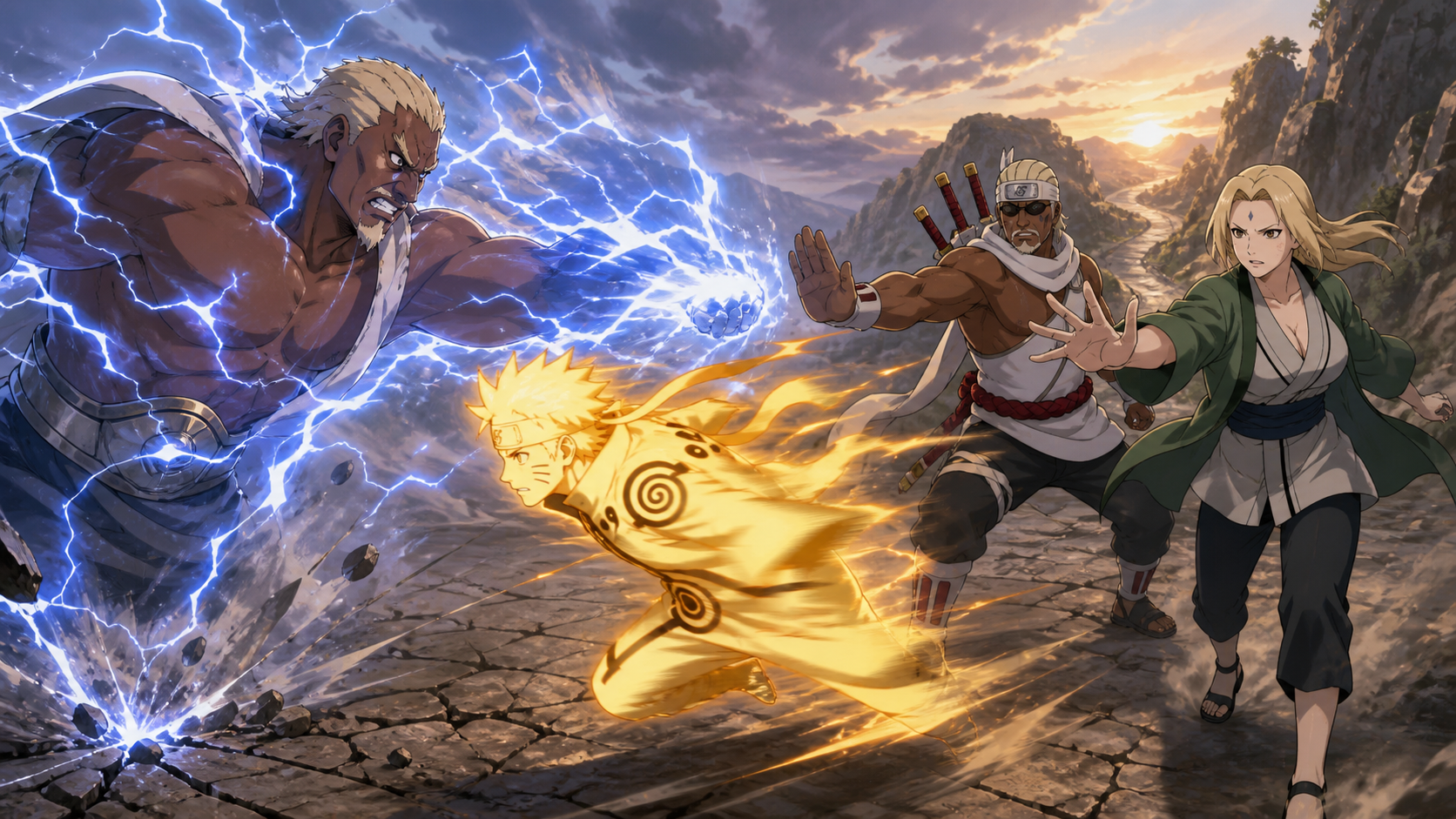
Two Suns
A changes course only after B challenges control, Tsunade challenges command, and Naruto proves that the shinobi on the road is no longer the child A imagined.
Bottom line
“Two Suns” works because Naruto does not win passage to the war by shouting louder than the Fourth Raikage. Killer B makes A face the difference between protecting a brother and controlling him, Tsunade stops hiding behind a decision she no longer believes, and Naruto proves that his promise has grown into usable power. A finally moves because three people force him to update his judgment. The boy standing on the road is no longer the reckless child A expected to contain.
The roadblock becomes a death threat
The Fourth Raikage refuses to let Naruto and Killer B reach the battlefield because Obito needs the last two tailed beasts. That risk is real. A takes the logic somewhere ugly when he decides killing Naruto would keep Kurama away from the enemy. A leader who calls execution protection has reduced a person to military cargo. Naruto hears the threat and still refuses to surrender his own life to somebody else's fear.
The catalog needs both numbering systems
Naruto Official records “Two Suns” as overall animated episode 503 under `01_727`. Crunchyroll lists the same story as Naruto Shippuden Episode 283, released October 11, 2012, with watch ID `GRQ4M9EPY`. The two numbers describe different catalogs, not different installments. The title, summary, release date, and A-versus-Naruto confrontation keep readers on the correct page.
A thinks only one kind of loss matters
A has built his decision around the worst possible outcome: Obito captures Naruto, extracts Kurama, and completes his plan. That fear makes every lesser loss look acceptable. Naruto's freedom, B's judgment, Tsunade's authority, and even Naruto's life become costs A is willing to pay. Strategy needs hard choices, but a hard choice is not automatically a wise one. A stops comparing risks once terror gives him one answer.
Naruto refuses the asset label
Naruto does not describe himself as a weapon the alliance should deploy. He speaks as a shinobi with friends already fighting and dying. The difference matters because Naruto's obligation comes from relationships rather than ownership. He knows the enemy wants Kurama. He also knows his chakra, clones, sensory reach, and ability to identify White Zetsu can save people. Confinement carries a battlefield cost that A keeps pretending does not exist.
B makes the argument personal
Killer B knows A's fear better than Naruto does. B remembers the selection test, their cousin's death, Gyūki's sealing, years of village suspicion, and every fist bump that allowed the brothers to read each other without a speech. B does not dismiss the danger. He argues that A has stopped seeing the adult standing before him. Protection built on an outdated picture of B cannot remain trustworthy.
The fist bump carries a whole biography
B uses their familiar fist bump as evidence. The gesture once confirmed that both brothers could match power, timing, and intention. Now A receives B's conviction and still tries to reject the message. That failure exposes the real roadblock. A has not lost the ability to understand his brother. Fear has made him unwilling to accept what B communicates. Their bond can only survive if the signal changes A as well as B.
B refuses to remain A's spare heart
A once promised to fill the emptiness that jinchūriki isolation created inside B. The promise gave B real support, but no single brother should become the owner of another person's heart. B formed a partnership with Gyūki, built a public identity, trained Naruto, and developed judgment through experience. A helped B survive. That history does not give A permanent authority to overrule every choice B makes.
Tsunade begins on the wrong side of herself
Tsunade initially supports the roadblock because the alliance agreed to protect both jinchūriki. Her office demands that she take catastrophic risk seriously. Her history with Naruto also tells her that he changes impossible situations by entering them, not by waiting somewhere safe. Tsunade's conflict is valuable because loyalty alone cannot decide the question. She must weigh command responsibility against the evidence Naruto has given her for years.
The necklace still has a receipt attached
Tsunade once bet the First Hokage's necklace on Naruto's dream and later trusted him with village-level responsibility. Those choices were not sentimental decorations. Naruto repeatedly paid for that trust through training, failure, recovery, and action. Tsunade cannot invoke their shared history only when Naruto succeeds. The promise means something during disagreement too. Standing beside him now makes her earlier faith answerable to the present crisis.
A treats Tsunade's change as weakness
When Tsunade decides to support Naruto, A can read the decision as emotion overruling duty. That reading ignores how much evidence she has observed. Tsunade watched Naruto defend the village, confront Pain, win Kurama's chakra, and return from failures without abandoning people. Her judgment includes affection, but affection does not erase professional knowledge. Leaders are allowed to change position when new facts make the old order worse.
Naruto names the promise behind the risk
Naruto insists that he will not let comrades carry the war while he remains hidden. His language can sound reckless because he has a long history of running toward danger. The promise has matured, though. Naruto now brings controlled chakra, mass shadow clones, sensory ability, and intelligence gathered from direct contact with Kurama. He is not demanding trust without preparation. He is asking A to judge the shinobi who actually arrived.
A tests speed because words have reached their limit
The confrontation turns into a physical test. A's lightning-enhanced movement has defined elite speed since Minato's death, so passing him would prove more than stubborn courage. Naruto must show that his body, chakra control, and reactions can survive the battlefield A fears. Combat does not settle every moral question. In this scene, the test gives A a kind of evidence he respects and cannot explain away.
Minato returns through remembered movement
A remembers Minato Namikaze as the one shinobi who could evade his fastest attack. Naruto's sudden movement brings that memory back. The comparison connects father and son without making Naruto a copy. Minato relied on Flying Raijin markings and exact teleportation. Naruto uses Kurama's chakra, training, instinct, and raw acceleration. Similar results come through different methods. A recognizes inherited possibility after Naruto gives that possibility his own form.
The yellow flash comparison has limits
Naruto should not receive permission merely because his father was famous. Bloodline has already given too many characters borrowed authority in this world. A responds to a resemblance, but Naruto earns the moment through demonstrated control and years of choices A did not witness directly. Minato's shadow opens A's memory. Naruto's movement closes the argument. The distinction protects Naruto from becoming a tribute act inside his own story.
Dodging A changes the practical calculation
Naruto evades A's strike at the final instant. That movement proves he can respond under lethal pressure rather than only display power during training. A must now account for Naruto's survival capacity, battlefield value, and determination together. The risk of capture remains. The cost of keeping Naruto away also becomes impossible to ignore. Good strategy changes when evidence changes, even when fear would prefer the old answer.
The title gives B and Naruto equal weight
“Two Suns” does not describe two identical heroes. Killer B became the light that answered A's grief and helped Kumogakure imagine a jinchūriki as a full person. Naruto carries a different promise across villages and generations. B's light is personal, stubborn, musical, and grounded in chosen brotherhood. Naruto's light is communal and restless. A finally understands that the world does not become safer by covering either source.
B's freedom makes A's love believable
A's affection only becomes trustworthy when he allows B to make a dangerous informed choice. Love that survives solely through obedience is control wearing family language. B does not stop being A's brother when he opposes him. He proves that their bond can hold disagreement, risk, and adulthood. A stepping aside does not mean he stops caring. The decision means care no longer requires a locked door.
Tsunade restores political balance
The alliance has multiple Kage because no single leader should own every judgment. A's attempt to decide Naruto's fate alone turns emergency authority into personal rule. Tsunade's resistance restores disagreement inside the command structure. She does not guarantee Naruto's safety or erase the alliance plan. She forces leadership to confront the fact that Naruto is a Leaf shinobi, a person, and a strategic participant whose Hokage has reached a different conclusion.
Kurama's power is present even without friendship
Naruto has not yet completed the later partnership that will redefine his bond with Kurama. His Chakra Mode already proves progress, but the seal still contains conflict and borrowed force. That unfinished relationship makes the victory more interesting. A is not approving a perfectly stable weapon. He is recognizing a young man who has learned enough control to act while continuing to change. Growth does not need to be complete before growth becomes relevant.
The episode lets an adult admit new evidence
A does not become gentle, apologize for every threat, or abandon caution. He allows Naruto and B to pass. The restraint keeps the resolution credible. A's personality remains blunt and forceful, while his decision proves that he can listen after resistance strips away every excuse. Stories often treat changing one's mind as weakness. “Two Suns” treats revision as the hardest responsible act available to a leader who has already committed to force.
The war needs people, not sealed containers
Obito's plan depends on turning living hosts into extracted power. The alliance cannot defeat that logic by treating Naruto and B as containers from the opposite side. Hiding them may look kinder than extraction, but both strategies deny their judgment when carried to an extreme. Naruto and B bring relationships, knowledge, improvisation, and moral purpose that no tailed-beast inventory can measure. Their personhood is part of the alliance's strength.
The animation sells speed through restraint
The crucial dodge lasts less time than the argument surrounding the road. That economy helps. Repeated speeches establish why A believes nobody can pass, then Naruto's movement makes the answer visible before another lecture can soften the impact. The flash of chakra, A's halted strike, and the remembered image of Minato create a clean recognition beat. The scene trusts motion to carry evidence that dialogue could only keep debating.
The performance turns stubbornness into listening
A's Japanese performance keeps his voice heavy and decisive even when doubt begins to enter. B's rhythm gives resistance personality without making the family conflict a joke. Naruto sounds urgent rather than polished, while Tsunade's shift lands through command presence instead of apology. The credited cast turns four versions of stubbornness into distinct choices. Nobody suddenly becomes calm. Listening happens while every personality remains intact.
A’s plan confuses preventing capture with preventing every choice
Keeping Naruto away from Obito is a legitimate objective. Killing him, imprisoning him indefinitely, or refusing to reassess his capacity are not interchangeable methods. A collapses them because fear makes the most restrictive option feel automatically responsible.
Strategy should compare harms, probabilities, and changing battlefield needs. White Zetsu is already killing alliance members Naruto can identify. Confinement is not neutral. The roadblock protects against one catastrophe while allowing other deaths to continue beyond sight.
B brings testimony from inside the risk
A understands capture as commander and grieving brother. B understands capture as a jinchūriki who has lived with Akatsuki pursuit, village expectation, and partnership with Gyūki. His judgment is not emotional decoration attached to Naruto’s request.
Expertise includes embodied knowledge institutions cannot reproduce in a briefing. A can disagree with B, but treating that account as bias while treating his own fear as pure strategy reveals whose experience command is willing to count.
Tsunade’s authority matters most when agreement ends
Five Kage cooperating does not mean one Kage becomes the final parent of every village’s shinobi. Tsunade initially supports containment, then reaches a different judgment. A responds as though revision threatens unity.
Real alliance requires a way to hold disagreement without force settling the question automatically. Tsunade standing beside Naruto reasserts that shared command is negotiation, evidence, and limits. Unity produced by silencing one leader is only hierarchy with more chairs.
Naruto’s history is evidence and not a blank check
He saved Konoha, faced Pain, trained with B, and gained new control. Those facts support trust. They do not make every future impulse correct or remove the need for communication.
The strongest case for passage combines demonstrated capacity with conditions: clones for distributed support, sensory reporting, escort, retreat thresholds, and honest updates from Kurama’s seal. Respecting agency does not require leadership to stop planning. Respect requires Naruto to participate in the plan governing his body.
The lethal speed test exposes the limits of institutional process
A needs proof in the language he respects, so Naruto must evade a strike that could kill him. The scene is thrilling and structurally terrible. A young person’s right to enter the war should not depend on surviving a leader’s attack.
The test works dramatically because the alliance lacks a trusted process for resolving the dispute. Naruto supplies undeniable evidence, but institutions should not need a near execution before updated information becomes audible.
Minato’s memory opens the door Naruto earned
The Fourth Raikage recognizes a movement once associated with the Yellow Flash. Memory interrupts certainty and gives A a category for what he just witnessed. Naruto still performs the dodge.
That order matters. Minato does not descend as a credential granting passage to his son. Naruto’s body produces evidence, and resemblance helps A understand the evidence. Inheritance becomes context rather than ownership of the achievement.
Two suns do not need to illuminate the world the same way
B’s light grows from private rhythm, Gyūki’s partnership, chosen brotherhood, and the freedom he carved inside Kumo’s expectations. Naruto’s light moves through villages, classmates, former enemies, and a promise to answer hatred.
Calling both suns does not make B a rehearsal for Naruto. Each man has a history, community, and method. A learns that protecting one source of hope by extinguishing another defeats the image before either reaches the battlefield.
Stepping aside is an action, not the absence of leadership
A does not simply lose. He makes a decision after receiving evidence he resisted. That choice accepts responsibility for danger without pretending danger disappeared.
Leaders often cling to an order because reversal looks weak in front of subordinates. A’s authority becomes more credible when he can stop escalating. The strongest body on the road does not need to make force the last word merely because force was available.
B’s adulthood cannot depend on A feeling ready
There may never be a moment when an older brother who survived loss feels fully prepared to watch B take mortal risk. If B’s freedom waits for that feeling, freedom never arrives.
Adulthood means B can understand A’s fear and still choose differently. Family can ask, warn, negotiate, and grieve. Family cannot convert love into permanent jurisdiction over another adult’s movement without damaging the person it claims to preserve.
The alliance gains more than two tailed-beast containers
Naruto can detect White Zetsu through negative emotion. B can interpret jinchūriki combat and coordinate with Gyūki. Both carry relationships capable of changing decisions under pressure.
Inventory language hides those contributions because inventory counts chakra and capture value. The men bring judgment, improvisation, morale, knowledge, and the ability to persuade allies who would not respond to command. Personhood is not an extra ethical concern beside strategy. Personhood is strategic capacity.
Permission creates obligations on the other side of the road
Naruto and B receive the freedom they demanded. They now owe the alliance communication, disciplined use of power, attention to escort and retreat signals, and honesty when conditions exceed control.
Agency is not immunity from consequence. The episode becomes stronger when passage is treated as reciprocal trust rather than a hero escaping boring adults. A must stop controlling them. Naruto and B must show that being heard changes how responsibly they carry the risk.
The resolution works because nobody becomes perfectly comfortable
A remains afraid. Tsunade cannot guarantee Naruto’s return. B cannot promise Gyūki will never be targeted. Naruto cannot know every battlefield awaiting his clones. The decision happens without emotional certainty.
That is adult trust. Waiting until danger vanishes would make trust unnecessary. They move because evidence supports the risk, people accept responsibility, and the alternative now carries harms nobody can keep pretending are invisible.
A listens late, but listening still prevents fear from becoming the only law on the road.
RaeRae's verdict
“Two Suns” earns its resolution because A is not defeated by one magic sentence. B challenges the family logic, Tsunade challenges the command logic, and Naruto challenges the physical assumption that he cannot survive A's road. Minato's memory helps A recognize the moment, but Naruto supplies the proof. The Raikage finally protects both jinchūriki by allowing them to act as people. That choice carries more risk than confinement and far more respect.
RaeRae’s call
A does not protect Naruto or B by making their bodies safer than their personhood. B supplies testimony, Tsunade supplies institutional resistance, and Naruto supplies current evidence. Stepping aside is the first decision on that road that treats both jinchūriki as people inside the strategy.
Episode details and viewing routes
- Official episode reference: Naruto Official episode guide
- Licensed episode route: Crunchyroll licensed episode page
Next on the road
Episode 284, “Helmet Splitter: Jinin Akebino!,” returns to the battlefield and the reanimated Seven Ninja Swordsmen. Sai receives sealing responsibility while Kakashi's division faces Jinin Akebino, giving the war another look at frightened shinobi who must perform specialized work before confidence arrives.