
True Kindness
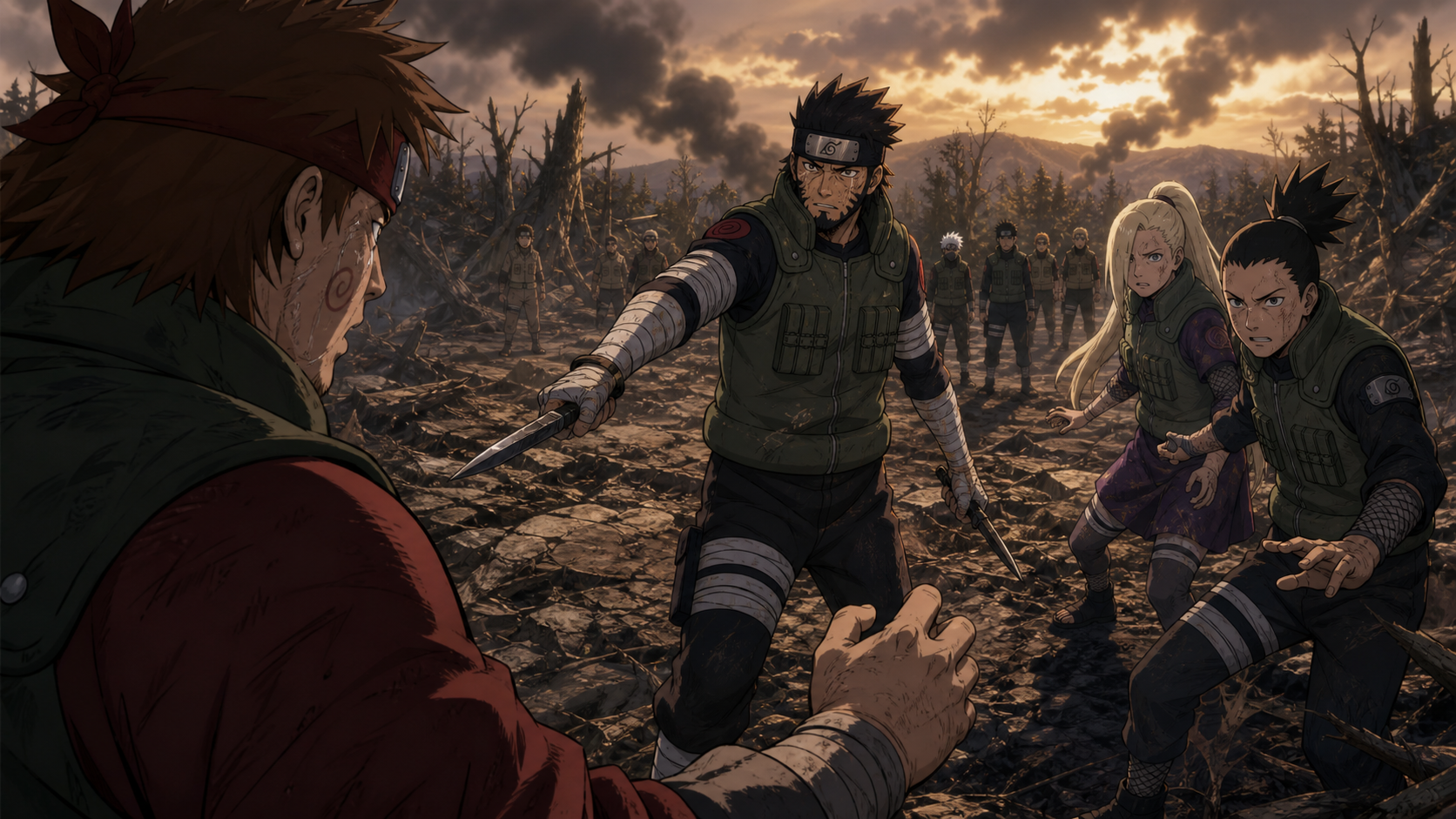
Chōji confronts the difference between gentle feeling and responsible action when Kabuto forces Asuma’s body to attack the students he loved.
Bottom line
“True Kindness” refuses the easy idea that a gentle person must stay harmless. Chōji loves Asuma enough that striking his teacher feels like betrayal, but Asuma is already being betrayed by the reanimation forcing his body to attack his students. Shikamaru and Ino understand the battlefield order first. Chōji needs longer because his compassion has always included a fear of hurting people. The episode asks whether kindness protects one painful feeling or the living people standing within reach of the next blade. Avoiding the choice cannot keep Chōji morally clean. Delay simply hands the danger to Ino, Shikamaru, and every alliance fighter forced to cover the space he leaves open.
Team 10 receives the order nobody wanted
Shikaku orders Ino-Shika-Chō to confront reanimated Asuma. The decision is tactically sound and emotionally brutal. They know Asuma’s techniques, habits, signals, and way of thinking better than most alliance fighters. That knowledge makes them the best counter and the worst people to send. Command does not pretend the assignment will feel fair. The war keeps turning intimate history into operational intelligence, then asking young soldiers to carry both meanings at once.
The records establish the battlefield return
The Naruto official site identifies the story as overall animated episode 493, while licensed catalogs place “True Kindness” at Shippuden Episode 273. The official summary names Shikaku’s order and the trio’s responsibility to stop Asuma. Crunchyroll records the release for August 9, 2012. Those facts matter because the previous episode ended on Hanzō’s recovered agency. This episode immediately tests whether Asuma can help his students resist Kabuto from inside another stolen body.
Asuma is present and not present
Asuma can speak, remember, recognize his students, and warn them. His body still follows Kabuto’s command when control tightens. That split makes every exchange painful. Team 10 sees the teacher they mourned, but the hands holding chakra blades are weapons aimed by somebody else. Treating the reanimated Asuma as fully himself would blame a victim for coerced violence. Treating him as an empty corpse would erase the person fighting to help them survive.
Shikamaru moves through grief by planning
Shikamaru responds the way he often handles terror: he identifies the board, assigns roles, and looks for the capture route. Strategy does not mean he feels less. Planning gives his grief somewhere useful to go. He remembers Asuma’s final lesson about protecting the king and now has to apply that lesson against Asuma’s own body. The contradiction hurts, but Shikamaru accepts that protecting the future may require stopping the teacher who taught him why the future matters.
Ino refuses to let emotion break the formation
Ino enters the fight with the same practical attention she showed Sakura in the previous episode, though the stakes are harsher here. She watches Asuma, Shikamaru, and Chōji at once. Her Mind Body Switch Technique depends on timing and trust, so she cannot disappear into private grief. Ino’s strength comes from remaining emotionally present without letting emotion dissolve her responsibilities. She knows Asuma would never ask them to protect his reanimated body at the cost of living comrades.
Chōji’s hesitation has a history
Chōji has spent years being mocked for his body, appetite, sensitivity, and reluctance to hurt people. Asuma protected his dignity and recognized that gentleness could become a strength. Now the war twists that relationship into a trap. The teacher who helped Chōji believe in himself appears to demand violence simply by standing in front of him. Chōji freezes because every lesson about loyalty and kindness seems to point in two directions.
Refusing to strike does not stop harm
Chōji initially treats inaction as the kinder choice. The battlefield exposes the missing half of that belief. Asuma’s forced attacks do not pause while Chōji sorts through guilt. Shikamaru, Ino, and nearby alliance fighters absorb the danger created by his hesitation. Nonviolence has moral value when nonviolence prevents harm or resists unjust power. Standing aside while a controlled weapon reaches other people transfers the cost instead of removing violence.
Asuma wants his students to surpass the memory
Asuma does not ask Team 10 to preserve a perfect image of him. He urges them to fight, corrects their movement, and measures whether they have grown. That response matches the teacher they knew. A mentor who genuinely prepared students for adulthood cannot demand permanent dependence on his approval. Asuma’s final gift is permission to act without protecting his feelings. He would rather be stopped by capable students than watch them die beside a sentimental version of respect.
Kabuto weaponizes unresolved mourning
Reanimation works because strength alone is not the only advantage. Kabuto chooses dead people whose faces, voices, and histories can disrupt living opponents. A stranger with Asuma’s techniques would still be dangerous, but Asuma’s body can make Team 10 hesitate before the first exchange. Kabuto turns mourning into delayed reaction time. The tactic reveals the cruelty of treating relationships as weaknesses while depending on those relationships to make the weapon effective.
The chakra blades carry the old classroom
Asuma’s trench knives once represented instruction. He taught chakra flow, close-range pressure, and the importance of understanding a fighter’s nature. The same blades now force his students to prove that learning took root. Every block contains memory. The weapons are not emotionally evil, and the episode does not need to make them symbolic monsters. Kabuto’s control changes who pays for familiar technique. Team 10 must separate the lesson from the forced hand delivering the strike.
Shikaku’s order carries parental weight
Shikaku is not merely a distant commander assigning units. He knows Shikamaru, Ino, Chōji, their fathers, and the history of the formation. Sending the trio against Asuma means trusting the children to perform work that their families cannot soften for them. Leadership here requires an ugly judgment: emotional familiarity increases tactical success even while emotional familiarity increases harm to the fighters. Shikaku accepts responsibility for that choice instead of hiding behind procedure.
The Ino-Shika-Chō formation needs all three
Their clan techniques were built to cover one another’s limitations. Shikamaru controls movement, Ino reaches the mind, and Chōji supplies physical force. Remove one part and the remaining techniques become easier to escape or punish. Chōji’s emotional withdrawal therefore changes more than his personal attack count. His friends lose the body of a formation designed across generations. True teamwork means each person’s private crisis becomes a shared tactical problem without becoming an excuse for contempt.
Chōji does not need humiliation
The worst way to move Chōji would be to repeat the cruelty that already shaped his insecurity. Calling him useless, weak, or soft might produce motion through shame, but shame would confirm that kindness has no place in a fighter. Ino and Shikamaru need him to understand the consequence of inaction while preserving the person Asuma valued. Accountability should identify who is at risk and what must change. Accountability does not require destroying somebody’s dignity first.
Asuma’s daughter changes the meaning of protection
Kurenai and Asuma’s unborn child remain part of the future he asked Shikamaru to protect. The “king” was never the Hokage alone. The king means the children who inherit whatever adults defend, damage, or leave unfinished. Chōji cannot honor Asuma by allowing a stolen version of Asuma to endanger that future. The lesson moves loyalty away from a dead authority figure and toward living people who cannot yet protect themselves.
Gentleness needs boundaries
Chōji’s compassion becomes sustainable only when he learns that kindness can include a firm stop. A boundary does not prove hatred. A boundary tells another person, system, or controlled body that harm cannot continue through this relationship. Asuma wants that boundary because Kabuto has removed his ability to set one himself. Chōji’s strike can become an act of care once the target is understood as coercion and danger rather than the beloved teacher’s worth.
The episode respects the delay without endorsing the delay
Chōji does not transform instantly after one sentence. His body still resists what his mind begins to understand. That lag feels human. People may accept a responsibility intellectually while fear, grief, and habit keep their muscles behind. The episode lets his hesitation frustrate the team because the battlefield cannot wait forever. Chōji deserves empathy and still must act. Those truths do not cancel each other.
Ino’s anger comes from endangered trust
Ino pushes Chōji because his paralysis threatens the people relying on him. Her frustration is not proof that she lacks compassion. She knows his heart and understands why Asuma’s face hurts. She also knows Shikamaru cannot hold every opening alone. Friendship sometimes means refusing to let a loved one hide inside a self-image that has become dangerous. Ino calls Chōji back into the formation because she expects him to remain someone the team can trust.
Asuma’s criticism remains specific
Asuma does not condemn Chōji’s whole character. He identifies the exact barrier keeping Chōji from using the strength already present. A good teacher separates a failed action from a worthless person. That difference matters for a student whose insecurity can swallow any criticism whole. Asuma wants Chōji to stop treating compassion and power as enemies. Strength without care would not make Chōji himself. Care without action cannot protect the people he loves.
The battle is also a graduation test
Team 10 already lost Asuma once and carried his final words forward. Reanimation forces another examination under worse conditions. The students must demonstrate that his lessons survive without his living supervision. A teacher’s success cannot depend on remaining physically present forever. Shikamaru’s plan, Ino’s control, and Chōji’s eventual commitment together show whether the team became adults capable of correcting one another and making decisions their teacher cannot make for them.
Victory cannot mean enjoying the strike
Chōji does not need to become eager to hit Asuma. Reluctance preserves the moral weight of the encounter. The necessary change is willingness, not pleasure. Naruto often celebrates determination through loud attacks, but “True Kindness” works because the attack remains sad. Chōji can accept responsibility while wishing the responsibility belonged to nobody. Mature courage often looks exactly like doing necessary work without pretending the work became good.
The title challenges a comforting definition
“True Kindness” could sound like a neat moral slogan. The episode earns the phrase by making every available choice painful. Protecting Asuma’s body abandons Asuma’s wishes and endangers the living. Striking him wounds Chōji and helps free the teacher from forced violence. Kindness becomes a judgment about consequences, consent, and whose safety a choice actually protects. Feeling gentle is not enough when another person carries the cost.
Chōji’s hesitation is evidence of love, not proof of failure
Chōji’s hesitation proves love, while its consequences demand action.
Asuma’s body is the wrong object of Chōji’s protection
Kabuto has already violated the teacher by forcing his techniques toward his students. Preserving the reanimated body does not preserve Asuma’s wishes, comfort, or legacy. It preserves the instrument through which the violation continues.
Chōji’s instinct is loyal but misdirected. The Asuma he loves is the person asking them to stop him, not the corpse carrying chakra blades. True kindness requires distinguishing a recognizable form from the person’s expressed need when another controller has made those two things conflict.
Inaction transfers violence rather than removing it
Chōji wants the morally clean position where he neither strikes his teacher nor betrays his teammates. Kabuto has designed the battlefield so that position does not exist. Every second outside the formation increases the chance that Asuma’s forced attack reaches somebody else.
Refusal can be brave when it interrupts an unjust command. Here, refusal helps the unjust command proceed. Chōji does not become responsible for Kabuto’s cruelty, but he remains responsible for what his available strength can prevent once the danger is clear.
Shikamaru’s planning is a form of mourning
He does not cry less deeply because his grief arrives as angles, timing, and assigned roles. Strategy gives unbearable feeling a shape that can protect someone. The board is not an escape from Asuma. It is where Shikamaru continues the lesson about the king.
That coping method has limits, and the episode should not make it universal. Chōji cannot think his body into the same response. Team 10 works because the members carry grief differently while still returning to a shared task. Planning becomes care when it makes room for those differences.
Ino performs emotional labor and combat labor at once
She watches the enemy, maintains the formation, reads Chōji’s collapse, and manages Shikamaru’s plan without the luxury of choosing one crisis. Her frustration grows because she knows exactly why Chōji hurts and exactly who will be injured if he remains absent.
That double attention is exhausting. Ino is often assigned the role of correcting other people’s feelings while her own grief stays operational. The episode gives her competence, but the editorial record should keep the cost visible. Holding a team together is not proof she needs less holding herself.
Accountability should call Chōji back without humiliating him
Shame may produce movement quickly, especially in someone trained to fear being the weak link. It would also teach that gentleness has no place in a capable fighter. Asuma spent years teaching the opposite.
The useful intervention names the consequence and the trust still available. People are in danger. The formation needs his exact strength. His friends believe he can return. Accountability becomes restorative when it asks a person to rejoin responsibility rather than proving he never deserved belonging.
Asuma refuses the comfort of being remembered as harmless
He knows his students would prefer a final image untouched by conflict. Reanimation makes that impossible, but Asuma does not protect their sentiment by softening the command. He warns, tests, and urges them to fight.
That choice is another act of teaching. A mentor who wants students to grow cannot demand they preserve his authority forever. Asuma would rather have them surpass the memory than die beside it. His love permits the boundary his stolen body cannot set.
The chakra blades make learning physically confront the learner
Asuma once used the knives to teach chakra nature, range, and close combat. Now every familiar angle asks whether the lesson became independent skill or remained attached to the teacher’s living supervision.
Kabuto wants familiarity to cause delay. Team 10 can answer by separating instruction from possession. The knowledge Asuma gave them belongs to the students now. Using it against his controlled body does not reject the teacher. It proves his work survived beyond his ability to direct it.
The king is a future that cannot defend itself yet
Kurenai’s unborn child gives Asuma’s old lesson an immediate face, but the idea extends beyond one family. The king is the next generation inheriting whatever the current one refuses to resolve.
Chōji protects that future by preventing a dead teacher from being used to create more bereaved children. The duty does not erase personal grief. It places grief inside a longer responsibility. Love for Asuma becomes active when it refuses to let Kabuto turn his body against everything Asuma wanted protected.
Necessary force should remain sad
Chōji does not need to enjoy the strike or pretend resolve makes it painless. Reluctance is part of the moral information. It shows he understands the body before him belongs to someone loved, even when stopping it is required.
The goal is willingness, not emotional hardening. A shinobi culture eager to praise numbness would call tears inefficient. Asuma’s teaching makes room for strength that grieves while acting. Sadness does not weaken the boundary. It prevents the boundary from becoming contempt.
Team 10’s inherited formation is a relationship before it is a brand
Ino–Shika–Chō carries clan history, but repeating three techniques in the approved order would not automatically make the current trio complete. The formation lives through knowledge of one another’s timing, limits, fears, and signals.
Chōji’s absence therefore cannot be replaced by any large fighter standing nearby. Ino and Shikamaru need the person whose rhythm they learned across years. Tradition becomes useful when the present generation inhabits it honestly rather than performing a famous name while one member disappears emotionally.
Kabuto mistakes attachment for a weakness with only one outcome
He correctly predicts that Asuma’s face will slow the students. He assumes the bond therefore belongs to his strategy. The same attachment gives Asuma a reason to warn them and gives Team 10 a reason to stop his continued use.
Love creates the hesitation and the route through it. Kabuto understands leverage but not loyalty as a living exchange. He sees a pressure point. The students eventually see a responsibility shared with the teacher still resisting inside the weapon.
RaeRae’s verdict
“True Kindness” understands Chōji’s heart better than viewers who call him useless for freezing. His hesitation comes from the same compassion that later makes his strength worth trusting. The episode also refuses to let compassion become permanent avoidance. Shikamaru plans, Ino holds the team together, and Asuma asks his students to protect the living instead of his corpse. Chōji’s next step must prove that love can draw a boundary without becoming cruelty.
RaeRae’s call
Chōji’s gentleness is not the obstacle. The obstacle is believing kindness can remain private while friends absorb the danger. Asuma asks him to keep his heart and use his strength, because love sometimes protects a person by stopping what is being done through them.
Episode details and viewing routes
- Official episode reference: Naruto Official episode guide
- Licensed episode route: Crunchyroll licensed series page
Next on the road
Episode 274, “The Complete Ino-Shika-Chō Formation,” finishes the confrontation. Chōji must stop shrinking from the power Asuma always saw in him, while Ino and Shikamaru turn three clan techniques into one coordinated answer. The trio’s inheritance matters only if the current generation can use that inheritance for one another rather than perform the names of their families.