
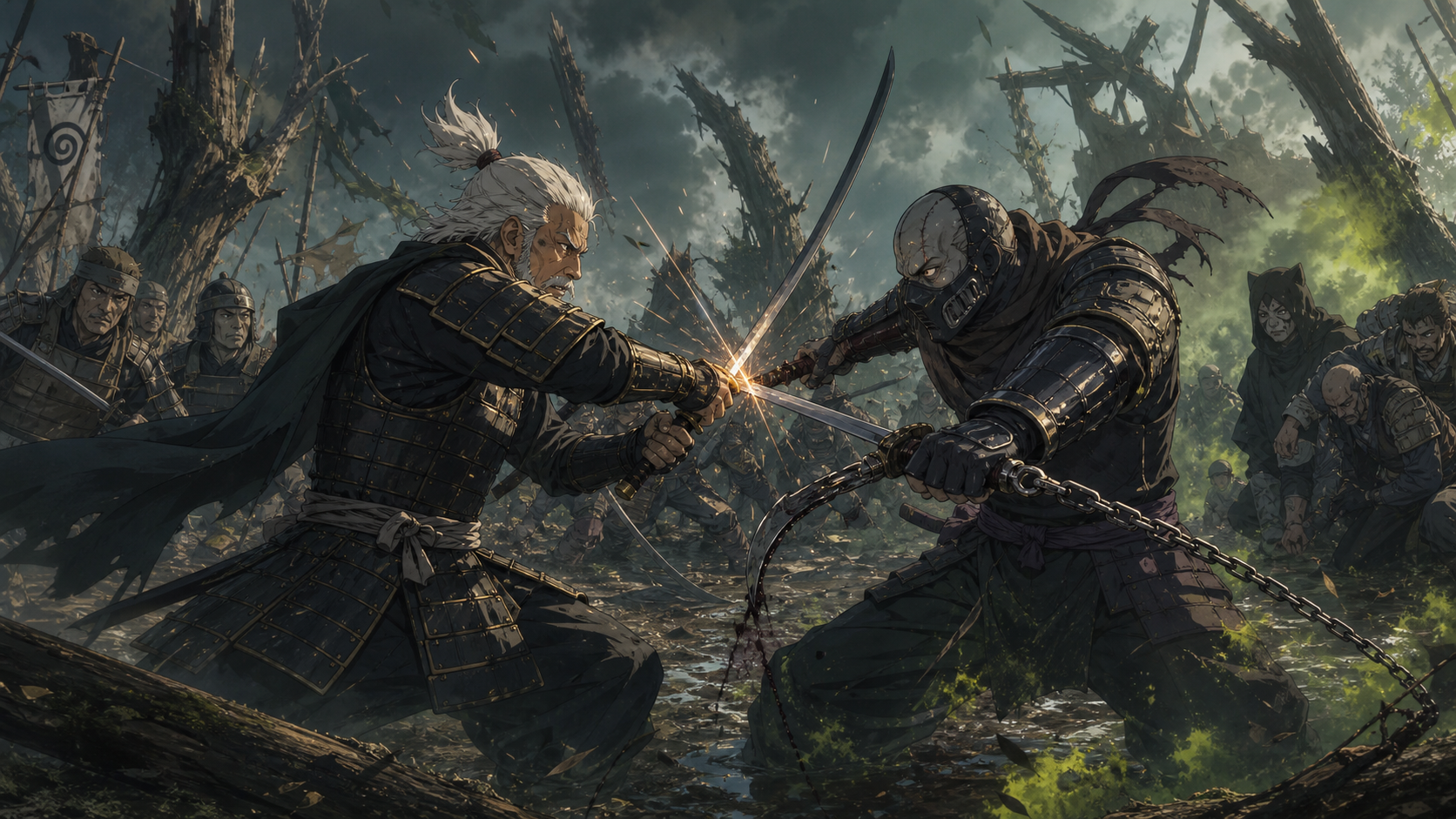
Mifune vs. Hanzō
Mifune’s blade exposes the fear that hollowed out Hanzō’s legend, leading Hanzō to resist Kabuto through the dangerous poison inside his own body.
Bottom line
“Mifune vs. Hanzō” is not really about deciding whether a samurai can beat a famous shinobi. Mifune wins because Hanzō already surrendered the conviction that once made his name frightening. The sword fight gives that argument a body, but the episode’s real wound comes from watching a man remember the exact moment fear replaced principle. Hanzō cannot undo the people he betrayed. He can still choose whether Kabuto gets to keep using his corpse.
The commando unit reaches the poison wall
Kankurō’s unit retreats through the forest while reanimated Chiyo, Kimimaro, and Hanzō keep pressing forward. Hanzō’s poison makes the pursuit more dangerous than an ordinary exchange of weapons. A single mistake can disable a squad before anyone reaches striking distance. Kankurō knows puppets and toxins, but knowledge does not create an antidote on command. The unit needs time, distance, and help before Hanzō turns the forest into a sealed execution ground.
Mifune arrives with the right kind of force
Mifune and the Fifth Company enter as protection, not as a dramatic rescue built around one hero. The samurai form a line between Hanzō and the poisoned alliance fighters. That formation matters because the duel requires containment. Mifune can focus on Hanzō only while other soldiers protect the wounded, watch the reanimated enemies, and prevent the battlefield from collapsing around both leaders. Discipline becomes a group resource before Mifune ever draws his blade.
Samurai speed changes ninjutsu timing
Mifune’s iaijutsu attacks during the tiny interval when a shinobi would form hand signs. The method does not make ninjutsu weak. Mifune removes the time needed to use ninjutsu safely. His draw, step, and cut become one action, forcing Hanzō into close weapon defense. That distinction keeps the samurai from feeling like shinobi with different costumes. Mifune’s system comes from repetition, range control, and commitment to the first clean motion.
The official routes fix the record
Crunchyroll identifies this installment as Shippuden Episode 272 and dates the subtitled release to August 2, 2012. The Naruto official site labels the same story as overall animated episode 492. Both records describe Kankurō’s unit trapped by Hanzō’s poison and Mifune’s Fifth Company arriving to assist. The numbering difference reflects franchise cataloging, not two separate episodes. Clear records prevent directory confusion before any editorial interpretation begins.
Hanzō once defeated Mifune
Their confrontation carries history. A younger Mifune challenged Hanzō and lost badly enough that death seemed certain. Hanzō recognized conviction in the defeated samurai and chose to preserve that life with an antidote. That mercy did not make Hanzō gentle. The choice showed that the feared leader once measured opponents by principle rather than immediate advantage. Mifune survived because Hanzō believed a worthy conviction could outlive defeat.
Mercy created a debt without ownership
Mifune remembers Hanzō’s antidote, but gratitude does not require obedience to the man Hanzō later became. That point separates respect from worship. Hanzō earned Mifune’s respect through one principled act. Hanzō then damaged that legacy through later choices. Mifune can honor the former conviction while condemning the corruption. A life saved years ago does not purchase silence when the savior begins sacrificing other people to protect his position.
The Salamander poison is a physical biography
Hanzō carried a venom sac implanted in his body after a black salamander died in his village. The procedure gave his breath deadly power while placing him in constant danger. If the sac ruptured, the same poison could kill or disable him. His respirator protects other people and controls exposure, but the mask also announces the cost of turning a human body into a weapon. Hanzō’s power never came without maintenance, risk, and isolation.
Mifune attacks the weapon system
Mifune understands that a duel against Hanzō cannot become a prolonged exchange inside poison. He pressures the sickle, the breathing rhythm, and the distance Hanzō needs. The approach is practical before the episode makes the fight philosophical. Mifune does not simply believe harder. He studies what Hanzō can do and refuses to give the reanimated shinobi room to build an advantage. Conviction works because preparation gives conviction a useful shape.
A dull blade is a moral diagnosis
Mifune tells Hanzō that his blade has become dull. The criticism concerns more than metal. Hanzō’s old strength came from decisions he accepted fully, including the danger attached to those decisions. The later Hanzō protected his reputation, distrusted rivals, and compromised with Danzō. Fear made every choice defensive. A weapon swung to preserve a title cannot carry the same certainty as a weapon drawn for a principle the wielder accepts even at personal cost.
Yahiko’s death sits inside this duel
Hanzō’s fall cannot be discussed as private disappointment. His alliance with Danzō helped trap the original Akatsuki and forced Nagato into the impossible choice that ended with Yahiko’s death. Hanzō feared the organization’s growing influence and treated young peace activists as threats to his authority. That political violence changed Nagato, Konan, the Akatsuki, and the Rain Village. Mifune’s accusation therefore carries public victims, not merely a samurai’s wounded memory.
Fear turned leadership into possession
Hanzō once represented resistance strong enough to name Jiraiya, Tsunade, and Orochimaru the Legendary Sannin. Later, he guarded status as though leadership meant owning the village’s future. That shift matters because fear often presents itself as responsibility. A ruler claims that any rival threatens stability, then calls repression necessary protection. Hanzō did not lose conviction in one dramatic instant. He kept choosing survival for his position until principle became a story about his younger self.
Reanimation removes one excuse
Kabuto’s technique forces Hanzō’s body back into war, but the jutsu does not erase every internal response. Hanzō hears Mifune, remembers their first duel, and recognizes the truth in the accusation. Reanimation creates coercion without making accountability meaningless. Hanzō cannot control the original summons or repair the past. He can resist the way his restored body is used once enough of his will returns. The episode gives him a final choice without pretending that choice cancels old harm.
Mifune fights the man, not the legend
Many alliance fighters know Hanzō through reputation. Mifune knows the gap between the legend and the person standing in front of him. That knowledge keeps him from freezing under Hanzō’s name. Mifune remembers losing, remembers being spared, and still judges the present evidence. The episode treats history as information rather than a command. Past greatness may explain why a person matters. Past greatness cannot prove that every later action deserves respect.
The duel refuses spectacle for spectacle’s sake
The animation emphasizes brief draws, weapon angles, foot placement, and close-range decisions. Mifune and Hanzō do not trade enormous landscape-destroying techniques. Their battle feels personal because small movements expose discipline. The restraint also suits the argument. Mifune wants Hanzō to confront the missing purpose behind his weapon, not merely run out of chakra beneath a larger explosion. A precise defeat leaves fewer excuses than overwhelming force.
Hanzō remembers who spared whom
The flashback reverses the apparent debt. Hanzō once spared Mifune, but Mifune’s present honesty gives Hanzō a final chance to recover himself. Mifune does not offer comfort. He names the failure clearly enough that Hanzō can stop hiding behind reputation. That truth becomes a form of mercy because Kabuto’s control would otherwise reduce Hanzō to poison, muscle memory, and an old title. Mifune addresses the person still buried inside the weapon.
The poison sac becomes Hanzō’s refusal
Hanzō cuts into his own poison sac, allowing the venom to paralyze his restored body. The act blocks Kabuto from using him effectively and gives the sealing team an opening. Hanzō chooses the vulnerability built into his power as the method of resistance. That ending fits the episode because conviction finally carries a personal cost again. He does not ask somebody else to suffer so his name can survive. He accepts pain and defeat to stop causing further harm.
A final act is not absolution
Hanzō’s resistance deserves recognition, but one brave decision cannot restore Yahiko, undo the Rain Village’s repression, or erase the alliance with Danzō. Redemption language becomes dangerous when a dramatic death or sacrifice swallows every victim. The episode offers a narrower judgment. Hanzō proves that the worst version of a person does not always control the final choice. The final choice still exists beside the damage, not on top of a clean slate.
Mifune’s honor is practical accountability
Mifune honors Hanzō by preserving the meaning of the final resistance and preparing to seal him with dignity. He does not lie about the corruption that came before. That combination makes Mifune’s honor useful. Respect does not require a false biography. Accountability does not require denying every decent act. Mifune can say that Hanzō lost himself, acknowledge that Hanzō found one remaining piece, and keep both truths visible for the people who inherit the story.
Kankurō’s unit still carried the immediate cost
The philosophical duel should not erase the soldiers endangered by poison. Kankurō and the commando unit bought the time that allowed Mifune’s company to arrive. Wounded fighters needed protection while leaders discussed conviction. War repeatedly lets famous men become the meaning of a battle while unnamed soldiers absorb the exposure, retreat, and medical risk. The episode shows enough of the unit to remind viewers that leadership arguments always land on somebody else’s body.
Chiyo and Kimimaro remain unresolved threats
Hanzō’s defeat does not end the reanimated pursuit. Chiyo and Kimimaro remain active, and the alliance still must manage enemies who possess dangerous knowledge, unusual bodies, and no normal fear of death. That unfinished pressure keeps the victory from feeling like a complete battlefield reset. One commander choosing resistance helps. The larger reanimation system continues turning personal histories into tactical weapons across multiple fronts.
Conviction without scrutiny can become another trap
The episode praises conviction, but conviction alone is not automatically moral. Danzō possessed determination. Nagato later pursued his own brutal certainty. A leader can commit fully to a harmful idea. Mifune’s stronger standard connects conviction to conduct, accountability, and willingness to bear personal cost. Hanzō failed because fear corrupted his stated principles and pushed the cost onto others. The problem was not merely hesitation. The problem was what his choices protected.
The battlefield returns after the detour
Episode 271 paused the war for an alternate-world movie tie-in. “Mifune vs. Hanzō” resumes the conflict without wasting time pretending the transition was smooth. Poisoned soldiers, reanimated veterans, and command structures immediately restore the campaign’s pressure. The placement makes the previous detour feel even stranger, but the strong duel helps viewers reconnect with the war through a self-contained moral conflict before the story shifts toward another reanimated relationship.
Hanzō’s legend survived longer than his governing purpose
People still speak his name as a measure of danger because he once defeated the three shinobi who became the Sannin. Reputation preserves the moment of greatest force and leaves years of fearful rule outside the frame.
Mifune remembers both versions. The warrior who spared him recognized conviction even in defeat. The ruler who conspired with Danzō treated emerging peace activists as threats to personal authority. A legend can remain factually impressive after the person has stopped deserving its moral protection.
Mercy did not purchase Mifune’s permanent obedience
Hanzō gave a younger Mifune the antidote and allowed him to live. Gratitude makes the present confrontation painful, but it does not require the samurai to flatter what his rescuer became.
That boundary matters beyond the duel. A good act creates responsibility to remember accurately, not a debt that silences later judgment. Mifune honors the life he received by using it according to the conviction Hanzō once admired, including the courage to oppose Hanzō when fear replaced that conviction.
Iaijutsu removes the space where Hanzō performs superiority
Mifune closes the interval needed for hand signs and prevents the battle from expanding into a showcase of poison and ninjutsu. His method is not mystical moral purity. It is disciplined control of timing, range, and the first committed motion.
That tactical precision makes the accusation sharper. Hanzō cannot hide behind overwhelming spectacle or blame defeat on a larger technique. Mifune meets him inside the smallest decision, where hesitation, maintenance, and purpose become visible through the blade.
The poison sac made Hanzō powerful by making everyone responsible for his body
Implanted venom turned his breath into a threat and forced masks, distance, antidotes, and constant awareness around him. The modification did not remain a private enhancement. Everyone sharing space with Hanzō had to organize around the danger he carried.
That history echoes his rule. Personal fear became public policy. Protecting his position required other people to accept surveillance, repression, and political violence. The poison is not a perfect metaphor, but both systems make a community manage the consequences of one powerful man’s survival.
Yahiko’s death prevents this from becoming a private redemption drama
Hanzō’s alliance with Danzō trapped young people who were trying to interrupt Amegakure’s cycle of war. Yahiko died inside the choice Hanzō presented, and Nagato’s answer reshaped Akatsuki into another source of mass violence.
Mifune’s disappointment is not the largest injury in the room. Remembering the public victims keeps Hanzō’s final resistance proportional. He can reclaim one decision from Kabuto. He cannot turn that decision into repayment for everyone whose future narrowed after his betrayal.
Kabuto restores ability while depending on moral exhaustion
Reanimation gives Hanzō poison, reflex, memory, and reputation. It works best if the restored person believes choice no longer matters because death has already closed the account.
Mifune interrupts that exhaustion. He speaks to the remaining self as someone still capable of responsibility. Kabuto controls the body, but Hanzō can choose whether to cooperate with that control. Agency is brutally limited, not completely absent, and the remaining fraction becomes enough to matter.
Cutting the poison sac makes conviction expensive again
Late Hanzō protected his status by moving danger onto other people. His final act reverses the direction. He uses the vulnerability inside his own power to paralyze the reanimated body, accepting pain and defeat so Kabuto cannot keep spending strangers through him.
The act deserves respect because it costs him something personally. It does not deserve absolution because cost today cannot return yesterday’s dead. Conviction regains meaning when Hanzō stops asking everyone else to finance it.
Mifune’s honor refuses both worship and contempt
He does not reduce Hanzō to the worst political choice or restore him to the legend untouched. Mifune remembers the antidote, names the corruption, recognizes the resistance, and prepares the seal.
That complete record is harder than choosing saint or monster. Worship would betray Hanzō’s victims. Contempt would deny the agency required for his final refusal. Honor becomes accurate witness: every part remains visible, and no single dramatic act is allowed to swallow the rest.
The samurai line makes a philosophical duel physically possible
Mifune can focus because other samurai shield poisoned allies, contain the approach, and watch Chiyo and Kimimaro. His intimate confrontation rests on collective labor.
The episode risks letting two famous men become the whole meaning of the battle. The formation corrects that image. Somebody maintains distance, moves the wounded, and guards the sealing window while conviction receives speeches. Leadership philosophy always depends on people performing less celebrated work nearby.
A final good choice belongs beside accountability, not above it
Stories love a sacrifice because death prevents the changed person from making another mistake. Hanzō is already dead, which makes the temptation stronger: one resistance can look like the clean ending his biography needs.
The better reading stays narrow. He refuses Kabuto. That refusal protects living people and recovers part of the principle Mifune remembered. Yahiko remains dead. Rain remains scarred. Danzō’s collaboration remains chosen. Grace enters the record without deleting the evidence.
Conviction needs an object beyond preserving the self
Hanzō did not simply lose confidence. He remained determined enough to repress threats and protect authority. Fear gave him plenty of decisive action. The missing question was what those decisions served.
Mifune’s standard joins commitment to accountability and personal cost. Conviction worthy of respect cannot mean never hesitating while everyone else pays. It means acting toward a principle that survives scrutiny, then accepting the danger rather than making subordinates and civilians absorb it first.
The episode lands because Mifune does not ask us to choose between remembering Hanzō’s mercy and condemning Hanzō’s rule. Both belong to him. The final resistance restores agency without laundering power, and the seal becomes a boundary the living place around a legacy that already consumed too many lives. That is enough today, never enough for yesterday.
RaeRae’s verdict
“Mifune vs. Hanzō” earns its solemn tone because the episode never reduces conviction to a motivational slogan. Mifune combines skill, memory, and an accusation backed by Hanzō’s victims. Hanzō responds with one costly act that stops Kabuto without magically repairing his legacy. The duel respects the person Hanzō once tried to be, condemns the ruler he became, and leaves the audience with a harder truth: people may recover agency after terrible choices, but recovered agency does not erase the bill.
RaeRae’s call
Hanzō’s final refusal matters because he makes his own body pay. It does not erase Yahiko or Rain. Mifune honors him by keeping the brave ending and the corrupted life in the same honest record.
Episode details and viewing routes
- Official episode reference: Naruto Official episode guide
- Licensed episode route: Crunchyroll licensed episode page
Next on the road
Episode 273, “True Kindness,” moves to Team 10 and reanimated Asuma. Chōji must decide whether gentleness means refusing to strike a beloved teacher or accepting the responsibility Asuma placed in his students. The war turns affection into another weapon, and the answer will depend on whether kindness protects a memory or protects the living people still standing beside him.