
Rivals
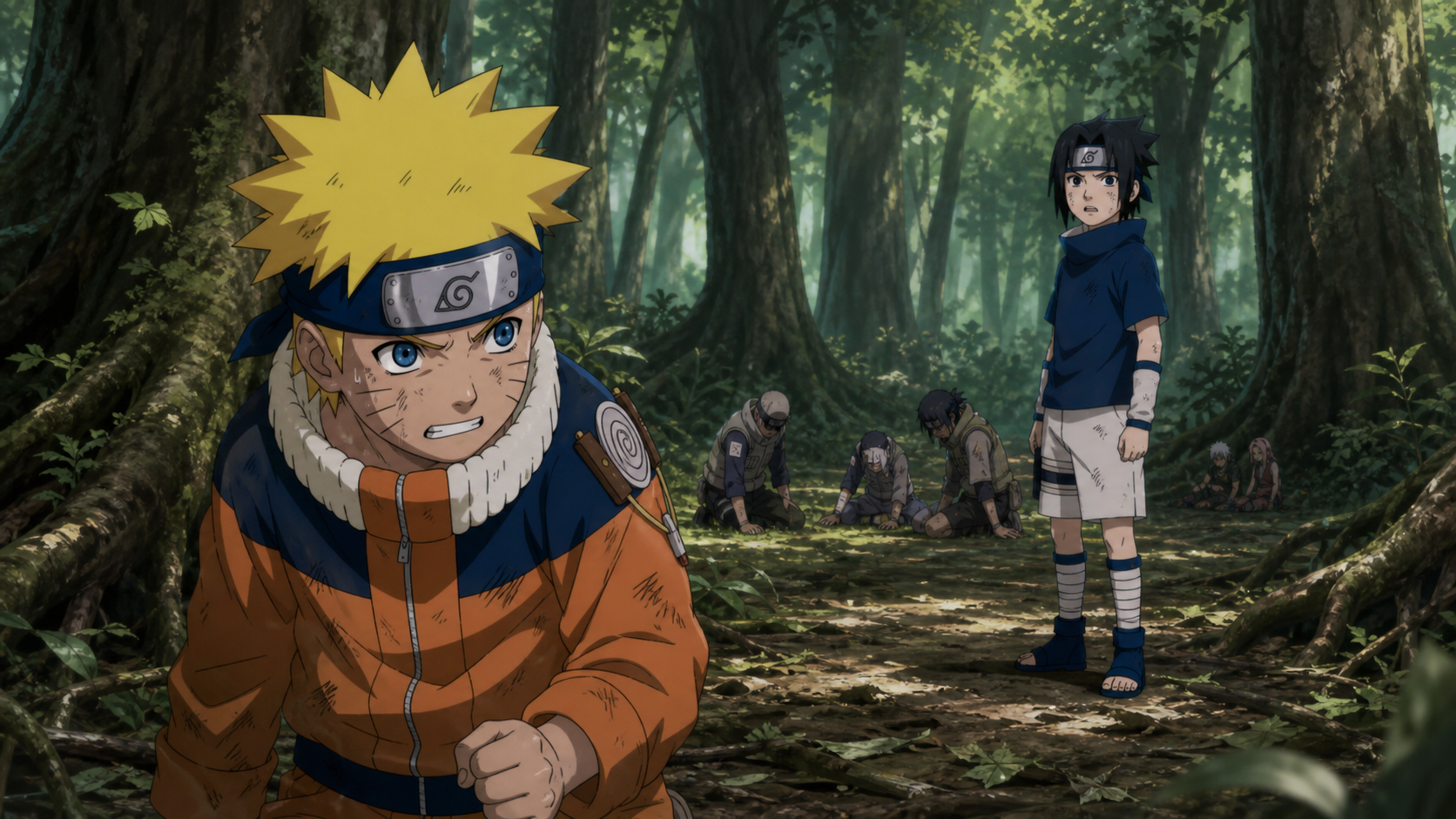
Naruto turns the Forest of Death against Team Oboro and becomes the strong opponent Sasuke finally wants to face.
Bottom line
Naruto Shippuden Episode 258 revisits the point when Sasuke stops treating Naruto as background noise and starts measuring himself against him. Naruto's growth during the Chūnin Exams does not comfort Sasuke. Recognition creates respect, excitement, and fear because every new skill Naruto shows makes Sasuke question whether revenge is moving farther away.
The Forest of Death supplies the clearest shift. Naruto fights through exhaustion, uses shadow clones and transformation to expose Team Oboro, and still has enough stubborn energy to finish the confrontation. Sasuke watches the class clown become the reason Team 7 survives. He tells Naruto that he is one of the strong opponents he wants to fight.
That admission sounds healthy for a moment. Rivalry can push both boys to train and acknowledge each other. Sasuke's goal remains tied to killing Itachi, which means every comparison carries a threat. Naruto can enjoy improvement. Sasuke treats strength as proof that he is either approaching revenge or failing his dead family.
The Land of Waves leaves Naruto wanting a settled score
After Team 7 returns home, Naruto challenges Sasuke's superiority. Sasuke answers that he does not think he is better than everybody. He only thinks he is better than Naruto.
The line is smug and effective because Sasuke understands exactly where to press. Naruto wants acknowledgment from the village, but Sasuke's acknowledgment matters differently. Sasuke is the teammate whose skill Naruto has seen under real danger.
Sasuke tells him to become stronger if he wants to settle the argument. The invitation creates a moving target that Naruto gladly accepts.
Rivalry becomes useful when both boys can answer
At the start, Naruto demands matches while Sasuke dismisses him. That imbalance makes the rivalry mostly Naruto's performance.
Episode 258 shows Sasuke beginning to respond. He notices Naruto's endurance, asks about his matches, and imagines meeting him later in the exam. Naruto is no longer merely an annoyance. He is a standard Sasuke uses.
Mutual rivalry can produce effort and honest recognition. The danger comes from why each boy needs the contest. Naruto wants proof that he belongs. Sasuke wants proof that he is still capable of avenging the Uchiha.
The Forest of Death makes teamwork compete with individual ambition
Anko explains that each three-person team must survive five days, protect one scroll, obtain the other scroll, and reach the tower together. A single incapacitated teammate eliminates the whole group.
The rules make dependence unavoidable. Sasuke cannot advance by abandoning Naruto. Naruto cannot turn the exam into a solo contest without risking Sakura and Sasuke's future.
The forest still rewards aggression because teams must take scrolls from one another. Cooperation within the squad rests beside sanctioned violence against everyone outside the squad.
Anko's rules tell children to expect serious harm
The exam treats injury and possible death as ordinary parts of promotion. Candidates sign consent forms before entering a forest filled with giant animals, traps, and rival shinobi.
The institution calls this evaluation. The participants are children being tested on whether they can complete an objective while other children try to stop them by force.
Naruto and Sasuke's rivalry develops inside that environment. Strength is not an extracurricular achievement. Their village links competence to survival, status, and the right to continue serving.
Orochimaru turns Sasuke's ambition into an entry point
Disguised as a Grass shinobi, Orochimaru targets Sasuke and marks him with the Cursed Seal of Heaven. He identifies the boy's hunger for power before Sasuke fully understands how easily that hunger can be exploited.
The mark creates immediate danger and a future offer. Orochimaru wants Sasuke to associate forbidden power with the ability to escape limits.
Naruto's growth later makes that offer more attractive. Every time Sasuke feels left behind, the curse mark waits as proof that somebody has already promised him another route.
Sakura sees the curse mark as a danger before Sasuke treats power as the danger
Sakura worries about Sasuke's condition and urges caution. Her concern is practical: the mark hurts him, destabilizes his chakra, and comes from an enemy who selected him for reasons nobody trusts.
Sasuke hears restraint as a threat to progress. He wants to fight strong opponents because combat lets him test whether the power needed for revenge is growing.
Their disagreement shows how ambition can make care sound insulting. Sakura wants Sasuke alive and free from Orochimaru's control. Sasuke wants evidence that his life still moves toward Itachi.
Kabuto enters as helpful information while concealing the larger agenda
Kabuto appears to assist Team 7 and supplies knowledge that helps them navigate the exam. His calm competence makes him useful before the team knows his loyalty.
The retrospective gains extra tension because the audience has just watched adult Kabuto mobilize a reanimated army. The polite exam candidate and the wartime manipulator are the same person at different stages.
His early success depends on reading what people need. Team 7 needs guidance and relief. Orochimaru needs observation. Kabuto makes both sides believe he belongs with them.
Team Oboro tries to win through exhaustion and concealment
The Rain genin use genjutsu, haze clones, and attacks from underground to drain Team 7 while avoiding direct exposure. The plan treats fatigue as the real weapon.
Sasuke recognizes the illusion through the Sharingan. Recognition alone does not end the trap because the attackers can keep sending false targets until Team 7 is too tired to resist the real strike.
The encounter tests patience and resource management, not only raw technique. Naruto's unusually large chakra reserve becomes useful because he can keep the deception going longer than the enemy expects.
Naruto answers a deception with a better deception
Naruto uses shadow clones and transformation to make the exhausted fighters appear to be Naruto, Sasuke, Sakura, and Kabuto. The real teammates recover in the trees while the disguised clones draw Team Oboro into the open.
The plan works because the attackers trust their own assessment. They believe they have worn down four targets and reveal themselves to finish the job.
Naruto wins through observation, endurance, and misdirection. The student dismissed as reckless uses the enemy's confidence against them.
Sasuke's surprise matters more than the defeated Rain team
When the trap reverses, Sasuke sees Naruto as a strategist and a source of stamina the team depends on. That view conflicts with the version of Naruto he has carried since the Academy.
Sasuke tells him to rest and offers to take over. The gesture recognizes that Naruto has already done enough.
Naruto refuses because letting Sasuke finish would surrender credit inside their private competition. The choice is petty, funny, and consistent. Growth has not made him less desperate to prove himself to Sasuke.
Naruto's final burst turns endurance into spectacle
After days of fighting and maintaining clones, Naruto still knocks down the exposed opponents. Sasuke is stunned by the remaining energy.
The moment shows one of Naruto's defining advantages before he understands the full source of his reserves. He can outlast people who appear technically cleaner and more composed.
Endurance also hides risk. Naruto repeatedly treats depletion as a challenge to ignore. The shinobi world rewards the result without teaching him when continuing becomes self-destruction.
Sasuke admits Team 7 needed Naruto
After the forest stage, Sasuke acknowledges that the team would not have passed without Naruto. The admission is more meaningful than casual praise because Sasuke dislikes surrendering status.
He cannot maintain the belief that Naruto contributes only noise. The exam produced evidence too clear to dismiss.
Recognition gives Naruto what he has wanted and gives Sasuke a new problem. Naruto's progress now occupies space inside Sasuke's evaluation of himself.
Calling Naruto strong makes the rivalry mutual
Sakura asks Sasuke to withdraw because of the curse mark. Sasuke insists on continuing and says he wants to fight strong people who passed the forest.
When Naruto challenges his treatment of Sakura, Sasuke names Naruto as one of the opponents he most wants to face. Naruto goes silent because the acknowledgment arrives directly.
The exchange is warm by their standards. Sasuke respects Naruto enough to want a real test. Naruto finally hears that his effort changed the person he has been chasing.
Kakashi gives Sasuke a technique built around concentrated risk
Sasuke asks Kakashi for training that will help him surpass Naruto and reach his larger goal. Kakashi tests his chakra nature and confirms an affinity for Lightning Release.
The result lets Kakashi pass down Chidori. The technique requires speed, focus, and the Sharingan's perception to manage the dangerous forward attack.
Training is both mentorship and escalation. Kakashi gives Sasuke a tool suited to his talent, while Sasuke measures the new power through the rival he wants to beat and the brother he wants to kill.
The chakra-paper addition makes mentorship feel specific
The retrospective includes Kakashi using chakra paper to determine Sasuke's nature. That detail gives their training a clearer technical bridge than a simple cut to a finished technique.
Kakashi sees similarity between them: Sharingan, Lightning Release, early loss, and a tendency toward isolation. He can teach Sasuke because he understands part of the boy's skill set and emotional posture.
Understanding does not guarantee prevention. Kakashi can pass down Chidori more easily than he can change the revenge structure controlling Sasuke's idea of strength.
Naruto defeating Neji changes Sasuke's expected hierarchy
Naruto reaches the finals and defeats Neji after much of the audience assumes the celebrated Hyūga prodigy controls the match. The victory demonstrates tactical adaptation, stubborn endurance, and Naruto's refusal to accept the future another person assigns him.
Sasuke arrives wanting to know whether Naruto won. His interest shows that the result matters beyond teammate loyalty.
Naruto declares that he wants to meet Sasuke in the final round. Sasuke smiles and returns the desire. For a moment, the exam promises a fair contest both boys chose.
Sasuke's late arrival turns rivalry into public expectation
Kakashi and Sasuke appear just before disqualification. The dramatic entrance frames Sasuke as the highly anticipated fighter while Naruto has already completed the less glamorous work of winning his match.
Naruto warns him not to lose. The challenge sounds like mockery and support at once. Naruto wants Sasuke safe enough and successful enough to become his opponent.
Their bond often works through this double meaning. Concern enters disguised as competition because direct affection still feels unsafe.
Gaara becomes the opponent who exposes the gap between purpose and power
Sasuke trains to penetrate Gaara's defense and proves that Chidori can break through the sand. The achievement confirms Kakashi's instruction and Sasuke's talent.
Gaara's instability and the invasion transform the exam match into a larger crisis. Sasuke's new power is not enough to resolve the threat alone.
Naruto later confronts Gaara through a different kind of strength. He recognizes another jinchūriki's loneliness, fights to protect friends, and reaches the person beneath the weapon. Sasuke witnesses an outcome training alone did not produce.
Naruto's growth threatens Sasuke because the goalposts are emotional
If rivalry were only about improving technique, Naruto's progress could motivate Sasuke without humiliating him. Sasuke has attached strength to duty toward the murdered Uchiha clan.
Being surpassed feels like failing that duty. Naruto's improvement becomes evidence that Sasuke may never reach Itachi through the path he chose.
That fear will let Orochimaru's offer appear practical. The problem is not that Naruto grows. The problem is that Sasuke believes another person's growth subtracts from his right to avenge his family.
The recap changes when Sasuke becomes the one watching
Naruto spent childhood staring at Sasuke’s back, furious that skill, beauty, and public approval seemed to arrive without effort. Episode 258 quietly reverses that old arrangement. Sasuke watches Naruto solve the Rain team’s trap, conserve Team 7’s strength, and keep moving after the forest should have emptied him.
That reversal is the episode’s real story. Sasuke does not merely learn that Naruto can fight. He discovers that his private ranking system is unreliable. The boy he placed safely beneath him has qualities that cannot be dismissed as luck, noise, or the Nine-Tails. Respect arrives with the terror of having misjudged the distance between them.
Acknowledgment feeds Naruto and frightens Sasuke
Sasuke calling Naruto a strong opponent is one of those tiny exchanges this relationship treats like a confession. Naruto has begged the entire village to see him, yet this recognition lands harder because Sasuke has observed the ugly work: fear, mistakes, recovery, strategy, and the refusal to quit when nobody is applauding.
Naruto hears belonging. Sasuke hears a countdown. The same sentence gives one boy proof that effort can change how people see him and gives the other proof that inherited talent cannot keep him secure. Their rivalry is mutual now, but the emotional cost is already uneven.
The Chunin Exams reward damage and call it readiness
Children sign waivers, enter a lethal forest, and steal from one another under rules designed by adults who later act surprised when ambition becomes cruelty. Anko’s briefing is honest about the danger. Honesty does not make the system humane. It only makes the institution’s priorities impossible to misunderstand.
Naruto’s endurance looks heroic because it is heroic. It also develops inside a structure that praises him for ignoring exhaustion. Sasuke’s fixation looks alarming because it is alarming. It also develops inside a structure that treats combat performance as evidence of maturity. Both boys are adapting beautifully to expectations that are hurting them.
Kakashi teaches technique where the deeper wound needs language
Kakashi understands Sasuke’s Lightning nature, Sharingan perception, speed, and Chidori with precision.
The emotional mentorship is less complete. Kakashi knows what vengeance can hollow out, but technical instruction is the language both of them trust most. Chidori answers Sasuke’s request for power without answering why every stronger peer feels like an accusation. A perfect lesson can still serve the wrong question.
Gaara proves strength without connection cannot settle the argument
Sasuke pierces Gaara’s defense and confirms that his new technique works. Then the exam collapses into invasion, Gaara becomes something larger than a bracket opponent, and the clean measurement Sasuke wanted disappears. Naruto reaches the crisis through identification and protection, not through a better version of Sasuke’s plan.
That difference matters more than who produced the largest attack. Naruto’s bonds give him reasons to exceed his expected limit. Sasuke reads the result as another change in rank because revenge has trained him to translate every human achievement into a question about whether he is strong enough to face Itachi.
The anniversary pause earns space only when memory becomes argument
A retrospective cannot survive on recognition alone. Viewers already know the Forest of Death, Neji’s defeat, Chidori, and Gaara’s collapse. The useful work is showing how those events looked from inside Sasuke’s narrowing idea of himself. Naruto’s rise is not a montage of wins. It is pressure applied to a wound Sasuke refuses to name.
That frame gives the familiar footage purpose. It does not erase the frustration of pausing a war just after Kabuto’s reanimated army appears. Only interpretation makes remembered footage meaningful.
Rivalry is not the poison, but it carries the poison forward
Naruto and Sasuke genuinely make each other better. They notice effort other people overlook, challenge complacency, and preserve a connection neither knows how to request directly. Their competition is one of the few relationships in either boy’s childhood that keeps returning after embarrassment and failure.
The danger is the burden Sasuke makes strength carry. If power must justify his survival and repay his clan, Naruto’s growth cannot remain inspiring. It becomes evidence of debt. Orochimaru does not invent that fear. He waits until the fear makes an offered shortcut sound like responsibility.
What landed
The Forest of Death material lands because Naruto earns Sasuke's respect through a plan, not only a burst of power. Endurance, clones, transformation, and timing all matter.
Sasuke naming Naruto as a desired opponent gives the rivalry a genuine moment of reciprocity. Both boys briefly imagine growth without separation.
The chakra-paper scene also improves the retrospective. Kakashi's decision to teach Chidori follows a visible assessment rather than appearing as unexplained favoritism.
What did not fully land
The recap compresses the exam so heavily that several emotional turns arrive as results rather than developed experiences. Orochimaru's attack, the curse mark, and Naruto's effect on Gaara each deserve more space than the episode can provide.
Sakura's concern again functions mainly as a measure of Sasuke's obsession. Her fear is justified, but the retrospective moves past her perspective quickly.
The anniversary structure also asks viewers to accept another week of familiar material after the war mobilization. The reframing has value, but the interruption remains an interruption.
Final reaction
Naruto Shippuden Episode 258 shows rivalry becoming real through recognition. Naruto survives the Forest of Death by refusing exhaustion, thinking through Team Oboro's deception, and carrying Team 7 when the polished prodigy cannot solve everything alone. Sasuke sees the evidence and finally calls him strong.
That acknowledgment gives both boys something they need. Naruto receives respect from the person he most wants to surpass. Sasuke gains an opponent capable of pushing him forward. The same bond also activates Sasuke's deepest fear because strength has become a moral debt to his murdered family.
The tragedy is already visible inside the good moment. Naruto believes closing the gap will bring them closer. Sasuke enjoys the challenge until Naruto's growth starts to feel like proof that his own path has failed. “Rivals” revisits the point when mutual respect becomes possible and the point when comparison begins preparing Sasuke to leave.
RaeRae’s call
“Rivals” matters because Sasuke finally sees Naruto clearly and immediately turns that recognition against himself. Their bond is real. So is the system that taught Sasuke another person’s growth must mean his own failure.
Episode details and viewing routes
- Official episode reference: Naruto Official episode guide
- Licensed episode route: Crunchyroll licensed episode page