
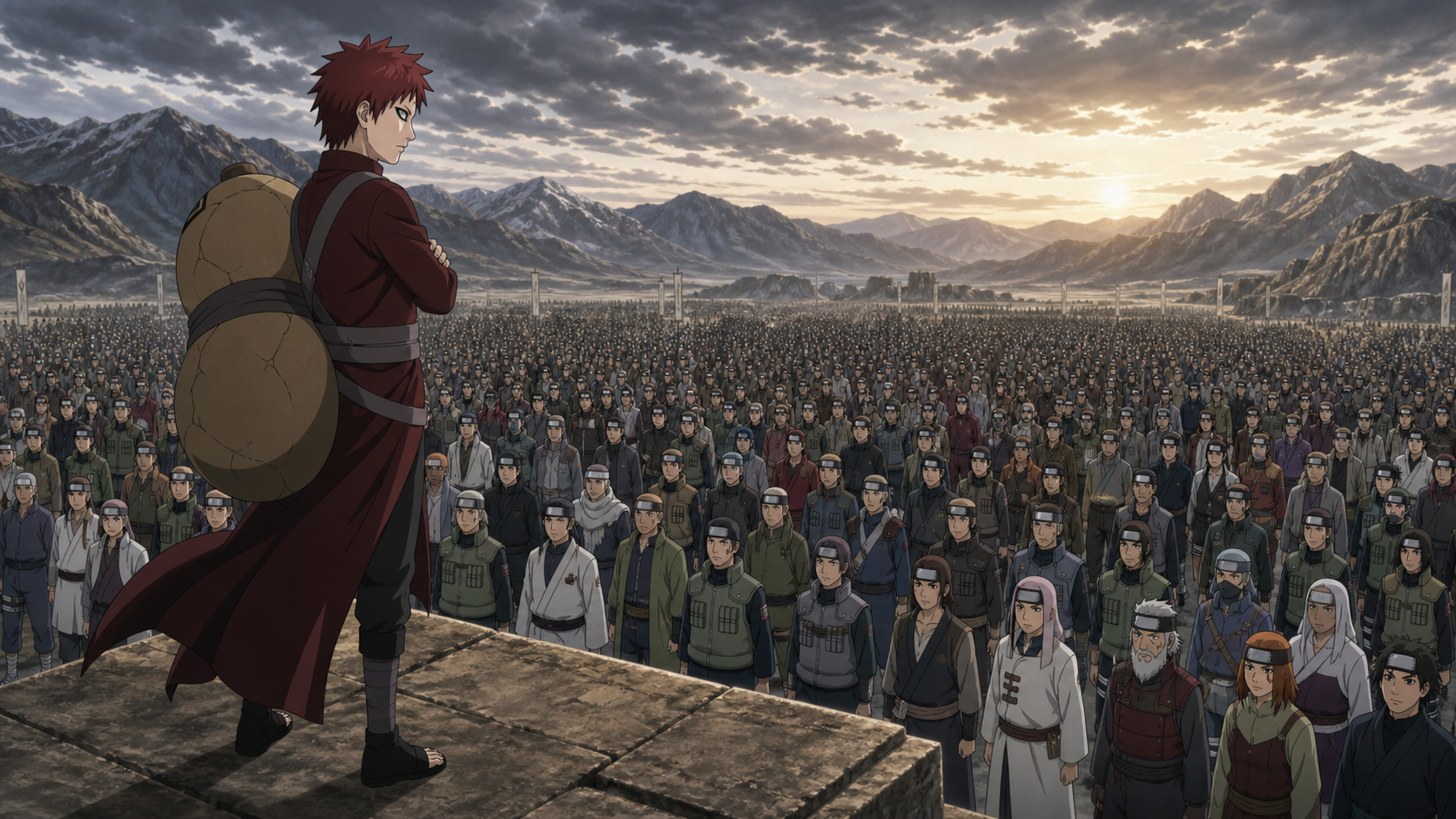
Assemble! Allied Shinobi Forces!
Gaara leads a multinational shinobi army while Kabuto organizes the dead and Tobi prepares White Zetsu for war.
Bottom line
Naruto Shippuden Episode 256 finally puts the Allied Shinobi Forces in one place, and the size of the formation makes the political achievement visible. Villages that spent generations spying on, exploiting, and killing one another have agreed to share commanders, intelligence, medical support, and battlefield responsibility. Nobody gets to pretend those old wounds disappeared because everyone received the same forehead protector.
Gaara stands at the center of that contradiction. He is young enough to represent a future the older leaders repeatedly failed to build, experienced enough to know what state violence does to a child, and powerful enough to command fighters who may still distrust the Sand. His appointment carries hope, but the episode does not let the audience forget why this alliance became possible. Akatsuki created a threat large enough to make cooperation less dangerous than separation.
Kabuto answers the living army with a dead one. Tobi has roughly one hundred thousand White Zetsu bodies. Kabuto adds reanimated Kage, former jinchūriki, Akatsuki members, and shinobi whose deaths still control the emotions of people now marching into war. One side sorts the living by skill. The other side sorts the dead by how much pain and power can still be extracted from them.
Ōnoki carries the island because protection now has a visible cost
Ōnoki uses his weight-altering Earth Release to move the enormous Island Turtle toward Kumogakure. The image turns an abstract security problem into physical labor. The oldest Kage carries a living refuge because the previous hiding plan has already failed.
His effort also completes the defense mission with an uncomfortable qualification. Naruto and Killer B remain out of Akatsuki's hands, but Yamato does not return. The alliance saves its official priorities while losing the person who helped maintain their safety.
Ōnoki cannot solve that loss by carrying more weight. Bringing the island home protects the jinchūriki and stabilizes the next stage of the plan. Kabuto has already taken the prisoner whose body can strengthen the enemy force waiting underground.
Naruto notices Yamato's absence before anyone offers the truth
Naruto finishes another part of his training and asks where Yamato has gone. The question is ordinary because Yamato has been a consistent presence throughout the trip, and absence becomes suspicious when everybody else knows more than Naruto does.
Aoba keeps the cover story alive. Killer B redirects Naruto toward further control of Nine-Tails chakra. The deception remains calm and practical even though Yamato was captured during an attack aimed at Naruto's hiding place.
The alliance's position has become harder to defend emotionally. Leaders first hid the war to keep Naruto from rushing toward danger. Now the same lie hides what happened to someone Naruto knows and trusts. Protection requires editing his relationships as well as his battlefield information.
Killer B trains Naruto while carrying knowledge Naruto does not have
B steps into the training role and helps Naruto work with the new chakra mode. His guidance is useful. Naruto needs precision because gaining Kurama's chakra did not automatically grant full mastery.
B is also participating in the cover. As another jinchūriki, he understands being treated as a strategic asset better than most people on the island. That shared experience makes his silence complicated rather than neutral.
The episode does not give B a long argument about the ethics of withholding the war. His actions show the choice: keep Naruto focused, improve his survival odds, and accept that Naruto cannot consent to a plan nobody will explain.
Yamato's body becomes an enemy production resource
Kabuto tells Tobi that Yamato must remain alive because Hashirama's cells can strengthen White Zetsu. The prisoner is no longer discussed as an intelligence source alone. Kabuto wants his body inside the enemy's manufacturing process.
That plan repeats the logic that shaped Yamato's childhood. Orochimaru placed Hashirama's cells into children to reproduce Wood Release. Yamato survived. Kabuto now takes that survivor and uses the result of the old experiment to improve a new generation of artificial bodies.
The cycle is cruel because survival never gives Yamato ownership over what happened to him. Powerful men keep treating the evidence inside his body as shared military property.
The White Zetsu army makes mass production look like manpower
Reconnaissance reveals the scale of Tobi's underground force. Tens of thousands of pale bodies fill the chamber until individuals become almost impossible to distinguish. The visual is designed to overwhelm.
Calling the formation an army can hide what the army represents. White Zetsu bodies are manufactured through stolen power and cultivated for use. They do not gather as citizens defending homes. They wait as inventory created for somebody else's war.
Yamato's capture threatens to increase their strength before the first major clash. Kabuto has converted a failed jinchūriki raid into an upgrade for an already enormous force.
Reconnaissance changes rumor into a number leaders must answer
The allied scouts use the Byakugan and communications network to confirm what waits near Akatsuki's base. That work matters because commanders cannot plan around the vague claim that the enemy has many soldiers. Scale changes routes, supply, medical preparation, reserve forces, and the cost of every mistake.
The scene also gives support specialists the importance a war story can easily reserve for fighters. Seeing the army, surviving close enough to report the army, and moving that information to decision-makers are battlefield acts.
The alliance begins as a communication problem before becoming a combat problem. Five villages can stand together and still fail if intelligence arrives late, commanders protect local pride, or units cannot understand one another.
The allied forehead protector is a promise, not proof
Fighters from every major village replace familiar symbols with a shared mark. The visual says that village identity must yield to shinobi cooperation for the duration of the war.
A changed forehead protector cannot remove memory. Some people in the formation fought one another. Some lost relatives to another village's policy. Some commanders built careers inside the rivalries the alliance now asks everyone to suspend.
The symbol has value because unity needs visible practice. The danger comes from treating the new mark as evidence that reconciliation is already complete. Cooperation has to survive orders, fear, casualties, and unequal sacrifice before the promise becomes trustworthy.
Dividing the force by ability is practical and politically risky
The alliance organizes combat units around battlefield function rather than village origin. That choice helps commanders combine complementary skills and prevents every nation from fighting as a separate army under one ceremonial title.
Mixed units also place former rivals under unfamiliar leadership. A Stone shinobi may receive orders from a Cloud commander. A Leaf fighter may depend on Sand support. Each assignment tests whether professional respect can outweigh inherited suspicion.
The structure creates interdependence on purpose. A real alliance cannot consist of five armies standing near one another while protecting separate priorities.
The support divisions prove war is larger than spectacular jutsu
Medical care, intelligence, sensory work, logistics, communication, and specialized operations receive formal places in the mobilization. The episode understands that an army cannot survive on named techniques alone.
Every dramatic battle depends on people moving supplies, treating wounds, finding targets, relaying orders, interpreting reports, and deciding which unit needs help first. Those systems determine whether individual courage produces a victory or a larger casualty count.
The division of labor also creates new vulnerabilities. An enemy who breaks communication or medical support can damage several battlefields without defeating every front-line unit.
Gaara's command is both earned and politically useful
Gaara leads the main battle regiments while the Raikage holds supreme authority over the wider allied force. His appointment recognizes his power and judgment. The role also gives the alliance a commander whose story crosses several village failures.
The Sand turned Gaara into a weapon, isolated him, feared him, and once tried to have him killed. Naruto's connection helped him choose another path. Gaara later became Kazekage and defended the same people who had treated his existence as a threat.
Putting him before the allied army signals that the shinobi system wants the product of its abuse to represent unity. Gaara accepts because people need protection, not because the old system has earned forgiveness.
A former target now directs the institutions that created targets
Gaara and Naruto were both made jinchūriki without consent and raised under suspicion. Their villages wanted the power inside them while resenting the children carrying that power.
Naruto remains hidden because leaders still define him as the war's most important protected asset. Gaara stands in public because leaders need his authority, combat strength, and story. The system uses two survivors differently according to current strategy.
Gaara's command gives him real agency, but that agency exists inside institutions that have not fully confronted what they did. His presence can inspire the alliance without absolving the villages.
The army shot works because familiar faces become part of a system
The episode moves through commanders, specialists, and rank-and-file shinobi the audience has met across years of story. Familiar faces help the enormous force feel human. Each person brings relationships and history into the formation.
The scale also changes how viewers read those characters. A beloved teacher, teammate, or former opponent is now one body inside a military structure with shared objectives. Personal skill matters, but nobody controls the whole battlefield.
That shift prepares the series for war storytelling. Consequences will move across units. A choice in one division may save or endanger people who never meet the person making the choice.
Kabuto assembles an army from unresolved grief
Impure World Reincarnation produces a force with military power and emotional leverage. Kabuto summons dead Akatsuki members, former Kage, previous jinchūriki, and other shinobi whose names still matter to the living.
Every reanimated fighter can injure the alliance twice. The body carries dangerous skills. The face can disrupt the person ordered to seal or destroy that body.
Kabuto does not need to understand the relationship attached to every corpse. He only needs to know that grief slows decisions, creates hesitation, and can turn a battlefield assignment into a personal crisis.
The former jinchūriki reveal another version of stolen service
The dead jinchūriki appear among Kabuto's forces after spending their lives carrying tailed beasts for their villages. Death should have ended the demands placed on their bodies. Kabuto calls them back for another man's war.
Their presence mirrors Naruto and B's current position without making the situations identical. The alliance hides its living jinchūriki for protection and strategic control. Kabuto openly deploys dead jinchūriki because their consent has become irrelevant to his technique.
Both sides measure people through the power connected to their bodies. The moral difference matters, but the shared habit deserves attention.
Former Kage turn institutional history against the alliance
Reanimated leaders bring rare techniques, battlefield knowledge, and political memory. They may understand village defenses and fighting traditions better than the younger shinobi facing them.
Their presence also forces the alliance to confront the leaders produced by earlier eras. A title does not guarantee a clean legacy. Some Kage protected their people, some expanded state power through violence, and many did both.
Kabuto turns that complicated history into a weapon. The alliance cannot defeat the past by declaring a new symbol. Fighters will have to meet the past directly and decide what deserves respect, resistance, grief, or rejection.
Tobi and Kabuto cooperate without trusting each other
The two enemy leaders now possess complementary armies. Tobi supplies White Zetsu and the larger plan. Kabuto supplies reanimated elites and biological expertise. Each man needs what the other controls.
Their partnership remains a negotiation between threats. Kabuto keeps proving his value while protecting his own leverage. Tobi accepts help while watching for betrayal.
That mistrust does not make the alliance harmless. Dangerous partners can accomplish a great deal before they turn on one another, especially when both benefit from beginning the war now.
The episode treats mobilization as the end of waiting
Previous episodes prepared villages, protected jinchūriki, gathered intelligence, and negotiated command. Episode 256 brings those separate actions into one military formation.
The enemy performs a parallel assembly. White Zetsu wait in mass ranks. Reanimated shinobi rise with their abilities intact. Yamato is attached to the production system that will strengthen them.
The final sense of movement comes from both sides becoming operational. War stops being a threat discussed in rooms and becomes an order that will move bodies across a map.
A shared uniform cannot perform reconciliation
The allied forehead protector is a visible promise that village identity will not outrank collective survival. It is not proof that generations of raids, betrayals, proxy wars, and resource competition vanished during one tailoring session.
The symbol matters because people need something new to practice. Trust will be built or broken when a medic treats a former enemy, a commander distributes risk fairly, and frightened units decide whether an unfamiliar village deserves support.
Mixed divisions create necessary political dependence
Organizing by function prevents five national armies from standing beside one another while quietly protecting separate priorities. Stone sensory skill may guide Leaf fighters. Sand defense may cover Mist medics. Cloud orders may determine where everyone moves.
That dependence is risky on purpose. An alliance becomes real when survival crosses old borders. It also makes prejudice operationally dangerous because one withheld warning or delayed rescue can kill people far beyond the offender’s home unit.
Gaara’s appointment is inspiring and deeply uncomfortable
The Sand sealed a beast inside him, isolated him, feared him, and authorized his death. Now the allied institutions need the survivor’s power, credibility, and story to make unity believable. His leadership is earned. Their use of it is not automatically innocent.
Gaara accepts because soldiers need direction, not because the system completed a moral repair. A former target commanding the villages should indict what those villages did even while showing what he chose to become.
Naruto and Gaara reveal two versions of strategic usefulness
Gaara stands before the army because his voice and strength help mobilization. Naruto remains hidden because his body contains the asset Akatsuki needs. The alliance gives one survivor public authority and denies the other knowledge according to current military value.
Both may be tactically defensible. Together, they show how quickly institutions translate people into functions. Respect requires asking whether those people shape the role or merely perform what strategy presently demands.
The enemy army removes the political problem by removing consent
Living allies must argue, trust, remember, and decide. Kabuto’s reanimated force obeys because death has stripped away refusal. White Zetsu bodies become numbers because individuality was never part of the production requirement.
That contrast is the war’s moral foundation. The alliance will be messy precisely because its people remain people. Kabuto’s formation looks orderly because corpses, copied bodies, and a captured survivor have been converted into inventory.
Yamato is the hidden body beneath the enemy’s scale
One hundred thousand White Zetsu sounds like a number from a strategy map. Their planned enhancement runs through a captive whose childhood already proved how brutally adults pursued Hashirama’s power. Kabuto turns the survivor of one experiment into infrastructure for another.
Every stronger Zetsu carries that theft into battle. The army’s scale should not make Yamato disappear. His body is the production line, and the alliance’s protected mobilization begins while one of its captains is being used underground.
The army is assembled. Unity remains unfinished, and that work will matter as much as any jutsu once people begin dying together.
What landed
The episode makes organization feel consequential. Unit assignments, intelligence reports, support roles, command structure, and force size receive attention because those details determine how the coming battles can function.
Gaara is the right emotional center. His life demonstrates both the cruelty of village systems and the possibility that survivors can choose obligations those systems never modeled for them.
Kabuto's reanimated formation provides an effective contrast. The allied force struggles to create cooperation among living people. His army removes cooperation by removing consent.
What did not fully land
The rapid introduction of divisions, commanders, and enemy fighters can feel like a roster presentation. Several appointments pass before the episode explains why a particular leader fits the role.
The alliance's old grievances remain mostly visual and implied. A force this large should contain anger, distrust, and fear that cannot disappear during one mobilization speech.
Yamato's capture also risks becoming a technical explanation about White Zetsu. The episode states his military value more clearly than his suffering, even though his history makes the enemy's plan deeply personal.
Final reaction
Naruto Shippuden Episode 256 earns its scale by showing what both armies are made from. The Allied Shinobi Forces combine living people who carry different loyalties, skills, prejudices, grief, and reasons to fight. Their shared symbol creates an obligation to cooperate. Their behavior will decide whether the alliance deserves the name.
Kabuto's army solves cooperation by denying freedom. Dead shinobi return under command. White Zetsu bodies wait as manufactured numbers. Yamato's stolen cells promise an upgrade. Tobi and Kabuto remain the only people in that system allowed to negotiate.
Gaara standing before the allied formation therefore carries more weight than a cool commander reveal. A child once turned into a village weapon now has to lead the villages against enemies who turn everybody into weapons. The war begins with thousands of people assembled on both sides, but the real division concerns who is still allowed to choose why they stand there.
RaeRae’s call
Five villages become an army only if cooperation survives old hatred and unequal sacrifice. Kabuto avoids that hard work by building obedience from corpses, copies, and Yamato’s stolen body.
Episode details and viewing routes
- Official episode reference: Naruto Official episode guide
- Licensed episode route: Crunchyroll licensed episode page