
Target: Nine Tails
Naruto learns that his birthday began with Kushina and Minato’s joy before a masked intruder transformed labor, love, and the weakened seal into a coordinated attack.
Bottom line
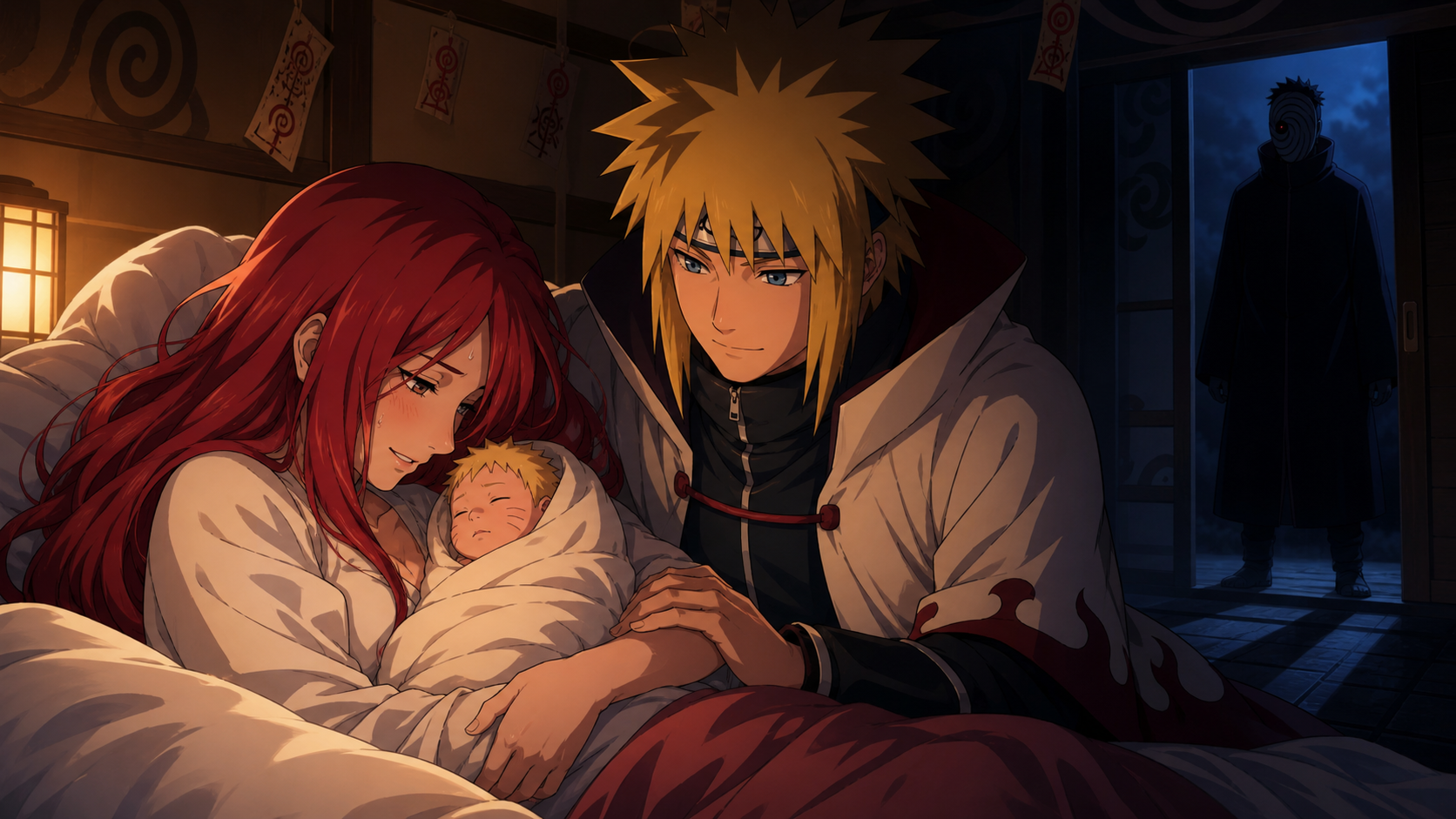
Naruto Shippuden Episode 247 turns Naruto's birth into a security operation because Kushina's body has never been allowed to belong only to her. The village knows childbirth will weaken the seal holding Kurama, so labor takes place in a hidden chamber under guard. Minato must welcome his son while maintaining a containment system. Kushina must endure birth while everyone around her monitors the weapon sealed inside her. Their joy is real, but institutional fear occupies the room with them.
That arrangement would already make “Target: Nine Tails” painful. Then the masked man weaponizes every secret meant to protect the family. He finds the chamber, eliminates the guards, kills Biwako and Taji, seizes newborn Naruto, and forces Minato to choose between protecting his child and remaining beside Kushina. The episode exposes the difference between a plan designed for a known risk and an enemy who understands the plan well enough to turn love into leverage.
Kushina tells this history to Naruto after helping him suppress Kurama in the present. That framing matters. Naruto is not hearing a village legend about the Nine-Tails attack. He is hearing his mother describe the night her body, child, and tailed beast became targets in the same operation. The attack on Konoha begins as an attack on a woman giving birth.
Naruto wins the chakra battle with help he can finally name
Before Kushina begins the flashback, Naruto returns to the struggle against Kurama with her chains holding the fox in place. The assistance does not erase Naruto's work. He still has to separate and claim the chakra. Yet the victory is no longer presented as solitary domination. Naruto succeeds because his mother gives him time, stability, and a form of restraint strong enough to keep hatred from swallowing him.
The resulting chakra mode is visually triumphant, but the episode wisely pauses before treating the transformation as the whole point. Naruto has acquired extraordinary power. More important, he now knows the red-haired woman inside the seal is his mother and that she has a story he needs to hear. Power opens the next door; family history determines what waits behind that door.
Kurama's reduced form also complicates the win. Naruto has taken the chakra while leaving the fox with its hatred. This is mastery under the existing rules, not reconciliation. The series celebrates Naruto's breakthrough without pretending that extraction has produced trust. Kushina's account will show how often powerful people treated Kurama, and her, as resources to be secured or stolen.
Kushina was the Nine-Tails jinchūriki before Naruto
Kushina's revelation reorganizes Naruto's understanding of his inheritance. Kurama did not enter his life from nowhere on the night of the attack. His mother carried the Nine-Tails before him. The red chakra, the seal, and the village's secrecy were already part of the family before Naruto became the next container.
That truth creates an immediate bond between mother and son, but the bond is not sentimental. Kushina knows the physical and emotional burden of housing Kurama. She understands why the fox's hatred feels invasive because she lived with the same presence. Her guidance carries authority no ordinary sealing instructor could provide.
The reveal also raises an ugly question about choice. Kushina came to Konoha because her unusual Uzumaki chakra made her suited to contain the Nine-Tails. Naruto received Kurama as a newborn because catastrophe left his parents with impossible options. Neither childhood began with informed consent. The village calls the arrangement protection, but protection and exploitation share the same seal.
Pregnancy turns a private life into classified risk
Kushina's pregnancy should belong to Kushina and Minato. Instead, the weakening seal makes the birth a classified event. The location is secret. Movement is controlled. Guards watch the perimeter. Only a narrow group can know the schedule and route. Every precaution confirms that the village views Kushina's labor through two competing truths: a child is arriving, and a strategic weapon may escape.
The episode does not need a speech about reproductive autonomy to make the discomfort visible. Minato focuses on the seal while Kushina labors. That focus is necessary, but necessity does not make the arrangement humane. Her pain becomes another variable in a containment procedure. Even trusted helpers speak in the language of maintaining control.
Kushina still claims joy inside those restrictions. She wants Naruto. She talks about his future. She and Minato imagine themselves as parents rather than simply a Hokage and jinchūriki fulfilling village duties. Their happiness matters precisely because the system surrounding them keeps trying to translate a family milestone into risk management.
Biwako gives Kushina blunt support instead of ceremony
Biwako Sarutobi enters as the Third Hokage's wife, but rank is not her primary function in the chamber. She is there as an experienced midwife who understands both childbirth and the exceptional danger of Kushina's seal. Her manner is direct, practical, and unsentimental. Kushina does not need reverence while laboring. She needs someone who will tell her what comes next and keep the room moving.
Taji assists beside her, creating a small circle of women responsible for bringing Naruto safely into the world while Minato maintains the seal. Their labor is essential and largely invisible to the history Naruto heard growing up. Public memory celebrates the Fourth Hokage's sacrifice. Episode 247 makes room for the women who delivered the child he would save.
That visibility makes their deaths more disturbing. The masked man does not kill anonymous security pieces. He erases the people who have just protected Kushina through labor and handled Naruto's first moments. The attack violates a care space before becoming a military assault.
Minato must be a father and Hokage at the same time
Minato's position in the birth chamber is emotionally impossible. He wants to comfort Kushina and meet his son. At the same time, his sealing skill is the central defense against Kurama's release. A moment of distraction could endanger the village. The episode lets tenderness break through his concentration, but responsibility never leaves his face.
When Naruto cries for the first time, Minato's relief feels enormous. His response is not the composed reaction of a monument. He is a young father overwhelmed by the sight of a child. Kushina's exhaustion and Minato's wonder briefly create the ordinary family scene both of them deserve.
The masked man has planned around that love. He understands that Minato will move to save Naruto. Threatening the newborn is not random cruelty; the threat is a tactical method for separating the only sealing expert in the room from Kushina. Minato's devotion becomes predictable, and predictability becomes an opening.
Naruto arrives inside love rather than loneliness
Naruto has understood his earliest life through absence. No parents waited at home. No one explained his birthday as a family story. October 10 became associated with the Nine-Tails attack and the village's grief. Episode 247 restores what happened before catastrophe claimed the date.
Naruto was wanted. Kushina carried him with hope. Minato looked at him with astonished love. Biwako and Taji worked to deliver him safely. His first cry was heard by people who cared whether he lived. Those facts do not cancel the orphaned childhood that followed, but they challenge the lie Naruto absorbed from years of rejection: that his life began as a burden nobody chose.
This knowledge is one of Kushina's most important gifts. She cannot return to the living world and raise him. She can make sure Naruto knows the attack was not the first truth of his life. Love came first, even if violence arrived almost immediately afterward.
The masked man attacks knowledge before attacking strength
The operation succeeds because the masked man possesses information he should not have. He knows the birth is taking place. He knows where the hidden chamber is located. He knows labor weakens the seal on a female jinchūriki. He knows Minato's priorities well enough to create a choice no father could ignore.
That intelligence makes him more frightening than raw power would. The guards and barriers were built to stop an intruder approaching from outside. He moves through those protections because his space-time ability ignores conventional boundaries. More troubling, someone who understands the jinchūriki system can identify the exact hour when its human cost creates maximum vulnerability.
Kushina asks the question the whole sequence leaves hanging: how did he know? The mystery turns the birth chamber into evidence. Secrecy failed somewhere, and the attacker arrived prepared not merely to release Kurama but to use a newborn as leverage.
A care room becomes a crime scene
The tonal violence of the attack comes from location. Medical linens, sealing tags, and the exhausted calm after birth should signal safety. The masked man converts those details into the background of a hostage situation. Naruto is taken before Kushina has time to hold him as long as she wants. Biwako and Taji are discarded after completing the work that brought him into the world.
The episode avoids dwelling on gore, which keeps attention on violation rather than spectacle. The intruder's calmness is enough. He treats every person in the room as an obstacle, tool, or pressure point. Kushina is valuable because she contains Kurama. Naruto is valuable because Minato loves him. The midwives and guards have no value once their functions end.
That worldview is the opposite of the family scene moments earlier. Kushina and Minato see a child whose existence matters before achievement. The masked man sees a usable vulnerability. Episode 247 puts those definitions of human value into immediate conflict.
The explosive blanket is cruelty designed as a timing problem
Seizing Naruto already guarantees Minato's attention. Wrapping the newborn in explosive tags makes the rescue harder by adding a second countdown. Minato cannot simply take his son. He must separate Naruto from the threat, move both of them away, and prevent the blast from reaching the child.
The sequence displays Minato's speed without turning the danger into a victory lap. Flying Raijin is astonishing, but every instant feels too slow because a newborn is involved. Minato solves the trap, yet the masked man still gains what he wanted: distance between Minato and Kushina.
This is strategic cruelty at its clearest. The attacker does not expect the tags to defeat the Fourth Hokage. He expects Minato's successful rescue to remove him from the chamber. Love is not a weakness in moral terms, but an enemy can exploit the actions love makes nonnegotiable.
Kushina's body becomes the battlefield
Once Minato is diverted, the masked man turns fully toward Kushina and Kurama. She has just given birth. Her seal is weakened. Her chakra and body are exhausted. The attack chooses the moment when resistance will cost her most.
Calling the episode “Target: Nine Tails” is accurate, but incomplete. Kurama is the strategic objective. Kushina is the person who must be invaded, abducted, and potentially killed to reach that objective. The title mirrors the attacker's perspective, where the woman surrounding the target barely counts.
Kushina's narration corrects that erasure. Naruto hears what happened through the person who endured the extraction, not through a military report. Her voice keeps the story centered on lived harm. The village lost control of the Nine-Tails; Kushina was attacked immediately after bringing her child into the world.
The chakra victory remains ethically unfinished
Naruto earns the transformation through courage, training, Kushina’s intervention, and skills developed outside Kurama. He also takes power while leaving the fox restrained with hatred. The scene can be triumphant without pretending it is mutual.
That unfinished quality matters because partnership would mean Kurama choosing to help. Naruto currently achieves enough control to survive and fight. He has not yet answered why a conscious being should trust another human who wants its strength more than its voice.
Kushina’s body is treated as classified infrastructure
The security plan monitors labor because childbirth weakens the seal. Every precaution may be tactically necessary, yet necessity does not make the arrangement humane. Kushina cannot experience birth as a private person while an entire village’s safety depends on what happens inside her body.
She still claims joy, jokes, argues, and imagines Naruto’s future. Those choices keep her from disappearing into the language of risk. The system sees a containment event. Kushina insists this is also her child’s arrival.
The masked man understands care well enough to weaponize it
He does not overpower every defense directly. He studies who matters to whom. Naruto becomes leverage because Minato will always save his newborn son. Kushina becomes accessible because the rescue pulls her strongest protector from the room.
This is colder than treating love as weakness. Love is the one morally certain action in the sequence, and the attacker builds his timing around that certainty. Minato succeeds as a father in the exact movement that creates the enemy’s tactical opening.
Biwako and Taji deserve to remain people
They are not decorations around a famous birth. Their knowledge, steadiness, and physical labor bring Naruto safely into the world while Minato concentrates on the seal. Public history will remember the Hokage’s sacrifice far more readily than the women who protected Kushina through labor.
Their rapid deaths show the intruder’s contempt for care, but speed risks repeating the erasure. Naruto’s birth story belongs partly to them. The violence should not reduce their contribution to proof that the villain is serious.
Naruto learns his birthday had a before
October 10 has always reached him through aftermath: the fox attacked, villagers died, his parents vanished, and he became the container everyone feared. Kushina restores the minutes before catastrophe monopolized the date.
He cried and people were relieved. His father stared in wonder. His mother wanted him before he possessed any achievement the village could celebrate. Violence shaped everything afterward, but it was not the first claim made on his life.
The title keeps revealing its own cruelty. “Target: Nine Tails” sounds like a military objective, a clean label for the power the intruder wants. That language removes Kushina’s laboring body, Naruto’s newborn terror, the murdered caregivers, and Minato’s impossible choices from view. Kushina’s narration puts every erased person back around the target. Kurama may be the strategic prize, but reaching the fox requires violence against a mother whose seal is weakest because she has just delivered a child. The attack does not begin when the beast reaches Konoha. It begins when somebody decides Kushina’s vulnerability is an acceptable route to power and every person protecting her is disposable in that room.
What landed for me
The quiet family moments land because the audience knows how little time they have. Kushina's exhaustion, Minato's awe, and Naruto's first cry create no false promise that tragedy will be avoided. They establish what the masked man is about to steal. Naruto learning that he entered the world surrounded by love gives the flashback a purpose beyond filling plot gaps.
Biwako and Taji also matter. Their presence broadens the birth story beyond the famous parents and recognizes care work history usually forgets. The masked man's arrival becomes more horrific because the episode first lets the chamber function as a place where skilled people protect a vulnerable mother and child.
The episode's strongest idea is that security can fail without being careless. The village anticipated the weakened seal, chose a remote location, assigned guards, and placed Minato beside Kushina. The attacker wins the opening because he has intimate knowledge and a technique the defense was not built to contain. Preparation matters, but preparation cannot cover a threat nobody is willing to imagine.
What did not fully land
The episode moves quickly through Biwako and Taji's deaths, giving the audience little time to register them as people after emphasizing their role in Naruto's birth. The abruptness supports the attacker's cold efficiency, but the women risk becoming emotional shorthand for danger rather than losses the story will remember.
The jinchūriki system also remains more background condition than subject. Kushina explains why childbirth weakens the seal, yet few characters question a village structure that makes one woman's labor a possible mass-casualty event. Everyone treats containment as necessary. The story leaves Naruto, and the audience, to notice how much necessity has been built on a person's lack of choice.
Those limits do not weaken the central revelation. They make Kushina's perspective more valuable. Her account contains human consequences the official story of the Nine-Tails attack could never express.
Final reaction
Naruto Shippuden Episode 247 reframes the night of October 10 by starting before the fox reaches Konoha. Naruto's birthday was first a moment of fierce happiness. Kushina survived labor. Minato met his son. Two midwives brought the child safely into the world. The masked man then entered that space and transformed knowledge, vulnerability, and parental love into weapons.
Naruto needed to hear this from Kushina. The village taught him that the Nine-Tails attack defined his birth. His mother tells him that love defined the first moments and violence came afterward. That order cannot undo his losses, but the order matters. He was not born as a curse.
The episode ends inside a threat that Minato can only partially solve. He saves Naruto from the explosive trap, but that rescue separates him from Kushina at the exact moment her weakened seal requires protection. The next chapter of the flashback will decide the village's fate. Episode 247 makes sure we understand that the first people placed in danger were a mother and the child she had barely begun to hold.
RaeRae’s call
Naruto was not born as a curse. He arrived inside love, skilled care, and his parents’ joy before a masked man turned every vulnerability around that birth into a weapon.
Episode details and viewing routes
- Official episode reference: Naruto Official episode guide
- Licensed episode route: Crunchyroll licensed episode page