
The Orange Spark
Kurama’s hatred nearly takes Naruto until Kushina enters the seal with the embrace, power, and family history her son has waited his whole life to receive.
Bottom line
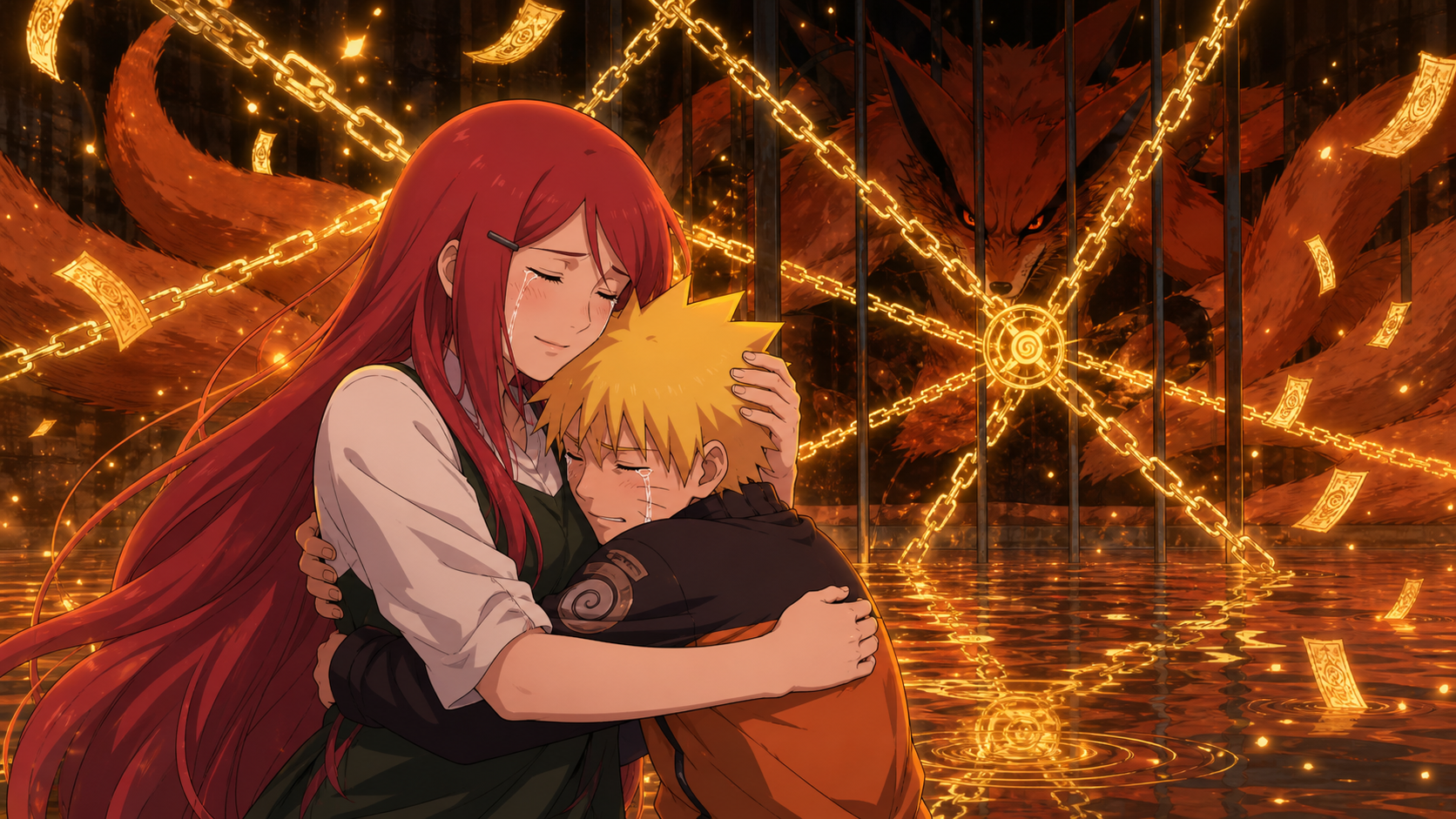
Naruto Shippuden Episode 246 gives Naruto the reunion he never knew he was allowed to want. One moment, Kurama's hatred is swallowing the confidence Naruto carried into the seal chamber. The next, a red-haired woman catches him before that hatred can finish the job. Kushina Uzumaki does not enter as a distant legend or a tidy answer to an old mystery. She arrives as Naruto's mother, hugs him while both of them cry, restrains Kurama with her own chakra, and begins telling the son she lost what his birth concealed from him.
That emotional turn makes “The Orange Spark” far more than an interruption in the chakra battle. Naruto has spent years building family from teachers, teammates, rivals, and villagers who slowly learned to see him. Episode 246 lets his biological family speak back at last. Kushina's presence proves that Minato's seal contained care as well as sacrifice, yet the episode never erases the cost of that plan. Naruto receives a mother's love through a limited chakra imprint because the living woman was denied the chance to raise him. Warmth and grief occupy the same flooded room.
Kurama's hatred finds the opening
Naruto entered this fight believing self-acceptance had prepared him for Kurama. The Waterfall of Truth mattered, but accepting Dark Naruto did not make the Nine-Tails harmless. Once Naruto pulls at Kurama's chakra, the fox's accumulated hatred travels back through the connection. The struggle stops resembling a simple contest of strength. Naruto is not only trying to take power from an unwilling being; he is touching the emotional poison that power has carried across generations.
That distinction matters. Sage Mode gives Naruto force and clarity, but neither quality automatically protects his inner life. Kurama's hatred spreads across him until the controlled extraction begins turning into another version of possession. Naruto's red transformation is frightening because his intentions remain recognizable while his body starts answering to rage. The boy who promised to master this power is seconds away from becoming the very threat everyone expected him to become.
The scene also exposes a limit in Killer B's teaching model. B can show Naruto how to confront a tailed beast because Gyūki now works with him. Naruto and Kurama do not share that trust. Their connection is still organized around a gate, a seal, and competing claims over chakra. Technique can start the encounter, but technique cannot repair a relationship built through captivity and fear.
A hand reaches Naruto before hatred closes over him
Kushina's arrival changes the temperature before Naruto understands her identity. Her chakra catches him at the point where willpower alone has failed. The interruption feels intimate rather than triumphant. She does not defeat Naruto's darkness with a speech. Her presence gives him enough distance from Kurama's hatred to recognize himself again.
Naruto initially reacts with confusion and suspicion, which fits a life shaped by traps, transformations, and incomplete explanations. Then Kushina's familiar verbal habit gives her away. Recognition lands in pieces: red hair, a distinctive turn of phrase, a face he has never seen, and an affection he somehow understands. Naruto asks the question that has waited beneath almost every lonely swing and empty apartment. When the answer is yes, he moves toward her without hesitation.
Their hug is the episode's center. Naruto does not perform toughness for Kushina. He cries. He holds on. Kushina cries too, allowing the reunion to belong to both of them rather than casting her as a perfect maternal spirit who exists only to comfort him. She lost years with her child. Naruto lost every ordinary memory a child should have with a mother. The embrace cannot restore those years, but the story gives their grief a body and a name.
Kushina enters as a person before becoming an explanation
Naruto has heard Minato described through monuments, battlefield stories, and the title of Fourth Hokage. Kushina enters differently. Her temper appears quickly. So does her humor, her embarrassment, and her fierce tenderness. The episode refuses to reduce her to “the Fourth Hokage's wife” or “Naruto's mother,” even while those relationships shape the reunion.
That choice strengthens the family reveal. Naruto does not discover a symbolic mother assembled from saintly qualities. He meets someone with a voice large enough to fill the seal chamber. Kushina can be comforting and overwhelming within the same exchange. Her energy resembles Naruto's, but the resemblance does not flatten her into a female copy of him. She has her own history with being marked as different, her own ambitions, and her own power.
Her presence also corrects the emotional imbalance of Naruto's earlier meeting with Minato. Minato stopped the transformation during Pain's assault and gave Naruto crucial answers, yet that conversation carried a restrained, strategic quality. Kushina supplies the touch, teasing, and openly expressed love Naruto never received. The two chakra imprints reveal different parents rather than two interchangeable pieces of exposition.
Adamantine Sealing Chains redraw the power balance
Kushina's golden chains binding Kurama are not decorative proof that Naruto has a powerful mother. They establish why her chakra could become the safeguard Minato left behind. Kurama has dominated the chamber through scale and hatred, but Kushina can pin the fox long enough for Naruto to recover. Her authority comes from Uzumaki sealing power and practiced resolve, not from standing near a famous husband.
The chains also make the episode's emotional logic visible. A mother's embrace steadies Naruto in the foreground while her chakra restrains the force trying to erase him in the background. Protection is both gentle and formidable. Kushina does not ask Naruto to become less ambitious or less willing to face danger. She creates the space where he can return to the struggle as himself.
There is still an uncomfortable edge. Kurama remains bound and Naruto still intends to take chakra. The series has not reached mutual cooperation. Episode 246 earns its emotion without pretending the seal is a healthy relationship. Kushina's chains save her son, but they also preserve the coercive structure surrounding the tailed beast. That tension will matter when Naruto eventually has to move beyond control toward recognition.
Minato built a family contingency into the seal
Kushina explains that Minato placed her chakra within Naruto's seal so she could appear when their son tried to control the Nine-Tails. That decision reveals remarkable foresight. Minato did not assume Naruto would succeed through inherited talent or determination. He anticipated a moment when Naruto might need protection that only Kushina could provide.
The Four Symbols Seal therefore contains more than a prison mechanism. The architecture carries two final meetings, one from each parent, timed for different crises. Minato's imprint appeared when Naruto was about to break the seal completely. Kushina appears when contact with Kurama's hatred threatens to overwhelm him during a deliberate attempt at mastery. Their chakra cannot raise Naruto, but their choices can keep him alive long enough to make his own.
That design is loving and devastating. Naruto gets parental guidance as an emergency resource stored inside his body. Every answer reminds us that no parent was available for breakfast, illness, academy failures, or birthdays. The seal offers extraordinary care because ordinary care became impossible. Episode 246 lets Naruto be grateful without requiring the audience to call that arrangement fair.
The red hair that made Kushina a target
Kushina begins her childhood story with the feature everyone noticed first. Her vivid red hair made her conspicuous after she came to Konoha. Other children mocked her and turned difference into permission for cruelty. Kushina fought back so fiercely that “Red Hot-Blooded Habanero” became a warning attached to her name.
The story echoes Naruto's childhood without claiming their experiences were identical. Naruto was isolated because adults feared the fox sealed inside him. Kushina faced ridicule as an outsider whose appearance announced that she did not match the local norm. Both learned to meet humiliation with volume and defiance. Both announced the dream of becoming Hokage in environments ready to laugh.
Kushina's response is satisfying because she refuses shame, but the episode also shows the cost of needing aggression as protection. Her temper becomes part of her legend because gentleness was not safe in the schoolyard. Naruto understands that pattern immediately. He, too, created noise when silence meant disappearing.
Minato follows the trail Kushina chose to leave
When shinobi from the Hidden Cloud kidnap Kushina for her unusual chakra, she refuses to become a passive prize. She pulls strands from her red hair and leaves a trail as the captors carry her away. Minato is the one who notices and follows that trail, but Kushina creates the route to her own rescue. Their connection begins through his attention and her resourcefulness working together.
That framing protects the scene from becoming a simple fantasy where a gifted boy grants value to an unwanted girl. Minato later tells Kushina that he noticed her beautiful hair. His words matter because her hair had been used against her, yet the rescue was possible because Kushina turned the same visible difference into strategy. The feature that exposed her also became a signal only someone observant enough could read.
Kushina's affection grows from being seen fully. Minato does not praise an abstract version of her after the danger has passed. He recognizes the clue she deliberately left and the courage behind that choice. Romance begins when attention meets agency.
Why the title is orange
“The Orange Spark” joins Kushina's red with the yellow associated with Minato. Naruto's orange has always made him impossible to overlook, sometimes comically so. Here, that color gains a family history. Orange becomes the visible meeting point between two parents whose traits continue through their son.
The title also fits the episode's lighting and emotional movement. Kurama's chakra burns with threatening red-orange heat. Kushina's chains and presence add gold. What begins as the color of Naruto's possible loss becomes the color of reunion. The spark is not a new power-up. The spark is recognition: Naruto finally seeing where parts of himself came from.
Family symbolism can become too neat if every trait receives a genetic explanation. Naruto's compassion, loyalty, and stubborn hope were shaped by people far beyond his parents. Episode 246 works because heritage expands his identity instead of replacing the family he built. Kushina and Minato are sources, not complete authors, of the person standing before Kurama.
Kushina interrupts the fight without becoming a reward
Naruto does not receive his mother because he won, mastered Kurama, or proved himself worthy. She catches him during failure, when hatred is climbing over every defense and the heroic version of Naruto is disappearing. Love arrives before achievement can purchase it.
That timing answers the oldest wound in his story. Konoha learned to celebrate Naruto after he saved it. Kushina loved him before he did anything. Her presence cannot replace the childhood he lost, but it gives him evidence that his value existed before usefulness.
Her power keeps motherhood from shrinking her
The chains make Kushina more than warmth delivered during a male protagonist’s crisis. She understands the seal, restrains Kurama, controls the room, and chooses when the family history begins. Naruto is not borrowing Minato’s famous protection with a softer face attached.
Kushina protects through expertise specific to her body, lineage, and experience. The hug and the restraint happen together because care is not presented as passivity. She can cry over her son while holding a tailed beast in place.
The seal contains love because ordinary parenting was stolen
It is tempting to call Minato’s contingency beautiful and stop there. The design is beautiful. It is also an emergency archive built because Naruto could not receive daily care from living parents. A chakra imprint appears where breakfasts, fevers, birthdays, and boring conversations should have been.
Naruto is allowed gratitude. The audience should keep the grief. Extraordinary planning does not make the loss fair, and parental foresight does not erase the burden placed inside a newborn who never agreed to become the answer to a future war.
Kushina’s hair carries danger, strategy, and desire
Other children use the red hair to mark her as foreign. Cloud kidnappers target the chakra associated with her difference. Kushina then turns that same visible feature into a trail. The thing used to isolate her becomes the method by which she participates in her own rescue.
Minato matters because he reads what she deliberately leaves. He does not invent her escape or discover a helpless girl by accident. His attention meets her planning. Their romance begins with Kushina making herself findable and Minato respecting the intelligence inside the clue.
Orange expands Naruto’s identity without explaining all of it
Red from Kushina and yellow from Minato create a lovely family shorthand. It should not become a genetic receipt for everything Naruto is. Iruka’s recognition, Team 7’s failures, Jiraiya’s teaching, Hinata’s courage, and Naruto’s own repeated choices built the person in this chamber too.
Heritage gives him roots, not a complete script. Naruto can recognize his temper, coloring, stubbornness, and dreams inside his parents while still owning a life neither parent witnessed. The orange belongs to what he inherited and what he made.
Kurama’s hatred remains a relationship problem
Kushina’s chains solve the immediate emergency, but they do not turn coercion into trust. Kurama is still imprisoned. Naruto is still pulling chakra from an unwilling consciousness. The fox’s hatred is dangerous, and generations of human use helped create the conditions feeding it.
The reunion gives Naruto stability, not moral permission to stop asking questions. He can finish this battle and gain safety without pretending domination is partnership. Kushina’s protection buys time for a future relationship the current seal cannot manufacture.
The reunion lets Naruto need something without performing
He does not make a grand promise before hugging her. He does not rescue anyone, win a contest, or hide tears behind a joke. He asks whether she is his mother and reaches for the answer with the direct need of the child he never got to be.
Kushina meets that need while bringing her own. She grieves the years she missed and speaks with the oversized personality Naruto inherited. Their embrace is mutual recognition, not a saintly mother descending solely to repair her son.
The scene hurts because Naruto receives exactly what he needed and immediately learns how temporary it is. Kushina can hold him, answer him, and protect him, but she cannot walk out of the chamber beside him.
What landed for me
The hug landed hardest because the episode allows Naruto's need to stay simple. He does not ask Kushina to justify herself before accepting her embrace. He has questions, but love arrives before the answers. After years of watching him chase acknowledgment through pranks, battles, and promises, seeing Naruto receive unconditional recognition feels almost physically relieving.
Kushina's characterization also lands. Her power is immediate, her comedy does not cancel her grief, and her childhood story belongs to her. The red-hair sequence links vulnerability, identity, and ingenuity without sanding away her anger. Minato's role remains meaningful, but Kushina never becomes an accessory in his legend.
Most of all, the episode understands that inherited pain and inherited care can travel through the same seal. Kurama's hatred moves into Naruto through chakra contact. Kushina's love reaches him through chakra left behind. Naruto stands between those inheritances and must decide which one guides his next action.
What did not fully land
The transition from near-possession to family storytelling is abrupt. Emotional interruption is the point, yet the danger around Kurama briefly feels suspended so the episode can deliver history. Kushina's chains justify the pause inside the plot, but the pacing still carries the sensation of a battle placed on hold for a long conversation.
The kidnapping memory also moves quickly past the political meaning of the Hidden Cloud targeting a child for special chakra. Kushina's agency inside the escape is strong, but the larger system that treated her body as a strategic resource receives little attention here. Her later life as a jinchūriki will make that omission even sharper.
Neither concern breaks the episode. Both reveal how much story sits behind this reunion. Kushina has arrived with enough force that a single episode cannot contain every question attached to her life.
Final reaction
Naruto Shippuden Episode 246 succeeds because Kushina does more than save Naruto from Kurama. She gives him a missing piece of personal history while remaining a vivid person in her own right. Her chains hold back the fox, her hug reaches the abandoned child inside the shinobi, and her story transforms red hair from a mark of exclusion into a line of survival.
Naruto will still have to win the chakra struggle. Love does not erase Kurama's hatred or resolve the ethics of taking power from a sealed being. What Kushina gives him is the chance to continue without surrendering his identity. For a boy who spent childhood wondering why nobody chose him, learning that both parents planned across death to protect him changes the room.
The orange spark is not merely the blend of red hair and yellow flash. The real spark is the moment Naruto realizes that he was loved before he had achievements, titles, or a village cheering his name. That knowledge cannot return his childhood. Still, for the first time, Naruto can carry his mother into the future instead of carrying only her absence.
RaeRae’s call
Kushina does not erase Kurama’s hatred or Naruto’s lost childhood. She gives him unconditional recognition, fierce protection, and a family history strong enough to help him continue without pretending the loss was fair.
Episode details and viewing routes
- Official episode reference: Naruto Official episode guide
- Licensed episode route: Crunchyroll licensed episode page