
Land Ahoy! Is This the Island of Paradise?
Bee already has the partnership Naruto wants. The Waterfall of Truth shows why copying his style cannot replace facing the anger beneath Naruto’s smile.
Bottom line
Naruto Shippuden Episode 243 finally puts Naruto in front of the teacher his journey was designed to hide. Killer Bee rescues the ship from a giant squid, demonstrates complete partnership with the Eight-Tails, then refuses Naruto’s request for training after Naruto tries to imitate his style and accidentally insults him. Naruto wants the result before understanding the person who achieved that result.
Motoi redirects him to the Waterfall of Truth, where Bee began confronting the emotions required for tailed-beast control. Naruto meets a version of himself filled with resentment toward the village that once hated him and now celebrates him. The “paradise” island is dangerous wildlife on a living turtle, but the greater danger is internal. Naruto cannot control the Nine-Tails while pretending public acceptance erased years of pain.
The boat journey ends with the wrong octopus
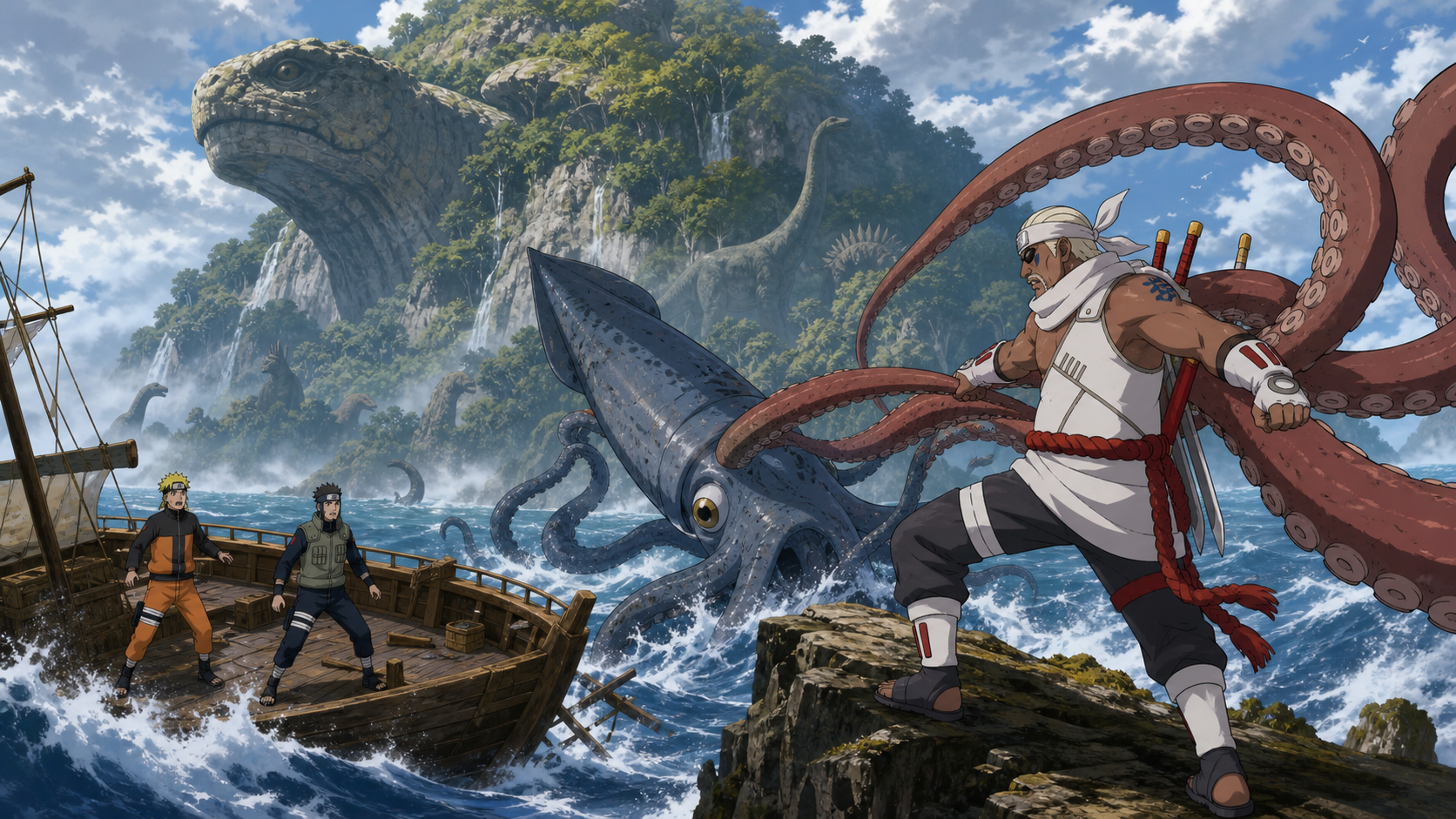
After months of detours, Naruto’s ship reaches the Island Turtle. A giant squid attacks before anyone can safely disembark. Naruto initially mistakes the tentacles for the octopus from the Great Toad Sage’s prophecy and rushes toward danger with misplaced excitement.
The joke summarizes his travel mindset. Naruto expects prophecy to announce itself clearly and assumes every strange obstacle may be guidance. The squid reminds him that symbols require judgment. Not every tentacle belongs to the teacher he wants.
Killer Bee’s entrance establishes mastery immediately
Killer Bee arrives and uses the Eight-Tails’ power to restrain the squid. His control looks casual because partnership has made enormous force part of his normal movement.
Naruto does not need a lecture about Bee’s qualifications. He watches another jinchūriki transform without losing himself, protect strangers, and return to human form with confidence. Bee embodies the future Naruto has struggled to imagine.
Bee rescues people before introducing himself
Bee’s first meaningful action is protection. He does not perform control for applause or demand recognition from the Leaf shinobi. The rescue demonstrates that his bond with Gyuki serves choices larger than survival.
That action also complicates Naruto’s quick judgment later. Bee can be arrogant, evasive, and difficult to approach while still being dependable when lives are threatened. Naruto must learn to read more than the response to his own request.
The island is a sanctuary built from danger
The Island Turtle holds enormous animals and terrain that resembles an intensified Forest of Death. Naruto questions how anyone could call the place paradise. Safety comes from secrecy, isolation, and creatures Bee has tamed rather than from comfort.
The Allied Shinobi Forces use the island to hide Naruto and Bee from Akatsuki and, indirectly, from the war. Their protection resembles confinement because the people being protected do not receive the full political truth. Paradise becomes a word authorities use for a strategic cage.
Naruto does not know the real mission
Naruto believes he traveled for a special ecological or research assignment. The alliance needs him away from the battlefield because Akatsuki’s plan depends on capturing the Nine-Tails. Keeping him uninformed reduces the risk that he will reject the restriction.
The deception may be tactically understandable, but the episode places his training inside compromised consent. Naruto reaches the right teacher through a mission whose purpose was hidden from him. Later control will increase his agency, even while the alliance tries to limit where he can use that power.
Motoi introduces the island through Bee’s work
Motoi serves as caretaker and guide. He explains that Bee tamed the island’s giant animals and learned to control the Eight-Tails there. His respect makes Bee’s accomplishment part of the environment rather than a private claim.
The island tells a history of practice. Every creature that responds to Bee and every training site Motoi identifies shows that mastery grew through repeated relationships. Naruto sees the finished sanctuary before he understands the loneliness and conflict behind the work.
Naruto asks for training too quickly
Naruto approaches Bee as soon as he recognizes the opportunity. The urgency fits the approaching threat and his lifelong hunger to improve. The request still assumes Bee should become available because Naruto needs him.
Bee has orders to remain on the island, not an obligation to teach another jinchūriki. He is also one of the few people who can understand Naruto’s burden without being reduced to a resource for solving that burden. Refusal protects his autonomy.
Bee’s vacation is a boundary
Bee says he is on vacation and rejects the training request. The claim sounds unserious beside the coming war, yet the right to rest matters for someone whose village has treated his body as military infrastructure.
The alliance wants Bee hidden because Gyuki is strategically valuable. Naruto wants Bee’s knowledge because that knowledge may unlock Kurama’s power. Bee insisting on personal time resists both forms of extraction.
Naruto mistakes style for access
Naruto notices Bee’s rap and enka rhythm, then tries to imitate the performance. He hopes similarity will create rapport quickly. The attempt focuses on the most visible part of Bee while bypassing everything that made the style meaningful.
Imitation can communicate admiration, but Naruto treats Bee’s self-expression like a password. The approach fails because relationship cannot be hacked through costume, cadence, or enthusiasm.
The fist bump is not automatic consent
Bee briefly acknowledges Naruto through a fist bump. Naruto interprets the gesture as permission to keep pushing. He continues performing, crosses into insult, and loses the small opening.
The moment teaches an important boundary. Connection can be real without granting unlimited access. A friendly response does not erase Bee’s earlier refusal or obligate him to tolerate whatever Naruto says next.
The accidental insult exposes Naruto’s impatience
Naruto’s improvised rhyme lands as disrespect. He wants to repair the mistake immediately because the training opportunity feels too important to lose. Bee closes the door.
Consequences matter even when harm was unintended. Naruto’s ignorance of Bee’s style does not require Bee to absorb the insult kindly. The failed encounter slows Naruto long enough to seek context from someone who knows Bee.
Motoi defends Bee from easy judgment
Naruto complains that Bee is conceited and difficult. Motoi becomes angry because he has watched Bee carry burdens Naruto has not yet asked about. His loyalty interrupts the student-centered story Naruto wants to tell.
Bee is not merely an eccentric gatekeeper blocking Naruto’s progress. He is a person whose village history, friendships, grief, and discipline shaped his boundaries. Motoi insists that Naruto respect that person before asking for his method.
Naruto and Bee share a status, not the same life
Both men are jinchūriki, but shared classification does not make their experiences interchangeable. Naruto grew up isolated in Konoha without knowing why. Bee had the Raikage as a brother and still faced fear, resentment, and the expectations placed on a living weapon.
Naruto approaches as though mutual status should create instant understanding. Episode 243 begins correcting that assumption. Solidarity requires curiosity about difference, not only recognition of similarity.
Bee’s control is relational rather than mechanical
Naruto initially wants a technique for controlling tailed-beast power. Bee’s rescue already shows that mastery is not simply forcing chakra into obedience. His movements with Gyuki resemble coordinated action between partners.
The Waterfall of Truth points Naruto toward the emotional groundwork. A person cannot build stable power through denial of his own hatred. Control begins with knowing what enters the relationship before attempting domination.
Gyuki’s cooperation changes what Naruto believes possible
Naruto has experienced Kurama mainly as pressure behind a seal, a source of emergency chakra, and a consciousness waiting for anger to weaken his boundaries. Bee and Gyuki display another arrangement. Power passes between them without Bee disappearing.
That example matters more than reassurance from someone outside jinchūriki life. Bee proves through his body that a host can remain recognizable while drawing on tailed-beast power. Naruto sees a future where access does not automatically mean possession.
The rescue also shows that cooperation produces judgment. Bee uses overwhelming strength with enough control to separate the squid from the ship and protect people nearby. Mastery includes deciding how much force a situation needs, not merely surviving the amount available.
Island wildlife reflects Bee’s leadership
Motoi explains that Bee tamed the island’s giant animals. The word “tamed” could suggest domination, yet the sanctuary operates because creatures respond to his presence without constant violence. Bee has learned how to move through power that other people call monstrous.
Naruto arrives expecting danger and labels the island a poor paradise. Bee’s history offers another reading. A place full of frightening creatures can become safe when somebody builds relationships rather than demanding that every threat disappear.
That pattern connects the animals, Gyuki, and Naruto’s coming work. Control does not require making every wild or angry part harmless. Control requires recognition, boundaries, and enough trust for strength to stop treating every encounter as captivity.
The Waterfall of Truth rejects public performance
Motoi takes Naruto to the place where Bee began his training. The waterfall produces an internal counterpart rather than a physical opponent from outside. Reputation, rank, and the village’s praise offer no advantage.
Naruto has spent years proving himself through visible action. The waterfall asks what remains when nobody else is watching and no heroic result can settle the conflict.
Dark Naruto speaks the resentment praise could not erase
Naruto’s counterpart voices anger toward villagers who treated him as a monster, then celebrated him after Pain’s defeat. The resentment is not invented by Kurama. The village really changed its behavior after Naruto saved everyone.
Gratitude cannot retroactively make childhood rejection harmless. Dark Naruto holds the memory Naruto tried to outrun through achievement. Control requires him to acknowledge that success did not erase the child who wanted those same people to see him sooner.
Becoming a hero creates a new emotional problem
Naruto spent much of his life pursuing recognition. Konoha’s celebration fulfilled that desire, but fulfillment introduced suspicion. Does the village love Naruto, or only the person who defeated Pain? Would acceptance survive failure?
Dark Naruto turns those questions into hostility. The counterpart protects against future rejection by refusing to trust present affection. Naruto cannot defeat that defense through another public victory.
The village’s celebration was sincere for many people, but sincerity in the present does not settle responsibility for the past. Naruto needs room to value acceptance and remain angry that acceptance came so late. Forcing one emotion to cancel the other would repeat the denial the waterfall exposes.
The double is equal because denial supplied the strength
The dark counterpart matches Naruto’s abilities. A stronger Rasengan or faster attack cannot solve the encounter because both sides draw from the same person. Fighting the double as an enemy only confirms the split.
The equality forces a different form of growth. Naruto must listen, name the injury, and decide how resentment belongs inside his identity without allowing resentment to direct every future relationship.
The episode changes the series’ definition of control
Earlier efforts to manage the Nine-Tails relied on seals, suppression, external intervention, and fear of losing consciousness. Bee’s path begins with self-knowledge. Naruto cannot separate chakra control from emotional honesty.
That change makes the training more than a power upgrade. The war needs Kurama’s strength, but Naruto needs a relationship with the parts of himself that strength can amplify. Otherwise greater access only gives unresolved rage a larger weapon.
Bee refuses the role everybody has already assigned him
The alliance sees two jinchūriki and immediately turns one into a training resource for the other. Naruto does nearly the same thing with more enthusiasm and less paperwork. Bee’s refusal interrupts that assumption before mentorship can become another order placed on his body.
I love that the episode lets him be inconvenient. A perfect mentor would recognize destiny, smile warmly, and begin the lesson. Bee chooses vacation, bad rhymes, and the right to decide whether a stranger receives his time. Naruto needs that boundary before he can deserve instruction.
Naruto arrives carrying entitlement disguised as urgency
His need is real. Akatsuki wants him, war is approaching, and Kurama’s chakra can destroy the people closest to him. None of that automatically makes Bee responsible for fixing the problem. Naruto approaches as if shared pain should produce immediate access.
That habit mirrors his larger emotional struggle. He has spent years demanding recognition because nobody volunteered it. Now that he is celebrated, he assumes wanting connection loudly enough should make another isolated person open the door. Bee teaches the lesson by keeping it shut.
The failed imitation is funny because it is also revealing
Naruto studies the rap, not the man. He treats Bee’s cadence like a shortcut to intimacy, the social version of copying a hand sign without understanding the chakra control beneath it. The result sounds false because it is performance aimed at getting something.
Bee’s style belongs to a life Naruto has not bothered to ask about. It holds resistance, pleasure, ego, discipline, and a self-definition larger than jinchūriki status. Borrowing the surface while ignoring that history turns admiration into accidental disrespect.
The fist bump cannot do all the emotional labor
Later, the gesture will carry chakra, recognition, and astonishing trust. Here it is only an opening. Naruto mistakes a moment of acknowledgment for a completed relationship, then barrels past Bee’s stated limit because the larger mission feels more important than the smaller consent.
The episode wisely lets the gesture fail. Symbols become sentimental nonsense when characters use them to skip listening. Before Naruto and Bee can share power through contact, Naruto has to learn that connection is not something he can claim because their fists touched once.
Dark Naruto is not an evil twin
He is the part of Naruto fandom sometimes wants silenced because gratitude makes a cleaner hero story. The village cheered after Pain. Iruka, Kakashi, Sakura, Hinata, and others built real bonds with him. None of those truths changes the years when adults glared at a lonely child and refused to explain why.
Calling that anger darkness risks making the wound sound corrupt. The waterfall instead exposes anger denied until it learned to speak with contempt. Naruto does not need to destroy it. He needs to admit it belongs to him without allowing it to choose every future relationship.
Konoha’s acceptance cannot become a receipt marked paid
Saving the village created public love, but love delivered after extraordinary service raises an ugly question. Would they have accepted Naruto if he had remained ordinary? Does he have to keep rescuing everyone to remain welcome? The celebration cannot answer because the conditions changed with his usefulness.
Naruto wants to trust the new affection, and he has reasons to do so. He also has reasons to resent how late it arrived. Maturity here means holding both conclusions without forcing forgiveness to erase memory or forcing memory to cancel every genuine bond.
Bee and Gyuki offer partnership before the script explains it
The squid rescue gives viewers the argument in motion. Bee transforms, uses terrifying strength with precision, protects the ship, and returns without a possession crisis. Gyuki is not a battery chained behind a seal. Their coordinated response has timing and judgment.
Naruto sees the finished result and understandably wants the technique. The Waterfall of Truth reveals why technique comes later. Partnership with another consciousness cannot stabilize while Naruto treats pieces of his own consciousness as enemies that must be beaten into silence.
Paradise is a suspicious name for a beautiful cage
The island is alive, hidden, useful, and filled with creatures Bee has learned to navigate. It is also where two people become strategic objects protected through isolation and incomplete information. Naruto is told enough to cooperate, not enough to consent to the actual plan.
That contradiction keeps the setting interesting. The alliance may have sound tactical reasons, but calling confinement paradise does not make it freedom. Naruto’s training will increase his power inside a system currently working to prevent him from deciding where that power belongs.
The training begins before anybody throws a punch. Naruto has reached the right island and the teacher, but first he must stop confusing arrival with readiness and shared pain with permission.
What landed and what did not
Bee’s rescue is an efficient introduction because competence arrives before personality conflict. Motoi’s defense also prevents Naruto from treating Bee as a training device. The Waterfall of Truth gives Naruto’s post-Pain recognition a necessary emotional consequence.
The squid attack moves quickly, and the comedy around Naruto’s imitation can make Bee’s boundary seem like a gag. The episode also withholds the political truth about the island from Naruto, leaving the ethical problem mostly unexamined while the plot celebrates arrival.
Final reaction
“Land Ahoy! Is This the Island of Paradise?” ends Naruto’s travel and begins a harder journey. Killer Bee has what Naruto wants, but Naruto cannot reach that knowledge by copying rap, demanding instruction, or pointing to their shared jinchūriki status.
The Waterfall of Truth gives him the teacher he avoided. Dark Naruto remembers every person who looked away before the village needed a hero. Accepting that anger will not mean forgiving everything cheaply. Naruto must stop treating pain as proof that he failed to become the cheerful person everyone now expects.
RaeRae’s call
Bee is not a walking tutorial, and Dark Naruto is not a glitch. Episode 243 works because Naruto must respect another jinchūriki’s boundaries and finally hear the anger his hero reputation could not wash away.
Episode details and viewing routes
Naruto Shippuden Episode 243, “Land Ahoy! Is This the Island of Paradise?,” first aired in Japan on January 5, 2012. The manga-adapted episode opens the Taming of the Nine-Tails and Fateful Encounters arc on the Island Turtle.
- Official episode reference: Naruto Official episode guide
- Licensed episode route: Crunchyroll licensed episode page