
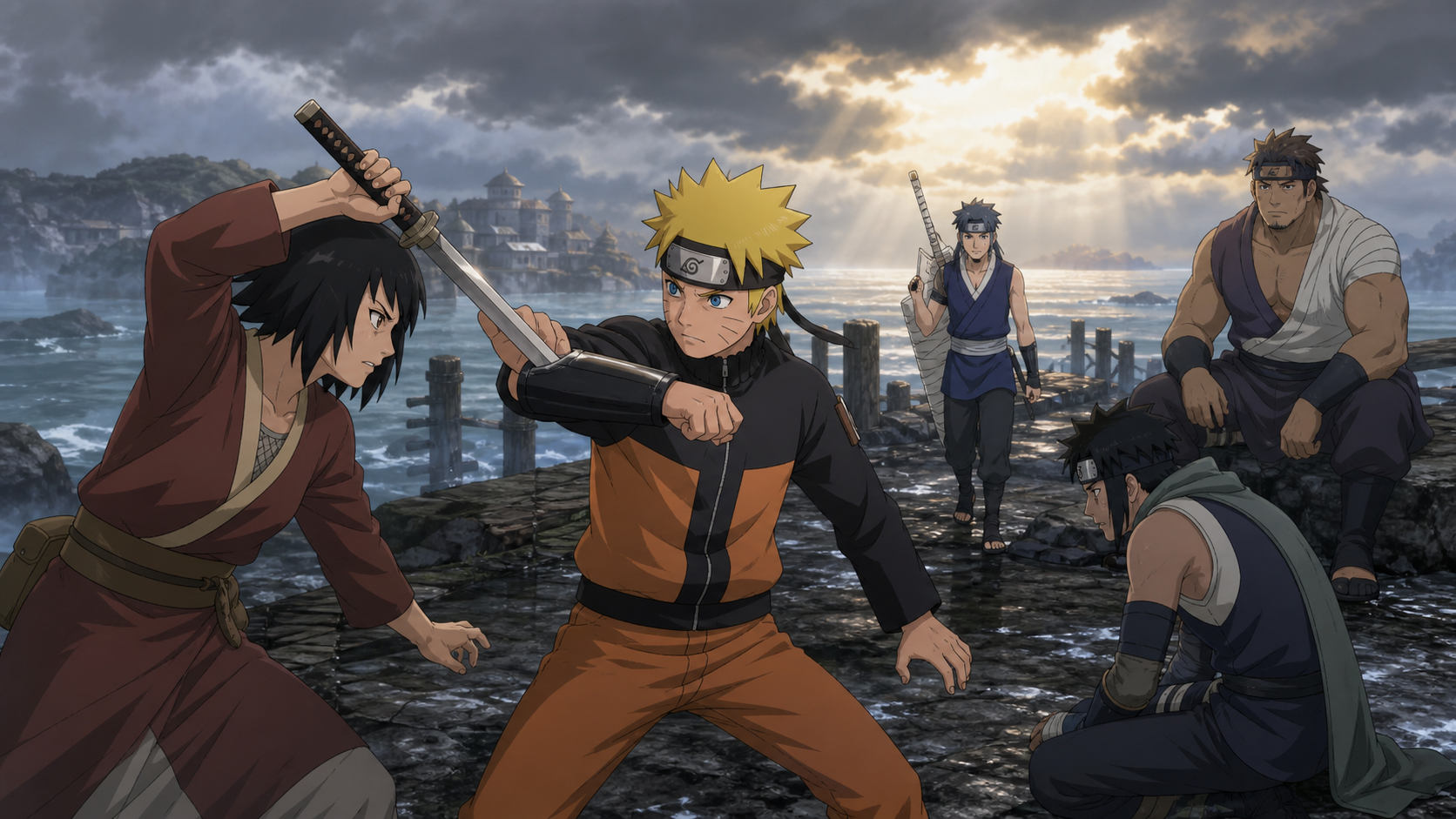
Naruto’s Vow
Ganryu survived Stone’s betrayal. Kurotsuchi wants him dead. Naruto’s vow must protect both grief and the future from another retaliatory strike.
Bottom line
Naruto Shippuden Episode 242 closes the long sea journey by placing Naruto between two villages carrying a real history of betrayal. Ganryu attacks Hidden Stone messengers because he survived the Tragedy of Yosuga Pass and watched comrades die. Kurotsuchi answers his violence with a plan to kill him first. Naruto blocks her sword with his own body because stopping hatred means protecting the person who started the present fight as well as the person seeking revenge.
Naruto’s vow only works because the episode supplies more than a speech. Onoki sent a formal apology and returned a fallen Mist shinobi’s personal belonging. Chojuro brings institutional authority. Akatsuchi refuses to weaponize his injury. Ganryu surrenders and must face consequences. Peace becomes a chain of costly choices rather than one hero asking everybody to forget.
The final supply stop becomes a diplomatic crossroads
Naruto’s ship stops at a small Land of Water island before continuing to the Land of Lightning. The location appears temporary, a place for provisions rather than history. At the same time, Akatsuchi and Kurotsuchi arrive as Hidden Stone messengers to meet Chojuro from the Hidden Mist.
The accidental overlap matters. Naruto is being moved toward a secret war destination while representatives of two allied villages try to repair an older wound. The alliance exists on paper, but the island shows how much local trust remains unfinished beneath official signatures.
Naruto goes looking for ramen and finds a war
Naruto leaves the supply group for food. The ordinary impulse keeps the encounter from feeling like an assigned diplomatic mission. He enters the conflict without rank, briefing, or authority from either village.
That lack of formal standing becomes useful. Naruto has no institutional reputation to defend in the Iwa–Kiri dispute. He can react to the human problem in front of him, though good intentions do not excuse him from learning the history behind the violence.
Chojuro moves ahead because delay carries risk
Chojuro knows Ganryu may target the rendezvous and decides to reach the messengers quickly. His concern reflects the Mizukage’s new political direction. The Bloody Mist cannot join an alliance merely by changing leaders. Chojuro must help enforce a break from the village’s violent habits.
His role is difficult because Ganryu’s grief came from a genuine betrayal. Calling the survivor a rogue does not make the grievance imaginary. Chojuro has to protect the alliance while acknowledging why one of his own shinobi refuses to trust the process.
Akatsuchi and Kurotsuchi carry Onoki’s message
Onoki sends Akatsuchi as an official messenger, and Kurotsuchi accompanies him. Their presence shows the Tsuchikage understands that the alliance requires direct repair with the Mist.
The mission also places younger Stone shinobi inside consequences created before their current authority. They did not order the betrayal at Yosuga Pass, yet they carry responsibility for how their village answers the harm. Political inheritance includes obligations nobody personally chose.
Ganryu’s ambush comes from remembered betrayal
Ganryu leads Mist shinobi against the Stone messengers and wounds Akatsuchi. His attack is wrong, but the episode refuses to make his anger random. He survived an operation where cooperation with Stone ended in death for his comrades.
Trauma has taught him that diplomatic language can hide another trap. The new alliance sounds like a larger version of the promise that failed at Yosuga Pass. He tries to prevent repetition by striking first, which recreates the same logic of betrayal he claims to oppose.
Akatsuchi’s injury makes revenge feel immediate
Kurotsuchi sees Akatsuchi hurt during a peace mission. Her desire to kill Ganryu grows from fresh evidence, not abstract village pride. Waiting for procedure can feel like abandoning the person beside her.
That urgency explains her choice without approving the execution. Retaliation offers a simple story: Ganryu attacked, so Ganryu must die. The simplicity removes the older betrayal, the failed institutions, and every future response his death could provoke.
Chojuro stops the first battle through authority
Naruto and Chojuro interrupt the clash. Chojuro orders Ganryu’s group to withdraw because their attack violates the Mizukage’s will. He uses official authority to create time before another death makes negotiation harder.
The order matters because peace cannot depend only on Naruto appearing at the correct moment. Villages need leaders and officers willing to restrain their own side. Chojuro shows loyalty to the Mist by refusing to let Mist grief become unauthorized killing.
Medical care becomes part of diplomacy
Kurotsuchi demands treatment for Akatsuchi. Chojuro explains that a medical ninja is needed and ensures care reaches him. The practical response prevents the conflict from becoming a debate while an injured person waits.
Peace work often fails when symbolic language outruns material responsibility. Treating Akatsuchi proves that Mist authority values the Stone messenger’s life. Care creates evidence that the current relationship differs from the betrayal Ganryu remembers.
The Tragedy of Yosuga Pass cannot be skipped
Chojuro explains that Ganryu survived the Tragedy of Yosuga Pass. Mist and Stone shinobi cooperated on a mission, then Stone forces turned against their partners. Ganryu lost people he trusted, including a comrade whose memory still organizes his anger.
Naming the event changes the moral frame. Ganryu is not opposing peace because hatred makes him uniquely broken. He doubts an alliance built by institutions that never repaired the first betrayal. Any vow that asks him to move forward must answer that absence.
Kurotsuchi chooses prevention through killing
Kurotsuchi goes after Ganryu before he can attack again. Her reasoning treats his death as protection for Akatsuchi and the alliance. Eliminate the immediate threat, and the diplomatic mission can continue.
The plan ignores what Ganryu represents. Killing the sole survivor before delivering Onoki’s apology would confirm his belief that Stone answers inconvenient history with force. Tactical prevention would become political proof for the next person seeking revenge.
Naruto protects the aggressor
Naruto reaches Ganryu and tries to stop Kurotsuchi. When words do not halt her strike, he places his own body between sword and target. The choice is morally demanding because Ganryu caused the current violence.
Protecting only innocent people would not break the cycle. Ganryu’s death could still create another grievance, while Kurotsuchi would carry the burden of an execution driven by anger. Naruto protects both of them from the future the strike would create.
Taking the blow gives the vow a cost
Naruto does not ask Kurotsuchi to risk compassion while standing safely outside the consequence. He absorbs the danger himself. The physical commitment distinguishes his intervention from a speech about peace delivered by somebody with nothing to lose.
His action also respects Ganryu’s distrust. Naruto cannot prove every village will behave honorably. He can prove one person will place his body behind the promise right now. That limited proof creates room for the next choice.
Naruto has learned from Nagato
The cycle-of-hatred argument comes directly from Naruto’s encounter with Nagato. Pain destroyed Konoha and killed people Naruto loved. Naruto chose to hear Nagato’s history rather than complete revenge, then accepted responsibility for pursuing an answer neither man could fully define.
Episode 242 tests whether that choice survives outside Konoha. Ganryu is not Naruto’s mirror in every detail, but both conflicts ask whether injury grants unlimited permission to reproduce injury. Naruto brings the lesson into a dispute where he has no personal claim to moral superiority.
A vow cannot demand forgetting
Naruto asks Ganryu to trust a future without endless retaliation. He does not have the right to erase Yosuga Pass or tell the survivor that grief has expired. Reconciliation requires memory to remain visible.
The episode supports Naruto by revealing that Onoki’s mission includes a formal apology and the return of personal effects. The past is acknowledged rather than buried. Ganryu can consider peace because somebody finally treats the dead as people owed recognition.
Onoki’s apology changes institutional responsibility
The Tsuchikage sent the messengers to apologize for Stone’s betrayal and return a belonging from one of Ganryu’s fallen comrades. Onoki is stubborn, proud, and deeply implicated in the old shinobi system. His decision therefore matters.
An apology does not restore the dead or eliminate responsibility. The gesture creates an official record that Stone admits wrongdoing. Alliances become more credible when leaders name what their institutions did instead of asking survivors to sacrifice memory for unity.
The personal belonging makes loss specific
Returning a fallen shinobi’s possession turns history from a village-level incident into one person’s absence. Ganryu receives evidence that the dead comrade was remembered somewhere beyond his own grief.
Objects cannot compensate for a life. They can carry touch, habit, and identity across time. The returned belonging gives the apology material weight and prevents political language from dissolving the individual people who paid for the betrayal.
Ganryu’s surrender preserves accountability
Ganryu agrees to stand down and later surrenders to Mist authority. Peace does not mean he walks away as though the ambush never happened. He accepts custody and the consequences attached to attacking messengers.
That distinction protects reconciliation from becoming impunity. Understanding the cause of violence does not cancel responsibility for the violence. Ganryu can be both a survivor owed truth and an attacker who endangered others.
Custody also transfers the next decision away from Kurotsuchi’s anger and Ganryu’s despair. A functioning alliance needs procedures capable of hearing context, protecting the injured, and assigning consequences without turning every dispute into battlefield judgment. Chojuro’s arrival creates that institutional space.
Whether the process deserves trust remains an open question. Ganryu has reasons to doubt village authorities. His surrender becomes meaningful precisely because certainty is unavailable. He accepts the risk that this new political arrangement may treat him differently from the system that abandoned his comrades.
Akatsuchi chooses mercy without denying harm
Akatsuchi downplays his injury, suggesting the Mist may owe Stone a favor rather than demanding Ganryu’s death. The wounded person refuses to let his body become a justification for escalation.
His humor should not erase the harm, but his agency matters. Kurotsuchi wanted revenge partly on his behalf. Akatsuchi shows that care for an injured person includes listening when that person rejects retaliation.
Chojuro represents a different Mist future
Chojuro carries the Mizukage’s authority without reproducing Bloody Mist cruelty. He arrests Ganryu, provides medical care, delivers the apology, and indicates execution is not inevitable.
His conduct gives Naruto’s vow an institutional partner. One outsider’s compassion cannot reform village policy alone. Chojuro demonstrates that Mist leadership can hold wrongdoing accountable while refusing automatic death.
Naruto leaves without collecting credit
Once the crisis resolves, Naruto rushes back toward his group without formally introducing himself. The choice fits his hunger and impatience, but also keeps the intervention from becoming a performance for diplomatic status.
Kurotsuchi, Chojuro, Akatsuchi, and Ganryu respond to what Naruto did before knowing the full reputation attached to his name. His action carries meaning without the title of Konoha’s hero doing the persuasion.
Peace begins when every side gives up a useful lie
Stone must abandon the lie that the old betrayal can stay buried because new leaders signed an alliance. Mist must abandon the lie that Ganryu’s pain licenses any response he chooses. Kurotsuchi must abandon the lie that killing one attacker will protect diplomacy from the history underneath him.
Naruto also gives something up: the fantasy that sincerity alone settles a political wound. His body can stop one sword. The apology, returned belonging, lawful custody, medical care, and choices made by the injured parties must carry the promise after he leaves.
Ganryu is sympathetic without being made innocent
The episode walks a line fandom arguments often flatten. Understanding why somebody attacks does not require pretending the attack was acceptable. Ganryu was betrayed, survived when comrades did not, and watched institutions proceed without the repair he was owed. He also ambushes messengers who did not create that crime.
Both facts belong in the same judgment. Remove the history and he becomes a disposable villain. Remove his agency and grief becomes a permission slip. The surrender matters because it keeps compassion and accountability in the room together.
Kurotsuchi exposes how quickly protection becomes retaliation
Akatsuchi is bleeding in front of her. Of course patience sounds obscene. She sees a friend harmed during an apology mission and reaches for the tool shinobi institutions trained her to trust: eliminate the threat before it moves again.
The problem is not that she cares too much. The problem is that anger starts speaking for Akatsuchi without asking what he wants, then calls the result protection. His later refusal to demand revenge returns ownership of the injury to the person who actually suffered it.
Onoki’s apology matters because power finally names its own harm
A survivor should not have to become perfectly calm before an institution admits what it did. Stone’s formal message reverses that usual demand. The Tsuchikage does not wait for Ganryu to forgive, surrender, or become politically convenient before placing responsibility on the record.
The gesture remains incomplete, and the episode knows an object cannot balance a death. Still, official memory changes what future leaders can deny. An alliance built over silence would ask Ganryu to participate in his comrades’ second disappearance.
The returned belonging carries what speeches cannot
Diplomatic language turns people into units, casualties, and incidents. A personal object refuses that scale. Somebody owned it, touched it, carried it, and expected to bring it home. Its return tells Ganryu that the dead were not completely absorbed into Stone’s paperwork.
That is not closure, a word people use when they want grief to finish on schedule. It is evidence. The apology arrives with something that survived the betrayal, allowing memory to become shared responsibility instead of a private burden Ganryu must defend through violence.
Naruto’s body is persuasive because his authority is limited
He cannot order Stone to confess more, command Mist to trust the alliance, or guarantee that another village will never betray anyone. He is a teenager who wandered away for ramen and found adults rebuilding a war inside a port.
What he controls is where he stands. Taking the strike creates a small fact nobody present can reinterpret: he believes the future is worth protecting even when the person behind him has done harm. The act buys time for everyone else to choose differently.
Chojuro quietly does the hardest institutional work
Naruto receives the dramatic wound, but Chojuro turns interruption into procedure. He restrains his own village’s fighter, arranges care for a foreign messenger, delivers the apology, and leaves room for consequences that are not summary execution.
This is what reform looks like after the heroic speech ends. The new Mist cannot erase the Bloody Mist by announcing kinder values. Its officers must practice those values when a survivor is furious, an ally is injured, and killing would be easier to explain than patience.
The boat journey ends by returning Naruto to the series thesis
After pirates, storms, clones, mushrooms, and enough seasickness to qualify as its own antagonist, the final stop remembers why Naruto is traveling. He is being hidden because nations are preparing for war, and that war grew from the same habit of turning pain into permission.
Episode 242 gives the detour a proper exit. Naruto carries Nagato’s challenge beyond Konoha and discovers that a vow needs institutions, witnesses, material repair, and people willing to surrender revenge. Hope is present. Nobody gets to call it easy.
The episode works for me because nobody receives a clean emotional reward. Ganryu does not get his comrades back. Onoki does not earn instant forgiveness. Kurotsuchi does not get to convert fear into righteous certainty. Naruto does not solve the villages and remain for applause. Even Akatsuchi, whose generosity steadies the scene, still leaves with a wound from a mission meant to prevent wounds. That refusal matters because reconciliation is often sold as a beautiful moment when everyone finally understands one another. Here, understanding only changes the next action. Ganryu still faces custody. Stone still owns a debt. Mist still has to prove its new leadership. Naruto keeps traveling toward a war nobody has prevented. The victory is smaller and more honest: one ambush does not become a killing, one betrayal is named, and one group of people leaves the island without adding fresh dead to the old memorial.
What landed and what did not
The strongest material connects Naruto’s Pain-arc vow to concrete acts: bodily risk, Onoki’s apology, the returned belonging, Ganryu’s surrender, Akatsuchi’s mercy, and Chojuro’s lawful restraint. Those elements keep “end hatred” from becoming empty language.
The episode compresses a major inter-village atrocity and reconciliation into one short encounter. Ganryu’s comrades and Kurotsuchi’s perspective need more development, while Naruto arrives at every crucial moment with unusual convenience. The resolution feels faster than the history deserves.
Final reaction
“Naruto’s Vow” closes the boat detour by proving Naruto’s answer to Nagato was not limited to Konoha. He protects Ganryu, the man responsible for the present ambush, because peace that only protects sympathetic people will collapse at the first difficult case.
The vow becomes credible through other choices around him. Stone apologizes. Mist restrains its own shinobi. Ganryu surrenders. Akatsuchi refuses revenge. None of those actions repairs Yosuga Pass. Together, they create a future where the next meeting does not have to repeat the betrayal.
RaeRae’s call
Naruto stops the blade, but peace only becomes believable because Stone apologizes, Mist chooses lawful restraint, Ganryu surrenders, and Akatsuchi refuses to turn his wound into another funeral.
Episode details and viewing routes
Naruto Shippuden Episode 242, “Naruto’s Vow,” first aired in Japan on December 28, 2011. The anime-original episode concludes the Paradise Life on a Boat stretch as Naruto’s group prepares to continue toward the island in the Land of Lightning.
- Official episode reference: Naruto Official episode guide
- Licensed episode route: Crunchyroll licensed episode page